


Apply 6 to 12 Months Early for Singapore Intl School Age Placement

Most international schools in Singapore place children using an academic-year cutoff, commonly September 1 or August 31: your child’s age on that date determines the grade offered, and this rule holds for the overwhelming majority of preschool through primary entry points. Past first or second grade, previous school records and short assessments carry more weight than birthdate alone. Your two immediate moves: confirm the exact cutoff date with each school on your shortlist, then gather transcripts and records now, before you need them.
TL;DR:
Most schools use a September 1 or August 31 cutoff, meaning children born within six weeks of this date may qualify for early or late entry, depending on the school’s policy.
From second grade onward, admissions prioritize transcripts and school records over birthdate, often requiring assessments and interviews to determine placement.
Schools are flexible with exceptions for children who have advanced or fallen behind academically, typically involving probation or bridging periods for adjustment.
Primary placements usually occur a year ahead at most, but mid-year moves are common, so early application, ideally six months to a year in advance, can improve chances.
Supporting documents should include recent reports and assessment results, with direct questions about cutoffs and support options vital for making informed decisions.
Table of Contents
What Are Singapore’s Standard Age Cutoffs for International Schools?
The cutoff date is the quiet detail that decides everything. A child must reach the required age by the school’s set date, usually August 31 or September 1, to enter a specific grade for that academic year. This single rule explains why two children born four weeks apart can land in entirely different classes.
Say one child turns 6 on August 20 and another turns 6 on September 15. Under a September 1 cutoff, the first child qualifies for Grade 1 that year; the second waits an extra year and enters Kindergarten instead. Neither child did anything wrong. The calendar simply drew the line between them, and this is exactly the scenario admissions teams field the most questions about.
A few things worth checking with any school you’re considering:
The exact cutoff date (not every school uses September 1: some use different dates)
Whether early entry is possible for a child who’s developmentally ahead
Whether a readiness assessment is offered for borderline birthdays
Pro Tip: If your child’s birthday falls within six weeks of the cutoff either way, ask the school directly whether they offer a readiness conversation before you commit to an application. Many will.
Grade-by-Age Chart for Preschool Through Primary in Singapore
International schools rarely use identical labels, which trips up parents comparing options across British, American, and IB systems. The chart below reflects the consensus pattern across Singapore-based international schools, built around a typical September cutoff. Treat it as a planning tool, not gospel: each school’s own published table, referenced in admissions guides like NLCS Dubai’s age placement policy, is the version that actually governs your application.
Typical Age (by Sept 1) | Common Grade/Year Label | IB Equivalent |
1.5–2 years | Pre-nursery / Playgroup | Early Years |
3 years | Nursery / Pre-K | PYP Early Years |
4 years | Kindergarten 1 (K1) | PYP Year 1 |
5 years | Kindergarten 2 (K2) / Reception | PYP Year 2 |
6 years | Grade 1 / Year 1 | PYP Year 3 |
7 years | Grade 2 / Year 2 | PYP Year 4 |
8 years | Grade 3 / Year 3 | PYP Year 5 |
9 years | Grade 4 / Year 4 | PYP Year 6 |
10 years | Grade 5 / Year 5 | MYP Year 1 |
11 years | Grade 6 / Year 6 | MYP Year 2 |
12 years | Grade 7 / Year 7 | MYP Year 3 |
American-system schools tend to say “Grade,” British-system schools say “Year,” and IB schools use Primary Years Programme or Middle Years Programme labels. A sample equivalency table like the one in the Danube International School Vienna admissions handbook shows this pattern holds well beyond Singapore.
How Do Schools Decide Where to Place Your Child?
Birth date carries the most weight in the early years, but that changes fast. For preschool through roughly first grade, most admissions teams place strictly by the cutoff date. From second grade onward, previous school records and transcripts become the more decisive factor, since a child’s academic history says more about readiness than a single date on a calendar.
Expect these common checks during the process:
Basic literacy and math screening appropriate to the applying grade
An English-language proficiency assessment if the home language isn’t English
A short interview with the child, sometimes the family too
Schools serving secondary-age applicants often add a cognitive or subject-specific assessment to confirm the right entry level before an offer goes out. If a language gap shows up during screening, most schools don’t reject the application. They flag the child for English as a Second Language support and place them in the age-appropriate grade with that support attached from day one.
Pro Tip: Bring report cards from the last two years, not just the most recent one. Admissions teams read trajectory, not a snapshot.
When Do Schools Make Exceptions to Standard Placement?
Standard cutoffs aren’t absolute. Schools regularly consider exceptions for children who’ve already been accelerated or held back at a previous school, for late arrivals mid-year, and for cases where a readiness assessment shows a child working meaningfully above or below their age cohort.
Common ways schools manage these situations:
A probationary placement with a review point, often after one term
A short bridging period focused on language or a specific subject gap
A conditional offer pending records from the previous school
Placing a child outside the age norm isn’t automatically the right call, even when it’s possible. A child placed a year ahead academically may still struggle socially with older classmates, so admissions teams generally weigh the whole picture, not test scores in isolation, before granting an exception.
When Should You Apply, and How Does Rolling Admissions Work?
Main intake runs August to September, with preschool spots often filling earlier and more competitively than primary places, since preschool intake windows tend to close sooner due to smaller cohort sizes.
Apply 6 to 12 months ahead for preschool; 3 to 6 months ahead for primary where possible.
Most primary places run on rolling admissions, so a mid-year move to Singapore rarely rules out that current year.
Confirm capacity directly with the school before assuming a mid-year seat is available.
Line up visas, transcripts, and immunization records early so a late start doesn’t stall on paperwork instead of on a seat.
What Documents and Questions Should You Prepare?
Have these ready before your first admissions conversation: proof of identity (passport and visa copies), the last two years of school reports, immunization records, and any prior assessment results.
Ask admissions directly:
What is the exact age cutoff date, and does it apply to my child’s specific case?
When and how is the placement assessment conducted?
What English-language or learning support is available, and at what cost?
Is there a review point where placement can be reconsidered?
Are there additional fees tied to assessments, support, or bridging programs?
For a fuller walkthrough of the paperwork side, our Singapore school enrollment guide and moving-with-kids checklist cover the administrative steps in more detail than we can here.
How Astor Handles Placement in Singapore
Astor Education Network runs a continuous pathway for children aged 1.5 to 12, from a preschool through primary years at different campuses. Small class sizes, capped around 20 and averaging 15, mean placement decisions get real attention rather than a rushed slot assignment.
Scenarios our admissions team sees often:
A family arriving mid-year needing a placement decision within weeks, not months
A child whose English needs targeted support rather than a delayed grade entry
A child moving from a different curriculum system whose transcript needs mapping against our chart
Because each class stays small, a child who needs a bridging period or extra language support doesn’t disappear into a large cohort. Placement here is a conversation with a teacher who will actually know your child’s name by the second week.
Can Parents Appeal an Age Placement Decision?
Yes. Most international schools in Singapore treat initial placement as a starting point, not a final verdict, and will reconsider it if new evidence comes in. If your child’s assessment results, previous records, or a specialist’s report suggest a different grade fits better, the right first step is a direct, written request to the admissions office asking for a reassessment.
A reasonable reassessment request usually includes an updated or additional academic record, a note from a previous teacher or specialist, and a clear statement of which grade you believe fits and why. Schools tend to respond faster and more favorably when the request is specific rather than a general complaint about the outcome.
Timing matters here. Requesting a review before the term starts is far easier for a school to act on than a request three months into the year, since a mid-year grade change disrupts both the curriculum sequence and the child’s peer group. Most schools also build in a natural review point, often at the end of a probationary term, where placement gets revisited anyway. If your child was placed on a conditional or bridging basis, ask upfront when that first formal review happens.
What doesn’t tend to work well: appealing purely on the grounds that a sibling or friend is in a different grade, or that a child seems “mature for their age” without assessment evidence behind it. Schools generally need something concrete, an assessment score, a record, a specialist’s note, to justify moving a child outside the standard cutoff. If a school declines a reassessment, ask specifically what evidence would change that answer at the next review point rather than treating the first decision as closed permanently.
Does Grade Placement Affect a Child’s Social Fit?
It does, and it’s one of the most underdiscussed parts of this whole process. A child placed a year ahead academically still needs to make friends, navigate playground dynamics, and keep up physically with classmates who may be a full year older. The reverse holds too: a child held back a year for language support might outgrow the social rhythms of a younger cohort within a few months.

Age placement and social fit usually align well for most children, since cutoff-based placement exists precisely because same-age peers tend to share similar developmental stages, sports capabilities, and social interests. Problems tend to show up at the edges, specifically with children placed outside the standard cutoff for academic or language reasons.
A few patterns worth watching for if your child’s placement is anything other than standard:
Younger-for-grade children sometimes struggle with the size or physical demands of PE and sports alongside older classmates.
Older-for-grade children (common after a bridging period) may find classroom content easy but feel socially out of step with younger peers.
Language-support placements can create a temporary social gap if a child spends time in a separate ESL group during the day.
None of these patterns are reasons to avoid a non-standard placement when it’s the right academic call. They’re reasons to ask the school directly how they support social integration during the adjustment period, whether through buddy systems, mixed-age enrichment activities, or simply smaller class sizes that make it easier for a teacher to notice when a child is struggling to connect.
What About Placement for Children With Learning Differences?
Standard age cutoffs assume a fairly typical developmental path, which is exactly why children with learning differences or diagnosed special educational needs often need a more individualized placement conversation rather than a strict birth-date rule.
The starting point is usually the same: previous school records, any existing diagnostic reports (educational psychologist assessments, speech and language evaluations, occupational therapy notes), and an honest conversation with admissions about what support the child currently receives. Schools use this information to answer two separate questions: which grade fits the child academically and socially, and what support resources need to be in place before the first day, not after.
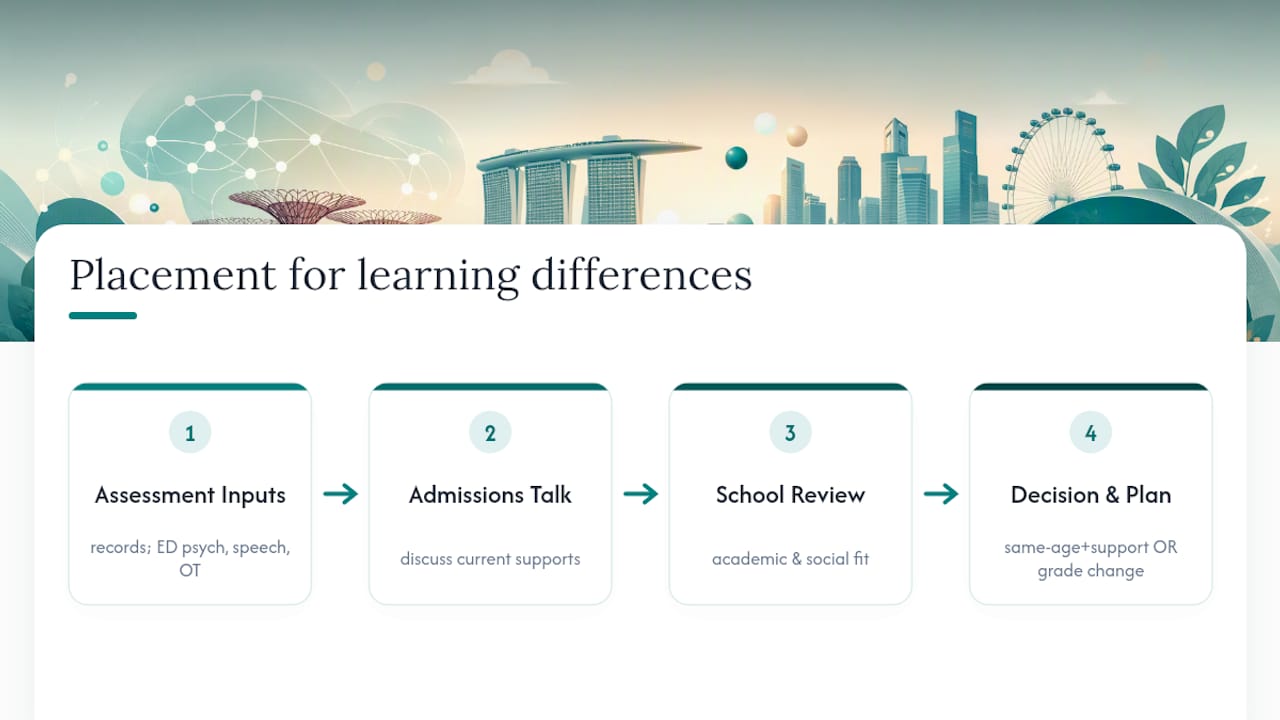
Some schools place a child with learning differences at their chronological age grade with additional support layered in, similar to how ESL support works. Others may recommend a grade adjustment if the gap between chronological age and developmental readiness is significant enough that neither the standard grade nor the support available would set the child up well. This decision should never be made unilaterally by a school without input from parents and, ideally, whoever conducted the child’s most recent assessment.
Ask directly whether the school has experience with your child’s specific need, what a support plan looks like in practice, and whether that plan is reviewed and adjusted over the term. A school that can answer these questions concretely, rather than with generic reassurance, is generally the one worth prioritizing over one offering a slightly more convenient cutoff date.
The Real Question Isn’t the Cutoff Date
Most of the anxiety around age placement centers on the wrong variable. Parents fixate on the exact cutoff date, as if missing it by a week is a crisis, when the research consistently points somewhere else: what actually determines whether a placement works is how well the school supports the transition once the grade is decided.
A child placed exactly on cutoff into a large, impersonal class can still struggle. A child placed slightly outside the norm, given real attention during a bridging period, often thrives. The conventional advice, obsess over hitting the “right” grade, misses that placement is a starting point a good school adjusts from, not a fixed verdict it enforces regardless of how the child is actually doing.
If there’s one thing worth prioritizing above the chart-matching exercise, it’s this: ask every school on your shortlist not just what grade they’d offer, but how they’ve handled a placement that didn’t work perfectly on day one. The answer tells you more about fit than any cutoff table ever will. Schools with smaller classes tend to give more honest, specific answers here, simply because they notice sooner when something’s off.
— Elena
Ready to Talk Placement With Astor?
Choosing the right grade shouldn’t feel like guessing against a chart. Small class sizes, generally capped to a modest number with an average around the low teens, mean placement decisions come from teachers who actually get to know your child before the term starts, not a formula applied at a distance.
Families weighing options after this guide typically fall into one of two groups: those who want the flexibility of Option A – FLEXI FEES at $17,580 SGD per year, and those who prefer the predictability of Option B – FIXED FEES at $23,650 SGD per year. Both pathways include our enquiry-based course structure, and either works well whether your child is entering on a standard cutoff or needs a bridging conversation first.
If your child’s birthday sits near a cutoff, or you’re moving to Singapore mid-year and need a straight answer on grade fit, book a tour and ask our admissions team for a placement review before you commit to an application elsewhere.
Where to Verify Placement and Accreditation Details
Check programme age ranges and year-group naming directly on the International Baccalaureate Organization site.
Confirm accreditation status through Cognia before trusting a grade label.
Review paperwork requirements at Singapore’s private education resources page.
Sources
FAQ
Can Singaporean Citizens Send Their Kids to International School?
Yes, Singaporean citizens can enroll children in international schools, though most schools in Singapore prioritize applications from expat families first under Ministry of Education guidelines. Availability for local citizens varies by school, so it’s worth confirming directly with each admissions office rather than assuming a blanket rule applies.
Does Junior College Have an Age Limit?
Junior College sits within Singapore’s national education system rather than the international school pathway this guide covers, so its specific age rules follow separate Ministry of Education criteria. Parents asking this question are often better served checking directly with Singapore’s national education authorities, since international schools generally use their own upper-secondary or IB Diploma pathway instead of Junior College.
What Should Parents Look for in a Good International School?
Beyond curriculum and accreditation, prioritize class size, how transparent the school is about its age cutoff and assessment process, and whether it offers English-language or learning support without pushing a child into a delayed grade unnecessarily. Astor’s small-class model, averaging 15 students per class, has been recognized as Best Small School and Best Affordable International School in Singapore, which reflects our own claim to that distinction rather than an independent ranking.
Can an 11-Year-Old Be in Secondary School?
It depends on the school’s cutoff date and curriculum structure. Under a typical September 1 cutoff, an 11 year old usually sits in the final year of primary (Grade 6 or Year 6) or the first year of lower secondary (Grade 7 or Year 7), depending on exactly where their birthday falls relative to the cutoff and the school’s specific grade boundaries.
How Much Does Astor Charge for Primary School Placement?
Astor offers two fee structures: Option A, FLEXI FEES at $17,580 SGD per year, and Option B, FIXED FEES at $23,650 SGD per year. Additional fees apply, with full details listed on our fees page.
Recommended
Comments