


Parents: In School EAL or After School ESL, Which Keeps Ages 5–12 on Track

EAL and ESL describe overlapping support, but they carry different philosophies. ESL usually means course-style English instruction delivered outside the regular curriculum. EAL describes language support woven directly into subject lessons, treating a child’s home language as a strength rather than a gap to close. For most families, that distinction shapes whether your child learns English and keeps pace in math, science, and humanities, or works on English separately from everything else.
TL;DR:
School-based EAL support integrates language development into subject lessons, promoting subject-specific vocabulary and comprehension directly tied to curriculum content.
In-class scaffolding and team teaching help students learn academic language in context, leading to faster progress than separate ESL lessons focused on general fluency.
Effective strategies include using visuals, sentence frames, and leveraging a child’s home language to build language skills without delaying content mastery.
Progress usually moves from pull-out or withdrawal sessions toward full participation over several terms, varying based on prior knowledge and classroom support.
For optimal results, parents should ask about assessment measures, targeted language goals, and how support aligns with classroom learning during meetings.
Table of Contents
EAL vs ESL: Definitions and Related Terms Parents Should Know
Schools rarely agree on one label, and that inconsistency confuses even experienced parents. Here’s what each term actually signals.
ESL (English as a Second Language) traditionally refers to structured lessons for non-native English speakers, often delivered as a standalone class or after-school course. It treats English as a subject to master, separate from geography or science homework.
EAL (English as an Additional Language) reframes the same learner as someone adding English to a language they already know, rather than someone missing a skill. The English Language Institute’s comparison of the two terms notes that EAL support is typically integrated into mainstream classroom teaching, with language goals built into the same lesson as the curriculum content.
A handful of related labels show up on reports and school websites, and it helps to know what each one means:
ELL (English Language Learner): a common umbrella term in American schools for any student developing English proficiency.
ENL (English as a New Language): used in some US states as a rebrand of ESL, closer in spirit to EAL.
EFL (English as a Foreign Language): describes English taught in a country where it isn’t the dominant language, such as tuition centers abroad.
ESOL (English for Speakers of Other Languages): common in adult education and some UK contexts, functionally similar to ESL.
The word “additional” matters more than it looks. Framing English as added to a child’s existing language, rather than a second language replacing a deficit, reflects what researchers call an asset-based view of multilingual learners. Schools that adopt EAL language tend to build lessons around what a child already knows, not just what they’re missing.
How School-Based EAL Support Differs From After-School ESL Lessons
The practical gap between EAL and ESL shows up most clearly in where the learning happens. In-school EAL support usually takes one of a few forms:
In-class scaffolding, where a classroom or subject teacher adjusts materials and instruction for EAL learners without pulling them out of the lesson.
Small-group pull-out sessions, timed around specific skills a diagnostic assessment has flagged.
Team teaching, where an EAL specialist and subject teacher co-plan a lesson so language and content develop together.
Withdrawal lessons for students who need intensive, short-term support before rejoining the mainstream class full time.
The advantage of school-based EAL is curriculum alignment. A child isn’t just learning English vocabulary in the abstract; they’re learning the specific words and sentence structures needed for that week’s science unit or history topic. Placement typically starts with a diagnostic assessment covering language history, prior schooling, and a four-skill check across listening, speaking, reading, and writing, according to the Bell Foundation’s classroom guidance.
After-school ESL lessons serve a different purpose. They tend to focus on general fluency, conversation confidence, homework support, or exam preparation, and they can be genuinely useful when a child needs extra practice time or a parent wants dedicated one-on-one attention. Where after-school tuition falls short is subject-specific vocabulary. A tutor working from a generic ESL workbook may build confidence without touching the exact academic language a child needs for Tuesday’s geography test.
Pro Tip: Before enrolling in extra ESL tuition, ask your child’s school what specific curriculum gaps their EAL support is already targeting. If tuition duplicates that work, your money is better spent on tutoring tied to an actual subject, like a struggling math unit.
Practitioner guidance from EAL Diaries argues that in-school support often produces stronger academic outcomes precisely because it’s coordinated with subject teachers, not because after-school lessons lack value.
What Evidence-Based EAL Teaching Actually Looks Like in Class
Good EAL teaching isn’t guesswork. A practice brief from NCELA and OELA synthesizes classroom research into five principles that show up in effective programs, regardless of a school’s specific label for the service.
Build content and language together. A science lesson on ecosystems teaches “habitat” and “predator” in context, not as a separate vocabulary drill.
Leverage home language and prior knowledge. A student who already understands photosynthesis in Mandarin needs new words, not a new concept.
Increase comprehensible input. Teachers use visuals, gestures, and simplified sentence structures so a lesson stays accessible without watering down the content.
Promote interaction. Structured pair work and small-group talk give children low-pressure chances to practice new language out loud.
Develop written language through explicit instruction. Sentence frames and modeled writing help learners move from spoken fluency to academic writing.
Classroom toolkits compiling effective instructional practices for EAL learners point to sentence frames, visual anchors, and targeted vocabulary instruction as the most common scaffolds teachers reach for day to day. Using a child’s home language intentionally, through comparison tasks or brief translations, is a strength-based practice that supports rather than slows English literacy.
These five principles aren’t a checklist for after-school tutors to memorize. They’re a description of what should be happening inside every subject lesson, taught by every teacher, not just the EAL specialist.
A Parent’s Checklist for School Meetings and Home Support
Walking into a parent-teacher meeting with the right questions changes the conversation. Ask how your child was placed, what the diagnostic assessment measured, what specific language targets are being tracked this term, and what criteria the school uses to decide when a child is ready to move fully into mainstream classes without extra support.
Healthy progress usually looks like steady movement from withdrawal or pull-out sessions toward full in-class participation over a matter of terms, not days. There’s no fixed universal timeline, and a child arriving with strong literacy in their home language often mainstreams faster than one starting from limited prior schooling.
At home, tie activities to what your child is actually studying in class. Read aloud from books connected to a current topic, practice subject-specific vocabulary rather than generic flashcards, and don’t discourage home-language conversation. Literacy skills in a child’s first language tend to transfer and support English literacy gains rather than compete with it. Resources on encouraging language learning at home offer concrete daily activities parents can start immediately.

Pro Tip: If your child comes home excited to explain a science concept in their home language first, let them. That’s not a detour from English fluency. It’s often the fastest route to it.
Why Integrated Support Changes the Outcome
Teachers who’ve watched language development up close tend to notice the same pattern: children thrive fastest when English isn’t taught in isolation from what they’re actually learning. A child working through a fractions unit needs the language of fractions, not a disconnected vocabulary list. That’s the quiet logic behind EAL as a philosophy, not just a rebrand of ESL.
One pattern that shows up again and again in classrooms: a student arrives mid-year with strong math skills in their home language but limited English. Within a few months of curriculum-linked support, embedded directly into math and science lessons rather than a separate English class, that same student is participating fully in mainstream lessons. The subject knowledge was never the problem. The bridge to express it was.
If you’re unsure how a school’s language support actually works day to day, ask them directly. A short conversation about assessment, placement, and classroom practice tells you more than any label on a brochure ever will.
— Elena
How Astor Supports Children Learning English Alongside the Curriculum
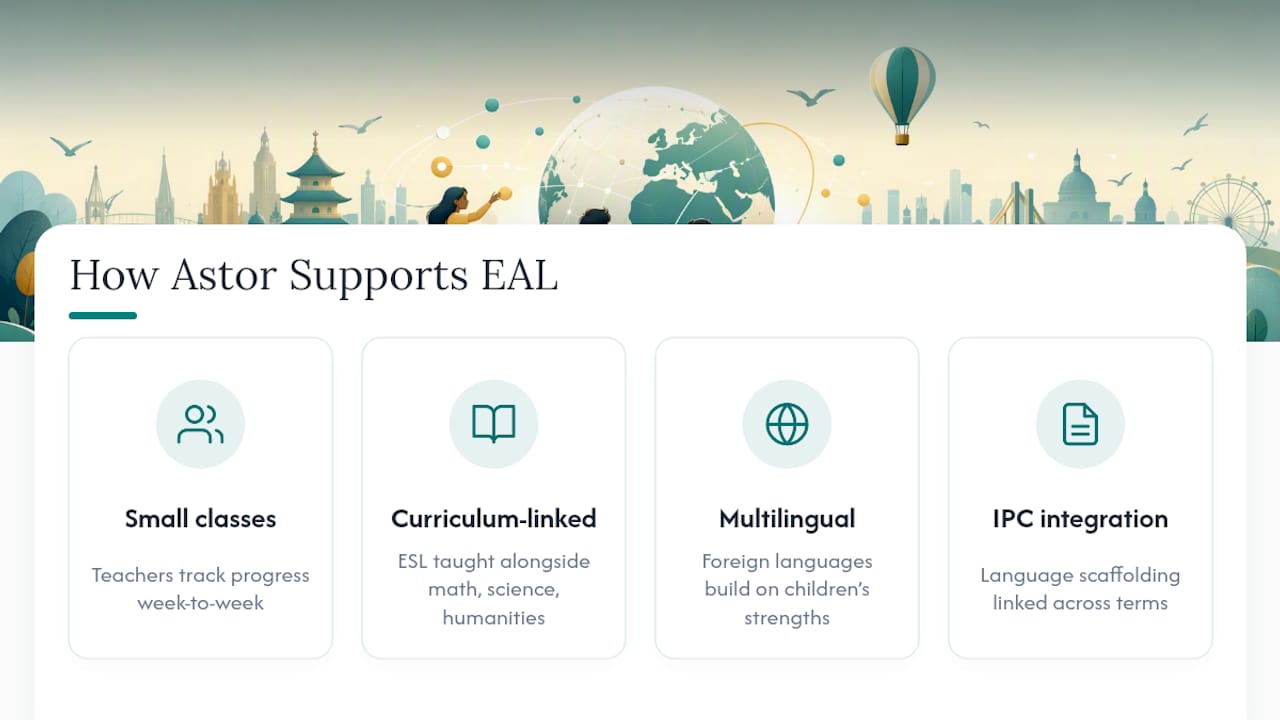
Astor International School keeps class sizes small on purpose, so language support never gets lost in a crowd. Every child aged 5 to 12 learns in a setting where teachers can actually track individual progress week to week, not just at report time.
Astor’s ESL support programs are built to work alongside classroom teaching rather than replace it, pairing language development with the same subject content children are learning in math, science, and humanities. Language learning at Astor extends beyond English support too, with foreign language offerings that let children build on multilingual strengths rather than treat them as a hurdle. The whole approach sits inside Astor’s broader IPC curriculum, which links subject learning across topics so language scaffolding has a consistent home to attach to, term after term.
If you’re weighing whether your child needs school-based EAL support, extra tuition, or both, the clearest next step is a conversation. Reach out to Astor to arrange an initial discussion about assessment and placement, and see how curriculum-linked language support might fit your child’s specific starting point.
Where to Learn More About EAL and ESL Practices
For deeper reading, the Bell Foundation’s classroom guidance and the NCELA/OELA practice brief offer practical, research-backed toolkits for assessment and instruction that go well beyond what any single article can cover.
Sources
Recommended
Comments