


30 STEM Activity Examples for Preschoolers: Parents & Teachers
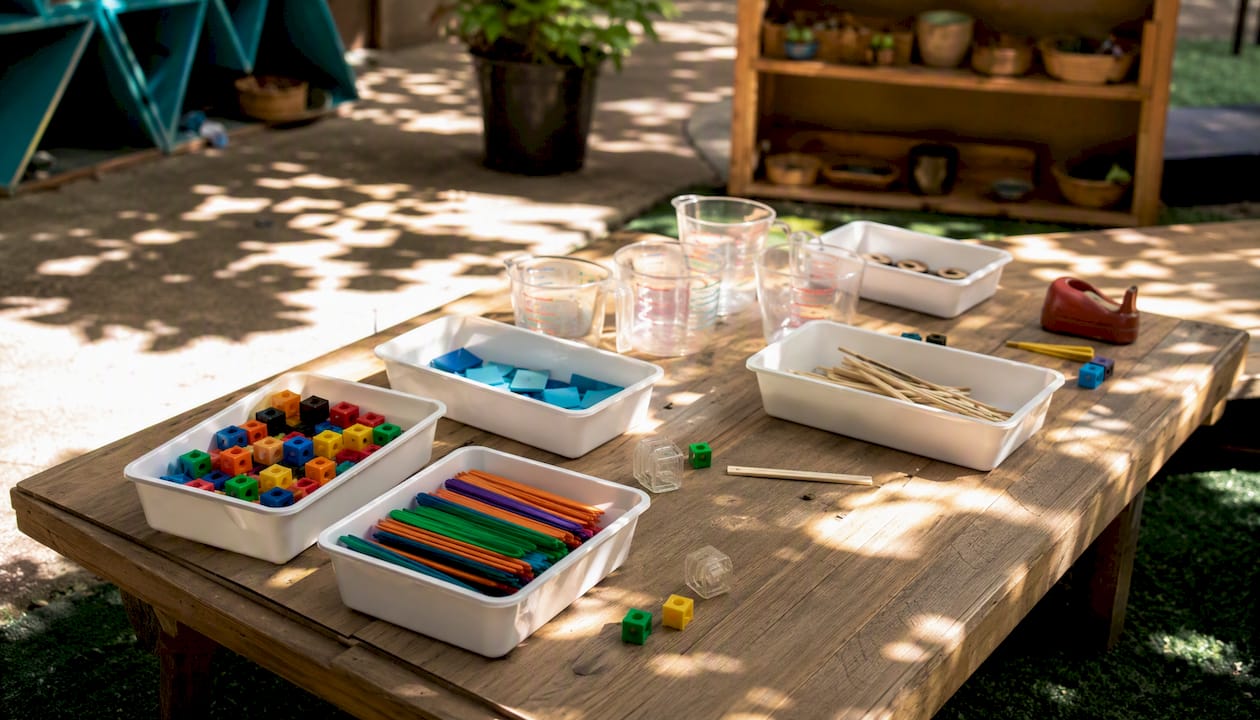
Use these ready-to-run examples of STEM activities for preschoolers today — no special equipment, no complicated prep, just curious children and household materials.
Sink or float — children predict, test, and record which objects sink or float in a tub of water
Tower challenge — build the tallest freestanding tower using only cardboard tubes and tape
Color mixing — combine primary-color water in clear cups to discover secondary colors
Magnetic sorting — sort a tray of mixed objects by whether a magnet attracts them
Seed planting — plant seeds in clear cups so roots are visible as they grow
Measuring with spoons — scoop and count spoonfuls to fill containers of different sizes
Ramp races — roll toy cars down ramps of different heights and compare distances
Unplugged coding walk — follow arrow cards on the floor to reach a “treasure,” learning sequencing
Every activity above takes 10–20 minutes, uses materials you likely already own, and targets at least two developmental skills at once.
Key Takeaways
Hands-on, inquiry-based STEM activities for preschoolers build early math, language, and problem-solving skills using household materials and open-ended questions — no special equipment needed.
Point | Details |
Start with what you have | Cardboard, cups, tape, and dried beans cover most preschool STEM activities without any purchased kits. |
Inquiry questions drive learning | Asking “What do you think will happen?” before each activity builds prediction and reasoning skills. |
Short and frequent beats long and rare | Three to five focused sessions of 10–20 minutes per week produce more durable learning than one long session. |
Match activities to milestones | CDC 4-year milestones (counting, asking “why”) give practical anchors for setting age-appropriate expectations. |
Free curricula exist | ZERO TO THREE’s Problem Solvers offers 44 structured, play-based activities at no cost, with family resources in English and Spanish. |
Table of Contents
Why STEM activities help preschoolers grow
STEM activities build early math, language, inquiry, fine-motor, and executive-function skills simultaneously — and the research behind that claim is compelling. Longitudinal evidence links strong early numeracy to better academic outcomes across subjects, not just math. Starting these experiences in the preschool years, when brain architecture is most responsive to supportive interactions, makes a real difference.
The Harvard Center on the Developing Child explains that repeated, responsive experiences literally shape the neural connections children rely on for reasoning and self-regulation. Each time a child tests a hypothesis (“Will this rock sink?”), gets a result, and tries again, those circuits strengthen.
Early math and counting. Activities like measuring with spoons or sorting by size give children direct, physical experience with quantity, comparison, and number language. These are the building blocks that NAEYC identifies as foundational STEM skills, achievable through block play and simple investigation long before formal schooling.
Scientific thinking and inquiry. When a child asks “What happens if I add more water?” they are practicing observation, prediction, and testing — the core of the scientific method. Peer-reviewed research confirms that play-based, inquiry-focused early STEM instruction supports observation, language, and problem-solving skills in young children.
Engineering design thinking. Building a bridge from craft sticks, watching it collapse, and rebuilding it teaches iterative thinking. Children learn that failure is data, not defeat — a mindset that serves them well into primary school and beyond. For more on how this connects to STEM in primary education, the progression from preschool tinkering to structured design challenges is a natural continuum.
Fine motor skills and language. Pouring, pinching seeds, using tweezers to sort, and drawing observations all strengthen hand muscles needed for writing. Narrating what they notice (“The big one sank faster!”) builds vocabulary and sentence structure at the same time.
Activity examples grouped by STEM domain
The activities below are organized by domain so you can vary the focus across a week. Each card includes a purpose, materials, three quick steps, an inquiry prompt, and one extension.
Science
1. Sink or floatPurpose: Introduce prediction and observation. Materials: Tub of water, household objects (coin, sponge, leaf, stone, plastic lid). Steps: (1) Ask children to predict “sink” or “float” before each object. (2) Drop each item in and observe. (3) Sort objects into two groups after testing. Ask: “Why do you think the sponge floats but the stone sinks?” Extension: Try wrapping the stone in foil — does it change?
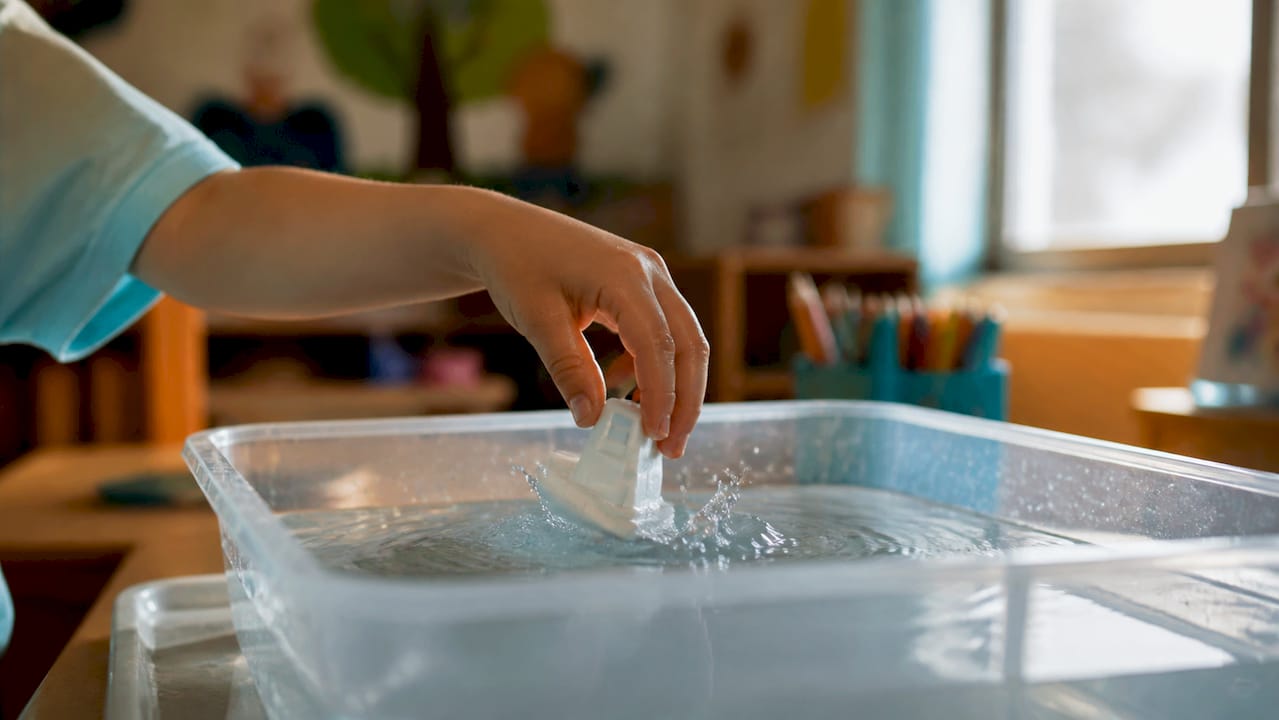
2. Color mixing with waterPurpose: Explore cause and effect with color. Materials: Clear cups, food coloring (red, yellow, blue), pipettes or spoons. Steps: (1) Fill three cups with water, add one color each. (2) Use a pipette to transfer small amounts into an empty cup. (3) Record the new color on a simple chart. Ask: “What do you think will happen if we mix red and blue?” Extension: Try mixing all three colors.
3. Melting ice investigationPurpose: Observe states of matter changing. Materials: Ice cubes, small trays, salt, warm water, spoons. Steps: (1) Place ice cubes on separate trays. (2) Add salt to one, warm water to another, leave one plain. (3) Time which melts first. Ask: “Which one do you think will melt the fastest? Why?” Extension: Freeze a small toy inside an ice block and excavate it.
4. Seed in a bagPurpose: Observe plant growth over days. Materials: Zip-lock bag, damp paper towel, bean seed, tape, sunny window. Steps: (1) Place the damp towel and seed inside the bag. (2) Tape to a window. (3) Check and draw observations daily. Ask: “What does the seed need to start growing?” Extension: Compare a bag in sunlight with one in a dark cupboard.
5. Magnet explorationPurpose: Discover magnetic and non-magnetic materials. Materials: Small magnets, tray of mixed objects (paper clip, button, coin, eraser, foil). Steps: (1) Predict which objects will stick. (2) Test each with the magnet. (3) Sort into two groups. Ask: “Can you find something in the room that surprises you — magnetic or not?” Extension: Test through paper, fabric, and water.
Safety note: Keep small magnets away from children under 3 and supervise closely to prevent swallowing.
Engineering and building
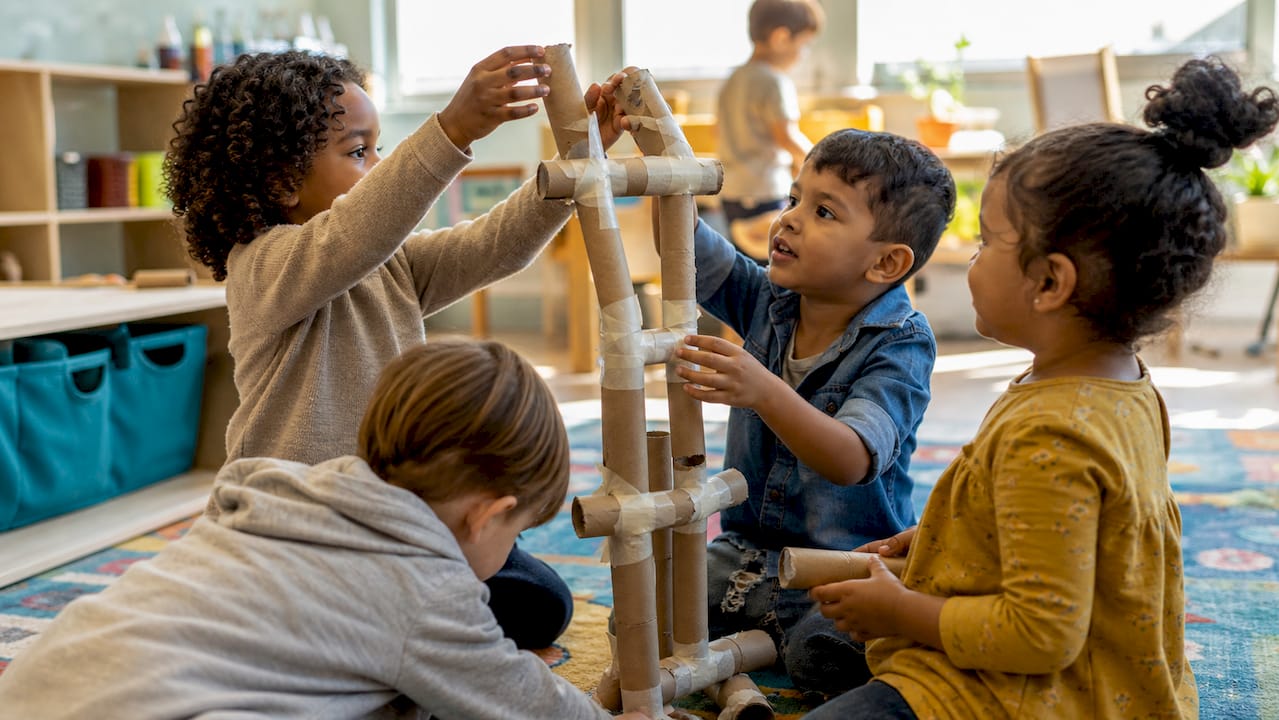
6. Tallest tower challengePurpose: Practice iterative design and balance. Materials: Cardboard tubes, tape, index cards. Steps: (1) Set a goal: build the tallest freestanding tower. (2) Build, test stability, adjust. (3) Measure with a ruler or hand-spans. Ask: “What made your tower fall? What could you change?” Extension: Add a “roof” and see if the tower still stands.
7. Bridge buildingPurpose: Explore load-bearing and structure. Materials: Craft sticks, playdough (as connectors), small toy as the “load.” Steps: (1) Build a bridge between two stacks of books. (2) Place the toy on it. (3) Strengthen weak spots and retest. Ask: “How many toys can your bridge hold before it bends?” Extension: Try building with only tape and paper.
8. Ramp racesPurpose: Investigate slope and speed. Materials: Cardboard ramp, books for height, toy cars. Steps: (1) Set ramp at low height; roll a car. (2) Raise the ramp; roll again. (3) Compare distances traveled. Ask: “Does a steeper ramp always make the car go farther?” Extension: Test different surfaces on the ramp (smooth cardboard vs. sandpaper).
9. Paper boat floatPurpose: Explore buoyancy through design. Materials: Paper, aluminum foil, tub of water, pennies as weights. Steps: (1) Fold a simple boat from paper. (2) Float it and add pennies one at a time. (3) Redesign using foil to hold more weight. Ask: “What shape do you think will hold the most pennies?” Extension: Compare a flat foil sheet with a shaped foil boat.
Math and measurement
10. Measuring with spoons and cupsPurpose: Build number sense and comparison vocabulary. Materials: Measuring spoons, cups of different sizes, dry rice or sand. Steps: (1) Fill a large cup using only a teaspoon — count spoonfuls. (2) Repeat with a tablespoon. (3) Compare the counts. Ask: “Which spoon do you think will fill the cup faster?” Extension: Estimate first, then measure — how close was the guess?
11. Pattern making with shapesPurpose: Introduce repeating patterns. Materials: Colored blocks, stickers, or cut paper shapes. Steps: (1) Start a pattern (red, blue, red, blue). (2) Ask the child to continue it. (3) Create their own pattern for a friend to continue. Ask: “What comes next? How do you know?” Extension: Make a pattern with sounds (clap, stomp, clap, stomp).
12. Sorting and graphingPurpose: Practice classification and simple data recording. Materials: Mixed small objects (buttons, blocks, shells), paper, crayons. Steps: (1) Sort objects by one attribute (color, size, shape). (2) Line them up in rows on paper. (3) Count each row and compare. Ask: “Which group has the most? How can you tell without counting?” Extension: Re-sort by a different attribute.
Sensory and process exploration
13. Cloud doughPurpose: Explore texture and material properties. Materials: 8 cups flour, 1 cup baby oil, bowl. Steps: (1) Mix flour and oil until crumbly. (2) Squeeze, mold, and crumble freely. (3) Describe the texture using feeling words. Ask: “How does it feel different from regular playdough?” Extension: Add a small amount of water — what changes?
14. Oobleck (non-Newtonian fluid)Purpose: Discover that some materials behave like both solids and liquids. Materials: Cornstarch, water, bowl, food coloring (optional). Steps: (1) Mix 2 parts cornstarch to 1 part water. (2) Squeeze it fast, then let it rest. (3) Describe what happens each way. Ask: “Is this a solid or a liquid? How can you tell?” Extension: Place the bowl on a speaker playing music and watch it move.
15. Sensory bin sortingPurpose: Build fine motor skills and classification. Materials: Bin of dried beans or rice, hidden small objects, tweezers or spoons. Steps: (1) Hide objects in the bin. (2) Children excavate using tweezers. (3) Sort found objects by category. Ask: “Can you find all the round ones? How many did you find?” Extension: Add letter or number tiles to find and identify.
Outdoor and nature
16. Nature scavenger huntPurpose: Practice observation and classification outdoors. Materials: Simple picture checklist, bag for collecting. Steps: (1) Give children a checklist (leaf, rock, stick, flower, insect). (2) Collect or photograph each item. (3) Sort and discuss findings back inside. Ask: “Where did you find the most insects? Why do you think they were there?” Extension: Press leaves between paper and compare shapes.
17. Puddle and rain observationPurpose: Connect to the water cycle in a concrete way. Materials: Chalk, outdoor space after rain. Steps: (1) Trace a puddle outline with chalk. (2) Check every 30 minutes and trace again. (3) Discuss where the water went. Ask: “Where do you think the water goes when the puddle disappears?” Extension: Use USGS water cycle diagrams to show children a simple visual of evaporation.
18. Shadow tracingPurpose: Explore light and position. Materials: Chalk, outdoor space, sunny day. Steps: (1) Trace a child’s shadow in the morning. (2) Return at midday and trace again. (3) Compare the two outlines. Ask: “Why did your shadow move? What made it shorter?” Extension: Trace the shadow of a tree or post across the day.
19. Worm and soil investigationPurpose: Observe living things and their habitat. Materials: Trowel, small tray, magnifying glass. Steps: (1) Dig a small patch of soil together. (2) Observe what lives there using the magnifying glass. (3) Return everything gently after observing. Ask: “What do you think worms eat? How could we find out?” Extension: Create a simple worm habitat in a jar with layers of soil and sand.
Simple tech and unplugged coding
20. Arrow card sequencingPurpose: Introduce sequencing and directional language. Materials: Large arrow cards (forward, left, right, stop), floor space. Steps: (1) Lay arrow cards in a path. (2) One child acts as the “robot” and follows the path. (3) Swap roles and create a new path. Ask: “What would happen if we changed this arrow? Where would the robot end up?” Extension: Add an obstacle the path must go around.
21. Pattern block codingPurpose: Connect patterns to programming logic. Materials: Pattern blocks, simple instruction cards (e.g., “place triangle, then square, repeat”). Steps: (1) Read the instruction card together. (2) Build the pattern. (3) Write a new instruction for a friend. Ask: “Can you write instructions so clear that I could build your pattern without seeing it?” Extension: Use a simple free app like ScratchJr to recreate the pattern digitally.
22. Bee-Bot or floor robot (unplugged version)Purpose: Practice sequencing and spatial reasoning. Materials: Arrow cards, grid drawn on paper or tape on the floor. Steps: (1) Place a stuffed animal at “start.” (2) Lay arrow cards to create a route to “finish.” (3) Walk the route to check it works. Ask: “How many steps forward does the bear need? How do you know?” Extension: Add a “bug” (wrong card) for children to debug.
The ZERO TO THREE Problem Solvers curriculum includes 44 structured, play-based activities for children aged 30–48 months, and a study at South Carolina preschool sites found better outcomes for classrooms using these activities compared to controls.
How to build a reusable activity card
A simple, consistent format helps you plan quickly and helps children know what to expect. Copy the template below into a lesson planner or print it for a classroom binder.
Field | What to write |
Title | Short, child-friendly name (e.g., “Ramp Races”) |
Age range | 2–3 years / 3–4 years / 4–5 years |
Objective | One skill or concept the child practices |
Materials | 3–5 items; note household substitutes |
Prep time | Honest estimate (most activities: under 5 minutes) |
Steps | 3 numbered steps, each one sentence |
Inquiry prompts | 2 open-ended questions to ask during the activity |
Modifications | Simpler version for younger children; extension for older |
Assessment | One observable behavior showing the skill was practiced |
For age-appropriate modifications, CDC developmental milestones for 4-year-olds offer a practical checklist: by age 4, most children can count small groups of objects, name some numbers, and ask many “why” questions — useful anchors when setting realistic expectations.
Pro Tip: When scaffolding inquiry, resist the urge to show children the “right” answer. Instead, ask “What could you try?” and give them 30 seconds of quiet thinking time before offering any hint. Children who generate their own next step stay engaged far longer than those who are guided step-by-step.
Running preschool STEM activities so learning actually happens
The single most important rule: prioritize open-ended questions and safe exploration over correct outcomes. A child who “fails” to build a standing tower but tries four different designs has learned more than one who built a perfect tower by following adult instructions.
Setup and grouping. Small groups of two to four children work best for most activities. Each child gets hands-on time rather than watching. Set materials out before children arrive so the invitation to explore is immediate.
Questioning during the activity. Use the inquiry prompts on your activity card, but follow the child’s curiosity. If a child goes off-script and starts testing something unexpected, that is the learning. Inquiry-based pedagogy frames this as the teacher’s most important move: noticing what the child is investigating and asking a question that deepens it rather than redirecting it.
Transitions. Keep a consistent “clean-up signal” (a song, a bell) so children know the activity is ending. A brief two-minute share-out (“Tell me one thing you noticed”) reinforces vocabulary and gives quieter children a voice.
Safety reminders. Water activities need direct supervision. Small objects (beads, buttons, magnets) are choking hazards for children under 3 — substitute larger items for younger groups. Oobleck and cloud dough are non-toxic but check for cornstarch or flour allergies before use.
Pro Tip: Keep a “just-right challenge” in mind for each child. If a child finishes the tower challenge in two minutes, add a constraint: “Now build it using only five pieces.” That small adjustment keeps engagement high without requiring a completely new activity.
Low-cost materials and prep shortcuts
Most meaningful STEM activities for preschoolers need nothing more than what you already have at home or in a classroom supply closet. The ZERO TO THREE STEM activities resource deliberately uses household items so the focus stays on scientific thinking rather than purchased kits.
Core materials to keep on hand:
Cardboard tubes, boxes, and egg cartons (building and ramp materials)
Clear plastic cups and zip-lock bags (observation and measurement)
Measuring spoons and cups (math and sensory activities)
Masking tape and painter’s tape (construction and floor grids)
Small magnets (sorting and exploration)
Dried beans, rice, or sand (sensory bins and measurement)
Food coloring (color mixing and ice experiments)
Magnifying glasses (nature and sensory observation)
Batch prep shortcuts. Pre-measure dry ingredients into labeled zip-lock bags so each activity kit is grab-and-go. Store kits in a labeled tub by domain (Science, Building, Math) so you can pull one out in under a minute. Replenish after each use so the kit is always ready.
Safe materials reminder. Avoid small beads, button batteries, and strong rare-earth magnets for children under 3. Cornstarch, food coloring, and standard craft materials are generally safe; always check for known allergies before a sensory activity.
Pro Tip: Save cereal boxes, paper towel tubes, and plastic lids in a “maker bin.” Repurposing recyclables teaches children that materials have multiple uses — a concept that shows up later in engineering design thinking. Parents can send a small bag of clean recyclables each week to keep the bin stocked.
A sample weekly STEM plan you can copy
Spreading STEM across the week in short bursts is more effective than one long session. Three to five focused experiences of 10–20 minutes each, with one longer exploratory block, gives children time to revisit ideas and deepen understanding.
Monday (Science, 15 min): Sink or float at the water table during free play. Ask one inquiry question per child. Transition tie-in: Sort the tested objects into bins as part of clean-up.
Tuesday (Math, 10 min): Pattern making with colored blocks before snack. Children create a pattern, then a friend continues it.
Wednesday (Engineering, 30–45 min exploratory block): Tower or bridge challenge in small groups. Allow free building first, then introduce a constraint (“Make it tall enough to fit this book underneath”).
Thursday (Outdoor/Nature, 20 min): Nature scavenger hunt during outdoor play. Bring findings inside and sort by color or size.
Friday (Unplugged coding, 15 min): Arrow card sequencing on the floor. Rotate so every child takes a turn as the “robot.”
Short STEM moments also fit naturally into daily routines: counting steps on the way to the playground, noticing cloud shapes during outdoor time, or measuring water at the sink before washing hands. Home learning math activities follow the same principle — brief, frequent, and tied to what children are already doing.
What the research says about early STEM learning
Early math and inquiry-focused play consistently predict stronger academic outcomes, and the evidence base for starting STEM in the preschool years is well-established. The sources below are free, reputable, and worth bookmarking.
ZERO TO THREE — Problem Solvers curriculum: A free, downloadable curriculum with 44 play-based activities for children aged 30–48 months. Includes family send-home resources in English and Spanish, songs, and book suggestions.
Harvard Center on the Developing Child — Brain Architecture: Explains how early experiences shape neural connections. Useful for sharing with parents who want to understand why play-based STEM matters, not just what to do.
PMC peer-reviewed article on early STEM: A research summary confirming that play-based, inquiry-focused early STEM instruction supports observation, language, and problem-solving in young children.
CDC Developmental Milestones: 4 Years: Practical age-appropriate skill targets for setting realistic activity expectations. Free and printable.
NAEYC — STEM Starts Early: Guidance on integrating STEM through block play, simple experiments, and investigation. Includes classroom examples and professional development links.
USGS Water Cycle Diagrams: Clear, accurate diagrams suitable for adapting weather and water activities for preschool conversations.
For a deeper look at how experiential preschool learning shapes children’s development, the connection between hands-on STEM and long-term learning outcomes is well worth exploring.
What works in practice: a note from Elena
The activities in this article are ones I return to again and again, particularly in mixed-age settings where a three-year-old and a five-year-old might be working side by side. What I have found is that the domain grouping matters less than the questioning. A ramp race is a math activity if you ask “How many books high is the ramp?” and a physics activity if you ask “Why does the steeper ramp make the car go faster?” The same materials, the same ten minutes, two completely different learning conversations.
The other thing that consistently surprises parents is how little preparation these activities actually need. The most memorable STEM moments often happen spontaneously — a child notices that ice in their cup is melting, and suddenly you have a ten-minute investigation with no prep at all. That readiness to follow a child’s curiosity is the real skill, and it is something that small, attentive learning environments nurture particularly well.
At Edu, Astor’s preschool and primary school program in Singapore, small class sizes and dedicated outdoor learning spaces make exactly this kind of responsive, inquiry-led STEM possible every day. If you are curious about how these approaches are woven into a full curriculum, the Astor learning program is a good place to start. Families interested in enrichment options beyond the core day can also explore Astor’s enrichment classes for extended STEM and creative learning experiences.
Sources
Recommended
Comments