


+5 Months for Teens: Homework vs No Homework, Age by Age Guidance
- sasha2644
- 2 days ago
- 13 min read

Homework helps older students most when the task is purposeful, tied to what happened in class that day, and followed by real feedback. For younger children, less tends to be better, and busywork with no feedback loop rarely justifies the time it takes. The real question isn’t homework versus no homework. It’s whether the specific assignment in front of your child is worth doing.
TL;DR:
Homework’s benefits increase with age, adding about five months of progress for secondary students and three months for primary students when paired with feedback.
Repetitive homework with no feedback and excessive workload can increase stress and inequalities without significantly boosting achievement.
Well-designed tasks, such as inquiry-based activities or short practice exercises, are more effective and fair than traditional worksheets or extended assignments.
Schools that shift to alternative models like flipped classrooms or project-based learning can mitigate equity issues while maintaining learning gains.
The most impactful homework is purposeful, connected to classroom work, and includes immediate or short-term feedback, especially for older students.
Table of Contents
Homework vs No Homework: What Does the Research Actually Say?
The strongest, most cited evidence on this question comes from the Education Endowment Foundation, which has tracked homework’s impact on learning across hundreds of studies. Their headline finding: homework produces a positive average effect, but the size of that effect depends heavily on age.
Secondary students gain additional progress on average
Primary students gain additional progress
Impact rises sharply when homework connects directly to what was taught that day and includes feedback from a teacher
That grade-level split isn’t new. Cooper, Robinson, and Patall’s synthesis of homework research found the same pattern years earlier: homework’s benefits grow with age, and effects in early elementary grades are mixed or negligible. A more recent systematic review published through PMC confirms the picture is still messy. Effects vary by subject, by grade band, and by how researchers define and measure “homework” in the first place, which makes clean, universal conclusions hard to defend.
The core evidence in one line: Homework adds an estimated +5 months of progress for secondary students and +3 months for primary students, but mainly when it’s linked to classroom content and paired with feedback, according to the EEF.
There’s also a real shift underway in practice. Hechinger Report found that by 2024, a noticeably larger share of fourth and eighth-grade math teachers said they were assigning no math homework at all compared with previous years. Fewer worksheets are going home, not more, and that trend predates most of the AI conversation now shaping the debate.
When Homework Helps: Learning Gains, Study Skills, and Family Time
Homework earns its place in a child’s evening when it does something practice in class can’t. The clearest case is retrieval practice: pulling a fact or method back out of memory a day or two after first learning it, which cements it far better than passive review. This matters more as students get older and content gets cumulative, since a student who can’t retrieve last week’s algebra struggles with this week’s.
Homework done well also builds skills that live outside any single subject: breaking a task into steps, estimating how long something will take, and working without someone standing over you. These are the same skills that carry a student through college coursework and, eventually, a job.
Spaced, low-stakes practice strengthens long-term retention better than one large cram session
Independent tasks build time-management habits that transfer across subjects
Interactive, family-facing assignments (a short interview, a shared observation) build engagement without turning parents into co-authors, as discussed in this Community Storytime SEL Benefits for Parents and Educators resource
Joyce Epstein’s research group at Johns Hopkins makes a point worth sitting with: the best family homework isn’t a worksheet parents help complete. It’s a task the child owns, where a parent’s role is to talk, not to correct.
Pro Tip: If a family assignment requires you to check your child’s answers before it’s turned in, it’s probably not designed as family homework. Well-designed interactive tasks ask the child to interview, observe, or explain, not to be graded by you first.
Where Homework Goes Wrong: Stress, Inequity, and Busywork
Homework’s downsides aren’t hypothetical, and they show up in three predictable places: wellbeing, fairness, and design quality.
Too much homework, especially unstructured or repetitive homework, correlates with higher stress and shorter sleep in older students, and that tradeoff rarely shows up in the achievement numbers schools track. A worksheet that costs a teenager thirty minutes of sleep for a marginal grade bump is a bad trade, even if the underlying skill was worth practicing.
Homework also tends to punish students unevenly. A child with a quiet room, a parent available at 7pm, and reliable Wi-Fi finishes the same assignment a classmate without those things simply cannot complete under similar conditions.
Stress and sleep loss rise with heavier, less purposeful homework loads, particularly among older students
Unequal access to devices, internet, and a parent’s free time turns identical assignments into unequal opportunities
Repetitive drills with no feedback loop teach very little regardless of how much time they consume
One structural problem the NPR reporting on homework policy shifts surfaces clearly: the same assignment can take one student fifteen minutes and another ninety, which makes “minutes spent” a poor way to judge whether homework is working as intended.
None of this means homework is inherently harmful. It means quantity and inequity, not homework itself, are usually the actual problem.
How Much Homework Is Right for Each Grade?
A useful starting rule, widely used informally among educators, is roughly ten minutes per grade level, adjusted for the individual student rather than applied rigidly.
Early primary (ages 5 to 8): Keep it minimal or skip formal homework entirely. Reading together and short, playful practice matter more than worksheets at this stage.
Upper primary (ages 9 to 12): Short, structured practice, roughly 20 to 40 minutes, works best when it reinforces that day’s lesson and comes with feedback the next day.
Lower secondary: Homework can grow into scaffolded practice sets, generally under an hour, with an emphasis on building independent study habits rather than covering new material alone.
Upper secondary: Exam preparation and extended projects justify more time, but a cap of roughly 1.5 to 2.5 hours a night protects sleep and prevents diminishing returns.
Treat all of these as starting points, not mandates. A student who’s exhausted after twenty minutes of primary math practice needs a shorter task, not a longer one, and a motivated upper secondary student working on a passion project may reasonably exceed the cap for something they chose themselves.
What Makes a Homework Assignment Actually Work?
Good homework starts with a question: what is this assignment supposed to accomplish that classroom time couldn’t? If there’s no clear answer, the task probably isn’t worth assigning.
From there, a few design principles separate homework that builds skill from homework that just burns time.
State the purpose of the task plainly, even to students, so they understand what they’re practicing and why
Favor short, spaced practice over long single sessions; a 15-minute task twice a week beats one 45-minute Sunday session
Build in low-stakes feedback quickly, ideally within a day or two, since delayed feedback teaches almost nothing
Offer differentiated versions of the same task so struggling and advanced students both get appropriate challenge
Give students in-class time to start assignments when possible, which surfaces confusion before it becomes a wasted evening at home
Concrete examples beat abstract principles here. A short family interview about a grandparent’s childhood teaches interviewing, listening, and narrative structure, and it’s nearly impossible to outsource. A five-question retrieval quiz on last week’s science vocabulary, self-checked against an answer key, takes ten minutes and reinforces memory far better than rereading notes. Astor’s own home learning activities lean on exactly this kind of applied, inquiry-based task rather than repetition for its own sake.
Pro Tip: Before assigning anything, try the “kitchen table test”: could a curious parent watch their child do this task and understand what skill it’s building? If the answer is no, the task probably needs a redesign.
Does Homework Widen the Gap Between Students?
Homework’s fairness problem is structural, not incidental. A child without home internet, a quiet space, or a parent free in the evening starts every identical assignment at a disadvantage, and that gap compounds across a school year.
The usual barriers are predictable: shared devices, unreliable internet, noisy or crowded homes, and caregivers working evening shifts who simply aren’t available to help. None of these reflect a student’s ability or effort.
Schools that take this seriously tend to build in specific supports rather than hoping the gap closes on its own.
Homework clubs or supervised study halls that give students quiet time and access to help during the school day
Optional, ungraded family tasks instead of graded assignments that assume equal home support
Device lending programs for students without reliable access at home
Flexible deadlines that account for unpredictable home circumstances without penalizing the student
Schools changing homework policy should track outcomes by subgroup, not just the average, since an average score can hold steady while the gap between advantaged and disadvantaged students quietly widens underneath it.
How Is AI Changing the Value of Homework?
Generative AI has made traditional homework a lot easier to fake and a lot harder to trust as evidence of learning. A worksheet that once proved a student understood a concept now sometimes just proves they know how to prompt a chatbot. KQED’s Mindshift reporting found teachers scaling back repetitive assignments partly because AI has made them trivially easy to bypass.
The fix isn’t banning AI. It’s shifting what homework asks for.
Ask for drafts and revision history, not just a finished answer, since process reveals learning that a polished result hides
Use short oral defenses or in-class demonstrations to confirm understanding behind written work
Build portfolios over single assignments, so growth over time matters more than any one submission
Design tasks around local observation or family interaction, the kind of firsthand experience AI simply cannot generate
Pro Tip: Ask your child to explain their homework answer out loud in one sentence. If they can’t, AI likely did more of the thinking than they did.
How Astor Approaches Homework in Small, Inquiry-Based Classes
Small class sizes change what homework needs to accomplish. When a teacher already knows exactly where each child is struggling, homework doesn’t need to serve as a diagnostic tool. It can focus purely on reinforcing what a lesson already revealed, which cuts out a lot of the generic busywork larger classes fall back on.
At Astor, inquiry-based tasks lean on curiosity rather than repetition. Practical resources like fun home learning math activities and guidance on building a positive learning environment at home reflect that same philosophy: short, purposeful, and tied to something the child actually did in class that week.
If your child’s current homework load feels like effort without a clear payoff, that’s worth raising directly with their teacher. A conversation about purpose, not just volume, usually gets further.
How Do Homework Policies Differ Around the World?
Homework norms vary enormously by education system, and the differences reveal a lot about each country’s underlying priorities. Finland, often cited for strong outcomes on international assessments, assigns comparatively little homework at the primary level, leaning instead on high-quality classroom instruction and shorter school days. South Korea and Japan traditionally lean toward heavier homework and after-school study loads, tied to intensive exam-preparation cultures, though both have seen public pushback over student stress in recent years.
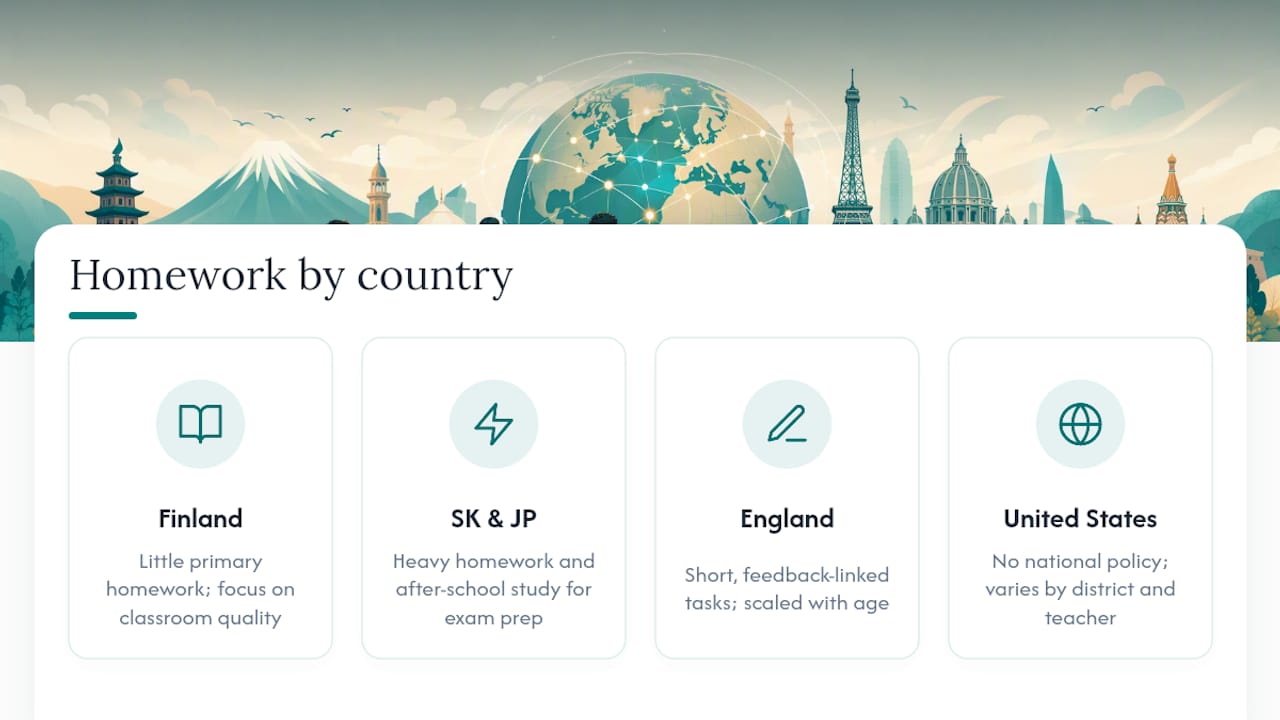
England’s system, shaped partly by the EEF’s own research, encourages homework that’s short, feedback-linked, and scaled up with age rather than applied uniformly. The United States has no single national policy; homework varies district by district and even teacher by teacher, which is part of why national reporting on the topic tends to focus on trends rather than a single rule.
What separates systems with strong outcomes from those with weaker ones isn’t really the presence or absence of homework. It’s whether homework is designed with the same rigor as classroom instruction, or treated as an afterthought assigned mainly to fill time. Systems that link homework tightly to what happens in class, with real feedback, tend to see better returns regardless of how much homework they assign overall.
What Do Teachers and Parents Actually Disagree About?
Ask ten teachers about homework and you’ll get ten slightly different answers, but the disagreement usually clusters around a few recurring fault lines.
Teachers who defend homework tend to argue it’s the only reliable way to see whether a concept survived past the class period, especially in subjects like math where skills build sequentially. Teachers skeptical of homework counter that grading it consumes time better spent on feedback for in-class work, and that homework compliance often measures a student’s home support more than their understanding.
Parents split along similar lines. Some want more homework, seeing it as evidence their child’s school takes rigor seriously, and worry that a no-homework policy signals lowered expectations. Others, often parents managing multiple children’s schedules or unpredictable work hours, experience homework as a nightly source of conflict that damages their relationship with their child more than it builds any skill.
Both sides are usually reacting to real experiences, not imagined ones. A parent whose child thrives on structured practice and a parent whose child melts down over a worksheet are both describing something true. That’s exactly why blanket, one-size-fits-all homework policies tend to satisfy almost no one. The disagreement isn’t really about homework in the abstract. It’s about whose kid, whose home, and whose evening the policy was actually designed around.
How Have Attitudes Toward Homework Changed Over Time?
Homework wasn’t always the default. In the early 1900s, American education reformers actually campaigned against it, arguing that memorization-heavy drills at home did more harm than good for young children’s development. Some school districts banned homework for younger grades outright during that era.
That view flipped hard during the Cold War, when Sputnik triggered fears that American students were falling behind academically, and homework came back as a symbol of rigor and national competitiveness. By the 1980s and 1990s, homework load had crept upward across most grade levels, driven partly by standardized testing pressure.
The 2000s brought a partial correction. Research syntheses like Cooper’s started drawing a clearer line between “more homework” and “better learning,” and the two turned out not to be the same thing. That nuance has only sharpened recently: Hechinger’s reporting on declining math homework assignment rates suggests the pendulum is swinging again, this time toward quality over quantity rather than a full return to the anti-homework stance of a century ago.
The throughline across a hundred years of back-and-forth isn’t that homework is good or bad. It’s that every generation eventually rediscovers the same lesson: volume without purpose doesn’t work, and the fix is usually design, not elimination.
What Happens When Schools Cut Homework or Go Homework Free?
A handful of districts have tested no-homework policies directly, and the early evidence is genuinely mixed rather than a clean win for either side. NPR’s reporting on districts like LaSalle Parish found that eliminating or sharply reducing homework often reduced family stress and complaints without producing a measurable drop in achievement, at least in the short term measured so far.
That result tracks with the grade-level evidence covered earlier: since homework’s impact is smallest in early elementary and largest in secondary school, a no-homework policy for younger children costs very little academically while removing a real source of household friction. The calculation shifts for older students, where the EEF’s data suggests eliminating homework entirely likely does trade away some of that five-month average gain.
What the no-homework experiments consistently show is that removing homework rarely produces disaster, and it rarely produces a windfall either. The bigger effect tends to be on stress and family time, particularly for younger students, rather than on test scores. That’s a legitimate reason to cut homework for younger grades, but it’s not evidence that homework is inherently useless for every age. The honest conclusion is narrower and less dramatic than either side of the debate usually claims: cutting homework mostly redistributes time and stress, and its academic cost depends heavily on the age of the student and what the homework was actually accomplishing beforehand.
What Can Schools Do Instead of Traditional Homework?
Traditional worksheets aren’t the only way to reinforce learning outside class, and several alternatives address homework’s biggest weaknesses directly: equity, engagement, and busywork.
Flipped classrooms flip the usual order: students watch a short video or read material at home, then use class time for the practice and problem-solving that used to be homework. This puts the hardest part of learning, applying a concept, in the room with a teacher present to help, rather than alone at a kitchen table.
Project-based learning replaces repeated practice sets with a single extended task, often spanning weeks, that asks students to apply multiple skills to a real problem. A student researching and presenting on a local environmental issue is practicing writing, research, and public speaking simultaneously, in a way no worksheet replicates.

In-class practice time, sometimes called “homework at school,” simply moves the same tasks into a supervised classroom block, removing the equity gap tied to home support and internet access entirely. Astor’s approach to connecting inquiry-based activities to real life reflects this same instinct: learning that happens through doing and discussing, not through isolated repetition at home.
None of these alternatives eliminate the need for independent practice altogether. They just relocate it to where support, feedback, and fairness are easier to guarantee.
Homework vs No Homework: The Editorial Take
The conventional advice on this topic almost always dodges the hard part. Most guides land on “it depends” and stop there, as if that’s an answer rather than an evasion. It isn’t. The evidence is specific enough to act on: homework’s payoff scales with age, collapses without feedback, and widens existing gaps between students when access to help and quiet space isn’t equal.
What gets underestimated is how much design quality matters compared to volume. A ten-minute assignment with feedback the next day beats an hour of unchecked repetition every time, and most homework debates skip right past that to argue about minutes instead. Parents pushing for more homework and parents pushing for none are usually arguing about the wrong variable.
If there’s one place to start, it’s this: before assigning or accepting any homework task, ask what specific skill it’s meant to build and how the student will know if they got it right. If nobody can answer that clearly, the task isn’t ready to leave the classroom yet.
— Elena
Ready to see how small class sizes change what homework actually needs to do? Astor’s curriculum approach is built around inquiry rather than repetition, and the IPC program shows how that plays out day to day for children ages 1.5 to 12. If your child’s evenings feel heavier than they should, it’s worth exploring what a smaller, more responsive classroom can offer instead.
Sources
For readers who want to go deeper, these are the core references behind this guide. The EEF’s homework toolkit provides the headline effect-size data. Cooper, Robinson, and Patall’s synthesis established the grade-level interaction still cited today. The Johns Hopkins commentary makes the case for quality over quantity. Hechinger’s reporting and NPR’s coverage document real policy shifts underway. The PMC systematic review offers the most current academic synthesis available.
Recommended
Comments