


How to Select an Affordable School in Singapore

Selecting an affordable school means evaluating true net cost, not just comparing published tuition fees, to secure quality education within your family’s budget. Singapore parents face a wide range of schooling options, from government schools to international programs, and the price differences can be significant. Knowing how to select an affordable school before you start visiting campuses saves time, prevents emotional attachment to schools outside your budget, and gives your child a stronger, more stable start. This guide walks you through budgeting, cost tools, hidden fees, and quality checks so every decision you make is grounded in real numbers.
How to set a realistic budget for school selection
The single most important step in choosing budget-friendly schools is defining your budget before you look at a single school website. Affordable is a moving target without a specific dollar amount. Setting an explicit cost limit lets you rule out schools quickly and focus your energy where it counts.
Start by listing every cost your family will carry, not just tuition. A complete school budget for Singapore families typically includes:
Tuition fees (annual or termly)
Registration and application fees
Uniforms, books, and stationery
School bus or transport costs
Co-curricular activity fees
Meal plans or daily lunch costs
Technology levies or device requirements
Annual school trips or excursions
Once you have a full picture, set a firm annual ceiling. Parents should set a realistic total budget before beginning school selection to avoid unsustainable financial strain and emotional attachment to schools they cannot afford. That ceiling becomes your filter. Any school above it gets removed from the list immediately, regardless of reputation.
Pro Tip: Write your budget ceiling on paper and share it with your partner before you attend any school open house. Seeing a beautiful campus can shift your thinking fast. A written number keeps you grounded.
Residential status also matters significantly. Many schools have different tuition rates for local, permanent resident, and international families. In Singapore, this distinction directly affects what you pay at international schools. Always confirm which fee tier applies to your family before adding a school to your shortlist.
What tools and resources reveal the real cost of schools?
Sticker price is the tuition figure a school publishes on its website. Net price is what your family actually pays after grants, scholarships, and financial aid are applied. These two numbers are rarely the same, and the gap matters enormously.
Net price can be 30–60% lower than sticker price, sometimes making a private school more affordable than a public one for certain income brackets. That means a school that looks expensive on paper may actually cost your family less than a cheaper-looking alternative. Never skip this step.
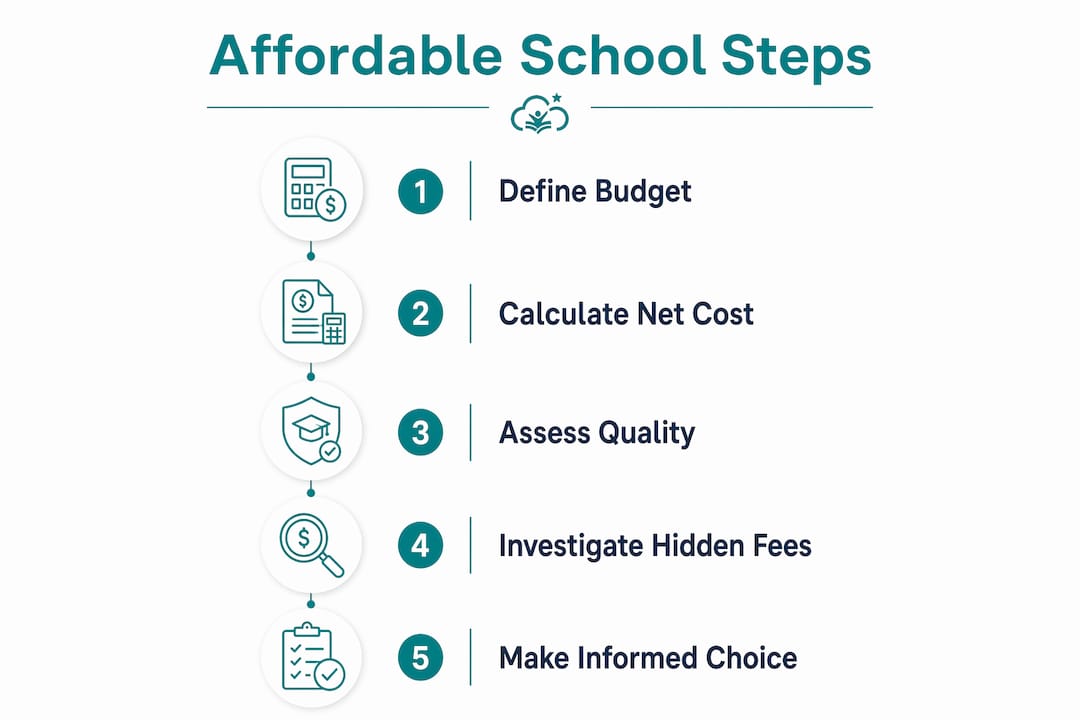
Here is a practical four-step process for uncovering real costs:
Request the full fee schedule. Ask each school for a complete list of compulsory fees, not just tuition. Many schools publish a simplified figure that excludes technology levies, activity fees, and meal costs.
Ask about scholarships and bursaries. Singapore international schools, including smaller boutique schools, often offer merit-based or need-based financial assistance that is not prominently advertised.
Use net price calculators where available. Official tools like the Net Price Calculator help families move beyond marketing figures to real annual costs based on their financial profile. Some Singapore schools offer similar fee estimation tools on their admissions pages.
Compare total annual cost, not just tuition. Build a side-by-side comparison using the full cost picture.
Cost category | What to ask the school |
Tuition | Annual fee by student nationality or residency |
Compulsory fees | Technology, activity, and facility levies |
Financial aid | Scholarships, bursaries, sibling discounts |
Transport | School bus routes and annual cost |
Meals | Canteen plans or packed lunch policies |
Institutional financial aid packaging varies widely and is not standardized across schools. Understanding each school’s methodology helps you set realistic expectations before you apply. Always ask the admissions team directly how aid is calculated and when it is reviewed.
How to balance affordability with academic quality and hidden costs
Affordability and quality are not opposites. The goal is to find schools where both align with your family’s needs. When two schools are close in total annual cost, academic quality and career outcomes should take priority over the price difference. A small cost saving at a weaker school rarely pays off over time.

Hidden fees are the most common trap parents fall into when choosing budget-friendly schools. Low sticker price schools sometimes carry high hidden fees for labs, technology, and wellness programs that are not covered by financial aid. These charges can offset tuition savings significantly.
Expense type | Often advertised? | Typical annual impact |
Technology levy | Rarely | Moderate |
Excursion and trip fees | Sometimes | Moderate to high |
Uniform and book costs | Sometimes | Low to moderate |
Meal plan (if mandatory) | Rarely | High |
Co-curricular activity fees | Rarely | Moderate |
Mandatory meal plans and residency costs can add $8,000–$12,000 per year to school expenses. While full boarding is less common in Singapore’s day school market, mandatory meal plans and activity packages at some international schools can still add several thousand dollars annually to your bill.
Tuition also rises over time. Calculate four-year total cost incorporating 3–5% annual tuition increases to avoid surprises before your child finishes the program. A school that fits your budget today may not fit it in three years if you have not planned for annual fee increases.
Pro Tip: Ask each school for its tuition increase history over the past five years. Schools that raise fees consistently above inflation deserve extra scrutiny before you commit.
Assess program quality by looking at class size, teacher qualifications, and curriculum accreditation. Smaller class sizes often signal more personalized attention, which translates to better learning outcomes for your child. An international school checklist can help you compare these factors systematically across multiple schools.
Strategies to maximize affordability while ensuring quality education
Finding the best low-cost schools is not just about searching for the lowest tuition. It requires a deliberate strategy that combines financial planning with academic research.
Apply to multiple schools. Limiting your shortlist to one or two schools removes your negotiating power and your backup options. Aim for at least three to five schools across different price points.
Ask about sibling discounts. Many Singapore international schools offer reduced fees for second and third children. This benefit is rarely advertised but can significantly reduce your total annual cost.
Explore merit-based scholarships early. Some schools award academic or talent-based scholarships during the admissions process. Applying early increases your child’s chances of being considered.
Consider smaller boutique international schools. Smaller schools often carry lower overheads and pass those savings to families through more competitive tuition. They also tend to offer smaller class sizes, which benefits learning directly.
Schedule school tours before committing. Visiting a campus reveals details no brochure shows, including the actual condition of facilities, the energy of the classroom environment, and how staff interact with children. These observations matter as much as the fee schedule.
Plan for the full schooling period. If your child is five years old today, calculate what you will spend through age twelve. A school that is affordable at entry but raises fees aggressively may cost far more than a slightly pricier school with stable, predictable fees.
Use school counselors and admissions teams. These professionals can walk you through aid options, payment plans, and scholarship timelines. Smart tips for international school admission in Singapore can help you prepare the right questions before those conversations.
Families should prioritize schools that align financially and academically before forming emotional attachments to prestige. A nurturing school where your child thrives and your family stays financially stable is always the better choice over a prestigious name that stretches your budget to its limit.
Common pitfalls to avoid when selecting an affordable school
Most budget mistakes in school selection happen before a single application is submitted. Recognizing these patterns early protects your family from costly regrets.
Mistaking low sticker price for affordability. A low published tuition means nothing if hidden fees push the real cost above your ceiling.
Ignoring mandatory fees and living costs. Transport, meals, uniforms, and activity fees are real expenses. They belong in your budget from day one.
Failing to calculate multi-year total cost. A school that fits your budget this year may not fit it in year three if tuition rises annually.
Letting prestige overshadow fit and cost. A school’s reputation does not guarantee it is the right environment for your child. Academic fit and personal attention matter more than a famous name.
Skipping the school visit. No amount of online research replaces an in-person tour. Facilities, classroom culture, and teacher warmth are things you can only assess in person.
“The best learning happens when every child is truly seen and supported.” Choosing a school where your child feels known and valued is worth more than any ranking.
The key advantages of affordable international schools in Singapore show that cost and quality can coexist. The families who find that balance are the ones who plan carefully, ask the right questions, and stay disciplined about their budget from the start.
Key takeaways
Selecting an affordable school requires defining a firm budget, calculating true net costs, and evaluating both hidden fees and academic quality before making any commitment.
Point | Details |
Set a firm budget first | Define your annual cost ceiling before visiting any school to avoid emotional overspending. |
Net price beats sticker price | Always ask for the real cost after scholarships and aid, not just the published tuition figure. |
Hidden fees add up fast | Technology levies, meals, and activity fees can significantly raise a school’s true annual cost. |
Plan for multi-year costs | Factor in annual tuition increases of 3–5% to avoid budget surprises in later years. |
Quality and cost can align | Smaller boutique international schools often offer strong academics at more accessible fee levels. |
What I’ve learned about school affordability in Singapore
Working with Singapore families over many years, I have seen one pattern repeat itself: parents who skip the budget conversation early almost always regret it later. They fall in love with a school, commit emotionally, and then scramble to cover fees that were never truly within reach.
The families who navigate this well do one thing differently. They treat the budget as a non-negotiable starting point, not a flexible afterthought. They also look beyond the obvious options. Singapore’s international school market includes genuinely excellent smaller schools that charge far less than the large, well-marketed campuses. These schools are small but mighty, and they often deliver more personalized attention than their larger counterparts.
My honest recommendation is to visit at least one school that you would not normally consider because of assumptions about size or prestige. You may be surprised. The benefits of affordable education for children go well beyond the fee savings. Stability, confidence, and a nurturing classroom environment are the foundations that actually shape a child’s future.
— Elena
Astor International School: quality education at an accessible fee
Astor International School, located in the Tanglin area of Singapore, has been awarded best affordable international school in Singapore. It serves children aged 5–12 with small class sizes and a full International Primary Curriculum that builds curiosity, confidence, and a genuine love of learning.
Astor’s boutique model keeps class sizes small, which means every child receives real personal attention from teachers who know them well. The school’s current fee schedule is transparent and competitive, and the admissions team is available to walk families through aid options and payment plans. If you are ready to see the school in person, you can book a private school tour and experience the environment firsthand. Families who visit consistently say the warmth of the community is what convinces them.
FAQ
What does “affordable school” actually mean?
An affordable school is one where the total annual cost, including tuition, fees, transport, and meals, fits within your family’s budget without creating financial strain. The key is calculating net cost, not just comparing published tuition figures.
How do I find the real cost of a Singapore international school?
Request the full fee schedule directly from the admissions office, including all compulsory levies and activity fees. Ask about scholarships, sibling discounts, and any available payment plans to determine your actual annual outlay.
When should cost stop being the main factor in school selection?
When the total cost difference between two schools is small over the full schooling period, academic quality and program fit should take priority. A slightly higher fee at a better-fit school often delivers stronger long-term value.
Are smaller international schools in Singapore actually more affordable?
Smaller boutique international schools frequently carry lower overheads and offer more competitive tuition than large campuses. They also tend to provide smaller class sizes, which benefits learning outcomes directly.
How early should I start researching affordable school options?
Start at least one full academic year before your intended enrollment date. Early research gives you time to compare costs carefully, apply for scholarships, and visit multiple campuses without pressure.
Recommended
Thumbs up guys your doing a really good job. Huawei batterij
Wonderful blog post. This is absolute magic from you! I have never seen a more wonderful post than this one. You've really made my day today with this. I hope you keep this up! Warmtepomp lucht-lucht
Thanks for such a great post and the review, I am totally impressed! Keep stuff like this coming. Prijs van een thuisbatterij
This is a splendid website! I"m extremely content with the remarks!. Zonnepanelen met thuisbatterij
The blog and data is excellent and informative as well Lucht-lucht warmtepomp