


Start in April or May: Mid Year School Intake in Singapore for Parents
Parents relocating mid-year have three real pathways into a Singapore school: the S-AEIS route for international students, Returning Singaporean admissions with Assured School Placement for citizens and permanent residents, or a direct approach to schools with open vacancies. Every route depends on available places and usually includes a school-based test, so your first move is to check the Ministry of Education (MOE) portal or contact your target school’s admissions office directly.
TL;DR:
International students should prepare for the S-AEIS exam, which typically runs from January to March, with placements announced in April or May.
Returning Singaporeans and PR families can apply anytime, but early registration increases chances of same-year placement through the Assured School Placement scheme.
Primary school transfers are scheduled within specific cycles before holidays, requiring timely, complete applications aligned with these windows.
All mid-year routes depend on school vacancies, making early document preparation and proactive communication crucial for successful enrollment.
Small class sizes and early, tailored induction support are key factors in smooth transition and academic success for mid-year entrants.
Table of Contents
What Are the Mid-Year School Intake Routes in Singapore?
Singapore’s school year runs January through November, which is why “mid-year intake” is really shorthand for several distinct admission mechanisms, each with its own rules, timing, and paperwork. Knowing which one applies to your family saves weeks of confusion.
If your child is not a Singapore citizen or permanent resident, the Supplementary Admissions Exercise for International Students (S-AEIS) is your primary channel for entering partway through the year. If your family holds Singapore citizenship or permanent residency and you’re returning from overseas, the Returning Singaporeans admissions scheme offers more flexibility and includes Assured School Placement. And if neither centralized exercise fits your timeline, some schools, including smaller international schools, accept direct applications whenever a seat opens up.
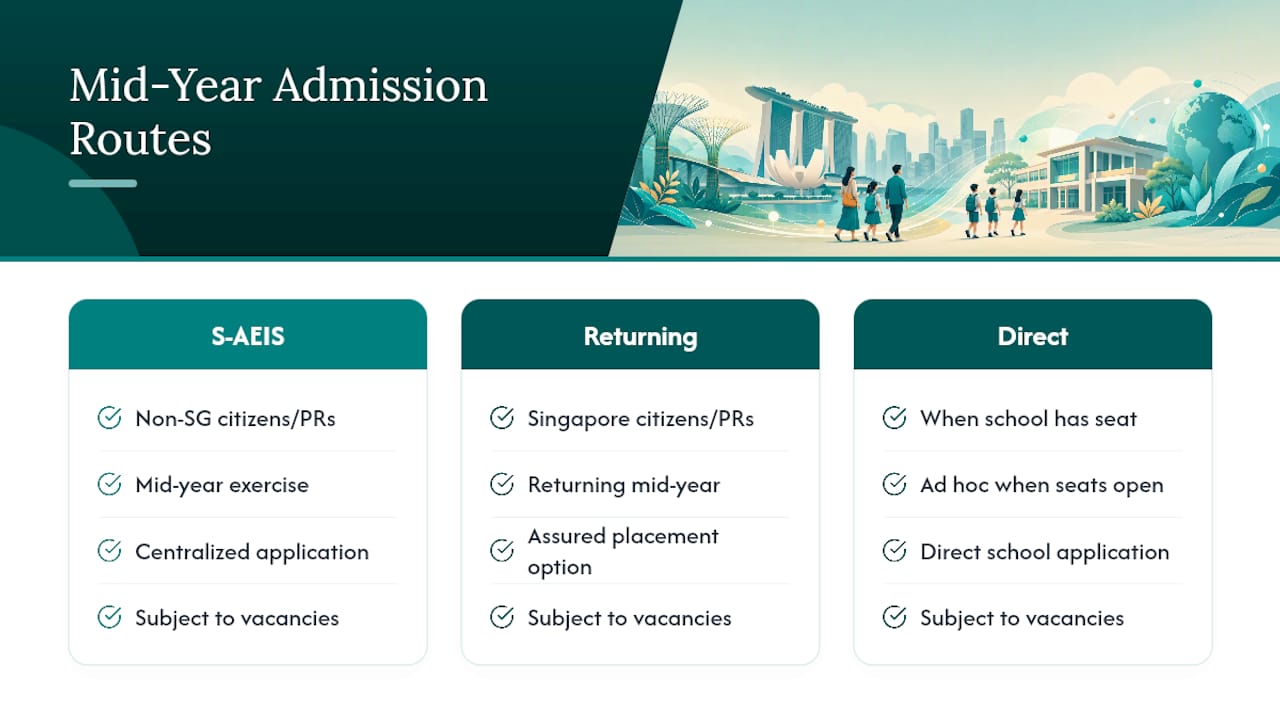
The common thread across all three: none of them guarantee a spot. Vacancies drive everything. A school with a full Primary 3 cohort simply cannot take another student, no matter how strong the application. That’s the single fact that trips up most relocating parents, who assume enrollment works like a straightforward transaction rather than a waitlist system tied to actual classroom capacity.
AEIS and S-AEIS: The Centralized Route for International Students
AEIS is the main intake exercise, held once a year for a January start. S-AEIS is the supplementary round that exists specifically for families who missed that window or arrived in Singapore later in the year. It typically runs from January through March, with successful candidates usually starting school in April or May of the same year, which makes it the realistic mid-year option for most international families.
S-AEIS doesn’t cover every grade level. It’s generally open to Primary 2 through Primary 4 and Secondary 1 through Secondary 2, and even within those bands, placement hinges on which schools actually have empty seats that year.
Here’s what the process typically involves:
Register through the MOE Candidates Portal during the S-AEIS application window.
Sit for standardized tests in English and mathematics, the two subjects MOE uses to gauge readiness.
Provide Cambridge English Qualifications (CEQ) results if your child has them, since primary-level applicants may need this as supporting documentation.
Wait for placement results, which account for both test performance and vacancy availability at eligible schools.
Pro Tip: Start gathering your child’s Cambridge English Qualifications scores and translated academic reports the moment you know you’re relocating. Test slots and document reviews move fast in a three-month window, and scrambling for a certified translation in February costs you time you don’t have.
Because S-AEIS only opens for a few months each year and covers a narrow band of grade levels, families who arrive outside that window, or whose child sits above Secondary 2, often need to pursue direct applications to individual schools instead. That’s a real gap in the system worth planning around.
Returning Singaporeans and Assured School Placement: What SC/PR Families Should Know
If your child holds Singapore citizenship or permanent residency, you have considerably more room to maneuver. Returning Singaporean children can apply for admission at any time during the year, unlike international students bound to the AEIS/S-AEIS calendar. That said, earlier is always better, since school terms run January through November and vacancies tighten as the year progresses.
For same-year admission to a primary school, MOE recommends submitting your application early before the third quarter. Miss that window, and your child may end up waiting until the following January intake instead.
The scheme’s biggest advantage is Assured School Placement (ASP), which guarantees a spot at a school with vacancies near your residence, even if it isn’t your first choice. Actual level and class assignment usually follow a school-based test or short interview.
A practical checklist for SC/PR families:
Register as early as possible, ideally while still overseas, using the Letter of Acceptance (LOA) process to hold a place before you land.
Gather your child’s passport or FIN details, birth certificate, and recent school reports.
Confirm your target move date against the September cutoff if you want same-year placement.
Prepare for a placement test or interview once ASP assigns a school.
Registering before you touch down, rather than after, is the difference between walking into term with a confirmed seat and spending your first month in Singapore chasing paperwork.
Primary School Transfer Cycles: Dates That Actually Matter
For families already in Singapore who want to move a child from one primary school to another, MOE runs the Primary School Transfer Service through planned cycles rather than a rolling, apply-anytime system. These cycles are timed so that a successful transfer lines up with the start of a new term, not the middle of one.
Cycle window | Typical timing | Outcome released |
Cycle 1 | Before the March school holidays | Ahead of Term 2 |
Cycle 2 | May/June | Ahead of Term 3 |
Cycle 3 | November | Ahead of the new school year in January |
Notice what’s missing: September. Schools deliberately avoid running a transfer cycle late in the final term because uprooting a child a few weeks before the school year ends serves nobody. There’s little academic benefit to switching classrooms right as the current cohort winds down toward year-end assessments.
A few things worth doing if you’re eyeing a transfer:
Monitor the specific school’s vacancy listings rather than assuming a spot exists because a cycle is open.
Submit a complete application within the stated window. Late or incomplete submissions typically roll to the next cycle.
Time your family’s relocation, where possible, to land just ahead of a cycle opening rather than in the dead zone between them.
How Do Schools Decide Which Year Group and Class Fit?
Don’t assume your child’s grade level transfers cleanly from another country’s system. A “Year 4” student in the UK, a “5th grader” in the US, and a Singapore “Primary 4” pupil aren’t automatically equivalent, and MOE guidance is clear that families should confirm placement directly with the admitting school rather than guess based on age or a foreign report card.
Schools typically place mid-year entrants using a combination of tools:
Short written assessments in English and mathematics, similar in spirit to the AEIS/S-AEIS tests but administered internally.
A brief interview with the child, sometimes with a parent present, to gauge language comfort and social readiness.
A review of the last one to two years of school reports, plus any national exam results if your child sat for them.
Bring more documentation than you think you need. A syllabus summary from the previous school, even a rough one, gives the receiving school context that a bare report card can’t provide.
Pro Tip: Ask the admissions office directly for a sample placement rubric or a past year’s test topics before the assessment date. Most schools will share this on request, and it turns a nerve-wracking guessing game into focused, targeted preparation.
What to Prepare Before You Apply
Paperwork gaps are the single most common reason a mid-year application stalls. Work through this before you submit anything:
Identity documents. Passports, FIN numbers if already issued, and your child’s birth certificate.
Address proof. A tenancy agreement or utility bill showing your Singapore residence.
Academic records. The last one to two years of report cards, translated into English if needed, plus any national exam results.
Health records. Immunization history, since Singapore schools require proof of specific vaccinations before enrollment.
Custody or guardianship papers, if applicable to your family situation.
Immigration status confirmation. Check dependent pass or work pass timelines through the Immigration & Checkpoints Authority (ICA), since your child generally cannot enroll until their pass is issued.
If your child needs English language support, gather any prior ESL assessments or teacher notes now and flag them to the prospective school early. A school that knows about a learning gap before day one can prepare a targeted plan instead of discovering it three weeks in.
Pro Tip: Scan and organize every document into a single folder before you start any application, digital or paper. MOE portals and school admissions offices both move faster when everything arrives complete on the first try, rather than in three separate follow-up emails.
Helping Your Child Settle in the First Few Weeks
Academic placement is only half the job. The first six to twelve weeks at a new school shape whether your child sees the move as an adventure or an ordeal, and a lot of that comes down to communication you can start before the first day.
Write a short profile for the receiving teacher covering your child’s academic background, social temperament, any medical needs, and how they learn best. Teachers who receive this upfront can adjust seating, pacing, and peer groupings without waiting weeks to figure it out themselves.
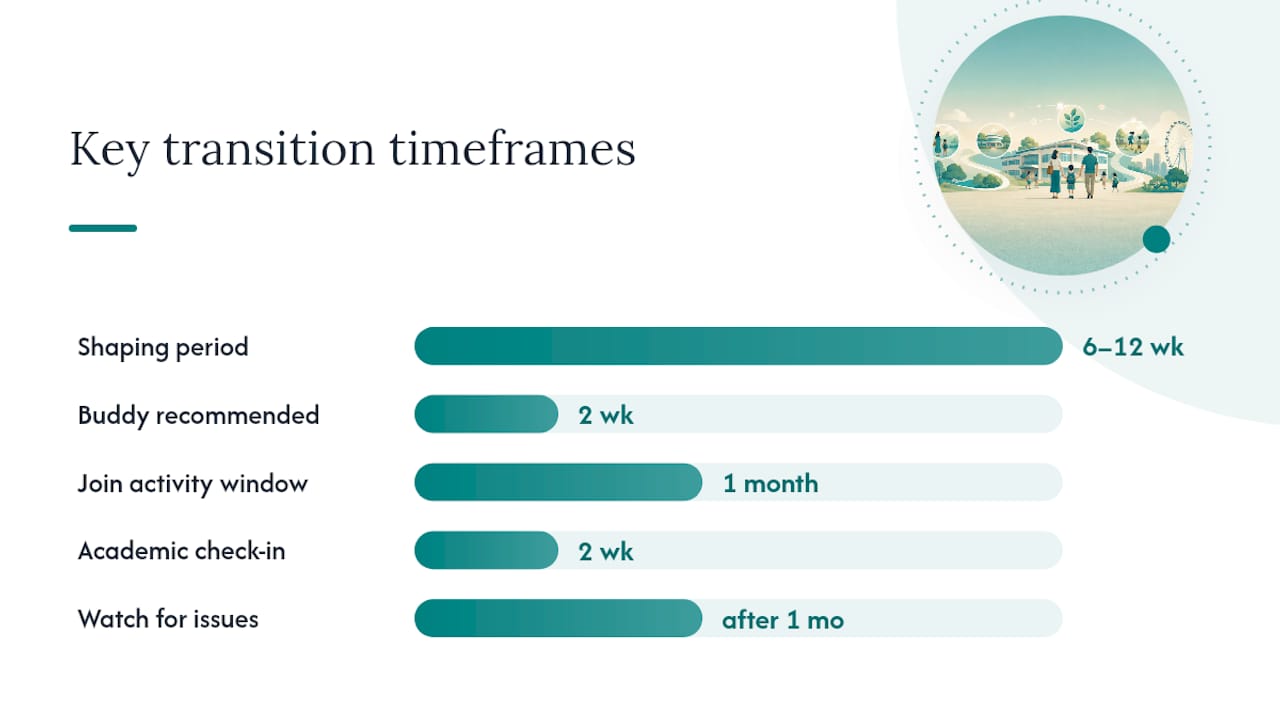
On the social side, ask if the school runs a buddy system for new students, and consider signing your child up for one after-school club or activity in the first month, following practical steps for integrating a child into a new school. Shared activity, not shared classroom time, is often where real friendships start.
Academically, work with the school to identify one to three priority gaps rather than trying to fix everything at once, and set a rough two-week check-in to see what’s improved. Practical transition strategies built around this kind of focused catch-up tend to outperform a scattershot approach.
Share a one-page child profile with the new teacher before day one.
Request a buddy or peer mentor for the first two weeks.
Set a two-week academic check-in with the school or a tutor.
Ask about counseling or structured ESL support if your child seems withdrawn or overwhelmed after the first month.
Watch for prolonged reluctance to attend, sleep disruption, or a sudden drop in the enthusiasm your child showed in week one. Those are the signals worth raising with the school’s pastoral care team rather than waiting to see if they pass on their own.
A Publisher’s View on Supporting Mid-Year Entrants
Small class sizes matter most in exactly this scenario: a child arriving mid-term needs a teacher who notices quickly, not one managing forty names. Astor’s classes stay capped low enough that a tailored induction, paired with practical multilingual support, is realistic rather than aspirational. If you’re weighing a mid-year move, start that conversation with an admissions team early.
— Elena
Considering Astor for a Mid-Year Placement?
If small classes and hands-on induction matter to you more than a big-name campus, a small school can offer a setting with class sizes typically capped around 20 students, providing more individualized attention for children aged 5 to 12. That’s a meaningful contrast to schools where a mid-year arrival gets absorbed into a large cohort with little individual attention in the first month.
Astor’s fee structure includes Option A, FLEXI FEES, at SGD 17,580 per year, and Option B, FIXED FEES, at SGD 23,650 per year, alongside enrichment and language support designed for exactly the kind of catch-up plan a mid-year entrant often needs. Availability depends on current vacancies, the same vacancy-driven reality that applies across every intake route in Singapore, so the practical next step is straightforward: contact Astor’s admissions team, ask about current openings for your child’s age group, and request a placement assessment or campus visit before you finalize your relocation timeline. Check the fees and enrollment page for current details.
FAQ
Why Did Singapore Remove Mid-Year Exams?
Many primary and secondary schools have phased out mid-year exams in recent years to reduce assessment pressure and shift toward continuous, bite-sized evaluation throughout the term rather than one high-stakes test. Policies vary by school, so check directly with your child’s intended school for its current assessment structure.
What Are the School Term Dates for Singapore in 2026?
Singapore’s academic year runs January through November, split into four terms with school holidays in between, including a longer break in November and December. Exact dates shift slightly year to year, so confirm them on the MOE website or directly with your target school.
Is It Illegal to Skip School in Singapore?
Singapore enforces compulsory education for citizens at the primary level, and repeated unauthorized absence can lead to legal consequences for parents under the Compulsory Education Act. Rules and enforcement details are best confirmed directly with MOE for your child’s specific residency status.
Do Primary Schools Have Mid-Year Exams?
Practice varies by school. Some primary schools still hold a mid-year assessment while others have moved to ongoing, smaller assessments spread across the term, so it’s worth asking your child’s school directly what to expect.
What Does Mid-Year Enrollment at Astor Cost?
Astor’s annual fees run either SGD 17,580 under the Flexi Fees option or SGD 23,650 under the Fixed Fees option, all listed on the fees page.
Recommended
Comments