


Does Mother Tongue Exemption Apply at International Schools?

No. If your child is enrolled in a private international preschool or primary school in Singapore, the Ministry of Education’s compulsory Mother Tongue Language rules do not apply to them, because that policy is tied to citizenship and permanent residency status inside MOE national schools. What governs your child’s language pathway instead is the individual school’s own policy.
Here’s what that means for your family right now:
Check citizenship status first. If your child is not a Singapore Citizen or Permanent Resident, MOE’s Mother Tongue framework simply doesn’t apply, and the school sets the rules.
Ask for the school’s written language policy during admissions, before you sign anything.
Flag any special circumstances early, such as mid-stream entry, years abroad, or a documented learning need, since most exemption or MTL-in-lieu conversations start here.
Key Takeaways
Mother Tongue exemption at a private international school in Singapore depends on the school’s own language policy, not MOE’s compulsory rules, and eligibility hinges on documented evidence like prior study, extended overseas residence, or a recent SEN assessment.
Point | Details |
MOE rules apply narrowly | Compulsory Mother Tongue policy governs MOE schools and SC/PR placement, not private international school enrollment. |
Evidence drives eligibility | Mid-stream entry, years overseas, or prior formal study in another language typically support an MTL-in-lieu request. |
SEN requests need recent proof | A medical or psychological report dated within three years is required; general learning difficulty alone isn’t enough. |
Processing takes time | Complex SEN-based cases can take up to about three months, so apply well before term starts. |
Astor offers individual attention | Small class sizes at Astor International Preschool and Astor International School let admissions teams assess each child’s language background directly rather than applying a blanket rule. |
Table of Contents
What Mother Tongue Exemption Means for International School Families
Which Children Typically Qualify for MTL-in-Lieu or Exemption?
How Do International Schools Structure Mother Tongue Pathways?
How Does an Exemption Affect Placement and Later Assessments?
How Astor Supports Families Working Through Language Decisions
What Mother Tongue Exemption Means for International School Families
This guide covers one thing specifically: how Mother Tongue requirements and exemptions play out for children at private international preschools and primary schools in Singapore, like Astor International Preschool and Astor International School. It does not walk through MOE’s own national-school exemption process, which is a separate application governed entirely by MOE and meant for a different audience.
If your child attends an MOE school and you’re navigating that exemption pathway, MOE’s learning-in-school guidance is the right starting point, not this article.
A few things worth keeping straight:
Everything here is Singapore-specific. There’s no generic “international schools everywhere” advice mixed in.
The distinction that matters is administrative: MOE binds MOE schools. Private international schools write their own rules.
Your school’s admissions team, not MOE, is who you’ll be talking to about language pathways.
Which Children Typically Qualify for MTL-in-Lieu or Exemption?
International students, meaning children who are neither Singapore Citizens nor Permanent Residents, generally sit outside MOE’s compulsory enforcement altogether. Their language pathway is set by the school’s own curriculum and policy, which is why the conversation with your school’s admissions office matters more than any MOE form.
For SC/PR families at international schools, or for schools that voluntarily mirror MOE-style frameworks, three situations tend to open the door to MTL-in-lieu or exemption:
Mid-stream entrants who never had continuous Mother Tongue instruction because they moved school systems partway through.
Children who lived overseas for extended periods, often several years, without access to formal Mother Tongue study.
Students with documented prior formal study in another language, such as completed coursework or certification in French, Japanese, or another approved language.
Special educational needs (SEN) cases form a distinct category. Schools weigh these conservatively, and a general learning difficulty on its own rarely satisfies the bar without a proper SEN assessment behind it.
Pro Tip: Start gathering paperwork the moment you suspect an exemption conversation is coming. Schools typically want the last one to two years of school reports, certificates proving prior language study, and, for SEN requests, a medical or psychological report dated within the past three years.
How Do International Schools Structure Mother Tongue Pathways?
Most international schools in Singapore run three parallel tracks, and understanding which one applies to your child avoids a lot of confusion at enrollment. There’s the standard school-taught official Mother Tongue (Chinese, Malay, or Tamil), MTL-in-lieu using an approved foreign or Asian language, and dedicated home-language programmes that support a child’s existing linguistic background.
MTL-in-lieu usually isn’t a simple swap. Schools want to see evidence of prior study, and if your family may eventually want your child sitting local examinations or applying to a Singapore university, that alternative language often needs to be backed by an external qualification, like IGCSE, O Level, or IB Language B, to keep those doors open later.
A few practical wrinkles parents should watch for:
Policies aren’t always static. If your family’s residency status shifts to PR or Citizen partway through your child’s schooling, some schools will reconfirm the language pathway rather than assume continuity.
An exemption granted in preschool doesn’t automatically carry into primary school at every institution. Ask specifically whether it persists across phases.
Complex cases, particularly those involving SEN documentation, can take up to about three months to process, so timing your request well ahead of term start matters.
If your child already has a strong foundation in a heritage language, a bilingual education pathway can sometimes serve better than a formal exemption, since it keeps that skill developing rather than sidelining it entirely.
How Do You Request Language Support or an Exemption?
The process runs in four stages, and skipping the early ones is the most common reason parents feel blindsided later.
Before you apply:
Read the school’s language policy in full, not just the admissions brochure summary.
Confirm your child’s residency status (Citizen, PR, or neither), since this changes which rules apply.
Pull together prior school records and any language certificates you already have.
During admissions:
Disclose your child’s language history in writing rather than mentioning it verbally in a tour.
Ask directly for the school’s MTL or alternative-language policy document.
Ask whether a placement test will determine the starting language level.
For SEN-related requests specifically, get a medical or psychological report no older than three years, and confirm what accommodations the school offers along with when the next review happens.
After a decision is made:
Get the decision and any attached conditions in writing.
Confirm the review period, since some exemptions are revisited annually.
Ask how the decision could affect future assessments or, if relevant, posting outcomes down the line.
Families moving into Singapore’s system partway through primary school often find this sequence especially useful, since mid-stream entry is one of the most common triggers for a language policy conversation. There’s more detail on navigating that transition in this guide to education options for expat families.
How Does an Exemption Affect Placement and Later Assessments?
Classroom placement usually follows the language decision fairly directly. A child on an MTL-in-lieu track will typically join a class group that mirrors students studying that same alternative language, sometimes with additional home-language support layered in rather than a fully separate stream.

Reporting matters more than most parents expect. MOE assigns a Mother Tongue score for posting purposes even when a student is exempted or studying an approved language in lieu, and that score can carry weight for secondary school posting decisions down the line.
A change in family circumstances can reopen the whole conversation:
A shift to PR or Citizen status often triggers a policy review, since MOE compulsory rules may then start applying.
Keep every external exam certificate and school report, since these become the evidence base if you need to demonstrate prior study later.
Ask your school to schedule a formal review checkpoint rather than assuming the exemption is permanent.
Parents planning further ahead, particularly toward eventual local university admission, should treat external language exam records as a long-term asset, not paperwork to file away and forget.
How Astor Supports Families Working Through Language Decisions
Astor Education Network runs two schools built around exactly this kind of individual attention: Astor International Preschool in the Holland area and Astor International School in Tanglin, both small by design, with class sizes that let teachers actually notice when a child is struggling with a language transition rather than a curriculum that assumes every child arrives with the same background.
Because the schools are small, the admissions conversation about language is a real conversation, not a form. If you’re weighing whether your child needs MTL-in-lieu, a home-language track, or straightforward enrichment, here’s what helps:
Bring your child’s last one to two years of school reports, plus any prior language certificates, to the first meeting.
Ask specifically how Astor structures its curriculum around language learning before you commit.
Read Astor’s guide to the IPC curriculum for expat parents, which walks through how language sits inside the broader learning framework.
If any of this applies to your family, request an admissions meeting and share your child’s records upfront. It saves everyone a second conversation later.
What Most Guides Get Wrong About This Topic
Most advice on Mother Tongue exemption treats it as a bureaucratic hurdle to clear once and forget. That’s the wrong instinct for international school families. The real decision isn’t whether your child qualifies for an exemption. It’s whether an exemption, an MTL-in-lieu arrangement, or a home-language programme actually serves your child’s long-term academic path, given where you might eventually want them to end up.
Conventional wisdom also overstates how permanent these decisions are. Policies shift when residency status changes, phases change, or a family’s plans change. Treating an exemption as a one-time checkbox rather than something to revisit is where parents get caught off guard two or three years later.
What I’d prioritize first: don’t ask “can my child skip Mother Tongue?” Ask “what language pathway keeps the most doors open?” A child with strong home-language exposure and a school that nurtures it often ends up better positioned than one who took the exemption and lost the language entirely. Small schools with real attention to individual language backgrounds, rather than blanket policies, tend to get this balance right more often than large institutions built for scale.
Ready to Talk Through Your Child’s Language Pathway?
If your family is weighing MTL-in-lieu, home-language support, or straightforward enrichment, a small school makes that conversation easier than a large one ever could, simply because the people making the decision actually know your child. Astor International Preschool in Holland Village and Astor International School in Tanglin were built around exactly that kind of attention, with small class sizes and a curriculum designed to notice individual language needs rather than sort children into one-size-fits-all tracks.
Astor’s IPC framework shows how language learning fits into the broader curriculum, and the enrichment courses page covers additional language options beyond the core program. If you want a straight answer on how your child’s specific background would be handled, book an admissions consultation and bring your child’s prior school reports and any language certificates you have. That single meeting usually settles more than weeks of research ever will.
Frequently Asked Questions
Does my child need to study an official Mother Tongue language at an international school in Singapore?
Only if the school’s own policy requires it. MOE’s compulsory Mother Tongue rule applies to MOE national schools and to SC/PR status specifically, so private international schools set their own language requirements independent of that framework.
What counts as valid evidence for an MTL-in-lieu request?
Schools typically want prior school reports covering one to two years, certificates showing formal study of the alternative language, and, for SEN-related requests, a medical or psychological assessment dated within the last three years.
Can an exemption granted in preschool carry through to primary school automatically?
Not always. Some schools treat each phase separately and will reassess the language pathway when a child moves from preschool into primary, so it’s worth confirming this directly with admissions rather than assuming continuity.
Will an MTL-in-lieu arrangement affect my child’s ability to apply to a local university later?
It can, depending on which alternative language track was used and whether it was backed by a recognized external exam. Keeping records of qualifications like IGCSE or IB Language B preserves more options down the line.
What happens if our family’s residency status changes from foreign to PR or Citizen?
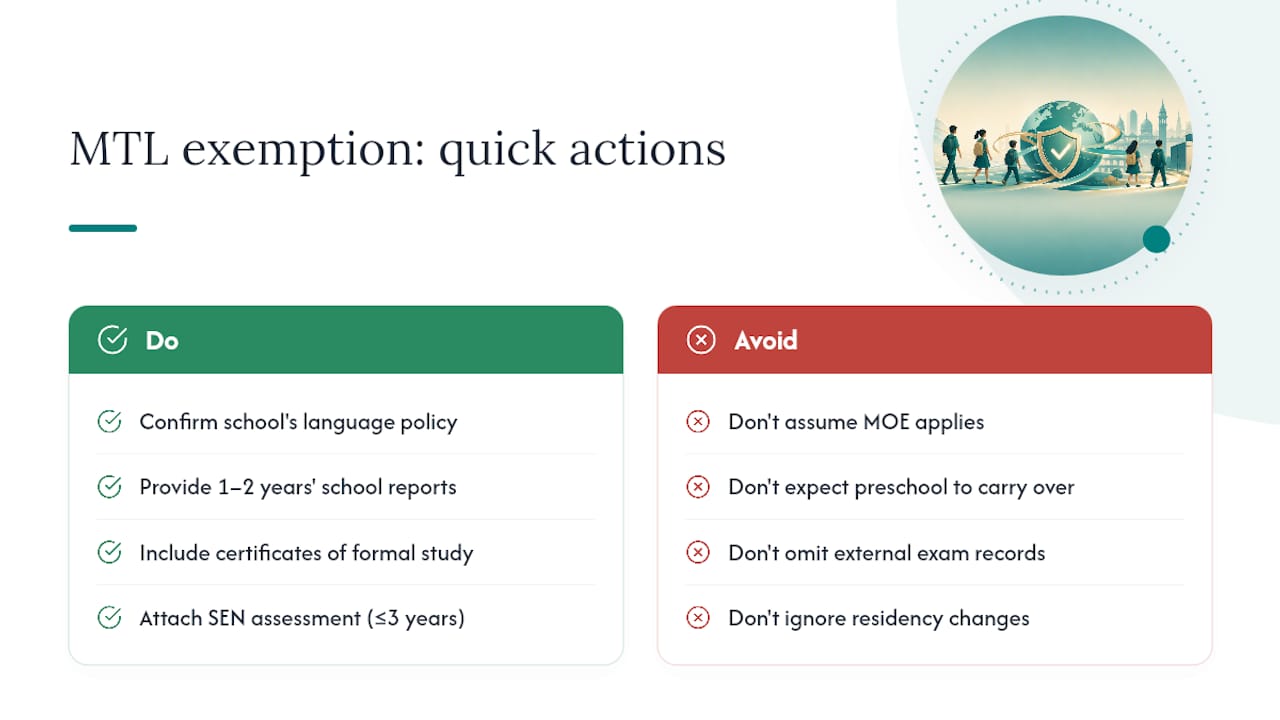
That shift often triggers a policy review, since MOE’s compulsory framework may then start applying to your child, and the school will likely revisit the existing language arrangement rather than leave it unchanged.
Sources
Recommended
Comments