


30 Minute Minimum: How to Check Singapore Nature Play Preschools
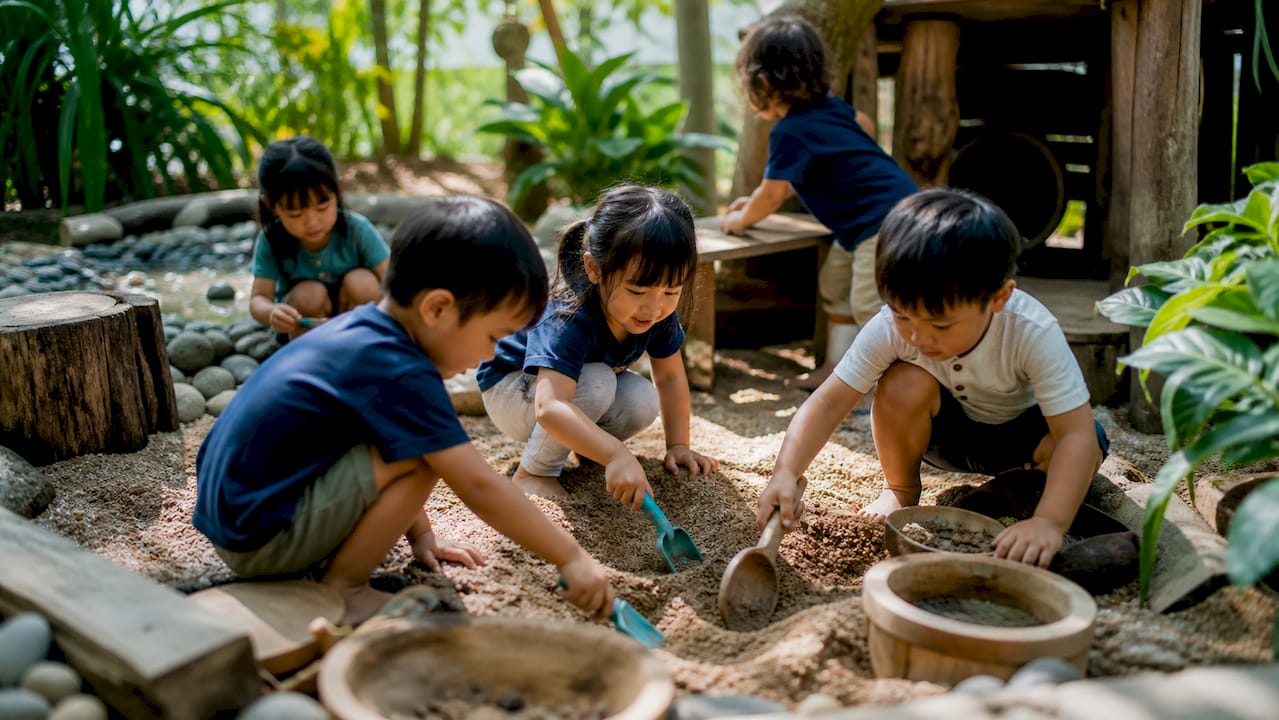
A nature play preschool suits most children between 1.5 and 5, whose growing bodies and minds thrive on sensory, gross motor, and imaginative experiences that a classroom alone cannot offer. Astor International Preschool’s Holland campus is a relevant local example, with two playgrounds woven into an outdoor and classroom curriculum. This guide walks through the ECDA rules, NParks design principles, and a practical checklist to bring on your next tour.
TL;DR:
Preschools must provide at least 30 minutes of outdoor activity daily, with schools encouraged to exceed this minimum for optimal development.
A quality nature-play preschool features real trees, natural materials, and varied terrain, not just plastic equipment and rubber mats.
During visits, inquire about rain-day plans, staff outdoor supervision ratios, and teacher training in outdoor pedagogy to ensure safety and quality.
Consistent outdoor exposure of short durations, managed by small classes, enhances motor skills, social-emotional learning, and curiosity.
Look for evidence of regular outdoor sessions, engaged teachers, safety signage, and accessible hygiene stations during campus tours.
Table of Contents
Why nature play matters in Singapore: what the research and policy say
Nature play is not a trend dressed up in leaves and mud. It is a documented approach to early childhood development that Singapore’s own planning bodies have studied and built guidance around.
NParks worked with the Singapore University of Social Sciences to produce design guidelines for nature playgardens, and the findings are worth knowing before you tour any preschool. Nature playgardens, unlike standard rubber-tiled playgrounds, use biophilic design: real trees, slopes, water features, and “borrowed landscapes” from surrounding greenery instead of manufactured play structures. The guide recommends these spaces for children in early childhood and primary years, with sensorial elements like textured surfaces and natural scents built in deliberately, alongside clear supervision recommendations for the adults managing the space.
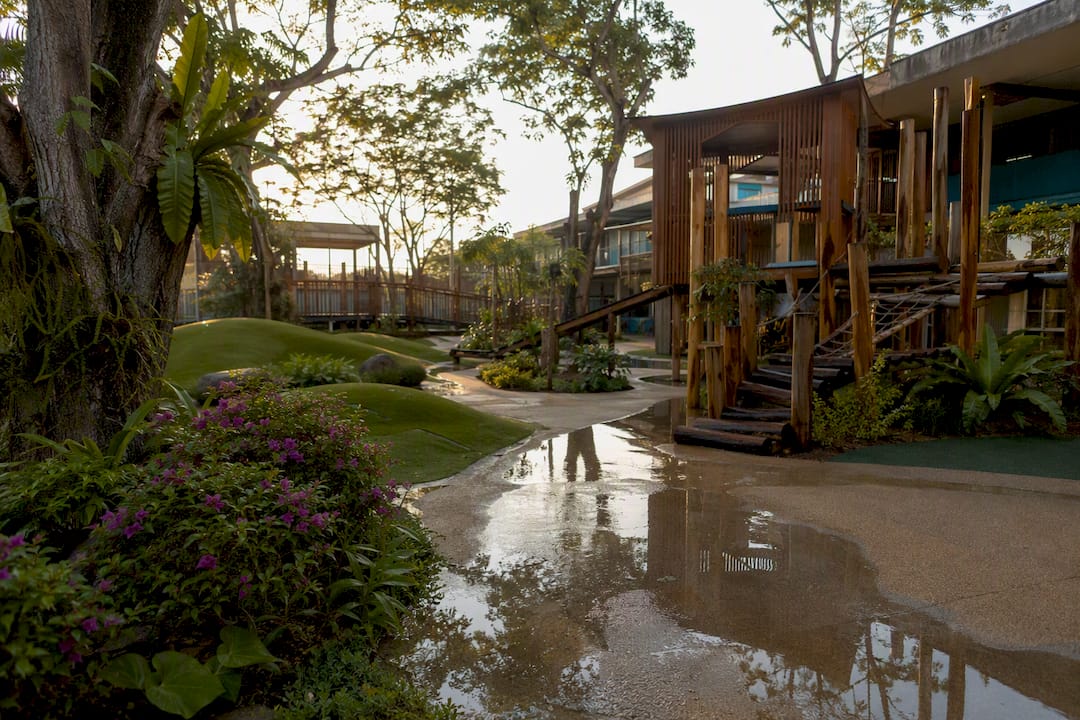
That open-ended, loose-parts approach matters because it changes what a child actually does with their time outside. A leaf pile can become a fort, a picnic, or a science experiment depending on the day, which is precisely the kind of unscripted play that builds problem-solving skills a fixed slide cannot replicate.
Singapore requires a real outdoor minimum, not just a suggestion. The Early Childhood Development Agency mandates that full-day preschools provide at least 30 minutes of outdoor activity daily, or 45 minutes three times weekly, while half-day programs must offer at least 30 minutes of gross motor activity three times a week. ECDA explicitly encourages schools to exceed these numbers rather than treat them as a ceiling.
For toddlers and preschoolers, the developmental payoff shows up in several areas at once:
Gross motor skills improve through climbing, balancing on uneven ground, and running on grass instead of flat tile.
Social-emotional learning develops naturally when children negotiate turns on a slope or share loose materials like sticks and stones.
Curiosity and early problem-solving sharpen through open-ended tasks, such as figuring out how to dam a small stream of rainwater.
NParks’ Kids for Nature program demonstrates this isn’t a fringe idea. It’s a structured, government-backed outdoor education model already used in Singapore schools, built around exactly this kind of nature-based skill building. Astor’s own breakdown of outdoor play research covers the developmental evidence in more depth if you want to read further before your first tour.
How do you evaluate a nature-play preschool in Singapore?
Touring a preschool can feel like a whirlwind of smiling staff and bright classrooms, so it helps to walk in with a fixed set of questions rather than relying on the general vibe of the place.
Here is the order to work through, from most to least critical:
Ask how often, and for how long, children go outside. Get a specific number, not “regularly.” ECDA’s minima give you the floor to measure against, but strong programs schedule repeated short outdoor blocks across the week rather than one long Friday excursion.
Ask what happens on rainy days. Singapore’s weather makes this unavoidable. Find out whether the school has covered outdoor areas or an indoor “nature atelier” that replicates sensory and loose-parts play when the skies open up.
Ask about staff-to-child ratios specifically during outdoor time, not just the general classroom ratio. Supervision on a slope or near a water feature needs closer attention than a quiet reading corner.
Ask what training teachers have in outdoor pedagogy. A teacher who understands how to scaffold risk (letting a child navigate a slope without hovering) is different from one who simply watches from a bench.
Ask about hygiene protocols after mud or water play, and check whether handwashing stations are visible and accessible near the outdoor space.
Look at the physical site itself. Are there real trees, loose natural materials, and varied terrain, or is it a single rubber mat with two plastic slides?
Pro Tip: Ask to see a week’s worth of activity photos or logs, not just one glossy brochure shot. A school confident in its outdoor program will happily show you Tuesday and Thursday, not just the one sunny afternoon they used for marketing.
A red flag worth noting: if a school gets vague or defensive when you ask about their rain policy, that usually means outdoor time quietly disappears the moment weather turns, which in Singapore’s climate can mean several days a week.
What does a nature-play week look like for ages 1.5 to 5?
Seeing the actual rhythm of a week makes it much easier to judge whether a school’s promises match its timetable.
A well-run program typically blends these activities across the week, adjusted by age group; for more inspiration, see this resource with outdoor learning ideas for preschoolers.
Free loose-parts play, where children use sticks, stones, leaves, and sand however they choose, with minimal adult direction.
Guided nature walks, often short and repeated rather than one long weekly trip, focused on noticing changes like new flowers or fallen leaves.
Sensory tables and mud or water play, which give younger toddlers a controlled way to explore textures.
Bug hunts and simple garden care, such as watering plants or checking on a small vegetable patch.
Nature-inspired art, using collected leaves or petals rather than only paper and crayons.
For toddlers around 18 months, outdoor blocks tend to run shorter and more frequent, often three or four short sessions across the week focused on sensory exploration. For children closer to 5, sessions can stretch longer and incorporate more structured elements, like a short walk paired with a specific observation task.
Safety details matter just as much as the activities themselves. Good programs manage sun exposure with shaded zones and hats, keep a clear handwashing routine after mud or water sessions, and always have a covered indoor fallback ready when Singapore’s afternoon storms roll in.
Your preschool visit checklist and next steps
Bring a short list with you on tour day, and don’t be shy about checking items off in front of staff. It signals you’re a serious parent, not just a browser.
Look for these during the walkthrough:
Visible outdoor space with real greenery, not only synthetic turf and plastic equipment.
Evidence of regular outdoor sessions, such as posted schedules or photo logs from different days.
Teachers actively engaging outside, kneeling down to talk with children rather than standing off to the side.
A covered outdoor area or indoor alternative for rainy days.
Clear safety signage, plus a visible first-aid kit and posted emergency procedure.
A functioning handwashing station near the outdoor play area.
Once you’ve toured, move quickly to the practical questions. Request a sample weekly timetable in writing so you can compare stated outdoor minutes against what you actually observed. Ask how settling-in works for a child moving from home or another program, and get clear on fee structure and payment schedule before you commit. Astor’s guide to Singapore preschool curriculum is a useful reference for understanding how nature-based elements typically fit into a broader curriculum framework.
If you’re comparing two or three shortlisted schools, rank them side by side on the same three factors: outdoor minutes per week, teacher engagement you personally observed, and clarity of their rain-day plan. The school that answers all three without hesitation is usually the one worth a second visit.
How does outdoor play actually shape a young child’s week?
Repeated, short exposure to the outdoors tends to matter more than the length of any single session. A child who spends fifteen focused minutes outside three times a week, poking at soil or watching ants cross a path, often builds sharper observation habits than one who gets a single long nature outing once a month. Consistency beats novelty at this age.
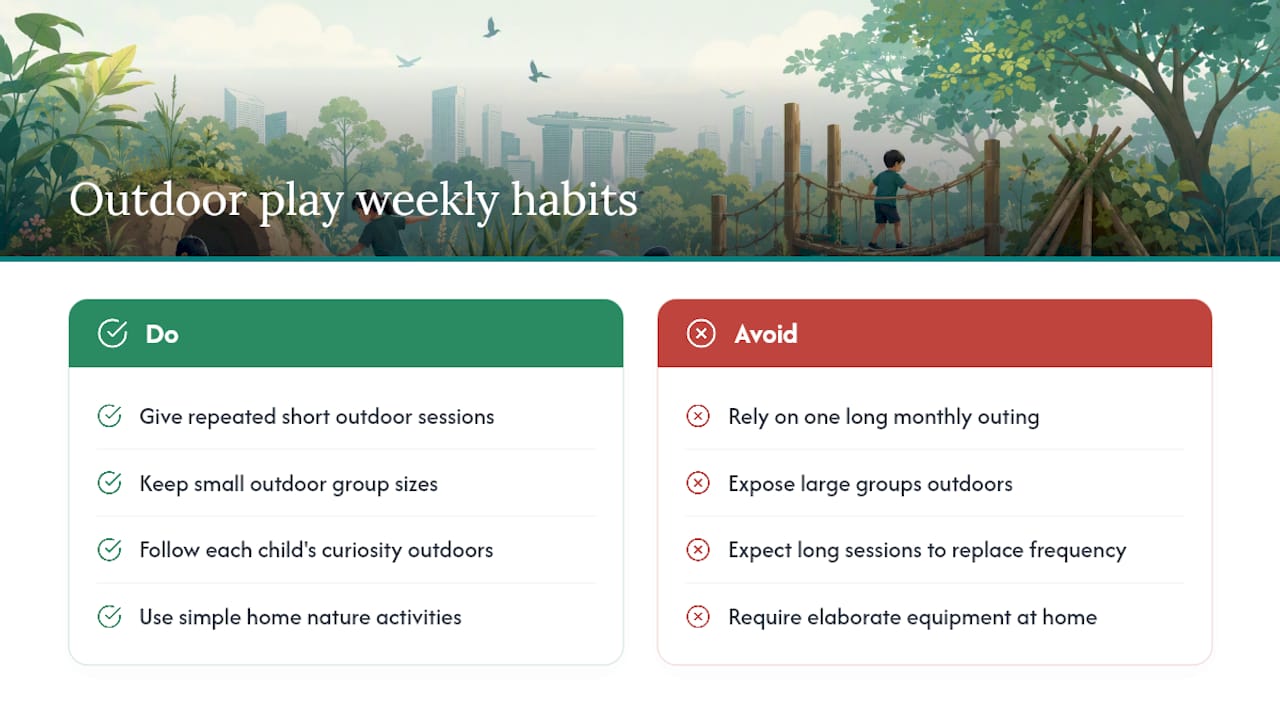
Small class sizes make that consistency easier to deliver well. When a teacher is only responsible for a handful of children outdoors, they can actually follow a child’s specific curiosity, whether that’s a fascination with snails or a stubborn interest in digging the same hole every day, instead of just managing a crowd.
At home, you don’t need elaborate equipment to extend this. A short walk to notice one new thing, a small pot of soil for planting seeds, or letting a child collect leaves for a rainy-day art project all reinforce what a good nature-play preschool is already doing during the week.
— Elena
Astor International Preschool: a nature-play option in Holland
Astor International Preschool’s Holland campus was built around the idea that outdoor and classroom learning should work together, not compete for a child’s attention. The campus has two playgrounds that support both unstructured free play and guided outdoor lessons, paired with small class sizes that let teachers actually notice what each child is drawn to outside.
If the checklist above raised questions you’d rather ask in person, that’s exactly what a campus tour is for. You can walk both playgrounds, see how outdoor sessions run on a typical day, and get a straight answer on rain-day plans instead of a brochure line. Start by reviewing how outdoor learning connects to the broader curriculum framework Astor uses across its programs, then reach out to book a tour of the Holland campus and request a sample weekly timetable for your child’s age group.
Sources
Recommended
Comments