


Preschool Age in Singapore: Stages, Timelines, and Choices
In Singapore, preschool covers children under 7, spanning infant care through Kindergarten 2. Preschool is not compulsory. The Ministry of Education and the Early Childhood Development Agency (ECDA) are the two bodies that set the rules, define the stages, and guide parents through enrollment.
If you’re a parent trying to figure out where your child fits, here’s the quick map:
Infant care: 2 months to 18 months
Playgroup: 18 months to about 2 or 3 years
N1/N2 (nursery): roughly 3 to 4 years
K1/K2 (kindergarten): roughly 5 to 6 years
Key Takeaways
Singapore preschool spans infant care through K2 for children under 7, remains non-compulsory, and follows MOE and ECDA guidance on stages, curriculum, and subsidies.
Point | Details |
Age bands are consistent | Infant care runs 2 to 18 months, playgroup to age 3, N1/N2 covers ages 3 to 4, K1/K2 covers ages 5 to 6. |
Preschool isn’t compulsory | Children can enter Primary 1 without preschool, though attendance among 3 to 6 year olds runs high. |
Check cohort cutoffs early | Centers use turning-year or academic-year rules, which can shift your child’s placement group. |
Curriculum shapes milestones | The NEL Framework guides social-emotional and literacy goals for ages 4 to 6 in most centers. |
Small settings suit close attention | Astor International Preschool offers small class sizes and a blend of outdoor and classroom learning in Holland Village. |
Where to Check Official Details Next
MOE preschool overview: official age definitions and framework.
ECDA parents page: guidance on choosing a preschool and subsidies.
LifeSG enrollment guide: step-by-step enrollment for ages 2 months to 7 years.
Astor’s curriculum page: details on Astor’s teaching approach.
Table of Contents
What Are the Official Preschool Age Ranges in Singapore?
Every preschool in Singapore, whether it’s a neighborhood childcare center or a boutique international preschool, tends to follow a similar age structure. The labels can vary slightly from center to center, but the underlying age bands stay consistent because they follow developmental logic, not marketing convenience.
Here’s how the stages typically break down:
Infant care: 2 months to 18 months. Focused on caregiving, sensory play, and secure attachment.
Playgroup (sometimes called pre-nursery or PG): roughly 18 months to 2 or 3 years. Short, structured sessions build early social exposure.
Nursery 1 (N1): around age 3. Children start longer days with more structured group activities.
Nursery 2 (N2): around age 4. Group learning deepens, with more emphasis on language and fine motor skills.
Kindergarten 1 (K1): around age 5. This is where pre-literacy and pre-numeracy really pick up pace.
Kindergarten 2 (K2): around age 6, the final stretch before Primary 1.
A few practical wrinkles matter here. Centers use different cutoff dates to decide which cohort a child joins. Some go by a “turning-year” rule, where a child’s age on January 1 determines placement; others follow the academic year a child was born in. This is not a small detail. It can shift your child into a different cohort than you expected, so always confirm each center’s specific cutoff policy before you commit rather than assuming it matches the neighborhood center down the road. These age bands are widely used across preschool programs in Singapore, and ECDA’s guidance echoes the same general structure for parents comparing options.
Is Preschool Compulsory in Singapore?
No. Singapore does not legally require preschool attendance, and a child can enter Primary 1 without ever setting foot in a preschool classroom. That said, the Ministry of Education actively encourages early enrollment, and most families follow through on that encouragement.
Attendance among 3 to 6 year olds runs high, with various government and industry summaries estimating figures in the 80 to 95 percent range depending on the age band measured. Preschool has become the practical default, even without a legal mandate behind it.
Cost is often the real barrier, not policy. ECDA publishes detailed subsidy schemes for infant care and childcare, and eligibility depends on household income and citizenship status. LifeSG also walks parents through the enrollment process step by step, covering children from 2 months to 7 years. If subsidies factor into your budget, that’s worth checking early. Our guide to affordable preschool education in Singapore breaks down how these subsidies interact with different fee structures.
What Should Children Learn at Each Preschool Stage?
Every stage builds on the one before it, and the shifts are more noticeable than most parents expect walking in cold.
Infant care (2 to 18 months): attachment security, sensory exploration, early babbling and gesture communication.
Playgroup (18 months to 3 years): parallel play shifting into cooperative play, vocabulary bursts, basic self-help skills like feeding and simple dressing.
N1/N2 (ages 3 to 4): turn-taking, following multi-step instructions, recognizing letters and numbers, holding a crayon with purpose rather than a fist.
K1/K2 (ages 5 to 6): early reading fluency, simple addition and subtraction, sustained attention for group tasks, and growing independence in problem-solving.
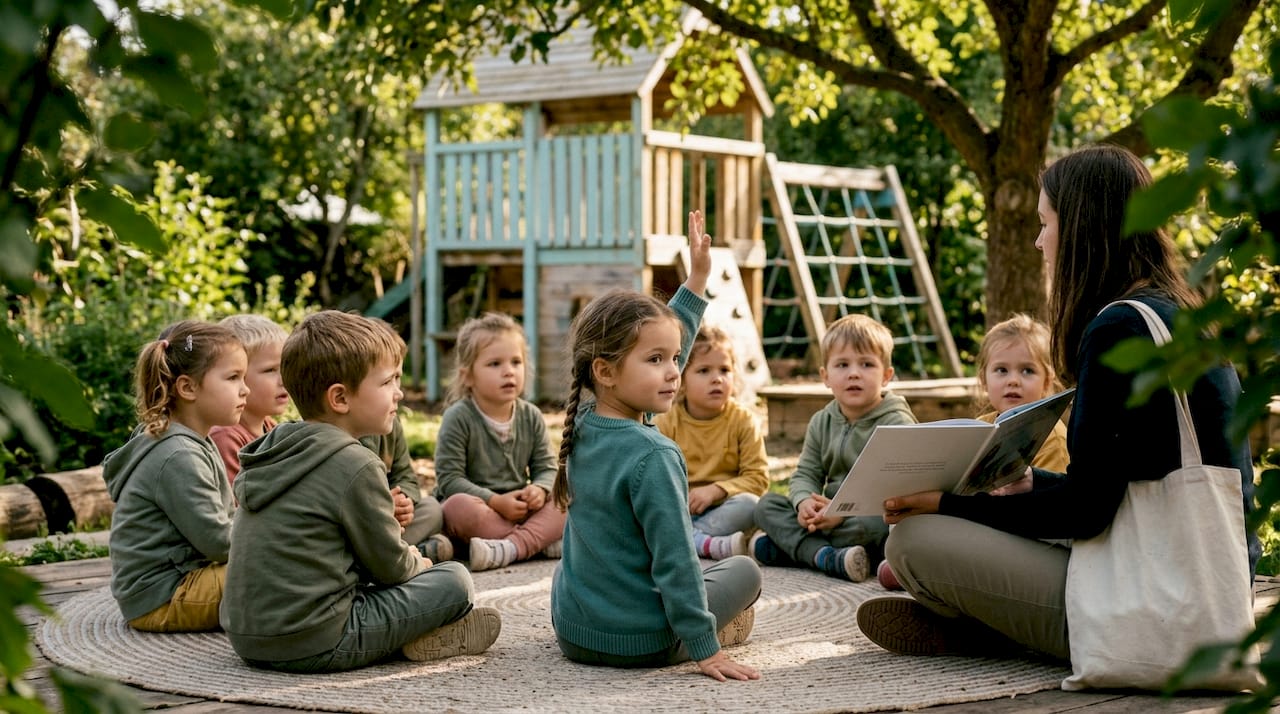
Much of this is guided by the Nurturing Early Learners (NEL) Framework, which shapes kindergarten practice for children aged 4 to 6 and puts real weight on social-emotional development alongside academics. Play-based learning isn’t a soft alternative to “real” instruction here. It’s the mechanism through which these milestones actually take hold, particularly for language and social skills. Structured storytelling sessions, for instance, are linked to stronger social-emotional outcomes than passive screen time or solitary play.
Pro Tip: Watch for frustration tolerance, not just vocabulary size, when deciding if your child is ready to move up a stage. A child who can sit through a 15-minute group activity without melting down is often more ready for K1 than one with a bigger vocabulary but zero patience for group routines.
How Do You Choose the Right Preschool for Your Child’s Age?
Picking a preschool comes down to matching a center’s approach to your child’s actual stage, not just its reputation. ECDA’s own guidance on choosing a preschool points to a handful of operational checks that matter more than glossy brochures.
Staff-to-child ratios, especially for infant care and playgroup age groups.
Curriculum philosophy: NEL-aligned, international (like IPC), Montessori, or a hybrid.
Teacher qualifications and how long staff tend to stay.
Daily routines, including nap schedules, outdoor time, and meal structure.
Language exposure, particularly if you want bilingual or trilingual immersion.
Fees, subsidy eligibility, and any enrichment add-ons.
When you tour a center, ask direct questions: What’s the staff turnover been like this year? Will my child have the same primary teacher for the full term? What does a typical Tuesday look like, hour by hour? How do you support children moving from N2 into K1?
Watch for vague answers on ratios or turnover. That’s usually a bigger red flag than an unfamiliar curriculum name. Our practical checklist for choosing a preschool covers the full list of questions worth bringing to a tour.
Pro Tip: Ask to sit in on a snack time or transition period, not just circle time. Transitions reveal more about a center’s real management style than a rehearsed lesson does.
When Should You Enroll and How Do You Prepare?
Timing catches a lot of families off guard, especially expats moving mid-year.
Apply early, ideally 6 to 12 months ahead for popular centers, since infant care and K1 slots fill fastest.
Confirm the cohort cutoff your center uses (turning-year versus academic-year), since this determines which classroom your child actually joins.
Gather documents early: birth certificate, immunization records, and proof of income if you’re applying for ECDA subsidies.
Practice routines at home beforehand, including toileting independence and short separations, since these ease the first-week adjustment more than any orientation session will.
When a Small International Preschool Fits Best
Some families do best with a small, intentional setting, where teachers know every child by name and outdoor play sits alongside classroom time. That tends to suit expat families craving continuity and parents who want direct, ongoing relationships with their child’s teacher, not a rotating cast.
— Elena
A Preschool Built Around Small Classes and Real Attention
If close teacher relationships and a genuine outdoor-classroom balance are what you’re after, Astor International Preschool in Holland Village was built around exactly that idea. It’s a small preschool by design, with two playgrounds and a deliberate mix of outdoor and classroom learning, not the sprawling, high-turnover model many parents feel lost inside.
Small classes mean your child isn’t one of forty faces a teacher tries to remember. It means a teacher who notices when your son is finally ready to write his name, or when your daughter needs a quieter corner during transitions. That kind of attention is hard to manufacture at scale, and it’s exactly what many parents say they wish they’d prioritized sooner. If your child falls somewhere between playgroup age and K2, and you want a curriculum that blends structured learning goals with genuine outdoor time, take a look at Astor’s International Primary Curriculum and book a visit to see the classrooms in person.
Sources
Recommended
Comments