


Preschool Fees in Singapore: What Parents Pay in 2026

Most Singaporean households pay nowhere near the sticker price for preschool once subsidies kick in. Expect a nett range of roughly $0 to $160 a month for MOE Kindergarten, generally moderate to higher fees for Anchor or Partner Operator childcare, and a higher, mostly subsidy-free range for private international preschools. The two numbers worth memorizing right now are MOE’s fixed fee of $160 for citizens and $320 for permanent residents, and the 2026 fee caps that trimmed what Anchor and Partner Operators can charge before subsidies even apply.
TL;DR:
Most Singaporean households pay between $0 and $160 monthly for MOE Kindergartens, with higher fees applying to private international preschools.
Subsidies, including basic, additional, and KiFAS, can significantly reduce nett costs, often bringing full-day childcare fees down to around $300 to $450 for middle-income families.
The upcoming 2026 fee caps lower the gross charges for childcare and infant care, which will further boost subsidy effectiveness and reduce families’ out-of-pocket expenses.
Fees are primarily driven by operating hours, curriculum choices, class size, and location, with private and international schools charging several thousand dollars monthly without subsidies.
Early registration and broad application are vital for securing spots in popular preschools, especially for MOE Kindergartens and centers in high-demand areas.
Table of Contents
How Preschool Fees Are Structured by Provider Type
Singapore’s early childhood sector splits into three broad categories, and the label on the gate tells you almost everything about the fee band inside.
MOE Kindergartens sit at the affordable end by design. They run half-day programs, charge a flat fee regardless of household income, and don’t offer infant care. Anchor Operators (like PCF Sparkletots and My First Skool) and Partner Operators run full-day childcare and infant care under government-negotiated fee caps, in exchange for reserving places for lower-income families. Private and international preschools, including boutique options, set their own fees entirely, often layering in enrichment, smaller class sizes, or a foreign curriculum.
Here’s how the before-subsidy monthly fees typically break down by program type:
Kindergarten (half-day, MOE): $160 (citizens) or $320 (permanent residents), flat rate regardless of income
Full-day childcare (Anchor/Partner): capped at $610 (Anchor) or $650 (Partner) before GST as of January 2026
Infant care (Anchor/Partner): capped at $1,235 (Anchor) or $1,290 (Partner) before GST
Private/international preschool: often several thousand dollars a month, with no fee cap and no government subsidy eligibility in most cases
Registration and deposit fees: often $200 to $500 one-time, separate from monthly tuition
What actually drives the variation within each band? Hours of operation matter most: a center open from 7am to 7pm costs more to staff than a 9am to noon kindergarten session. Class size and teacher-to-child ratios push fees up too, and so does curriculum. Centers running an international or bilingual curriculum, or ones with dedicated outdoor learning spaces, generally sit at the higher end of their category. Location plays a smaller but real role, with centers in central areas often pricing above their heartland counterparts for equivalent programs.
How Do Subsidies and KiFAS Reduce What Parents Pay?
The gap between gross fees and what actually leaves your bank account is almost entirely explained by three subsidy layers, and understanding how they stack matters more than memorizing any single number.
Basic Subsidy applies to all Singapore citizen households using licensed infant care or childcare, regardless of income, administered through ECDA’s subsidy scheme.
Additional Subsidy layers on top for families with lower per-capita household income, provided at least one parent is working, studying, or has a valid reason for not doing so.
KiFAS (Kindergarten Fee Assistance Scheme) covers MOE Kindergartens and Anchor Operator kindergartens specifically, using means-tested assessment points tied to household income, with a minimum co-payment built into every tier so no family pays zero.
Pro Tip: KiFAS assessments happen at fixed points in the year, not continuously. If your household income drops (a retrenchment, reduced hours), don’t wait for the next scheduled review. Request a reassessment directly, because centers apply the higher subsidy only from the date it’s processed, not retroactively.
Budget 2025/2026 raised the income thresholds for eligibility, with the household income ceiling reportedly moving from $12,000 toward $15,000, which pulls more middle-income families into subsidy range for the first time. Centers typically handle the paperwork at enrollment on your behalf, and the subsidy is paid directly to the center rather than reimbursed to you, so your monthly bill already reflects the nett amount.
What Are the New 2026 Fee Caps and Where Is Policy Heading?
From January 1, 2026, the government locked in lower ceilings on what operators can charge before GST: $610 a month for Anchor Operators and $650 for Partner Operators running full-day childcare, with infant care capped at $1,235 and $1,290 respectively.
Full-day childcare: $610 (Anchor) / $650 (Partner), before GST
Infant care: $1,235 (Anchor) / $1,290 (Partner), before GST
Both caps apply to gross fees, meaning subsidies are calculated on an already-lower base
Why this matters more than it sounds: a lower gross fee doesn’t just save a few dollars on its own. Since subsidies are calculated against the gross fee, capping that baseline compounds with the subsidy layers above it, pushing nett costs down further for eligible families rather than leaving the saving isolated to one line item.
Longer term, the government’s National Day Rally 2026 announcement signaled plans to reduce government-supported childcare and infant care fees further by 2030, with staged rollouts expected to begin around 2028. Specific figures and timelines for that phase haven’t been finalized, so treat 2026 caps as the current reality and the 2030 goal as a direction, not a locked-in number.
How Are Preschool Fees Billed and Paid?
Most centers bill monthly, but MOE Kindergartens and many childcare operators still collect fees during the June and December school holidays, which catches new parents off guard when the “holiday” month arrives with a bill anyway.
Deposits or registration fees usually run $200 to $500 and are often non-refundable after a set notice period
Withdrawal typically requires one month’s written notice, or the deposit is forfeited
Ask upfront: does the quoted fee include GST, and is it shown before or after subsidy?
Pro Tip: Before signing anything, ask the center for a written fee schedule broken into three lines: the gross fee, the subsidy amount applied, and your resulting minimum co-payment. A verbal quote of “around $400 a month” hides which of those three numbers is doing the work.
What Does Preschool Actually Cost After Subsidies?
Numbers only mean something once you see them applied to a real household. Here are three common scenarios:
MOE Kindergarten, Singapore citizen household, eligible for full KiFAS: gross fee $160, KiFAS and basic subsidy can bring this down close to the minimum co-payment tier, landing many eligible families near $0 to $50 a month.
Anchor Operator full-day childcare, middle-income dual-earner household: gross fee capped at $610, basic subsidy plus a partial additional subsidy (since household income sits above the lowest tier) often lands nett cost around $300 to $450 a month.
Private international preschool, subsidy-ineligible: gross fee $1,800 as an example, with no basic or additional subsidy applied in most cases, landing nett cost at or near the full gross figure, plus enrichment extras.
When budgeting, add these on top of monthly tuition: registration/deposit (one-time), uniforms, enrichment classes or transport if not bundled in, and GST where it applies to the quoted fee. Families often underestimate the one-time costs, which can add several hundred dollars in the enrollment month alone.
Astor’s Approach to Affordable International Preschool
At Astor’s Holland preschool, small class sizes and a mix of outdoor and classroom learning across two playgrounds are the foundation, not an add-on. Astor has been recognized as best small school in Singapore and best affordable international school, a combination that matters when you’re weighing quality against a monthly budget.

Rather than treating fee comparison as guesswork, we’d encourage you to line up Astor’s nett fees and IPC curriculum details against the scenarios above, and to review our admission timeline so you know exactly when deposits and paperwork are due.
How Do You Navigate Waiting Lists at Popular Preschools?
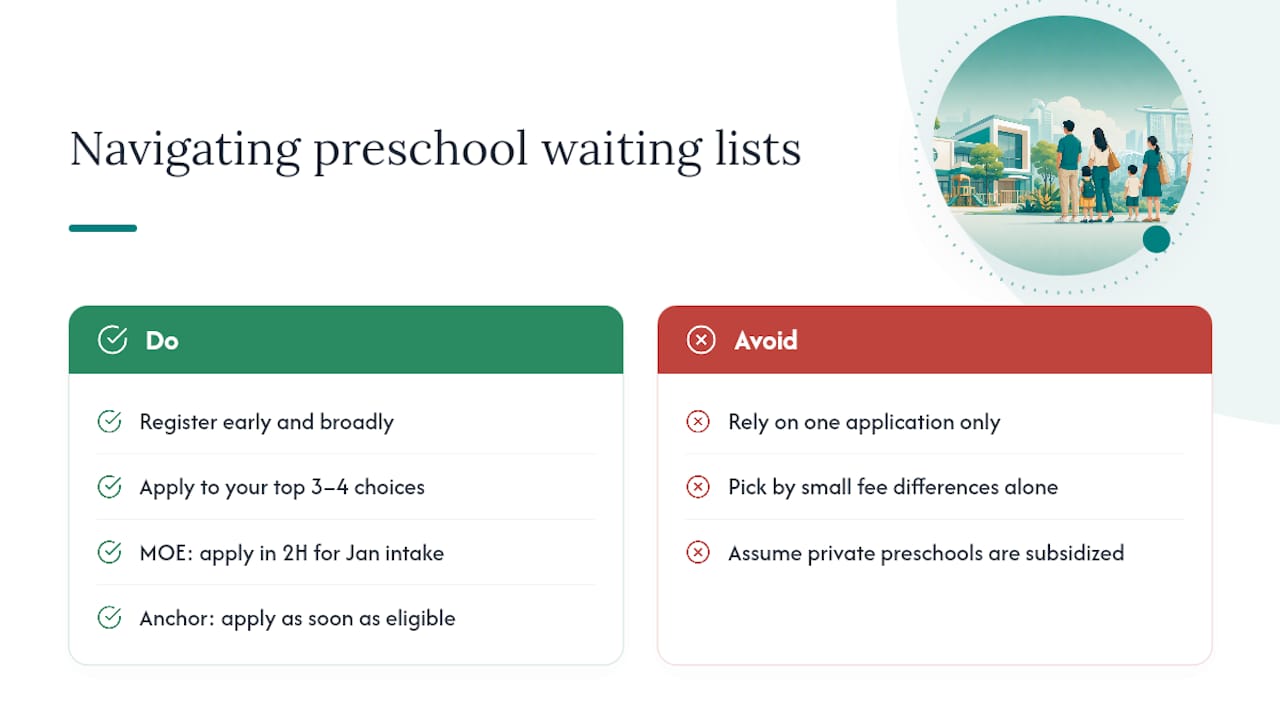
Popular centers, especially MOE Kindergartens near sought-after primary schools and well-regarded Anchor Operator branches, often fill up six to twelve months ahead of the intake year. The practical move is to register early and register broadly: apply to your top three or four choices simultaneously rather than waiting on one response, since most centers don’t penalize parallel applications.
MOE Kindergarten registration typically opens in the second half of the year for enrollment beginning the following January, with priority given to siblings of current students and children living near the affiliated primary school. If a center offers priority admission into a specific primary school, that can outweigh a small fee difference when you’re deciding between two otherwise similar options, a trade-off worth thinking through before fees alone decide it for you.
For Anchor and Partner Operator childcare, waiting lists move faster in centers near MRT stations or within large housing estates, so applying the moment your child’s date of birth qualifies (usually 18 months before the intake age) improves your odds. Private and international preschools generally have more flexible intake, sometimes admitting mid-year, but the trade-off is a higher fee with no subsidy cushion. Whichever route you take, reviewing the practical checklist for choosing a preschool before you commit to a waiting list saves you from applying somewhere that doesn’t fit your schedule or budget once you’re actually offered a place.
Are There Other Grants Beyond the Basic and Additional Subsidy?
Beyond the basic subsidy, Additional Subsidy, and KiFAS, a few other schemes can shave down what a family pays, though eligibility tends to be narrower.
Households already receiving ComCare assistance may qualify for further fee support layered on top of standard subsidies, administered through the same application process at the center. Some employers, particularly in the public sector, offer childcare fee reimbursement or flexible benefits that can be applied toward preschool costs, so it’s worth checking your own workplace benefits before assuming subsidies are the only lever available.
Grandparent caregivers or families using infant care may also want to check whether their household qualifies for enhanced subsidy tiers, since per-capita income calculations (which divide total household income by the number of family members) can qualify a larger family for a subsidy tier that raw household income alone would miss. This is one of the more overlooked mechanics in the system: two households earning the same total income can land in different subsidy tiers purely because of family size.
None of these additional schemes replace the core three subsidies. They sit on top of them, and centers are generally well-placed to tell you at enrollment whether your family profile qualifies for anything beyond the standard package.
What Should You Check in a Fee Schedule Before Signing?
A fee schedule is a contract, even when it’s presented as a simple one-page printout, and reading it carefully before enrollment day avoids most billing disputes later.
Look for the gross monthly fee stated separately from any subsidy deduction, since some centers publish only the nett figure, which makes it harder to spot a fee increase down the line if the gross number quietly moves upward. Confirm whether GST is included in the quoted number or added afterward. Check the notice period required for withdrawal, typically one month, and whether the registration deposit is refundable under any circumstance.
Pay attention to the fine print on annual fee reviews. Many centers reserve the right to raise fees once a year with written notice, and the contract should specify how much notice you’re entitled to before a new rate applies. If the schedule references “subject to change” language without a notice period attached, ask the center directly rather than assuming it works in your favor. A center confident in its pricing will usually put the notice period in writing without hesitation.
A Parent’s Priority List When Comparing Preschool Costs
The single most common mistake I see parents make is comparing gross fees across centers instead of nett fees, which makes a heavily subsidized MOE Kindergarten look artificially close in price to a private preschool that offers no subsidy at all. Confirm your actual nett cost first, apply for every subsidy you’re eligible for as early as possible, and ask each center for a written fee breakdown before you compare anything.
Once the nett cost is genuinely workable for your household, that’s the point to start weighing fit, schedule, and curriculum rather than shaving another $50 off the bill.
— Elena
How Astor Can Help You Plan Preschool Costs
Astor is a direct option for Singapore parents who want an international curriculum without the private-preschool price tag that usually comes attached to it. At the Holland campus, two playgrounds and a deliberate mix of outdoor and classroom learning sit inside small class sizes, the same setup that earned Astor recognition as one of Singapore’s best affordable international schools.
If the scenarios above have you thinking through what nett cost actually looks like for your family, the clearest next step is to look at the numbers directly. Review Astor’s curriculum structure alongside the IPC programme details, or head to Astor’s IPC page to see how the fees and programme fit together. Booking a visit to the Holland campus is the fastest way to see the playgrounds and class sizes for yourself before you commit to a waiting list anywhere.
Sources
Confirm current figures directly with MOE Kindergarten fees, ECDA’s KCare guidance, and ECDA’s subsidy overview, since caps and thresholds are updated periodically.
Recommended
Comments