


The Role of Routine in Early Childhood: A Parent's Guide
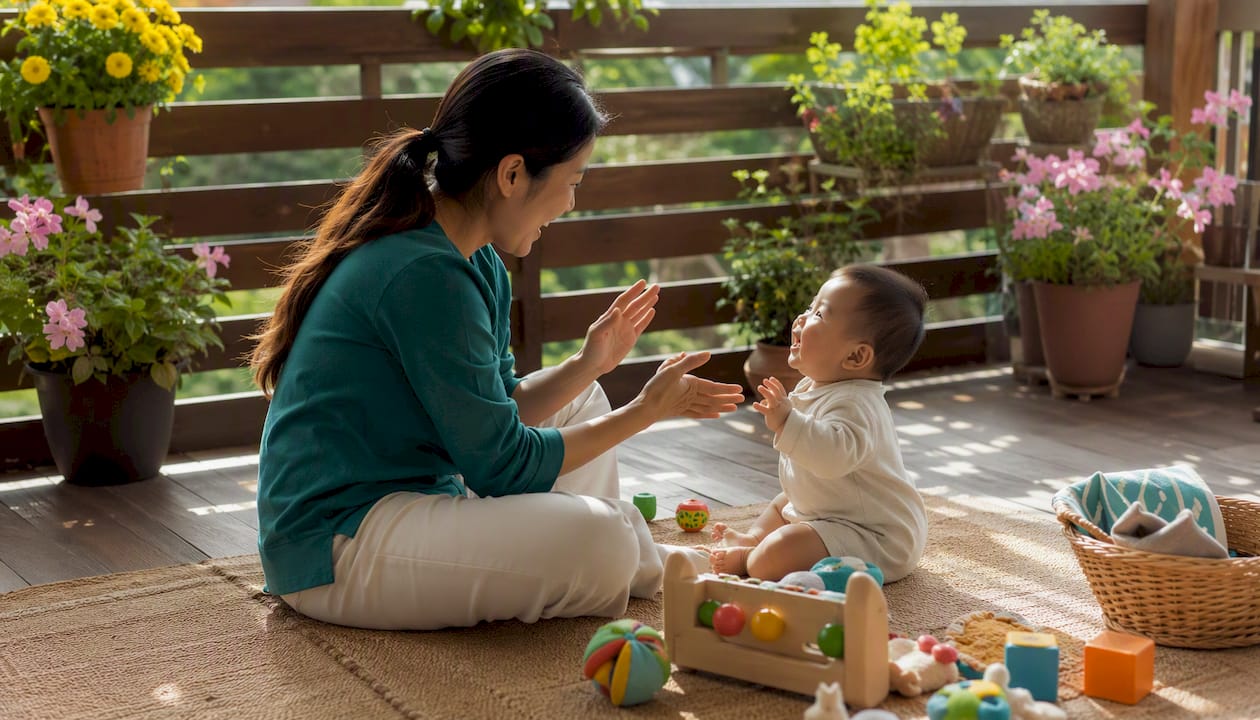
Routines give young children something they need deeply: the ability to predict what comes next. When a toddler knows that bath time follows dinner, or that a clean-up song means play is wrapping up, their brain can stop spending energy on “what’s happening?” and start spending it on learning, connecting, and growing. The Harvard Center on the Developing Child, Head Start, and Zero to Three all point to the same conclusion: consistent daily routines reduce anxiety, support emotional regulation, and scaffold early learning in ways that matter for years.
Three core roles stand out:
Predictability and security. When children know what comes next, they feel safe. That sense of safety is the foundation for curiosity and exploration.
Self-regulation and learning. Repeated sequences teach children to manage transitions, wait their turn, and follow multi-step directions — skills that transfer directly into classroom success.
Sleep and physical health. Consistent bedtime and mealtime routines are linked to better sleep quality and healthier physical development over time.
One practical step you can take today: pick one high-frequency moment — mealtime, naptime, or clean-up — and make the first two steps identical every single day. That small commitment is where lasting routines begin.
Table of Contents
Why routines matter so much for young children’s development
Schedule versus routine: why both belong in your child’s day
Age-appropriate routine examples for infants, toddlers, and preschoolers
How educators and caregivers can partner with families on routines
What the research actually shows about routines and child outcomes
Why routines matter so much for young children’s development
Predictability does something specific in a young child’s brain: it lowers the ambient cognitive load of daily life. When a child does not have to wonder what comes next, that freed-up attention goes toward higher-level play, language, and problem-solving. The CDC notes that structure built on consistency, predictability, and follow-through helps children anticipate transitions and build genuine independence — not just compliance.
Three mechanisms explain how this works in practice.
Scaffolded brain architecture. Serve-and-return interactions embedded in routines — a caregiver narrating each step of hand-washing, responding to a baby’s coo during diapering — build neural connections through repetition. The same sequence, repeated hundreds of times, literally shapes the circuits that support attention and memory.
Emotion regulation and self-control. Routines act as external scaffolding for the self-regulation skills children are still developing internally. A child who has practiced the “shoes on, backpack, door” sequence enough times can move through it with less adult prompting and fewer meltdowns. Seattle Children’s highlights that this benefit is especially pronounced for children with ASD, ADHD, or anxiety, where unpredictability is a primary stressor.
Physical health effects. The connection between routines and physical well-being is more concrete than many parents expect. Research from the Harvard Center on the Developing Child links the absence of a consistent sleep routine at age three to measurably higher body fat eight years later — a finding that underscores how early habits echo into later childhood.
“Routines provide the two key ingredients necessary for learning: relationships and repetition. They help babies and toddlers learn self-control, reduce power struggles, and create opportunities for language and social skills.” — Zero to Three
The same mechanisms that work at home show up in the classroom. A preschooler who has a consistent morning arrival sequence at school — hang up bag, check the job chart, choose a center — arrives ready to engage rather than spending the first twenty minutes recalibrating. Structure is not a constraint on learning; it is the condition that makes learning possible.
Schedule versus routine: why both belong in your child’s day
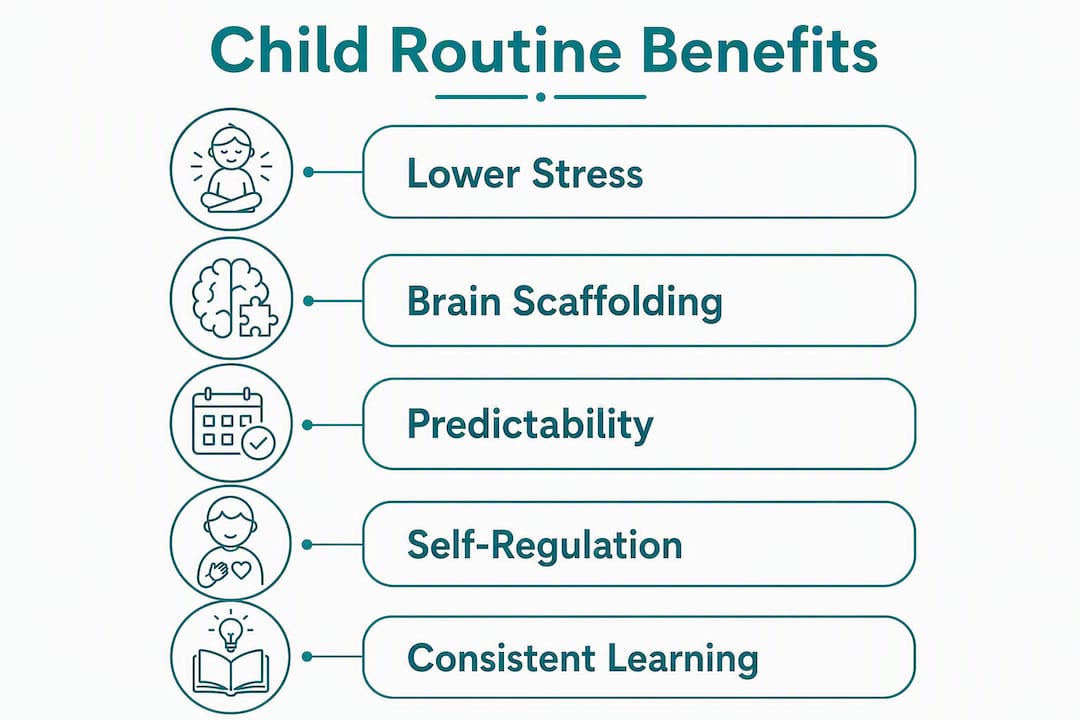
A schedule is the day’s big picture. A routine is the repeated set of steps used to move through one moment of that day. Both matter, and confusing them leads to plans that are either too vague to follow or too rigid to sustain.
PBS Parents puts it plainly: a daily schedule maps the main activities (snack time, outdoor play, rest); routines are the micro-sequences that make each activity work (wash hands → sit at table → snack → conversation).
Dimension | Daily schedule | Routine |
Purpose | Sets the day’s flow and sequence of activities | Teaches repeated steps for a specific moment |
Timing | Covers the whole day | Covers one recurring event (meals, bedtime, arrival) |
Example | snack time, outdoor play | Wash hands → sit → eat → clear plate |
Who manages it | Educator or caregiver plans it | Child gradually learns and owns the steps |
Flexibility | Can shift for field trips or special events | Core steps stay consistent; pace can vary |
Think of “snack time” as a schedule item. The routine is everything that happens to make snack time work: washing hands, choosing a seat, waiting for everyone to be ready, eating, and clearing up. The schedule tells the child when; the routine teaches the child how. Together, they create a day that feels both predictable and purposeful.
Age-appropriate routine examples for infants, toddlers, and preschoolers
Routines should match where a child is developmentally, not just how old they are. The goal at every age is to make high-frequency moments feel familiar and safe, then layer in more steps as the child grows.
Infants (0–12 months)
Biological rhythms are the routine at this stage. Feeding, diapering, nap windows, and awake time form a natural sequence that caregivers can make intentional. During a diaper change, narrate each step: “Now we lift your legs, now we wipe, now we fasten.” That running commentary turns a maintenance task into a language-rich, relationship-building moment. Zero to Three describes these high-frequency maintenance routines as among the most powerful learning opportunities available — precisely because they happen so often.
A simple infant day might flow: wake and feed → awake play on the floor → nap → feed → diaper → short outing or sensory play → nap → feed → bath → bedtime feed → sleep.
Toddlers (12–36 months)
Toddlers are ready for routines with named steps and simple cues. A morning routine might look like: wake up → diaper or potty → wash hands and face → get dressed → breakfast → brush teeth → play. Each step can be signaled with a short phrase or gesture the child comes to recognize. Do children need a morning routine? — yes, and at this age the answer is especially clear: a predictable morning reduces the power struggles that derail the whole day.
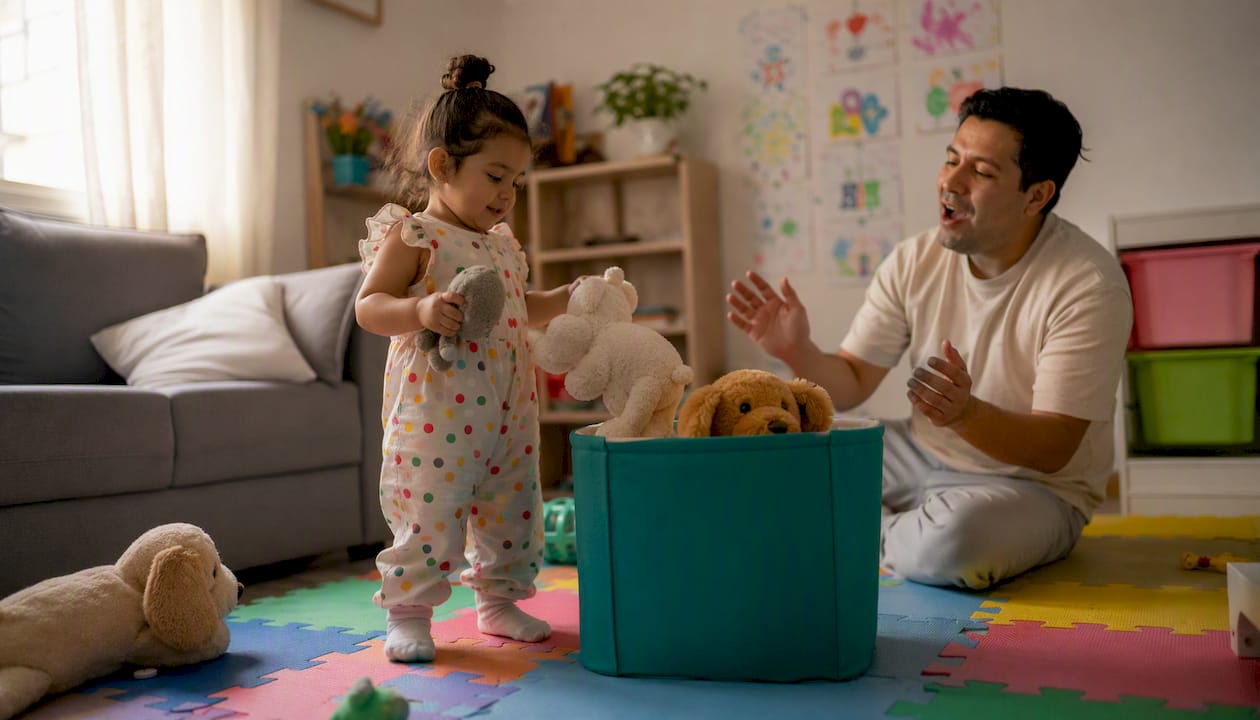
Clean-up time is a natural toddler routine. A clean-up song (the same one, every time) signals the transition, and “one toy in the bin, then another” gives the child a manageable sequence. Language and independence grow together when the steps are small and repeated.
Preschoolers (3–5 years)
Preschoolers can manage longer sequences and begin to take genuine ownership of their routines. Classroom routines for young learners at this age include arrival sequences, group-time rituals (greeting song → calendar → weather → read-aloud), transition cues, and simple classroom jobs.
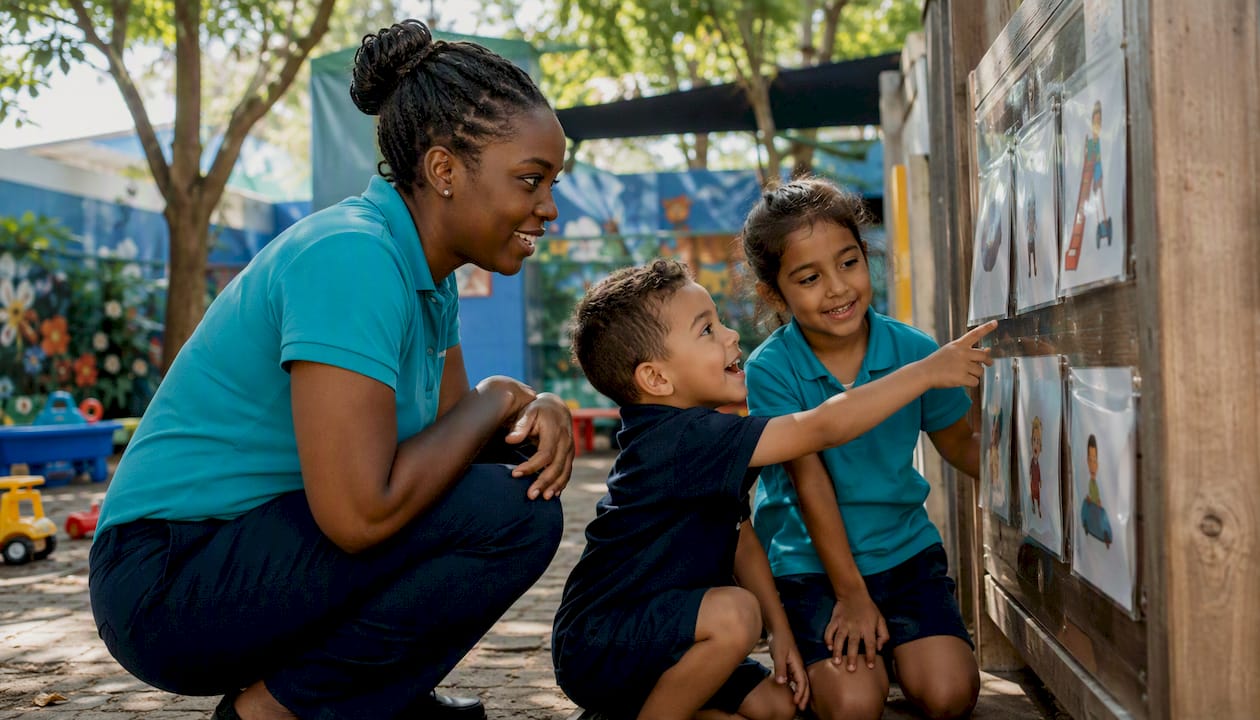
Visual cues become especially useful here: a picture chart showing the morning sequence, a sand timer for clean-up, or a transition song that always signals the same shift. Head Start guidance recommends combining visual, auditory, and physical cues so children can anticipate what comes next even before they can read a clock. A preschooler who knows the “five-minute warning” hand signal, hears the transition song, and sees the picture chart is receiving three simultaneous signals — and that redundancy is exactly what makes transitions smooth.
How to create routines that actually stick
The single most important principle: start with one moment, make the first two steps identical every time, and add consistency before you add complexity.
Step-by-step process:
Identify one high-frequency moment. Meals, bedtime, arrival, and clean-up happen every day — these are the best starting points because repetition builds the routine naturally.
Choose your cues. Pick a signal that will always mark the start: a specific song, a phrase (“time to wash up”), or a visual prompt. Multimodal cues (sound plus gesture plus image) work best for young children.
Model the steps out loud. Walk through the sequence with the child, narrating each step. “First we turn on the water, then we put soap on our hands, then we rub for ten seconds.”
Practice with scaffolding. Do the routine together for the first week or two. Prompt each step before the child needs to ask.
Fade adult support gradually. Move from doing it for the child to doing it with them to watching them do it independently. Celebrate each step they own.
Reinforce independence, not just compliance. Notice when the child initiates a step without prompting: “You remembered to hang up your bag — you did that all by yourself.”
Troubleshooting resistance: Tantrums and refusals during routines usually signal one of three things: the child is overtired, the routine has too many steps for their current developmental stage, or the cue is not clear enough. Simplify before you escalate. Reduce the sequence to two steps, re-establish the cue, and rebuild from there.
Pro Tip: Use the same song every single time for a specific transition — not just any song, but one reserved exclusively for that moment. Children as young as 18 months begin to associate the melody with the action, which means the song does the prompting for you.
How educators and caregivers can partner with families on routines
When a child’s home routine and program routine align, the child benefits from consistent expectations across two settings. That alignment does not happen automatically — it takes a short, intentional conversation between families and educators.
For educators sharing routines with families:
For families sharing what works at home:
A short alignment checklist helps both sides stay on the same page:
Timing of key moments (wake, meals, nap, bedtime)
Cues the child already recognizes (songs, phrases, gestures)
Steps the child can do independently versus steps needing support
Cultural or family practices that shape the routine (prayer before meals, specific foods, rest customs)
Cultural differences in routines are real and worth honoring. A family that prioritizes a shared midday meal, an extended rest period, or a specific bedtime ritual is not doing it wrong — they are doing it their way. The goal is to find the structure within those practices and make it predictable, not to replace family culture with a program template. Community storytime programs that pair predictable read-aloud routines with social-emotional skill-building offer one model for how cultural flexibility and structured routine can coexist naturally.
How to restart routines after disruptions
The fastest path back to a working routine after illness, a holiday, or a program closure is a short, intentional re-entry plan that ramps expectations over a few days rather than demanding an immediate return to normal.
Three-step re-entry plan:
Reintroduce high-safety moments first. Sleep and meals are the anchor points. Before worrying about the full daily schedule, re-establish consistent wake time, mealtimes, and bedtime. These biological rhythms stabilize mood and energy, which makes everything else easier.
Bring back predictable cues. Reintroduce the songs, phrases, and visual prompts the child knew before the disruption. Familiar cues signal “we’re back to normal” more effectively than any explanation.
Re-teach steps with extra adult support. Expect regression. A child who was managing the bedtime routine independently before a two-week holiday may need hand-holding through each step again. That is normal, not a setback — it is the routine re-learning itself.
Scripts for re-entry:
At home: “We’ve been on a big adventure, and now we’re getting back to our cozy home routine. Tonight we do bath, then book, then lights out — just like before.”
In the classroom: “Welcome back! We’re so glad you’re here. Let’s start with our morning routine — remember, first we hang up our bags, then we check the job chart.”
Sleep regression and separation anxiety are the two most common re-entry challenges. Both respond well to the same approach: more adult presence during the routine, not less. Sit with the child through the steps rather than stepping back too quickly, and reduce the number of steps if needed. Research consistently shows that children return to their pre-disruption baseline faster when caregivers stay calm, keep cues consistent, and resist the urge to abandon the routine entirely because it feels hard.
What the research actually shows about routines and child outcomes
The evidence base for routines in early childhood is substantial and growing. A 2024 systematic review identified 170 studies connecting routines to outcomes across five domains: cognitive development, self-regulation, social-emotional skills, academic achievement, and physical health. That breadth matters — it means routines are not a narrow intervention for one problem but a broad protective factor across a child’s development.
Key research signals:
Cognitive and language gains — Children in stable childcare settings with consistent routines show improvements in language, literacy, and cognitive skills compared with peers in less predictable placements, per Harvard Center on the Developing Child findings.
Research signal | Finding | Source |
Systematic review scope | 170 studies across 5 developmental domains | Selman et al., 2024 |
Sleep routine absence | Linked to higher body fat at age 11 | Harvard Center on the Developing Child |
Stable childcare placement | Associated with language and literacy gains | Harvard Center on the Developing Child |
Routines as protective factor | Positive outcomes in high-risk environments | Selman et al., 2024 |
For caregivers, the practical implication is clear: prioritize sleep and mealtime routines first (the health effects are most direct), then build classroom and transition routines that support self-regulation. Early childhood education that embeds intentional routines into every part of the day is not just good pedagogy — it is one of the most evidence-supported investments a program can make.
Key Takeaways
Consistent daily routines in early childhood reduce anxiety, scaffold self-regulation, and support cognitive, emotional, and physical development across all major developmental domains.
Point | Details |
Start with one moment | Pick one high-frequency event (meals, bedtime, clean-up) and make the first two steps identical every day. |
Use multimodal cues | Combine a song, a phrase, and a visual prompt so children can anticipate transitions before they understand clock time. |
Align home and program | Share timing, cues, and child preferences with educators or families to create consistent expectations across settings. |
Re-entry after disruption | Reintroduce sleep and meals first, then cues, then full steps — with extra adult support and no rush. |
Edu’s approach | Astor International School and its preschool embed intentional routines into small-class, inquiry-based learning for children aged 1.5–12. |
A practitioner’s perspective on what routines really do
The research is compelling, but the moment routines become real is when you watch a three-year-old walk into a classroom, hang up their bag without being asked, and head straight to the job chart. That child is not following a rule — they have internalized a sequence. It belongs to them.
What gets underestimated about routines is how much they give children back. The popular assumption is that structure limits freedom. The opposite is closer to the truth. When a toddler does not have to wonder what comes next, they are free to be curious, to take risks, to engage deeply with play. The predictable day is the condition for genuine exploration, not the enemy of it.
One small change that consistently produces visible results: introducing a clean-up song that is used exclusively for that transition. Within a week or two, children begin moving toward the bins when they hear the first notes — before any adult says a word. That is not magic. It is repetition doing its work, which is exactly what Zero to Three’s guidance on routines describes: relationships and repetition, working together.
The other thing worth saying plainly: routines are not rigid scripts. The best ones flex when a child is deeply engaged in something meaningful, when a family’s cultural practice shapes the sequence differently, or when a child is having a hard day and needs more support. A routine that serves the child is always more valuable than one that serves the schedule.
Authoritative sources and further reading
These are the primary sources behind this article. Each one is worth bookmarking if you are building or refining routines at home or in a program.
Harvard Center on the Developing Child — Stability and Routines: Research summary on how stability and consistent routines shape brain architecture and long-term health outcomes. Essential reading for the evidence base.
Head Start — The Importance of Schedules and Routines: Federal program guidance on how to structure the preschool day, including practical cue recommendations. Directly applicable to classroom planning.
Zero to Three — Creating Routines for Love and Learning: Practical, relationship-centered guidance on building routines with infants and toddlers. Particularly strong on maintenance routines as learning opportunities.
CDC — Structure, Rules, and Routines for Toddlers: Government guidance on the three ingredients of effective structure. Clear, accessible, and family-friendly.
Seattle Children’s — Kids Thrive on Structure and Routines: Clinical perspective on routines for children with ASD, ADHD, and anxiety. Useful for caregivers supporting neurodiverse children.
Selman et al., 2024 — Routines and Child Development: A Systematic Review: The most comprehensive recent review of the evidence, covering 170 studies across five developmental domains.
PBS Parents — The Power of Routines: Accessible, parent-friendly explanation of the schedule-versus-routine distinction with practical examples.
Astor Preschool Routine Guide — Ready-to-Copy Schedules: Printable templates and sample timelines caregivers can adapt immediately for home or classroom use.
Routines come to life at Astor International School
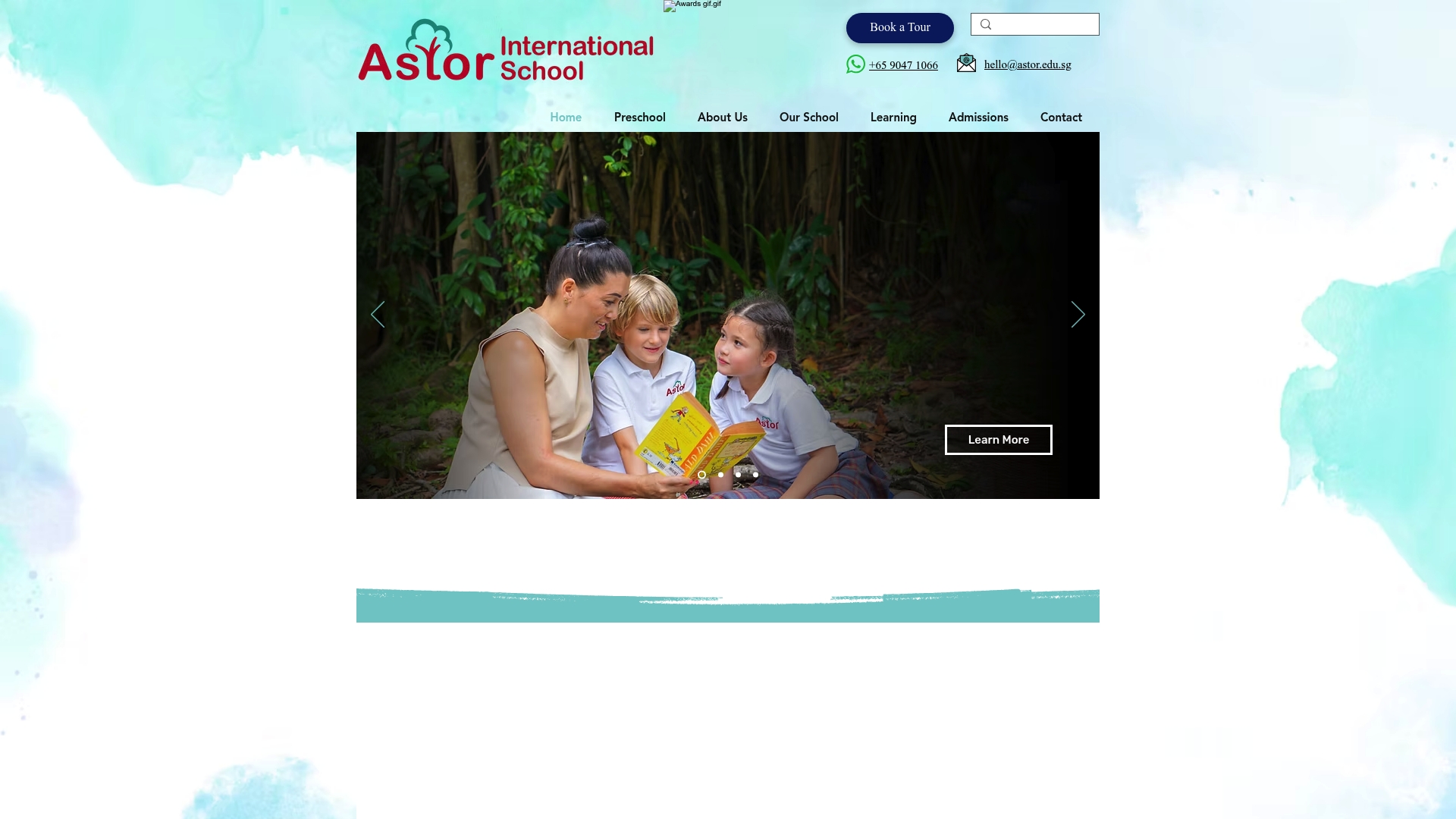
Small class sizes change what routines can do. At Astor International School in Singapore, every child aged 1.5 to 12 moves through a carefully designed daily structure where teachers know each child’s cues, temperament, and pace. That personal knowledge is what turns a routine from a schedule on paper into a genuinely nurturing experience. At the preschool in Holland Village, two playgrounds and a blend of outdoor and classroom learning mean that transitions between spaces are themselves intentional routines — not interruptions to learning, but part of it.
Astor has been recognized as both the best small school and the best affordable international school in Singapore, and that recognition reflects something specific: when class sizes stay small, educators can hold each child’s routine with real care. If you are looking for a program where your child’s day is predictable, purposeful, and genuinely personalized, explore Astor’s curriculum and learning approach or learn more about the International Primary Curriculum for children aged 5 to 12. Reach out to arrange a visit — seeing the routines in action is the best way to understand what they make possible.
Recommended
Comments