


Start in September to Beat Rolling Admissions in Singapore

Yes. Most international schools and many private schools in Singapore run on rolling admissions, reviewing files continuously rather than on a single deadline. Apply the moment your child’s file is complete, and call the admissions office directly to confirm current space, because places move on availability, not the calendar. Two quick checks matter early: the school’s own space page, and, for expatriate families, Dependants’ Pass eligibility timelines that affect when your child can actually start.
TL;DR:
Applying early in September for the upcoming academic year helps secure a spot before the strongest applicant pool fills popular grades months ahead.
Complete applications with all required documents, especially translated transcripts and visa paperwork, speed up decision times to as little as four weeks.
Schools with small class sizes or live online space availability listings can often provide immediate updates on current space in specific grades.
Priority lanes for early or sibling applicants can give a real advantage, so asking about seat availability early is highly recommended.
Waiting on application results is common, but timely follow-up and prompt acceptance or release of offers are crucial to securing the desired placement.
Table of Contents
How Rolling Admissions Work at Singapore Schools
Rolling admissions means a school reviews applications as they arrive and makes decisions on a continuous basis, rather than waiting to compare everyone against one cutoff date. Fixed-deadline admissions, by contrast, hold every file until a set date, then decide all at once. Singapore’s international and private school sector leans heavily toward the rolling model because class sizes are small and turnover happens year round as families relocate.
Space, not the calendar, is what actually closes a place. Singapore American School publishes grade-by-grade availability and uses a priority lane system that gives certain applicant groups (often siblings, or families already in the school community) first call on a seat before it opens more broadly. Once a grade level fills, later applicants typically move to a waiting list or the next intake, a pattern that also shows up at the tertiary level: NTU’s Master in Management program and SMU’s LLM admissions both state plainly that once a cohort reaches capacity, remaining applicants shift to the next round.
Decision speed varies more than most parents expect:
A complete file with all documents in order can get a decision in as little as four to eight weeks, based on typical rolling-admission decision windows.
Popular grade levels near capacity often take longer, since the school may hold your file to see how many current offers convert.
Missing documents, unpaid fees, or incomplete assessments are the most common reason a straightforward application drags into months instead of weeks.
Rolling admissions in a sentence: the school reviews continuously, priority lanes and space determine who gets in first, and a complete application almost always beats a “perfect” one submitted late.
When to Apply: The September Planning Window
Rolling admissions can lull parents into thinking there’s no urgency. There is. Popular year groups fill months ahead of the actual start date, which is why WhichSchoolAdvisor recommends parents begin planning as early as September for the following academic year, even though technically you could apply anytime. September gives you a full academic year’s runway to research schools, gather documents, and submit before the strongest applicant pool crowds a limited number of seats.
Here’s how the timeline typically breaks down by situation:
Relocating to Singapore now: Apply immediately once you have a passport, birth certificate, and any prior school records. Don’t wait for a confirmed Dependants’ Pass. Most schools will provisionally review your file while the pass is in process.
Planning for next academic year: Start in September, aim to submit a complete application by December or January, and treat any school-published deadline as the latest safe date, not the ideal one.
Mid-year transfer: Some schools, like the Swiss School in Singapore, publish set deadlines for certain grades but run ad hoc rolling admissions from March through July for others. Always check whether your target grade falls under a fixed window or the open rolling pool.
Pro Tip: Read a school’s admissions page for the phrase “applications considered until class is full.” That wording means the September head start genuinely matters. Schools using a hard cutoff date instead give you more breathing room, but far less flexibility if you’re relocating mid-year.
Managing Multiple Applications Without Losing Offers
Applying to several schools at once is smart. Managing them badly can cost you a seat you actually wanted.
Rank your shortlist honestly before you submit anything, weighing fit (curriculum, class size, learning approach), realistic availability, and daily commute. A school with an outstanding reputation but an hour’s drive each way rarely wins in practice.
Once applications are in, keep it simple:
Log submission dates, requested documents, and each school’s stated response window in one place.
Follow up politely every two to three weeks if you haven’t heard back, rather than daily.
Accept your top offer promptly and release any others in writing as soon as you decide, since another family may be waiting.
If you land on a waitlist, ask the school directly how many places usually open and by when, rather than guessing.
Waitlists at rolling-admission schools move more than fixed-deadline ones, since seats free up whenever a family departs rather than at one set point.
Preparing a Complete Application: Documents and Common Delays
A “complete” file is what actually moves fast in a rolling system. Have these ready before you submit:
Child’s passport and, for expatriate families, current or in-process Dependants’ Pass paperwork.
Birth certificate and immunization records.
Academic transcripts and reports from the previous school, translated into English if needed.
Application fee payment confirmation.
Assessment format depends on age. Preschool and early primary entries usually involve a short, informal observation session rather than a formal test, while older primary applicants may sit brief literacy and numeracy checks alongside a parent interview.
Pro Tip: Untranslated transcripts are the single biggest cause of delay in international applications. Get certified translations done before you submit, not after the school asks for them.

Confirm your family’s visa timeline against the Ministry of Manpower’s Dependants’ Pass eligibility guidance early, since a pending pass can hold up enrollment even after a school offers a seat.
After the Offer: Enrollment, Deposits, and Start Dates
An offer isn’t a finished placement. What happens next determines whether that seat actually holds.
Confirm within the deadline stated in your offer letter, usually by signing an acceptance form and paying a deposit, often within one to two weeks.
Ask before you pay: is the deposit refundable if your visa falls through, does it count toward first-term fees, and is there a probation period tied to assessment results?
Complete medical and immunization checks, which most schools require before the first day, not after.
Confirm your actual start date. Mid-year admissions often start the following Monday or the start of the next term, while new-academic-year admissions follow the school’s standard August or January intake.
How Edu Supports Families Through Rolling Admissions
Some international schools and preschools are built around small class sizes rather than large cohorts moving through fixed deadlines. That structure suits rolling admissions well: a handful of seats per grade means clear answers on availability, not vague waitlist language. Families working through relocation, Dependants’ Pass timing, or a mid-year transfer can ask Edu directly for a current space check and guidance on which documents to prioritize first.
Space Availability and Priority Lanes: What Schools Actually Publish
Not every school publicizes its space situation the same way, and reading these pages correctly saves weeks of guessing.
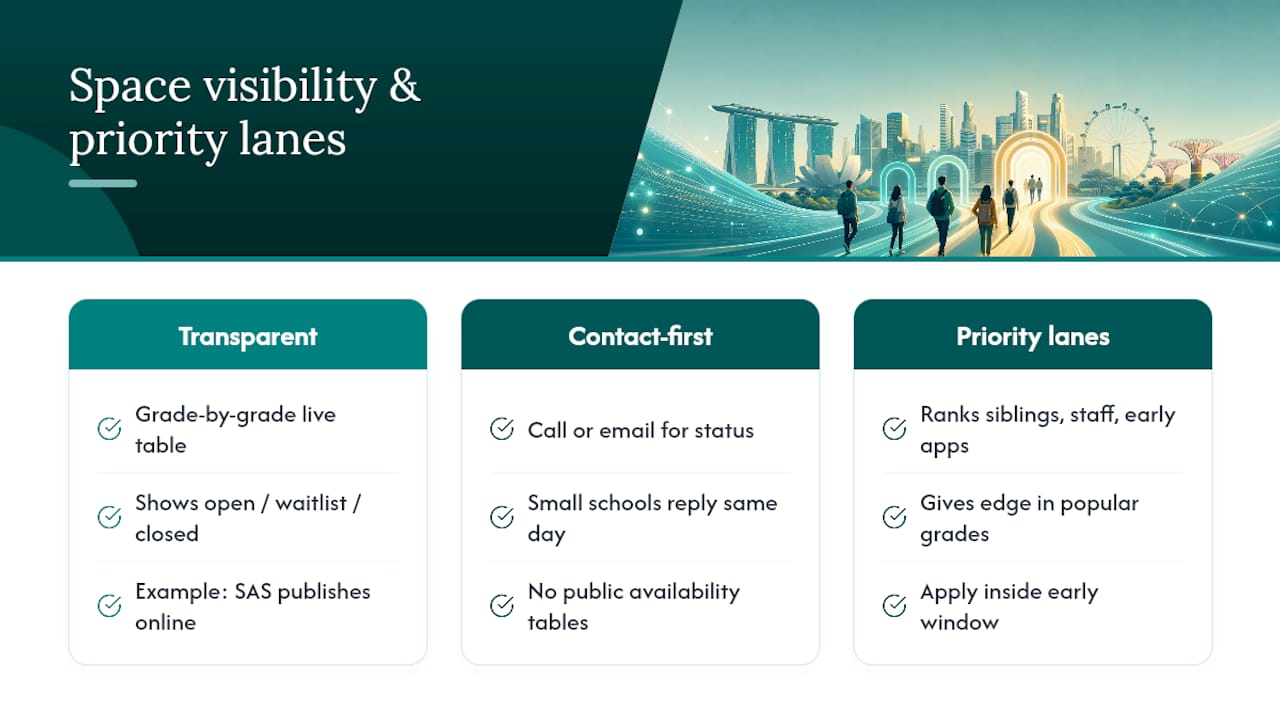
Some international schools, like SAS, publish live, grade-by-grade availability tables online so parents can see exactly which year groups are open, waitlisted, or closed before submitting a single document. That transparency is unusual. Many smaller schools instead ask families to call or email for a current status check, which is often faster than it sounds, since a small school with limited seats per grade can give a direct answer the same day.
Priority lanes are the other piece parents underestimate. A “lane” typically ranks certain applicant groups ahead of the general pool: existing siblings, staff children, or families who submitted during an early window a school opens before general admissions. This doesn’t mean the general pool has no chance. It means that if your target grade is genuinely popular, applying inside any early or priority window a school announces gives you a real edge over waiting for standard rolling review.
The practical takeaway: treat any school’s stated line “we accept applications until the class is full” as literal. NTU and SMU’s own rolling-admission wording makes clear that once a cohort fills, later applicants shift automatically to the next intake, and the same logic governs primary and preschool placements across the sector. There’s no penalty for asking a school outright, “How many seats are open in this grade right now?” That single question, asked early, tells you more than any published timeline ever will.
A Parent-First Perspective on Timing
Rolling admissions reward preparation more than urgency. Families who panic and submit incomplete files rarely move faster than those who spend a week gathering documents properly. This week, do three things: pull together your child’s passport, birth certificate, and school records; call your top three schools to ask about current space; and book an availability check rather than guessing from a webpage.
— Elena
Book an Availability Check With Astor
Astor is the direct, local alternative to piecing together admissions research on your own: small classes mean a real answer on space, not a generic waitlist reply, and one call to Astor’s admissions team tells you exactly where your child stands for the current or next intake. Families weighing curriculum fit alongside availability can review Astor’s IPC program before reaching out, then contact the school directly to check open seats for your child’s age group.
Whether you’re relocating this term or planning ahead for next year’s September window, the most useful next step is a direct conversation, not another search. Visit Astor’s Learning page to see current programs, then request an availability check to find out exactly which grades have space right now.
Where to Check Availability and Policy Right Now
MOM’s Dependants’ Pass eligibility page for visa timelines affecting start dates.
Always confirm exact figures directly on each school’s own admissions page before applying.
Sources
FAQ
When should you apply for rolling admission?
Apply as soon as your application file is complete, ideally starting your research in September for the following academic year, since popular grade levels can fill months ahead of the actual start date.
Can you skip a grade level in Singapore schools?
Grade placement decisions are made case by case based on age, prior academic records, and assessment results, so any request to place a child ahead of the standard age group needs to go through the school’s admissions team directly rather than being assumed as standard practice.
How long does it take to get a decision after applying?
A complete application often gets a decision within four to eight weeks, though popular grade levels near capacity can take longer while the school confirms how many current offers convert into enrollments.
What documents do schools typically ask for first?
Expect to provide a passport, birth certificate, immunization records, and translated transcripts from the previous school, since missing or untranslated documents are the most common cause of delay.
Does a small class size affect how quickly I get an answer on space?
Yes. Schools with fewer seats per grade, like Astor’s small-class model, can often confirm current availability in a single call, compared with larger schools that manage space through longer waitlist queues.
Recommended
Comments