


Stop Preschool Separation Anxiety: Singapore Parents' Teacher Scripts
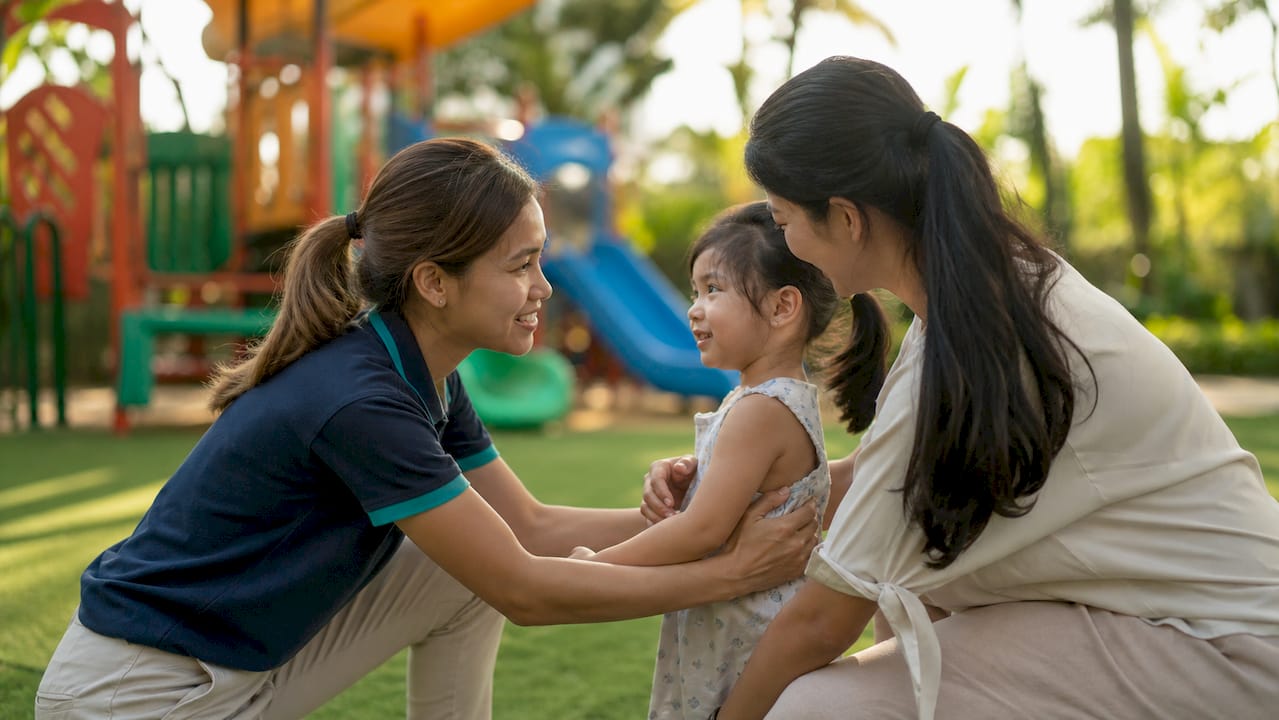
Preschool drop-off anxiety is normal and, in most cases, settles with a short, consistent goodbye and teacher partnership within a couple of weeks. Most children need about 1 to 3 weeks to find their footing, and many stop crying within minutes of a parent leaving the room. Tonight’s plan is simple: keep tomorrow’s goodbye brief, warm, and predictable, and let the teacher know it’s happening.
TL;DR:
Most preschool separation anxiety peaks between ages 2 and 4 and usually resolves within one to three weeks with consistent routines.
Short, predictable goodbyes combined with teacher partnerships and transitional objects significantly shorten distress and build trust.
Avoid lingering, renegotiating, or sneaking away, as these actions tend to reinforce anxiety and prolong the problem.
Red flags such as distress lasting beyond three weeks or physical symptoms should prompt consultation with a pediatrician or mental health professional.
Small class sizes and phased entry schedules, like those at Astor, allow for quicker diagnosis and support during the initial adjustment period.
Table of Contents
What Preschool Separation Anxiety Looks Like, and Why It Happens
If your child sobs at the classroom door, wraps both arms around your leg, or suddenly can’t manage the routine they had down last month, you’re watching separation anxiety preschool style, not a behavior problem. It’s one of the most predictable stages of early childhood, and it tends to cluster around specific ages and triggers.
Watch for these common signs:
Crying or wailing that starts as you approach the classroom, not before
Clinging to a leg, bag strap, or piece of clothing
Tantrums that seem out of proportion to the moment
Temporary regression, like forgetting how to zip a jacket or asking for a bottle again
Physical complaints, such as a stomachache, that fade once you’re gone
Separation anxiety commonly peaks between ages 2 and 4, which lines up almost exactly with the preschool years. New classes, a substitute teacher, a bout of illness, or even a disrupted bedtime routine can reignite it in a child who seemed fine the week before. None of this means something is wrong with your parenting or your child’s temperament. Tears at drop-off usually mean your child has formed a strong, secure bond with you, and that bond is exactly what makes goodbyes hard.
Practical Strategies to Use at Drop-Off This Week
Once you understand what’s driving the tears, the fix is almost entirely about consistency. Children read your calm (or your hesitation) faster than they read your words, so the goal is to make every goodbye feel boring in the best possible way.
Build a short, confident goodbye ritual. Say the same phrase every day, like “I’ll be back after snack time,” give a hug, and leave within 30 to 60 seconds. Lingering rarely helps.
Practice separations before the real one. Leave your child with a grandparent or babysitter for short stretches, or role-play “going to school” at home with a stuffed animal standing in for your child.
Introduce a transitional object. A small photo, a family bracelet, or a soft toy from home can anchor your child during the first stretch of the morning.
Never renegotiate or sneak out. If your child asks for “five more minutes,” decline warmly but firmly. If you slip away while they’re distracted, you save yourself a scene but you also erode the trust that makes tomorrow’s goodbye easier.
Have an exit plan if things escalate. Stay calm, hand your child to the teacher with a quick reassurance, and leave. Call or check in after drop-off rather than staying to manage the meltdown yourself.
This isn’t just intuition. Practitioner guidance consistently points to short, predictable goodbyes and teacher handoffs as the most effective way to shorten how long a child struggles.
Pro Tip: Pick one goodbye phrase and use it every single day, even on the hard mornings. The repetition, not the wording, is what tells your child’s nervous system that this moment is safe and predictable.
Goodbye Rituals and Classroom Warm-Ups You Can Copy Today
A ritual only works if it’s specific enough to repeat without thinking. Try pairing a phrase with a physical cue, such as “two high-fives, one hug, see you after snack,” and keep that combination identical every single day.
Teachers can help just as much on their end. A few warm-up moves that work well in the classroom:
Handing the child a simple “job,” like passing out napkins at the snack table
Guiding them to the sensory table, which tends to draw attention away from the doorway fast
A small-group greeting circle where a familiar peer says hello by name
For transitional objects, keep it small and low-stakes: a photo strip tucked into a cubby, a bracelet matching mom’s, or a tiny toy that stays in the backpack rather than the child’s hands during class. Introduce it at home first so it’s already a comfort object before the first tough morning arrives. Building a classroom routine around these small anchors makes the whole morning easier to predict.
Partnering With Teachers to Speed Up the Adjustment
You and the teacher are solving the same problem from two ends of the hallway, so a little coordination goes a long way. A good handoff sounds like this: the teacher greets your child by name, offers brief reassurance (“I’m so glad you’re here”), and immediately invites them into a simple task.
A few things worth asking for directly:
A one-line “settled” text or note 10 to 15 minutes after drop-off, so you’re not guessing all morning
A quick heads-up about anything unusual at home, like a rough night’s sleep or a new sibling, so the teacher can adjust their approach
Agreement on the same phrases and timing you use at home, since a consistent routine between school and home settles a child’s nervous system faster than either environment alone
Quick check-ins after drop-off measurably ease parental worry too, which matters, because a calmer parent tends to produce a calmer goodbye the next morning.
When Separation Anxiety Needs More Than Routine
Most tears fade within a few weeks. Pay closer attention if your child’s distress lasts far longer than that, or shows up in ways that go beyond a rough morning.
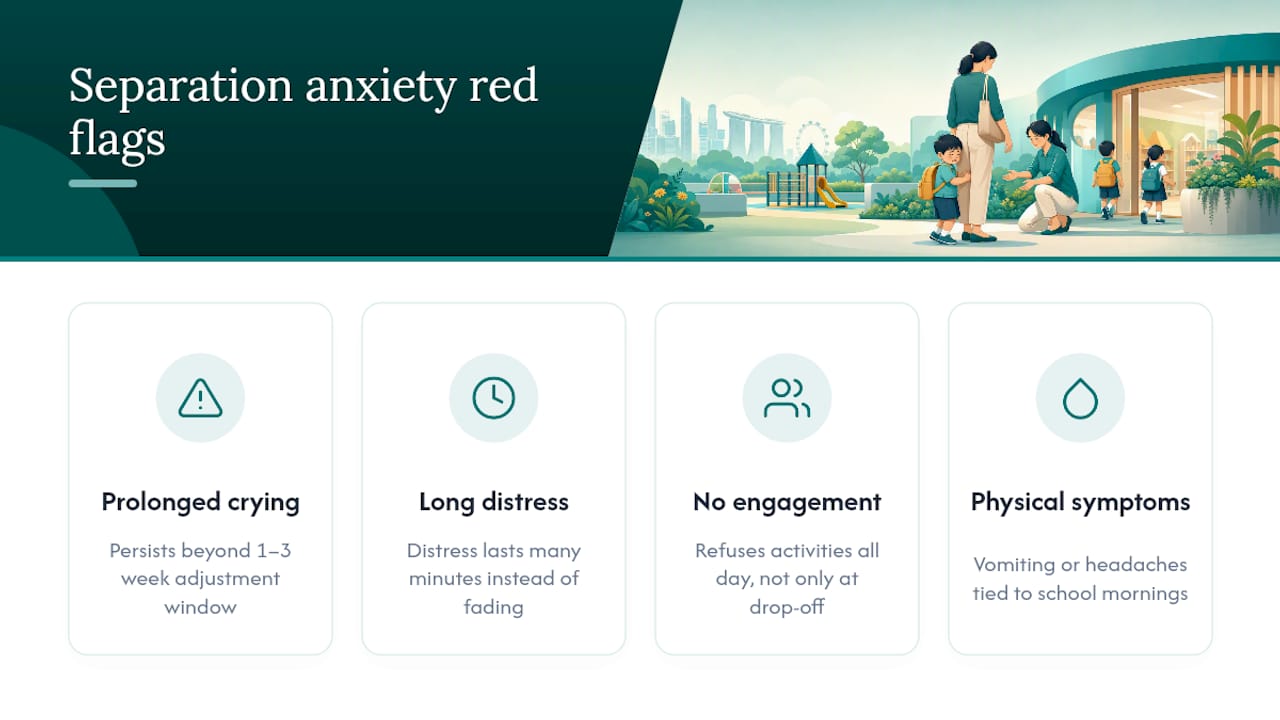
Watch for these red flags: crying that continues well past the 1 to 3 week adjustment window, distress that drags on for many minutes rather than fading quickly, refusal to engage with activities all day rather than just at drop-off, or physical symptoms like vomiting or headaches tied specifically to school mornings.
Start by comparing notes with the teacher; ask directly how your child is doing by midmorning, not just at the door. If the pattern holds, bring specific examples to your pediatrician or a child mental health professional. Clinical resources on anxiety disorders in children can help you understand when normal adjustment has tipped into something that benefits from extra support.
How Astor Approaches the First Weeks
Small class sizes at Astor mean teachers notice a struggling child within minutes, not days, and can respond with a scripted handoff and a real “settle” alert to parents rather than a vague reassurance. Phased entry schedules, where a child attends shorter days at first, let kids build stamina gradually instead of facing a full day cold. It’s a small-scale, closely watched version of exactly the strategies covered above.

Separation Anxiety’s Ripple Effect on Development
A child stuck in daily distress at drop-off isn’t just having a hard morning. Preschool is where children first practice sharing, taking turns, and reading social cues outside the family, and a child who spends the first hour of class dysregulated has less bandwidth left for any of that.
The good news: this window closes fast when the anxiety itself is handled well. A child who settles within minutes and gets pulled into a “job” or small group is, for practical purposes, back to full participation for the rest of the day. Consistent handling protects the very peer relationships and classroom confidence that separation anxiety threatens.
Emotionally, working through separation anxiety is a rehearsal for handling discomfort in general. A child who learns that goodbyes are hard but survivable, and that comfort returns predictably, is practicing a skill they’ll use for every transition afterward, from a new grade to a first sleepover. Left unmanaged, though, chronic drop-off distress can start to color how a child feels about school itself, turning a temporary adjustment into a longer-running association between the building and dread.
The difference almost always comes down to whether the adults around the child respond with calm consistency or with wavering, drawn-out goodbyes. Kids pick up on hesitation far more than they pick up on words.
What Happens Long-Term if Separation Anxiety Goes Unaddressed
Left alone, most preschool separation anxiety resolves on its own within a few weeks as a child’s brain builds trust in the routine. Left unaddressed in the specific sense of being reinforced rather than simply present, it can settle into a harder pattern.
The biggest risk factor is avoidance. Letting a child skip preschool on hard mornings, or repeatedly returning after a goodbye because the crying got worse, teaches a lesson opposite to the one you want: that distress is the tool that gets a parent to come back. Clinical guidance on school avoidance is consistent on this point. Consistency, not comfort in the moment, is what builds resilience.
Children whose separation anxiety gets reinforced this way sometimes carry a heightened sensitivity to transitions into kindergarten and beyond, showing similar clinginess at the start of each new school year or activity. That’s not a fixed outcome, and plenty of kids who struggled hard at 3 sail through kindergarten drop-off without a hitch. But the pattern is far more likely to persist if goodbyes stay unpredictable than if they stay short and steady.
The upside is that the fix is genuinely simple, even if it isn’t always easy in the moment. A parent who can tolerate a tearful thirty seconds today is doing more for their child’s long-term comfort with change than one who avoids that thirty seconds by staying, negotiating, or pulling their child from school on hard days.
Myths About Preschool Separation Anxiety, Debunked
A lot of well-meaning advice around drop-off anxiety is wrong, or at least incomplete. A few of the most common myths deserve a closer look.
“If my child cries, something is wrong with the preschool.” Not usually true. Separation anxiety is driven far more by a child’s developmental stage and attachment style than by classroom quality, and it shows up at excellent preschools just as often as anywhere else.
“Staying longer at drop-off helps my child feel more secure.” This tends to backfire. Lingering signals to a child that the goodbye is negotiable, which usually stretches out the crying rather than shortening it.
“Crying means my child isn’t ready for preschool.” Tears at the door and disengagement all morning are two very different things. Many children who cry hard at 8:00 AM are laughing at the sensory table by 8:10.
“A calm goodbye means my child doesn’t love me.” The opposite is closer to true. A child who separates easily has simply built enough trust in the routine to believe you’re coming back, which is itself a sign of a secure bond.
“This is a phase I just have to survive.” Passive waiting is the slowest path through it. Active steps like a fixed goodbye ritual and a teacher partnership shrink the adjustment window; they don’t just make it easier to endure.
A Note on the Hard Mornings
Watching your child cry at drop-off is genuinely hard, even when you know it’s normal and temporary. What actually moves the needle is boring consistency: the same short goodbye, the same calm tone, the same follow-through, day after day. If a pattern feels stuck, loop in your child’s teacher early. That partnership is often the fastest way through it.
— Elena
Finding the Right Fit for Your Child’s First Weeks
If you’re choosing where your child will spend those first anxious mornings, the setting matters as much as the strategy. Astor’s small class sizes mean a teacher notices a struggling child in real time, and phased entry schedules let kids build up to a full day instead of diving in cold. That kind of close attention is hard to replicate in a larger classroom, no matter how good the goodbye ritual is.
Astor’s IPC curriculum is built around exactly this kind of inquiry-based, hands-on learning that gives anxious preschoolers something engaging to step into once the goodbye is done. It’s one option among several for families weighing where their child will settle best, not a requirement. If you’d like to see how a small, closely supervised classroom handles the first weeks in person, explore the full curriculum and arrange a visit to see phased entry in action.
Sources
Recommended
Comments