


Small School Benefits Guide: What Parents Should Know
Small schools and small class sizes consistently produce better outcomes across academic performance, social development, and mental health. The research is clear: when children are truly seen by their teachers, they learn more, connect more deeply, and grow with greater confidence. This small school benefits guide covers everything parents and educators need to know, from classroom-level research to long-term career outcomes.
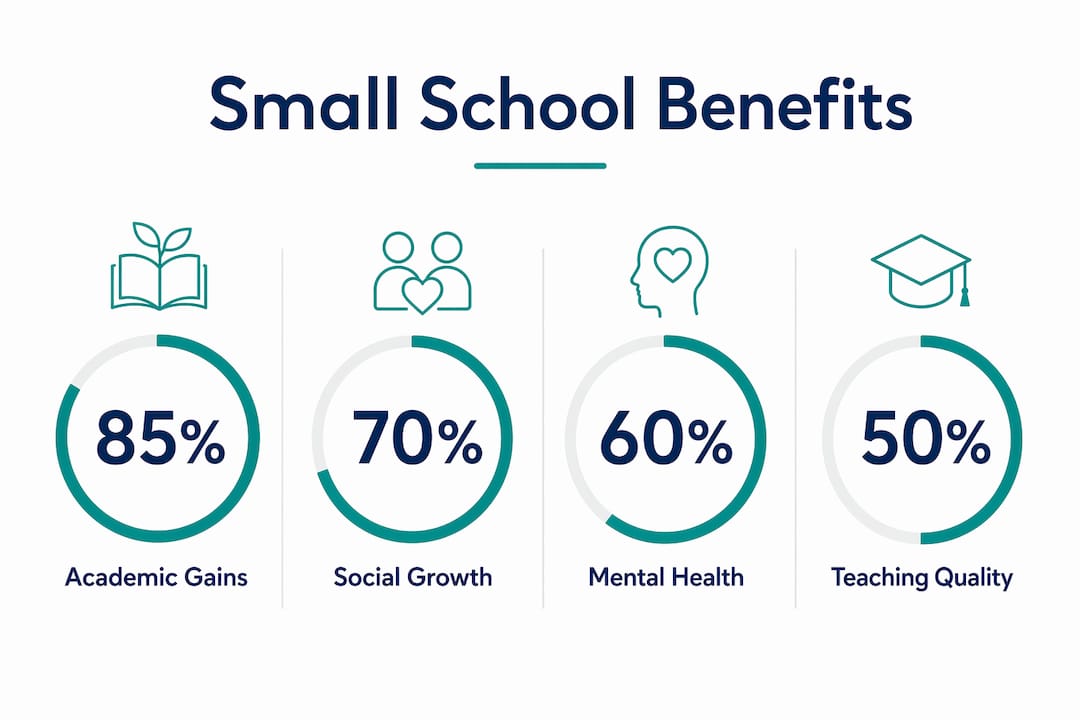
Here is what the evidence shows small schools do well:
Academic achievement: Personalized instruction and more teacher time lift student performance, especially in early grades
Social belonging: Smaller communities build genuine relationships across age groups and with adults
Mental health: Fewer incidents of bullying and stronger adult connections create emotionally safe environments
Engagement and behavior: Students participate more actively and teachers spend less time managing disruption
Extracurricular access: Higher participation rates mean more children find their strengths outside the classroom
What does the research say about academic benefits?
The academic case for smaller schools and class sizes is grounded in decades of credible research. The landmark Tennessee STAR study found that students in classes averaging 15 students outperformed peers in classes of 22 by the equivalent of about 3 months of additional schooling after four years. Those gains were largest for Black students, economically disadvantaged children, and boys.
Meaningful improvement typically requires a reduction of 7–10 students per class, and the effect is strongest in the earliest grades. The Washington State Institute for Public Policy found that reducing class size by one student in first grade produces $1,218 in long-term benefits per student, including gains in lifetime earnings, reduced criminality, and lower healthcare costs.
Metric | Small class / school | Larger class / school |
Academic gains (STAR study) | +3 months of learning after 4 years | Baseline |
Long-term benefit per student (grade 1) | $1,218 | Lower or negligible |
Class size reduction needed for impact | 7–10 fewer students | No threshold effect |
Disadvantaged student benefit | Largest gains | Smaller gains |
Key finding: A first-grade class size reduction carries a 94% probability of producing long-term benefits that exceed costs.
Research also shows that smaller schools promote equity. Students from disadvantaged backgrounds benefit most, and smaller schools are particularly valuable in communities where larger institutions tend to leave children behind.
How do small schools support social and emotional growth?
Small schools create the conditions for genuine community. When a child knows every teacher in the building and every teacher knows them, the school stops feeling like an institution and starts feeling like a place they belong. Cross-generational relationships in small schools give children rich, natural environments for developing social skills that no formal curriculum can fully replicate.
Student behavior also improves in smaller settings. Teachers report greater tolerance for typical classroom misbehavior because they understand each child’s context, and students respond to that understanding with more cooperative attitudes. Parent involvement tends to be higher too, since the culture of a small school is easier to enter and contribute to.
Key social-emotional benefits include:
Stronger sense of belonging and mutual respect across the school community
More consistent adult relationships that support emotional security
Improved student engagement and reduced disciplinary incidents
Greater parent participation in school life and decision-making
Richer peer relationships that span age groups rather than staying within a single grade
Pro Tip: If you are visiting a school to assess its community culture, ask how teachers communicate with families and how often. In a genuinely small school, that answer will be specific, frequent, and personal.
Why small schools are better for children’s mental health
Schools with fewer than 300 students have significantly fewer violent incidents and stronger emotional connections between students and adults. That combination matters enormously for children’s psychological safety. When a child feels known and protected, they are far more willing to take the academic and social risks that real learning requires.

Small class sizes also allow teachers to notice early warning signs of emotional distress. A teacher managing 15 students can observe changes in mood, energy, and engagement that would go undetected in a class of 30. That early visibility enables faster, more targeted support before small struggles become serious problems.
Smaller environments also build resilience. Children who feel securely connected to their school community tend to recover more quickly from setbacks, both academic and personal. The adult relationships available in a small school act as a consistent anchor during difficult periods.
How small schools enable better teaching every day
Teachers in small classes spend much less time managing behavior and more time on direct instruction. That shift in how a teacher’s day is spent has a direct effect on how much children actually learn. Less disruption means deeper lessons, more questions answered, and more individual feedback given.
Small schools also tend to have leaner administrative structures and shared decision-making, which gives teachers greater agency over their classrooms and curriculum. That autonomy correlates with higher job satisfaction and lower turnover, meaning children benefit from experienced, committed educators year after year.
Teaching and operational strengths in small schools include:
More instructional time per student per day
Greater teacher familiarity with each child’s learning style and pace
Higher extracurricular participation rates, with more students finding leadership roles
Faculty-driven school culture that reflects shared values rather than top-down mandates
Faster, more personalized responses to academic difficulty
Explore how teachers shape learning in small classroom settings for a closer look at these daily practices.
What leading researchers conclude about small schools
The scholarly consensus is nuanced but encouraging. Small class sizes mediate academic benefits through non-cognitive factors including improved engagement, stronger belonging, and better teacher morale, not just through more instructional minutes. That means the benefits are partly about how children feel in school, not only what they are taught.
Linda Darling-Hammond’s work at the Learning Policy Institute makes clear that small school size is necessary but not sufficient on its own. Schools must pair smaller size with equitable instruction and rigorous academics to achieve full effectiveness.
Study / Source | Key finding |
Tennessee STAR | Small classes produce gains equal to 3 months of extra schooling |
Brookings Institution | 7–10 student reductions needed for meaningful academic impact |
Washington State Institute for Public Policy | Early-grade reductions yield $1,218 in long-term benefits per student |
— | Schools under 300 students have fewer violent incidents |
Learning Policy Institute | Size must be paired with equitable instruction for full effect |
Small schools more effectively create a culture of belonging and mutual respect, which is vital to democratic citizenship and lifelong learning habits.
The challenges small schools face, including limited course offerings and tighter budgets, are real. The most effective response is intentional design: strong advisory programs, cross-disciplinary teaching, and community partnerships that expand what a small school can offer without sacrificing its relational core.
Do students from small schools succeed long-term?
The long-term outcomes for students from small schools are consistently positive. STAR study follow-up research found that students who attended small classes in early grades had higher rates of college attendance. The economic returns of those early investments, measured in lifetime earnings and reduced social costs, exceeded the program’s costs.
Beyond college attendance, students from small schools tend to develop stronger non-cognitive skills: self-regulation, persistence, and the ability to work within a community. These qualities translate directly into career readiness. Employers consistently cite communication, collaboration, and initiative as the skills most lacking in new graduates, and small school environments build all three through daily practice rather than formal instruction.
How do small schools compare to other educational models?
Small schools sit in a distinct position relative to large public schools, charter schools, and other models. Large public schools often offer more course variety and specialized programs, but research suggests those advantages are offset by weaker relationships, lower engagement, and higher rates of behavioral incidents for many students.
Charter schools vary widely. Some operate with small enrollment and achieve outcomes similar to well-designed small schools. Others are large by design and share the relational limitations of big institutions. The key variable is not the school’s legal structure but its size and the intentionality of its community design.
For families considering small international schools, the relational and academic benefits described throughout this guide apply directly. The added dimension of a multicultural community in a small setting can deepen social-emotional learning further, as children navigate genuine diversity within a safe, close-knit environment.
Edu: a small school built around every child
Astor International School, part of the Edu network in Singapore, is the kind of school this guide describes. Awarded best small school and best affordable international school in Singapore, Astor serves children aged 5–12 with intentionally small classes and a curriculum designed around personal attention and curiosity.
Every child at Astor is genuinely known by their teachers. The school’s IPC curriculum pairs academic rigor with cross-disciplinary inquiry, and the small campus in Tanglin creates the close community that research consistently links to better outcomes. For families who want the evidence-based advantages of small school learning without compromise, Astor is a clear next step. Visit astor.edu.sg to book a tour and see the environment for yourself.
Key Takeaways
Small schools and small class sizes deliver measurable academic, social, emotional, and mental health benefits, with the strongest gains concentrated in early grades and among disadvantaged students.
Point | Details |
Early-grade class size matters most | A first-grade reduction yields $1,218 in long-term benefits per student, with a 94% probability of exceeding costs. |
Non-cognitive gains drive outcomes | Engagement, belonging, and teacher morale mediate academic improvement alongside direct instruction time. |
Mental health and safety improve | Schools under 300 students report significantly fewer violent incidents and stronger adult-student connections. |
Size alone is not enough | Small schools must pair enrollment limits with equitable instruction and rigorous academics for full effect. |
Edu puts this into practice | Astor International School offers award-winning small school education for children aged 5–12 in Singapore. |
Recommended
Comments