


Parents: Save Weeks on International School Transfers in Singapore

Yes, transfers between international schools in Singapore happen regularly, and most schools accept new students outside the usual August start if a seat is open and the curriculum fits. Your first move should be simple: call the receiving school’s admissions office and get your child’s most recent school report and transcript ready to send over. Everything else, from placement testing to fees, follows once that conversation starts.
TL;DR:
Most international schools in Singapore accept mid-year transfers if a seat is available and the child’s curriculum aligns with school requirements.
Completing all required documentation early, especially the School Transfer Certificate and academic records, significantly speeds up the enrollment process.
Curriculum differences, such as transitioning from exam-heavy IGCSE to inquiry-based programs, may require additional placement assessments and cause delays.
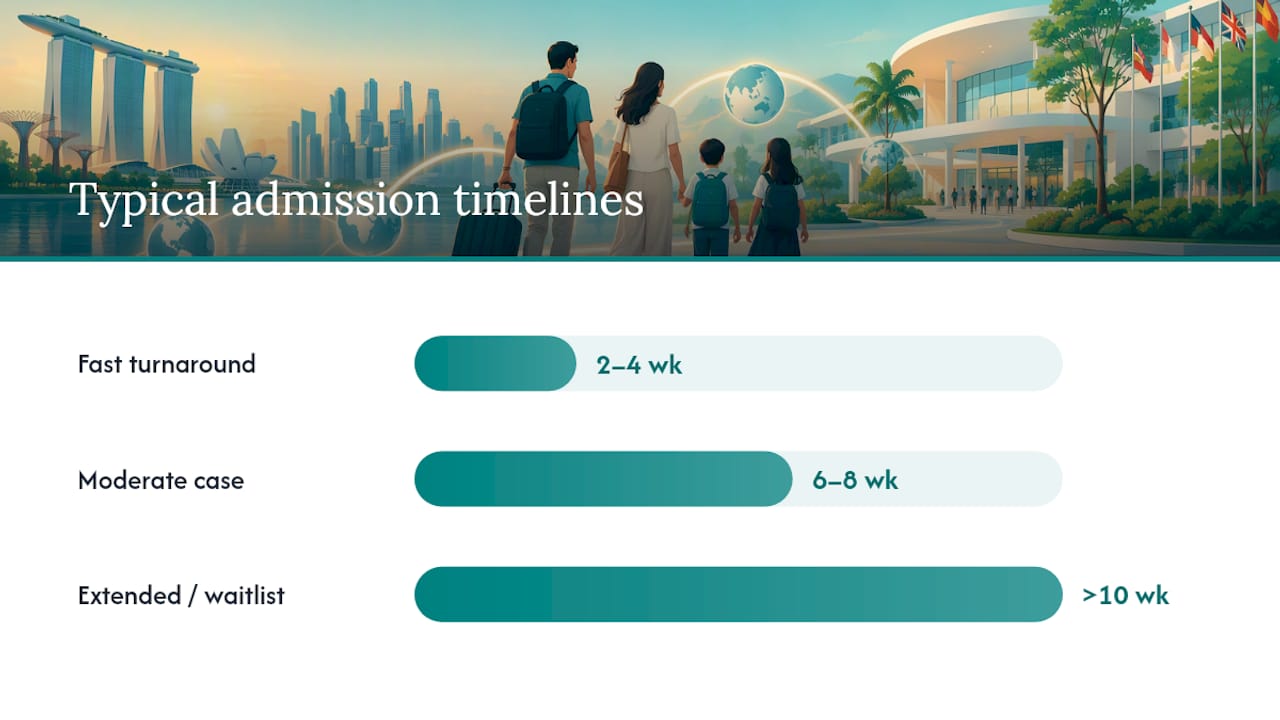
The typical transfer timeline ranges from two to four weeks for quick processes to over ten weeks if additional testing or waitlists are involved.
Prioritizing curriculum fit and support services over fees and start dates ensures a smoother transition and better long-term educational outcomes.
Table of Contents
How Does the Mid-Year Transfer Admissions Process Work?
Every international school runs its own admissions process, but the sequence rarely changes. What shifts is how fast each step moves, and that depends almost entirely on the season, the grade level, and how organized your paperwork is when you show up.
Here’s the sequence most families go through, from first enquiry to first day:
Enquiry. You contact the admissions office, share your child’s age, current curriculum, and desired start date.
Registration. The school sends a registration form and a document checklist specific to your child’s grade.
Document submission. You send report cards, identification, and any medical or special-needs documentation.
Placement and assessment. Most schools run a short academic assessment, sometimes paired with a teacher interview, to confirm the right grade level.
Offer and contract. If there’s a vacancy and the placement fits, the school issues an offer letter and enrollment contract.
Fee payment. You settle the admission fee, deposit, and first term’s tuition to confirm the seat.
Start date confirmation. The school sets an orientation or first day, often timed to a term break.
Timelines vary more than most parents expect. If a seat is open and paperwork is complete, some schools can turn around an enrollment in two to four weeks. A moderate case, where a placement test or a subject-gap review is needed, typically runs six to eight weeks. Anything involving a waitlist, a specialized grade level, or extra documentation review can stretch past ten weeks.
Rolling admissions are the norm at most international schools here, meaning you are not stuck waiting for a single annual intake date. That said, certain schools coordinate mid-year cohorts around specific windows. Astor’s guidance on mid-year intake points to April and May as common entry points for families relocating mid-school-year, since it lines up with many international relocations and gives new students a full term to settle before the next school break. Ask the receiving school directly whether it groups mid-year entrants this way. It changes how you plan the weeks before the move.
What Documents and Approvals Do You Need for a School Transfer?
Paperwork determines your timeline more than almost anything else. A complete file submitted on day one can shave weeks off the process; a missing document can stall it entirely.
Schools commonly ask for:
A completed registration form specific to the receiving school
Your child’s most recent report card and, where possible, the last two terms of academic records
Passport or identification for the child and at least one parent
Proof of residential address in Singapore
Immunization records and any relevant medical information
A School Transfer Certificate (STC), if your child is leaving a school that issues one
The School Transfer Certificate confirms a student has formally withdrawn from their previous school and is in good standing to enroll elsewhere. Not every international school issues one, since STCs are more closely tied to schools that follow national or MOE-linked registration frameworks. If your outgoing school does issue one, request it as soon as you know you’re leaving. It’s often the single document that holds up a placement decision if it arrives late.
Most transfers between private international schools don’t require direct MOE approval, since these schools set their own admissions criteria. That said, the Ministry of Education Singapore remains the authoritative source on national schooling policy, and it’s worth checking MOE’s guidance directly if your child’s visa is tied to school enrollment or if you’re moving between an MOE-registered school and a private international one. Local guides on the transfer process consistently point to the same lesson: complete documentation submitted early is the single biggest factor in a fast placement decision.
Pro Tip: Ask your outgoing school for digitized copies of report cards and transcripts before your last day. Chasing paperwork after you’ve left is far harder than requesting it while you’re still enrolled.
Will My Child’s Curriculum Transfer Smoothly to a New School?
Curriculum mismatch causes more transfer headaches than almost any administrative delay. Singapore’s international school scene runs on several different frameworks, and they don’t always line up neatly.
The IB Primary Years Programme emphasizes inquiry-based, cross-disciplinary learning with less emphasis on standardized testing at the primary level. IGCSE pathways, used more at the secondary level, follow a more subject-siloed, exam-driven structure building toward specific qualifications. Then there are national curricula, including the UK National Curriculum and various home-country programs, each with their own pacing and benchmarks. A child moving from an exam-heavy IGCSE-track school into an inquiry-based IPC classroom can feel a real shift, not just in subject content but in how they’re expected to think and demonstrate learning.
Receiving schools typically determine grade placement using a combination of the child’s age, their prior syllabus, a placement assessment, and direct teacher evaluation. Age is the starting point, but a strong or weak academic history can shift a child up or down a grade band, particularly in math and literacy.
When gaps show up, most schools address them through:
Short-term catch-up classes focused on the specific subject where the gap is widest
Enrichment programs that reinforce core skills without pulling a child out of their peer group
Subject mapping, where teachers chart what the child has already covered against the new curriculum to flag genuine gaps versus simple differences in sequencing
If your child is on a long-term academic path toward specific secondary exams, ask the receiving school how their curriculum connects to that pathway. Comparing curriculum pathways carefully before you commit saves you from discovering a mismatch two years down the line.
What Are the Practical Steps and Fees for Enrolling?
Once you’ve chosen a school, the administrative work is straightforward if you approach it in order.
Gather report cards and present them clearly. Attach a brief cover note explaining your child’s academic standing, any language considerations, and the reason for the move. Admissions staff read dozens of files a week; a clear summary helps yours stand out.
Confirm the fee sequence before you commit. Most schools require an admission fee at enrollment, followed by a deposit or first term’s tuition to secure the seat. Uniform and materials fees typically follow separately. Confirm exact figures with the specific school, since they vary widely between institutions.
Prepare your child for the assessment. Placement assessments usually cover reading, math, and sometimes a short writing sample, paired with an informal conversation to gauge comfort level and language ability. There’s no need to over-prepare. A calm, well-rested child performs better than one who’s been drilled the night before.
Pro Tip: If your child is anxious about the assessment, ask the school if you can visit the campus beforehand. Familiarity with the space takes the edge off the actual test day.
What Support Should Your Child Get After Arriving?
The first term after a transfer is where most of the real adjustment happens, academically and socially. A good receiving school builds this into its onboarding, not as an afterthought.
Look for these supports as standard, not optional extras:
A short bridging or orientation period to help your child learn routines, staff names, and classroom expectations
ESL or English-language support if your child is transitioning into an English-medium classroom
Small-group or one-on-one academic support for subjects where a gap was identified during placement
A clear reporting cadence, so you know how often you’ll hear from teachers and in what format
At enrollment, ask directly how often you’ll get progress updates and whether there’s a structured way to flag concerns early. Practical transition strategies matter here too, since a child’s social adjustment often predicts academic adjustment. If your child is still struggling after the first six to eight weeks, ask the school about setting up an individualized support plan rather than waiting for a term report to confirm what you already suspect.
How Do You Choose the Right Receiving School?
Choosing well under time pressure means knowing which criteria actually matter and which are just noise.
Prioritize these factors, roughly in order:
Curriculum fit for your child’s academic history and long-term pathway
Support services, particularly ESL and pastoral care, if your child needs either
Class size, since smaller classes generally mean more individual attention during a sensitive adjustment period
Logistics, including commute time and school calendar alignment with your family’s schedule
Cost structure, including whether fees are fixed or flexible across the year
Long-term pathway, meaning where this curriculum leads for secondary school and beyond
When you speak with admissions or a prospective teacher, ask these questions directly:
How exactly will my child’s grade placement be decided, and can I see the assessment criteria?
What does the catch-up plan look like if gaps are found, and how long does it typically run?
How often will I receive academic and pastoral updates in the first term?
Watch for red flags. A school that can’t clearly explain its placement process, offers no ESL support despite marketing itself to international families, or gives vague or shifting fee terms is worth a second look before you commit. Curriculum alignment and clear support structures consistently top the list of priorities that experienced parents and local guides recommend weighing most heavily.
A Small-School View on Mid-Year Transfers
Astor’s classroom model runs on small class sizes and an inquiry-based IPC curriculum, which gives teachers room to spot and address subject gaps quickly rather than losing a transferring student in a large cohort. Families arriving mid-year also have access to ESL support, enrichment options, and flexible fee arrangements built around real transition needs. This piece draws on Elena’s work covering curriculum comparison and school transition planning for families across Singapore.
What This Article Gets Right (and What Most Advice Misses)
Most transfer guides treat documentation and curriculum as separate problems. They aren’t. A late School Transfer Certificate delays enrollment, and a rushed enrollment skips the curriculum-mapping conversation that prevents your child from sitting in the wrong grade for six months. Handle both together, in the same phone call with admissions, or you’ll solve one problem while creating another.
The conventional advice, gather your documents, then find a school, has it backwards. Start the curriculum conversation first. A school that can’t explain how it will place your child, or brushes past subject gaps, will cause more disruption than any paperwork delay ever could. Fees and start dates are negotiable in ways that academic fit rarely is once your child is three months into the wrong classroom.
If you take one thing from this, prioritize the placement conversation over the timeline. A slower transfer into the right curriculum beats a fast one into the wrong classroom, every time.
— Elena
Ready to Talk to Astor About a Mid-Year Placement?
If you’re weighing a transfer right now, Astor’s small class sizes, capped at 20 students and averaging 15, mean a new student gets noticed immediately rather than lost in a large intake. That’s the real difference for a mid-year joiner: a teacher who can actually track where your child’s prior curriculum left off and where the gaps are, from week one.
Before you reach out, have a few things ready: your child’s full name and date of birth, their most recent school report, and a preferred start date. From there, the Astor fees page breaks down both fee options, Option A FLEXI FEES at $17,580 SGD per year and Option B FIXED FEES at $23,650 SGD per year, along with the $1,950 SGD one-off admission fee and other costs like materials and field trips. You can also browse the IPC curriculum to see how the inquiry-based approach maps against your child’s current syllabus. When you’re ready, request a meeting or an assessment slot directly with the admissions team to get a placement conversation started this week.
Sources
FAQ
How Do I Transfer My Child to Another School in Singapore?
Start by contacting the receiving school’s admissions office with your child’s age, grade, and current curriculum. Gather recent report cards and identification early, since complete documentation is the biggest factor in how fast the placement moves.
Is It Possible to Transfer From One International School to Another Mid-Year?
Yes, most international schools in Singapore accept mid-year transfers when a seat is available and the placement fits. Some schools, including Astor, structure mid-year intakes around specific windows like April or May to give new students a full term to adjust.
Can Singaporean Families Send Their Children to International School?
Yes, both expat and local Singaporean families can enroll children in private international schools, since these schools set their own admissions criteria independent of the national school system. Fee structures and eligibility details vary by school, so confirm specifics directly with the admissions office.
What Is the Best Reason to Transfer Schools?
The strongest reasons are curriculum mismatch, a need for more individual academic support, or a family relocation that makes the current school impractical. Local guides consistently point to curriculum fit and support services as the factors that matter most when deciding whether a transfer is worth the disruption.
What Does It Cost to Enroll at Astor Mid-Year?
Astor offers two fee structures: Option A FLEXI FEES at the publisher’s published price per year and Option B FIXED FEES at the publisher’s published price per year, plus a one-off admission fee as listed by the publisher. Full fee details, including materials and field trip costs, are listed on the Astor fees page.
Recommended
Comments