


Book in 1–2 Weeks: Singapore Preschool Trial, Verify Standards (Astor)

The fastest way to book a trial class preschool in Singapore is through the centre’s online booking form, a WhatsApp message, or a direct phone call, usually confirmed within a day or two. A trial lets you watch your child interact with a real teacher, follow the daily routine, and handle the moment of separation from you, which tells you more than any brochure. Astor International Preschool offers this kind of firsthand look, and booking one costs you little more than an afternoon.
TL;DR:
Most preschool trial classes in Singapore cost between free promotional sessions and paid options, with fees typically valid for a few weeks.
Booking a trial one to two weeks in advance ensures better availability, especially during peak enrollment periods in January and mid-year.
During the trial, observe teacher responsiveness, transition smoothness, safety practices, and how staff handle separation anxiety for accurate assessment.
Ask staff about teacher qualifications, such as DECCE-T or ECDA certification, and verify if the centre follows local curriculum frameworks like Nurturing Early Learners.
One strong trial session can be sufficient if the child’s routine seems steady and the environment feels warm, but a second visit is recommended if your child shows signs of distress or unfamiliarity.
Table of Contents
Why Trial Classes Matter and the Formats You’ll Meet in Singapore
A trial class and an open house answer different questions. An open house shows you the building, the curriculum posters, and a polished tour. A trial class puts your child in the room, doing the actual activities, with the actual teacher, on an actual day. That distinction is why parents comparing preschool programs in Singapore usually attend both.
You’ll come across a handful of common formats when researching early childhood education Singapore options:
Single paid session: one class, usually one to two hours, priced individually.
Two-session passes: a small pack that lets you see the same teacher twice, useful for spotting consistency.
Complimentary or discounted sessions: often tied to a new centre opening or promotional calendar.
Week-long trials: a fuller adaptation window, sometimes offered when a centre is building enrollment.
Open houses: informational, not hands-on, but a good first filter before booking a real trial.
For toddlers between 1.5 and 3 years, look for activities that echo the Early Years Development Framework/curriculum-frameworks/early-years-development-framework), which sets age-appropriate goals for infant and toddler care. For children closer to four, activities should connect loosely to the Nurturing Early Learners Framework, Singapore’s national guide for holistic preschool learning.
Booking Steps, Typical Costs, and Scheduling Tips
Booking a preschool trial class in Singapore follows a fairly predictable path, whether you’re calling a small neighborhood centre or an international campus.
Find the booking channel. Most centres list a trial booking form on their website, alongside a WhatsApp number for faster replies. Some still prefer a phone call, especially smaller preschools.
Provide basic details. Expect to share your child’s date of birth, any allergies or medical notes, and your preferred trial date and time.
Confirm the price and what it covers. Trial pricing varies. Some centres charge per single session with stated fees and validity terms you should read closely before paying, while others run free promotional windows you can find through enrichment trial calendars aimed at toddlers and preschoolers.
Ask about validity and rescheduling. A trial pass might be valid for two weeks or a month. Confirm whether a missed session can be rebooked without a new fee.
Pick a representative time slot. Morning sessions tend to show a fuller routine, including snack time and outdoor play, rather than a wind-down period near pickup.
Pack for a normal school day. A change of clothes, a water bottle, and a comfort item if your child uses one will help the visit feel less like a special event and more like a real day.
Book about one to two weeks ahead for popular time slots, especially around the January and mid-year intake periods when Singapore childcare trial requests spike.
What to Watch For During the Trial and Questions to Ask
A trial class is your chance to observe, not just sit and smile politely. Bring a notebook or your phone’s notes app, because the details blur fast once you’re comparing three or four centres.
Watch for these signs while you’re in the room:
Teacher responsiveness. Does the teacher notice when a child is upset or disengaged, and respond within a minute or two?
Smooth transitions. Moving from playtime to snack to circle time should feel practiced, not chaotic.
Genuine engagement. Are children choosing activities, or being herded through a checklist?
Safety habits. Are outlets covered, are ratios maintained during outdoor play, is there a clear sign-in and sign-out process?
Separation support. How does staff handle a crying child at drop-off? Distraction, comfort, or ignoring the moment tells you a lot.
Once the session ends, ask staff a few direct questions: What certification do the lead teachers hold, and are they registered with ECDA? What’s the average class size and the teacher-to-child ratio? What does a typical week look like, and how are fees structured, including notice periods for withdrawal? If your child has additional needs, ask specifically how the centre supports them day to day.
If the first visit leaves you unsure, ask for a second session before deciding. This is especially worth doing for toddlers who show separation anxiety. A single 90-minute trial rarely captures how a child settles once the novelty wears off, and educators generally agree that a longer look, spread across a few visits, paints a more honest picture.
Pro Tip: Score each centre the same way. After every trial, jot down three numbers: how quickly the teacher responded to a child in distress, how many transition hiccups you counted, and roughly what percentage of the session was child-led versus teacher-led. Comparing notebooks side by side beats comparing memories.
Local Standards Worth Checking On the Spot
Singapore’s early childhood sector runs on two curriculum frameworks and one certification standard, and knowing them turns a vague “good vibe” into something you can actually verify.
For preschoolers aged four to six, the Nurturing Early Learners Framework guides curriculum design around holistic development rather than rote academics. For children under three, the Early Years Development Framework sets the developmental benchmarks centres are expected to build activities around. If a trial session for your toddler looks suspiciously like a formal lesson, that’s worth a question.
On staffing, ask whether lead teachers hold the Diploma in Early Childhood Care & Education, Teaching (DECCE-T), which qualifies educators for children from 18 months to six years and feeds into ECDA’s L1/L2 certification system.
A trial visit is where credentials stop being a website claim and start being a conversation. Asking “Which staff hold DECCE-T or L1/L2 certification?” during the trial, not after enrollment, is the single most useful question a parent can ask.
Astor lists small class sizes, a mix of outdoor and classroom learning across two playgrounds, and industry recognition as part of its credentials, which is worth weighing alongside whatever you observe firsthand. Verifying trust signals on the spot comes down to one habit: ask the specific question, then watch whether the answer matches what you’re seeing in the room.
When One Trial Is Enough, and When It Isn’t
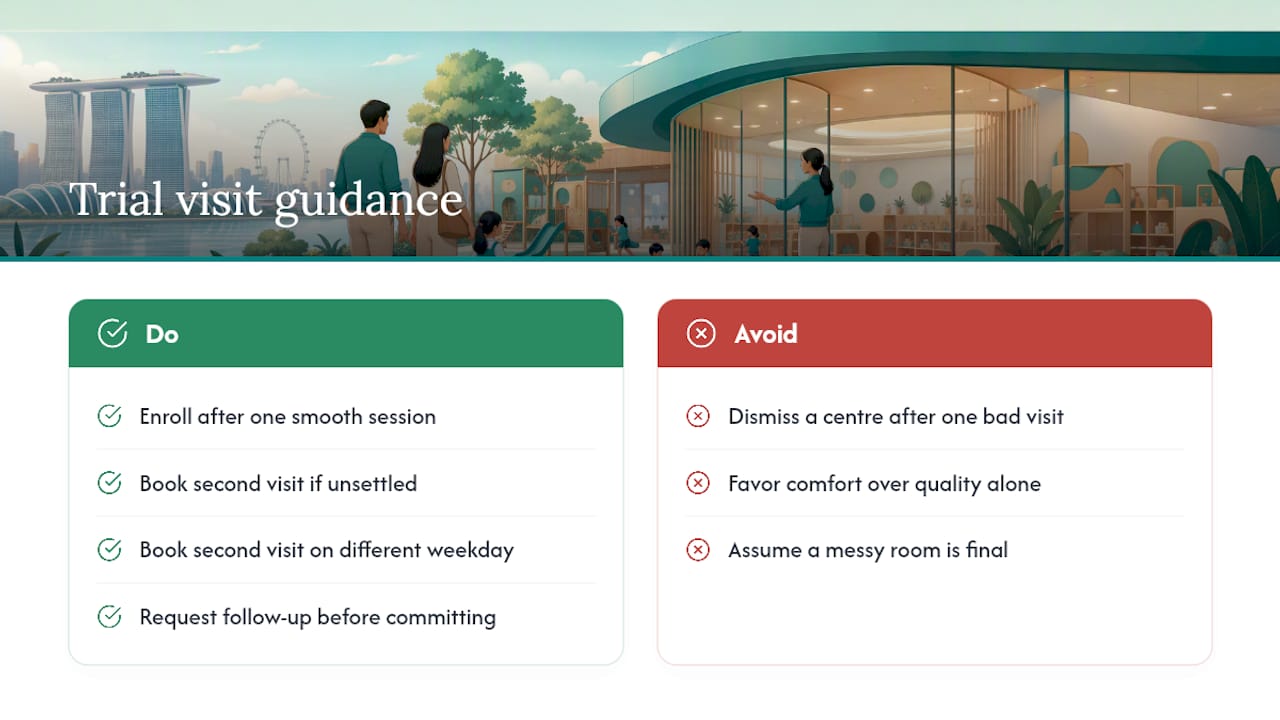
One good session tells you a lot, but not everything. If your child settles quickly, the teacher responds warmly, and the routine looks steady, that’s usually enough signal to move toward enrollment. If your child cried through drop-off or the room felt disorganized, don’t treat that as final. Book a second visit, ideally a different day of the week, before ruling a centre out.
Weigh comfort and quality together, not one against the other. A brilliant curriculum means little if your child dreads walking in, and a happy child in a loosely run classroom isn’t the win it looks like either. Once you’ve attended trials at two or three centres, request a short follow-up meeting with your top choice to talk through enrollment timing before you commit.
— Elena
Book a Trial at Astor International Preschool
Astor International Preschool gives you a real answer to the “will my child settle here” question, not a guess based on a glossy tour. Classes are kept to a moderate size to help ensure quality interaction, and the day mixes classroom learning with outdoor play across two playgrounds at the Holland campus.
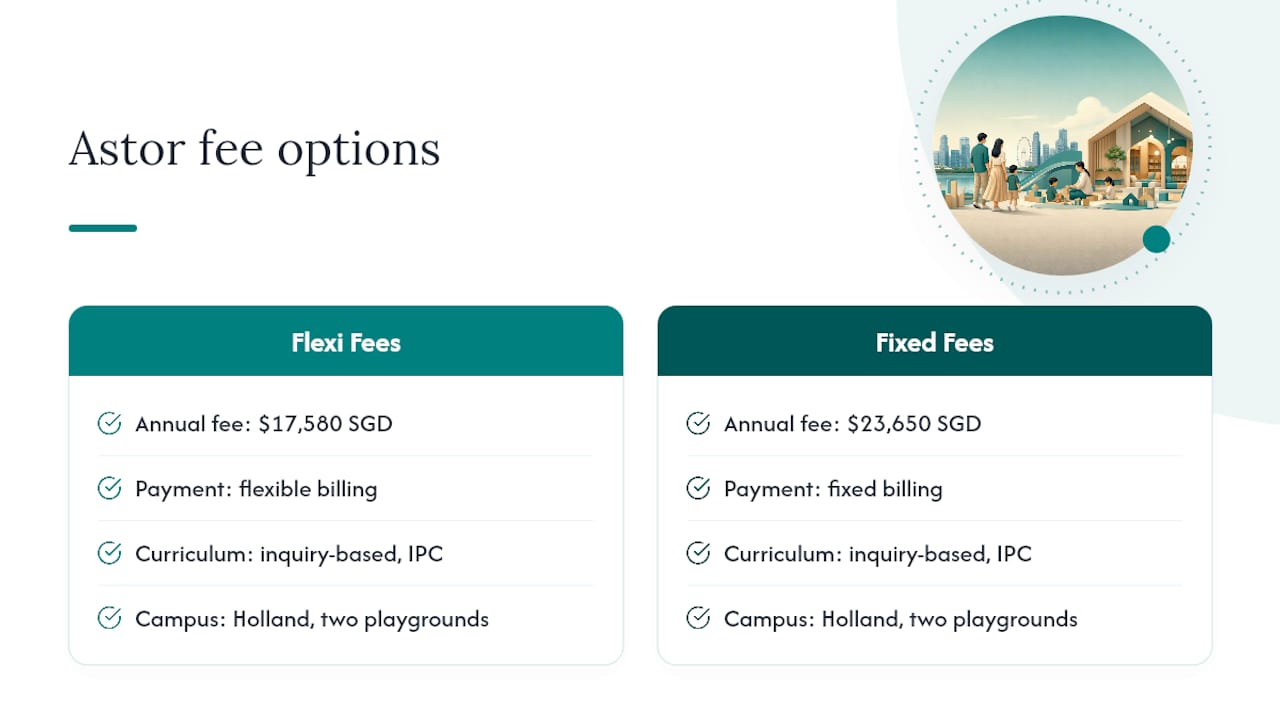
The curriculum follows an inquiry-based approach connected to the broader IPC framework used across Astor’s programs, and fee structures are flexible. Families can choose between Option A, FLEXI FEES, at $17,580 SGD per year, or Option B, FIXED FEES, at $23,650 SGD per year, depending on what suits your household budget. Astor states it has been recognized as a leading small and affordable international school in Singapore, a distinction worth factoring in alongside what you see during your visit.
If you’re weighing a preschool open house Singapore visit against an actual hands-on trial, book the trial. Reach out through Astor’s fees and enrollment page to check current availability and get a session scheduled around your child’s routine.
Where to Verify These Standards Yourself
For curriculum expectations, check the Ministry of Education’s Nurturing Early Learners Framework and ECDA’s Early Years Development Framework. For educator training, NIEC’s DECCE-T program page explains certification requirements. For a closer look at how one local centre applies inquiry-based learning, Astor’s curriculum overview is a useful next stop, alongside its practical guide on choosing a preschool.
Sources
FAQ
How Do I Book a Free Trial Class at a Preschool in Singapore?
Most centres let you book through an online form, WhatsApp, or a phone call, and confirmation usually comes within a day or two. Some run genuinely complimentary sessions during promotional periods, which you can often find through enrichment trial calendars that track discounted and free options for toddlers.
How Much Does a Preschool Trial Class Cost in Singapore?
Costs vary widely depending on the centre and format, ranging from free promotional sessions to paid single visits with stated pricing and validity terms. Astor’s own enrollment fees run separately from any trial, with Option A at $17,580 SGD per year or Option B at $23,650 SGD per year.
How Far in Advance Should I Book a Trial Class?
Booking one to two weeks ahead is usually enough to secure a good time slot, especially for morning sessions. Demand tends to rise around the January and mid-year intake windows, so booking earlier gives you more flexibility on scheduling.
How Do I Check a Preschool Teacher’s Qualifications?
Ask directly whether lead teachers hold the DECCE-T diploma or ECDA’s L1/L2 certification, which confirms formal training for children aged 18 months to six years. A center comfortable answering this question in detail is generally one worth trusting further.
What Should I Bring to a Preschool Trial Class?
Pack a change of clothes, a water bottle, and any comfort item your child usually carries, since these small details help the visit feel like a normal school day. Bringing a notebook for yourself also helps you compare observations across multiple centres later.
Recommended
Comments