


Age-Appropriate Learning: A Guide for Parents & Teachers

Age-appropriate learning means matching what you ask a child to do with what their developing brain, body, and social skills can genuinely handle at that stage of life. The NAEYC defines this through its Developmentally Appropriate Practice (DAP) framework, which applies from birth through age 8 and uses knowledge of typical child development to guide activity choices. The simplest first step you can take right now: watch your child for ten minutes during free play and note what they choose, how long they stay with it, and whether they seem curious or frustrated. That observation tells you more than any checklist.
DAP rests on three considerations that work together:
Age-based commonality: what most children at a given age can typically do
Individual fit: each child’s unique strengths, interests, and pace
Cultural and family context: the routines, language, and values that shape how a child learns
No single factor is enough on its own. A four-year-old who speaks two languages at home, for instance, may hit literacy milestones on a different timeline than a monolingual peer without that meaning anything is wrong. Holding all three lenses at once is what separates genuinely responsive teaching from one-size-fits-all instruction.
Table of Contents
What activities fit each age group, from infants to early school-age?
How does “age-appropriate” differ from developmentally appropriate practice?
How can you choose and adapt activities that genuinely fit each child?
When does a mismatch signal something more than a bad activity choice?
Small classes, big impact: how Astor puts these principles into practice
What are the core principles of age-appropriate learning?
The NAEYC’s DAP framework is the most widely used research foundation for early childhood education in the United States. Its guidelines identify five interconnected areas of practice: building a caring community of learners, teaching to enhance development and learning, planning an engaging curriculum, using assessment to inform decisions, and maintaining strong family partnerships. Each area shapes how an educator or parent decides what to offer a child on any given day.

The three-part decision rule sits at the heart of DAP. First, you consider what is typical for children of this age (commonality). Then you layer in what you know about this particular child (individuality). Finally, you factor in the family’s culture, language, and community (context). Skipping the second or third layer is how well-meaning programs end up with one-size-fits-all instruction that serves no child especially well.
DAP also insists on balancing challenge with attainability. Activities should sit in what Vygotsky called the “zone of proximal development,” meaning just beyond what the child can do alone but reachable with a little support. Too easy and curiosity fades; too hard and confidence erodes. The goal is that productive stretch where a child feels capable and engaged at the same time.
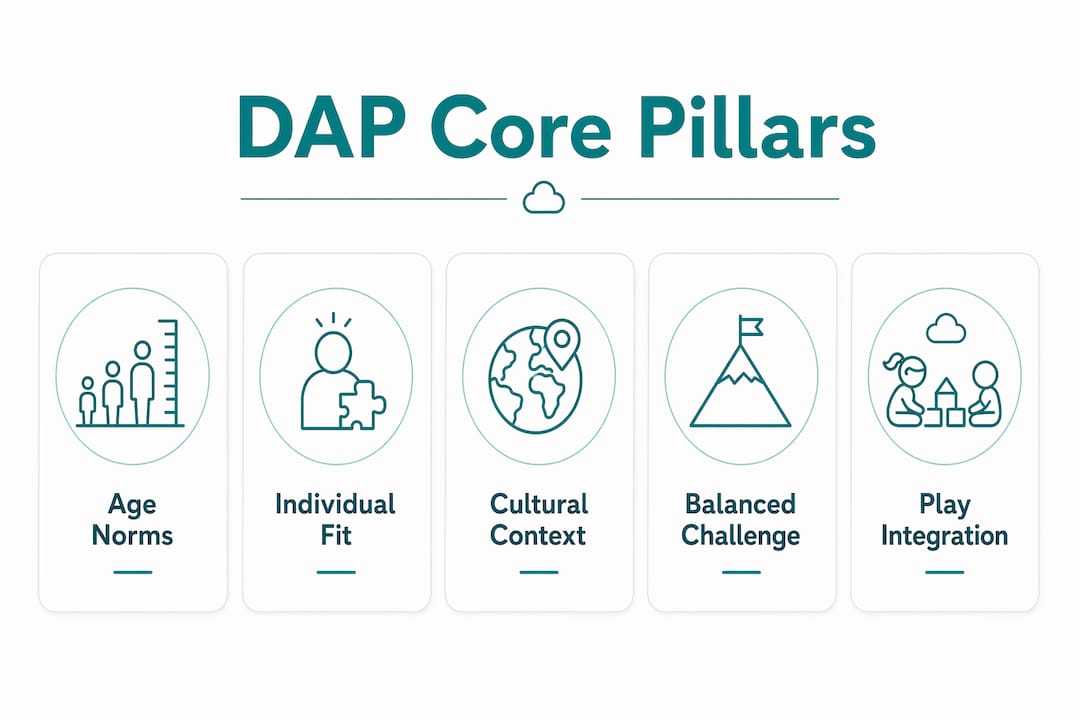
Play is not optional in this framework. NAEYC’s guidelines emphasize that effective DAP balances teacher-directed instruction with child-initiated play, prioritizing joyful, engaged learning as the vehicle for cognitive, social, emotional, and physical growth. Play-based approaches are not a break from learning. They are the method.
Pro Tip: Instead of running through a milestone checklist once a month, keep a simple observation journal. Jot two or three specific things you notice each week: what the child initiated, what they avoided, and how they responded to a new challenge. Patterns across weeks are far more useful than a single snapshot.
What activities fit each age group, from infants to early school-age?
Knowing the typical developmental sequence helps you choose activities that feel achievable and engaging rather than frustrating. The table below gives you a practical starting point for each age band, with scaffolding notes so you can adjust up or down depending on the individual child.
Age Band | Typical Behaviors | Sample Activities | Scaffolding Tip |
Infants (under 1 year) | Tracking faces, grasping, babbling, cause-and-effect exploration | Tummy time, high-contrast mobiles, responsive talking, peek-a-boo | Reduce stimulation if overwhelmed; add gentle narration to build language |
Toddlers (1–2 years) | Walking, parallel play, single words to short phrases, imitating adults | Simple puzzles, stacking blocks, sensory bins, picture books, pretend play | Offer two choices rather than open-ended options; model the action first |
Preschoolers (3–5 years) | Cooperative play, longer sentences, early counting, drawing shapes | Dramatic play, building projects, simple science experiments, shared storytelling | Add complexity by introducing a problem to solve; reduce it by breaking steps into one at a time |
Early school-age (5–8 years) | Reading readiness, logical thinking, peer relationships, rule-based games | Journaling, math manipulatives, collaborative projects, reader’s theater | Increase independence gradually; use peer pairing for social scaffolding |
For infants, the most powerful activity is responsive conversation. When a baby babbles and you respond with words and eye contact, you are building the neural pathways for language and attachment simultaneously. You do not need expensive materials. Your face and voice are the curriculum.
Toddlers learn through repetition and imitation, which is why play-based, experiential methods matter so much at this stage. Offering a sensory bin filled with rice and small cups gives a toddler practice with fine motor skills, cause-and-effect reasoning, and self-directed exploration all at once. When a child seems stuck, model the action once without taking over, then step back.
Preschoolers are ready for cooperative play and early literacy concepts, though readiness varies widely. Integrated, play-based learning at this stage might look like building a “grocery store” in the dramatic play corner, which simultaneously covers math (counting, sorting), literacy (reading labels), and social skills (negotiating roles). The learning is real; it just does not look like a worksheet.
By early school-age, children can handle more structured tasks, but classroom activities still work best when they include movement, choice, and collaboration. A child who struggles with writing may thrive when allowed to dictate a story first and then illustrate it. Changing the modality, not the learning goal, is often all the scaffolding needed.
Pro Tip: For children with diverse developmental trajectories or special needs, sensory toys and materials can remove barriers that have nothing to do with a child’s actual readiness. A child who avoids pencils may engage fully with finger painting, giving you the same fine motor data without the frustration.
How does “age-appropriate” differ from developmentally appropriate practice?
The two terms are related but not interchangeable, and conflating them leads to real planning mistakes.
“Age-appropriate” refers to what is generally suitable for children of a given chronological age, based on typical developmental sequences. It is a useful starting point and the basis for legal and policy definitions of program standards. Developmentally Appropriate Practice (DAP) goes further by requiring that age norms be combined with knowledge of the individual child and their cultural context before any teaching decision is made.
Decision Criteria | Age-Appropriate | Developmentally Appropriate Practice (DAP) |
Primary focus | Chronological age norms | Age + individual + cultural context |
Evidence used | Milestone charts, curriculum scope and sequence | Observation, family input, authentic assessment |
Role of individual differences | Limited; assumes typical trajectory | Central; drives adaptation and scaffolding |
Cultural/contextual adjustment | Rarely built in | Required by definition |
Risk of misapplication | Treating all same-age children identically | Requires more teacher knowledge and time |
Here is what the difference looks like in practice. A kindergarten curriculum that introduces letter-sound correspondence at age five is age-appropriate by most U.S. standards. But a DAP-informed teacher will notice that one child in the class already reads simple sentences while another has not yet shown interest in print. She adjusts: the advanced reader gets chapter books and writing prompts; the second child gets more read-alouds, alphabet songs, and time with magnetic letters before any formal phonics instruction begins. Same age, same classroom, two very different experiences.
The second example involves the “wait until ready” instinct. Many parents and educators hold back on introducing a concept because a child has not shown a clear sign of readiness. DAP research challenges this directly: small, scaffolded introductions through play can actually promote readiness rather than waiting for it to appear on its own.
Age-appropriate is the floor, not the ceiling.
DAP is the decision-making process that builds on that floor.
Using only age norms without individual and contextual knowledge produces instruction that fits the average child and truly serves very few.
How can you choose and adapt activities that genuinely fit each child?
A practical weekly workflow keeps planning grounded in what you actually observe rather than what a curriculum guide assumes. Here is a sequence that works for both parents and educators.
Observe first. Before selecting an activity, spend five to ten minutes watching the child in an unstructured setting. Note what they initiate, what they avoid, and how they handle a small challenge.
Identify the current edge. Ask: what can this child almost do but not quite yet? That gap is your target zone.
Select an activity that hits the edge. Choose something that requires one new skill or concept, not three. Complexity can always be added; starting too high creates frustration that is hard to walk back.
Scaffold intentionally. Model the task once. Offer a prompt if the child stalls. Reduce the number of steps or change the material if needed. Then step back and let the child lead.
Document what you see. A quick note after the activity (“she sorted by color independently but needed help with shape”) gives you a running record that is far more useful than a checklist.
Reflect and adjust. At the end of the week, review your notes. Did the child master the target? Move the challenge up. Did they disengage repeatedly? Simplify or change the modality.
Supporting your child’s learning at home follows the same logic. You do not need a formal curriculum. You need consistent, curious observation and a willingness to follow the child’s lead.
Useful observation prompts to keep in your back pocket:
“What did the child choose to do when nothing was required of them?”
“How did they respond when something was too hard? Did they ask for help, give up, or try a different approach?”
“What did their body language tell me about engagement versus stress?”
Pro Tip: Introduce novel concepts through play before any formal instruction. A child who has spent weeks building ramps with blocks has an intuitive understanding of slope and force that makes a later science lesson land much faster. Play is not preparation for learning. It is the learning.
Pro Tip: Involve families early and often. Ask parents what the child does at home, what language they use for key concepts, and what activities they love outside of school. Cultural and family context shapes how a child understands the world, and ignoring it means teaching to a version of the child that does not fully exist.
When does a mismatch signal something more than a bad activity choice?
Every child has off days, and a single frustrated session means nothing on its own. The concern rises when patterns persist across time, settings, and different types of activities.
Watch for these red flags:
Repeated and intense frustration with tasks that peers handle with ease
Withdrawal from activities the child previously enjoyed
Loss of a skill that was previously present (regression in language, motor control, or social engagement)
Physical safety issues arising from activities that are standard for the age group
Consistent inability to follow multi-step directions after age three
Significant difficulty with transitions or changes in routine that does not ease over several weeks
If a child shows persistent delays across two or more developmental areas, or if you notice a skill regression that lasts more than two to three weeks, that is the point to bring your observations to a pediatrician or early intervention specialist — not to wait and see.
The CDC’s developmental milestone resources offer free, age-specific checklists that give you a clear reference point. The Ages and Stages Questionnaire (ASQ) is a widely used screening tool that pediatricians and early intervention programs across the United States use to identify children who may benefit from further evaluation. You can request an ASQ through your child’s pediatrician or contact your state’s early intervention program directly.
A brief scenario: a three-year-old who rarely makes eye contact, has not combined two words by 24 months, and loses interest in other children is showing a pattern worth discussing with a developmental pediatrician, not simply adjusting the activity plan. Bringing a written record of specific observations to that appointment, rather than a general concern, helps the clinician make a faster and more accurate assessment.
For a parent-friendly overview of developmental milestones by age, having a reliable reference on hand makes it easier to know what to watch for and when to act.
What do people get wrong about age-appropriate learning?
Several persistent myths make it harder for parents and educators to apply DAP well. Clearing them up matters.
Myth 1: Developmental readiness is fixed. Many people treat readiness as something a child either has or does not have, like a switch that flips on its own schedule. Research tells a different story. Readiness is dynamic. Scaffolded exposure to a concept, introduced through play before formal instruction, actively builds the neural connections that make later learning easier. Waiting passively for readiness to appear can actually delay it.
Myth 2: Age norms are precise rules. Milestone charts describe what most children do within a range, not what every child must do by a specific date. A child who walks at 16 months instead of 12 is not behind; they are within the normal range. Treating norms as hard deadlines creates unnecessary anxiety and can lead to pushing children into activities they are not ready for.
Myth 3: “Easy” means “appropriate.” An activity that requires no effort is not developmentally appropriate; it is just easy. Appropriate means the right level of challenge for this child right now, which often means some productive struggle.
Equity is inseparable from this conversation. NAEYC is explicit that learning experiences must be culturally and linguistically relevant to each child’s family and community, not calibrated to a single standard of “typical” that reflects only one cultural background. A child who counts in Tagalog at home and English at school is not confused; they are building a richer cognitive foundation. Activities that honor the family’s language and routines are not accommodations. They are good practice.
“Developmentally appropriate practice requires both meeting children where they are and enabling them to reach goals that are both challenging and achievable.” — NAEYC DAP Position Statement
The Washington Post’s coverage of DAP debates makes a useful point: stage-based thinking has real limits when applied rigidly. The framework works when it stays flexible, observation-driven, and culturally responsive. It fails when it becomes a new kind of checklist.
Key Takeaways
Age-appropriate learning is most effective when it combines age-based norms, individual observation, and cultural context into every teaching decision.
Point | Details |
DAP has three pillars | Age norms, individual fit, and cultural context must all inform every activity choice. |
Observation beats checklists | Watching what a child initiates and how they handle challenge gives richer data than milestone ticking alone. |
Scaffolding closes the gap | Providing just enough support for tasks a child cannot yet do alone prevents mislabeling and builds genuine readiness. |
Red flags need action | Persistent delays across two or more areas, or skill regression lasting two to three weeks, warrant professional screening. |
Edu’s approach | Astor’s small-class, play-based settings apply these DAP principles with the individual attention each child deserves. |
A practitioner’s perspective on what actually matters
The part of DAP that most guides and curricula underemphasize is the cultural and family context pillar. Age norms and individual observation get most of the attention, and for good reason. But the third pillar is where the real equity work happens, and it is also where the most common planning failures occur.
A child who arrives at preschool speaking a language other than English is not developmentally behind. They are navigating a genuinely harder cognitive task than their monolingual peers, and they deserve activities that honor what they already know rather than treating their home language as an obstacle. The same principle applies to children from families with different routines, values, and ways of knowing. An activity that feels natural and engaging to one family may feel foreign and stressful to another, and that stress shows up as disengagement that gets misread as a developmental concern.
What actually works, in practice, is starting every planning conversation with the family. Not a form to fill out, but a real conversation: what does your child love at home? What do they call things? What are they proud of? That information shapes every activity choice in ways that no milestone chart can. The best learning happens when every child is truly seen and supported, and that requires knowing who they are outside the classroom, not just what they can do inside it.
Useful resources for parents and educators
The sources below are the most reliable starting points for deeper reading, screening tools, and curriculum planning.
NAEYC DAP Position Statement and Guidelines (naeyc.org): The definitive U.S. framework for early childhood practice, covering the three-part decision rule, play-based learning, and equity principles. Free to access online.
CDC “Learn the Signs. Act Early.” Milestone Resources (cdc.gov): Free, age-specific milestone checklists from birth through age 5, with a companion app (CDC Milestone Tracker) for logging observations over time.
California Department of Education Ages and Stages Guidance (cde.ca.gov): A state-level overview of developmental domains and age-band expectations, useful for educators working with California’s early learning standards or seeking a well-organized reference.
Ages and Stages Questionnaire (ASQ): A validated screening tool used by pediatricians and early intervention programs nationwide. Request it through your child’s doctor or your state’s Part C early intervention program.
Penn State Better Kid Care — DAP Overview (extension.psu.edu): A practitioner-friendly explainer of DAP’s five areas of practice, written for family childcare providers and classroom educators.
Resource | Best For | Access |
NAEYC DAP Guidelines | Educators planning curriculum and assessments | Free at naeyc.org |
CDC Milestone Tracker | Parents monitoring development at home | Free app and web checklists |
ASQ Screening Tool | Early identification of developmental delays | Via pediatrician or state EI program |
CA Dept. of Education Ages & Stages | State-aligned planning for educators | Free at cde.ca.gov |
Penn State Better Kid Care | Classroom-level DAP practice guidance | Free at extension.psu.edu |
For classroom-level strategies and activity ideas grounded in these same principles, the step-by-step classroom learning guide and the collaborative learning overview on the Astor site offer practical, age-specific examples you can use right away.
Small classes, big impact: how Astor puts these principles into practice

Astor International School and Astor International Preschool are built around exactly the kind of individual attention that DAP requires. With intentionally maintained class sizes that enable close teacher-child relationships, teachers genuinely know each child, which makes observation-driven, culturally responsive planning possible every single day rather than an occasional aspiration. The preschool in Holland Village offers a mix of outdoor and classroom learning across two playgrounds, giving young children the sensory-rich, play-based environment that supports development from the ground up. The international school in Tanglin serves children ages 5–12 through an internationally recognized curriculum that balances structured learning with child-initiated inquiry.
Astor has been recognized as both the best small school and the best affordable international school in Singapore, and that recognition reflects a genuine commitment to doing more with less: fewer children per class, stronger relationships, and learning experiences that are tailored rather than templated. If you are looking for a school where age-appropriate learning is not just a framework on paper but a daily practice, explore Astor’s curriculum approach or reach out to arrange a visit.
This article provides general educational information and is not a substitute for professional developmental assessment. For concerns about your child’s development, consult a qualified pediatrician or early childhood specialist.
Recommended

I quite like reading an article that can make people think. Also, thanks for allowing for me to comment! Zonnepanelen 4000 kwh prijs
I have a mission that I’m just now working on, and I have been at the look out for such information SolarEdge batterij
It is imperative that we read blog post very carefully. I am already done it and find that this post is really amazing. Zonnepanelen 5000 kwh prijs
It is perfect time to make some plans for the future and it is time to be happy. I’ve read this post and if I could I desire to suggest you few interesting things or tips. Perhaps you could write next articles referring to this article. I want to read more things about it! SMA Home Storage
I think this is an informative post and it is very useful and knowledgeable. therefore, I would like to thank you for the efforts you have made in writing this article. Zonnepanelen 6000 kwh prijs