


What Is an IB Student? A Clear Guide for Parents

An IB student is a learner placed at the center of an inquiry-based, transdisciplinary education that prioritizes how to learn over what to memorize, guided by the IB Learner Profile and the framework of the International Baccalaureate (IB). Rather than following a single national curriculum, IB students develop global-mindedness, self-management, and critical thinking across four programmes designed to serve learners from early childhood through pre-university.
A few things that define an IB student at a glance:
Enrolled in an IB programme: one of four pathways (PYP, MYP, Diploma Programme, or Career-related Programme) offered by IB World Schools worldwide
Guided by the IB Learner Profile: ten attributes including inquirer, thinker, communicator, and open-minded that shape classroom expectations and personal growth
Learning through inquiry: asking questions, connecting ideas across subjects, and reflecting on the learning process itself
Assessed on skills and understanding: not just recall, with Diploma Programme (DP) students completing an Extended Essay (EE), Theory of Knowledge (TOK), and Creativity, Activity, Service (CAS) alongside six subject exams
Table of Contents
What does it really mean to be an IB student?
The clearest way to understand an IB student is to look at what the IB describes as “learning how to learn.” Where a traditional classroom might reward a student who memorizes facts and reproduces them on a test, an IB classroom rewards a student who asks follow-up questions, connects a history lesson to a science concept, and reflects on what they still do not understand.
The IB Learner Profile in everyday terms
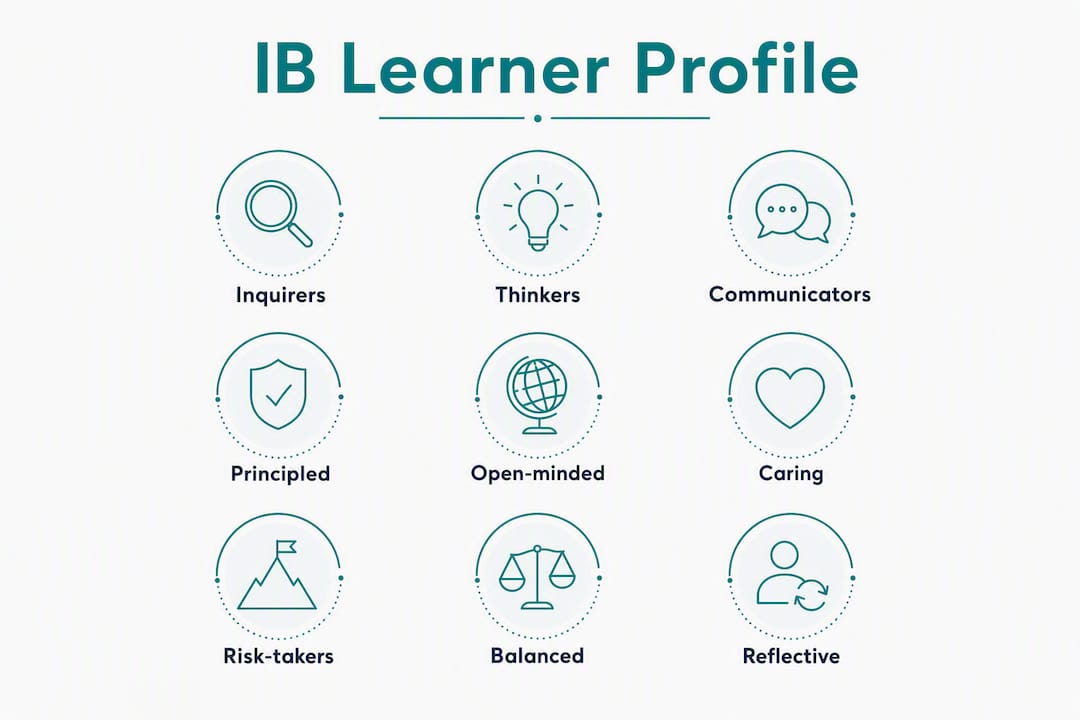
The IB Learner Profile lists ten attributes that every IB programme works to develop. Here is what each one looks like in practice:
Inquirers: asks “why?” and “what if?” and follows up with independent research
Knowledgeable: builds understanding across disciplines, not just one subject area
Thinkers: approaches problems with analysis and creativity rather than looking for a single right answer
Communicators: expresses ideas clearly in writing, speech, and other formats
Principled: acts with honesty and takes responsibility for their own work and choices
Open-minded: genuinely considers perspectives different from their own
Caring: shows empathy and takes action to support others in the community
Risk-takers: tries new approaches and learns from mistakes without fear
Balanced: manages academic, physical, and emotional wellbeing together
Reflective: regularly reviews their own learning and sets goals for improvement
These are not abstract ideals. Teachers build them into daily routines: a student might end a lesson with a written reflection, present a group project to the class, or revise an essay based on peer feedback. The profile shapes how students are expected to behave, not just what they are expected to know.
Approaches to learning in the classroom
The IB also defines five approaches to learning that cut across every subject: thinking skills, research skills, communication skills, social skills, and self-management skills. In practice, this means a student working on a science unit is also practicing how to find credible sources, how to collaborate with a partner, and how to manage a timeline. Homework is rarely a worksheet of repetition. It is more likely a reflection journal, a draft essay, or a planning document for a longer project.

Classroom routines often follow an inquiry cycle: students explore a question, gather evidence, analyze what they find, and present or apply their conclusions. Group projects are common, and so are formative check-ins where students assess their own progress before a teacher grades anything.
Pro Tip: When visiting a school, ask to see a sample unit planner or student reflection rubric. Schools with strong IB implementation will have these ready and will be able to explain how they track approaches-to-learning skills alongside subject grades. A school that can only show you a syllabus is still building its program.
How do the four IB programmes map to your child’s age?
The IB offers four programmes that together cover ages 3–19. Each one has a distinct focus, and they are designed to connect so that a student can move through all four as a continuous IB education.
Programme | Age / Grade Range | Primary Focus | Core Components | Typical Workload |
Primary Years Programme (PYP) | Ages 3–11 (PreK–Grade 6) | Transdisciplinary inquiry; whole-child development | Six transdisciplinary themes; Exhibition in final year | Moderate; project-based units |
Middle Years Programme (MYP) | Ages 11–16 (Grades 6–9) | Interdisciplinary learning; personal project | Eight subject groups; Personal Project in Year 5 | Moderate to demanding; e-assessment available |
Diploma Programme (DP) | Ages 16–19 (Grades 11) | Academic rigor; research and critical thinking | Six subject groups plus EE, TOK, CAS | High; sustained two-year commitment |
Career-related Programme (CP) | Ages 16–19 (Grades 11) | Career-focused learning alongside IB courses | CP core (reflective project, service learning, language development, personal and professional skills) | High; combines academic and vocational tracks |
A few things worth knowing about each programme:
PYP organizes learning around six transdisciplinary themes (such as “How We Organize Ourselves” and “Sharing the Planet”) rather than separate subjects. Students in the final year complete a collaborative Exhibition project.
MYP introduces subject-specific learning while keeping interdisciplinary connections strong. Students complete a Personal Project in their final MYP year, which is a self-directed research and creation project.
DP is the most widely recognized pathway internationally. Students choose six subjects across groups (language, individuals and societies, sciences, mathematics, arts, and a second language or additional subject), with at least three studied at Higher Level (HL). The DP core (EE, TOK, CAS) sits on top of those six subjects.
CP suits students who want to combine two or more DP courses with a career-related study, making it a strong fit for students with a clear vocational direction.
The Diploma Programme is typically what people mean when they say “IB” in a U.S. high school context, though many U.S. schools also offer the MYP in middle school.
How are IB students assessed, and what does earning the diploma mean?
Assessment in the IB is more layered than a single end-of-year exam. For DP students especially, the assessment picture includes both external exams and internal work completed over two years.

DP grading and diploma requirements
Each of the six DP subjects is graded on a 1–7 scale. Students can earn up to 3 additional points from their combined TOK and EE performance, making the maximum possible score 45 points. To be awarded the diploma, students must meet a minimum of 24 points along with a set of other conditions, including satisfactory completion of CAS and no failing grades in required components.
The three DP core elements each carry real weight:
Extended Essay (EE): a 4,000-word independent research paper on a topic of the student’s choosing, supervised by a school mentor
Theory of Knowledge (TOK): a course and assessed exhibition/essay that asks students to examine how we know what we know across disciplines
Creativity, Activity, Service (CAS): sustained experiential engagement across creative pursuits, physical activity, and community service, requiring planning, reflection, and evidence rather than simply logging hours
The EE and TOK are not simple add-ons. They demand planning, supervision records, and multiple drafts. CAS is similarly substantive: the IB expects purposeful, reflective activity rather than a checklist.
Assessment snapshot: DP students sit external exams in May or November of their second year, but internal assessments (IAs) are completed and submitted throughout the two-year program. IAs are graded by the classroom teacher and then moderated externally by the IB, so the quality of day-to-day work matters from the very start of Year 1.
What colleges see
U.S. colleges and universities are broadly familiar with IB results. Many award college credit for HL subjects with scores of 5, 6, or 7, though policies vary by institution. Some selective universities view the full IB Diploma as evidence of strong academic preparation, particularly for students who have taken multiple HL subjects. Students should request an official IB transcript directly from the IB and confirm each target school’s credit policy before assuming credit will transfer.
Pro Tip: Ask your school’s IB coordinator for a sample transcript and a list of colleges that have recently accepted IB Diploma graduates. Seeing real outcomes from your specific school is far more useful than reading a general college-credit policy page.
How does IB differ from regular U.S. high school and AP?
For U.S. families, the most practical question is often: how does IB compare to a standard diploma or to Advanced Placement (AP) courses? The differences are meaningful.
Dimension | IB Diploma Programme | AP-Style Courses | Typical U.S. High School Diploma |
Age / grade range | 16–19 (Grades 11) | — | — |
Primary focus | Inquiry, interdisciplinary thinking, global-mindedness | Subject-specific advanced content | State/district standards, credit accumulation |
Assessment type | External exams + internal assessment + DP core (EE, TOK, CAS) | End-of-course AP exam (optional) | State tests, teacher grades, credit hours |
Workload / time commitment | High; sustained two-year program with core requirements | Moderate to high per course; no program-wide core | Moderate; varies widely by school |
University recognition | Internationally recognized; credit at many U.S. and global universities | Credit at most U.S. universities for scores of 3–5 | Accepted domestically; limited international recognition |
Best for | Students who want a cohesive, research-focused program with global recognition | Students who want flexibility to accelerate in specific subjects | Students following a standard state graduation path |
A few quick comparisons families often ask about:
Will IB or AP earn college credit? Both can, but policies differ by college. AP credit is more uniformly accepted across U.S. institutions. IB HL credit is widely recognized but requires checking each school’s specific policy.
Is IB harder than AP? The workload is different rather than simply harder. AP concentrates effort on one exam per course. IB distributes effort across two years of internal assessment, a research essay, and a reflective course, in addition to final exams. Students who manage sustained projects well often find IB more natural; students who prefer discrete, exam-focused study may prefer AP.
How do U.S. transcripts show IB results? Schools typically report IB predicted grades and final scores on transcripts alongside GPA. Some schools weight IB courses similarly to AP for GPA calculation, though this varies by district.
The key distinction is that IB is a full program, not a menu of individual courses. A student taking three AP classes is still in a standard diploma track. A DP student has committed to a cohesive two-year framework with defined requirements.
Who actually succeeds in IB, and what do families get wrong?
One of the most persistent myths about IB is that it is designed for gifted students. The IB itself is clear that the Diploma Programme is open to any student aged 16–19 who is willing to commit to its inquiry-based framework. Giftedness is not the deciding factor. Commitment, curiosity, and the willingness to work through difficulty are.
Common misconceptions, corrected
“IB is only for the top students.” Research and IB guidance both point to growth mindset and study habits as stronger predictors of success than innate ability. Students who initially struggle in IB often lack self-management strategies rather than academic capacity. Schools that teach those strategies explicitly see students convert early difficulty into steady progress.
“IB is too stressful for most kids.” Workload is real, but schools that pace internal assessments thoughtfully and provide counseling access make a significant difference. The stress often comes from poor planning support, not from the program itself.
“You need to start IB in primary school.” Many students enter the DP having never done PYP or MYP. The DP has its own orientation, and motivated students adapt.
“IB guarantees university admission.” The diploma is respected, but it is one factor among many. Strong DP results open doors; they do not guarantee outcomes.
Skills that predict success
Students who thrive in IB tend to share a few practical habits: they manage their time across multiple long-term projects, they ask questions when they do not understand rather than waiting, and they treat feedback as useful rather than threatening. These are teachable skills, not fixed traits.
IB World Schools in the U.S.: The IB authorizes schools globally, and the United States has one of the largest networks of IB World Schools in the world, spanning public magnet programs, charter schools, and private institutions.
Pro Tip: During a school visit, ask specifically: “How do you teach time management and self-management skills to students entering the DP?” A school with a strong answer has thought carefully about student support. A vague answer is a warning sign.
What are the real advantages and challenges of being an IB student?
Choosing IB is a meaningful commitment, and it is worth looking at both sides honestly.
Advantages
Transferable skills: IB students practice research, analysis, and communication in every subject, not just English class. These skills translate directly to university coursework and professional life.
International recognition: The IB Diploma is accepted by universities in over 75 countries, making it particularly valuable for families who may relocate or students considering study abroad.
Deeper research skills: The Extended Essay gives students a genuine experience of independent academic research before they arrive at university, which many professors notice.
Global-mindedness: The IB Learner Profile builds habits of perspective-taking and cross-cultural awareness that are genuinely useful in diverse academic and professional environments.
College preparation: The DP core (EE, TOK, CAS) shapes college-readiness in ways that go well beyond subject knowledge, developing the reflection and self-direction that university study demands.
Challenges
Sustained workload: The two-year DP is not a sprint. Students manage six subjects, three core components, and ongoing internal assessments simultaneously. Families should plan for this from the start of Grade 11.
CAS requires genuine engagement: CAS hours are not a box to check. The IB expects students to plan, reflect, and document their experiences. Students who treat it as a formality often find themselves scrambling in Year 2.
Wellbeing pressure: Without good school support, the combination of HL subjects and core requirements can feel overwhelming. Schools that offer timely academic counseling and clear assessment calendars make a real difference.
Not every school implements it equally: Authorization means a school has met IB standards, but implementation quality varies. A school with experienced IB coordinators and trained teachers delivers a very different experience from one that is newly authorized.
The good news is that targeted academic support and accountability structures can make a measurable difference for students navigating the DP’s sustained demands. Families who build in support early rather than waiting for a crisis tend to see much better outcomes.
How do U.S. families find and enroll in an IB school?
Finding the right IB school takes a few deliberate steps. Here is a practical sequence for families starting the process.
Search for authorized IB World Schools. Use the official IB school search at ibo.org to find schools near you. Filter by programme (PYP, MYP, DP, or CP) and by state. Authorization matters: a school that says it is “working toward IB” is not yet delivering the full program.
Confirm which programmes the school offers. Some schools offer only the DP; others run a continuum from PYP through DP. If your child is in elementary school, check whether the school offers PYP and whether it feeds into an MYP and DP school.
Visit classrooms, not just the admissions office. Ask to observe a lesson or speak with current students. Look for evidence of inquiry cycles, student-led discussions, and visible reflection tools.
Ask targeted questions during the visit. A strong IB school will answer these confidently:
How do you teach approaches-to-learning skills to new DP students?
What does your CAS guidance process look like?
How do you support students who are struggling with internal assessment timelines?
What is your school’s university placement history for IB Diploma graduates?
How do you communicate IB results to U.S. college admissions offices?
Understand the application and enrollment timeline. Public IB magnet programs often have application deadlines in January or February for the following fall. Private IB schools may have rolling admissions but competitive spots. Start the process at least one full school year ahead.
Clarify costs. Public school IB programs are generally free to attend, though some districts charge a fee for IB exam registration (typically a few hundred dollars per exam session). Private IB schools charge full tuition, which varies widely. Exam fees are set by the IB and paid separately from school tuition.
A few practical resources to bookmark:
The IB’s official programme pages for programme-specific requirements
The IB school search tool at ibo.org for finding authorized schools by location and programme
Your state’s department of education website, which often lists public IB magnet programs by district
School IB coordinators, who are usually the most direct source of accurate, current information about enrollment and assessment
Key Takeaways
An IB student is defined not by a single exam but by a sustained commitment to inquiry, self-management, and global-mindedness across a structured programme that the IB designs to develop the whole learner.
Point | Details |
IB is a full programme, not a course | Students enroll in PYP, MYP, DP, or CP; the DP covers ages 16–19 with six subjects plus EE, TOK, and CAS. |
Success depends on mindset, not giftedness | Commitment, time management, and inquiry skills predict DP outcomes more reliably than innate academic ability. |
Assessment goes beyond final exams | DP students complete internal assessments, a 4,000-word Extended Essay, and TOK alongside external exams. |
U.S. families have real options | Public IB magnet programs and private IB schools both exist; use the official IB school search to find authorized programs near you. |
Start the search early | Public magnet application deadlines often fall in January or February; begin researching at least one school year in advance. |
Why the school matters as much as the label
There is something families do not always hear clearly enough: the IB framework is only as good as the school that implements it. Two schools can both hold IB authorization and deliver very different experiences for students. One has experienced coordinators who teach time management explicitly, pace internal assessments across the two years, and offer counseling before students hit a wall. The other has the credential but not the culture.
When evaluating any IB school, look past the branding and ask about the people. How long has the IB coordinator been in the role? How do teachers handle a student who is falling behind on their Extended Essay? What does the school do when a student’s CAS plan falls apart in Year 2?
At Edu, the belief is that the best learning happens when every child is truly seen and supported, and that principle applies whether a school follows the IB, the IPC, or any other internationally recognized framework. Inquiry-based learning, as described in Edu’s IPC curriculum approach, works because it puts the child’s curiosity at the center and builds the skills around it. That is exactly what the IB Learner Profile is trying to do. The label matters less than whether the school lives it every day.
Useful sources for further research
These are the authoritative starting points for families who want to verify details, find schools, or read the official programme requirements:
What it means to be an IB student — the IB’s own explanation of learner identity, approaches to learning, and student responsibilities; the clearest official answer to the core question
IB Learner Profile — the full description of all ten attributes and how they apply across programmes
Diploma Programme overview — programme structure, who it is for, and subject group descriptions
DP curriculum and core requirements — detailed breakdown of EE, TOK, CAS, and subject group requirements
DP passing criteria — official grading scale, bonus points, and diploma conditions
About the IB — overview of the organization, its mission, and the school authorization process
Astor International School: IPC curriculum — a real-world example of inquiry-based primary curriculum implementation, useful for families with younger children exploring international education frameworks
Recommended
nice
GOOD
sad