


What Is Early Childhood Education? A Parent's Guide

Early childhood education (ECE) is defined as structured learning and care for children from birth through age 5, covering the most critical window of brain development in a person’s life. The term “early childhood education” is the widely used public phrase, while educators and researchers often use ECE or “early years education” as the standard professional term. What happens in these first five years shapes how your child thinks, relates to others, manages emotions, and learns for decades to come. Organizations like UNESCO, the OECD, and Bright Horizons all recognize ECE as the single most cost-effective investment a family or government can make in a child’s future.
What is early childhood education and why does it matter?
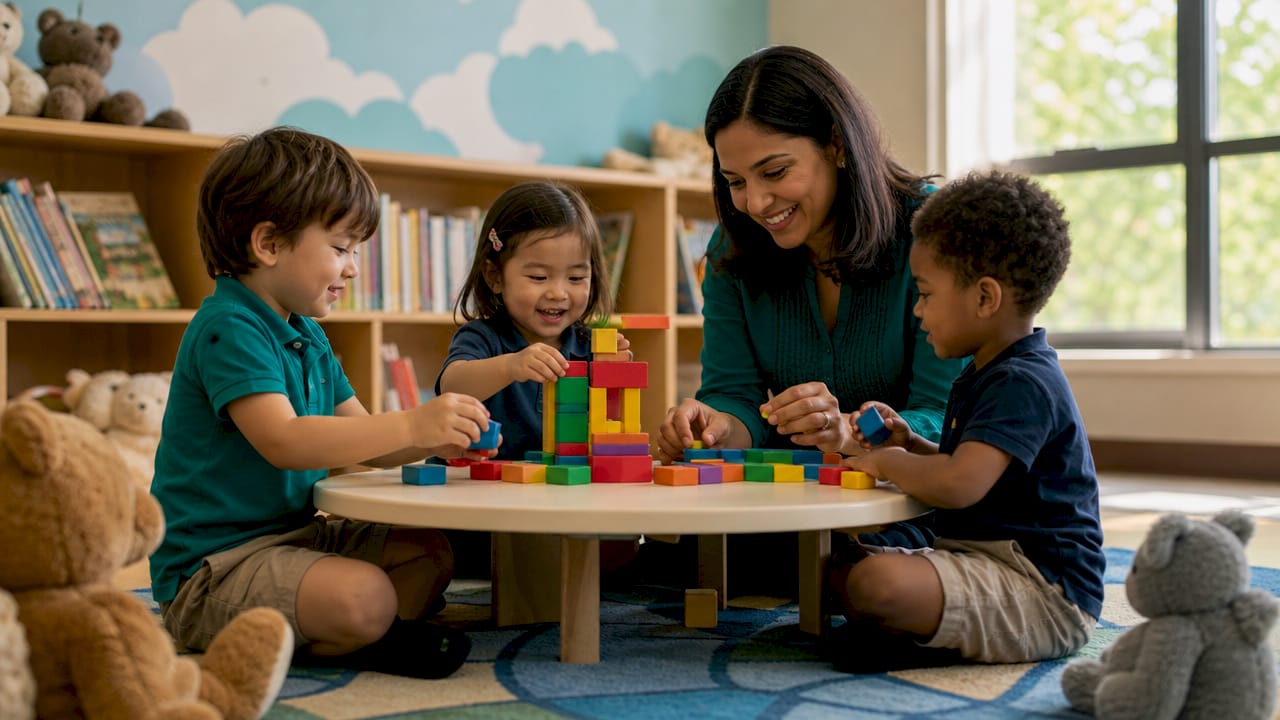
ECE covers far more than keeping children safe while parents work. It includes formal programs like preschool and pre-kindergarten, informal home-based care, and structured play groups, all designed to support cognitive, social, emotional, and physical development simultaneously.
The importance of early education becomes clear when you look at global data. About 30% of children worldwide are not developmentally on track. That gap does not appear at age 10 or 15. It appears before kindergarten, and it widens without quality support.
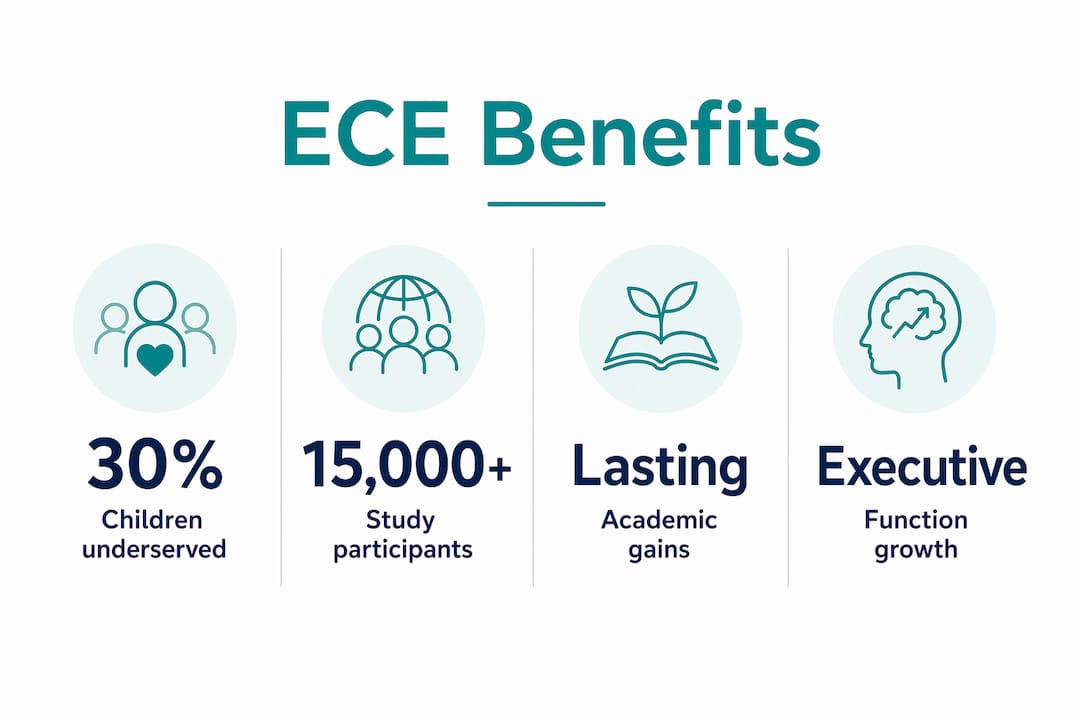
Access is deeply unequal. Only 55% of children from the poorest households are on track developmentally, compared to 78% in wealthier ones. UNESCO also reports that 91 of 188 countries offer zero years of free pre-primary education. That means millions of children enter formal schooling already behind, through no fault of their own.
Quality ECE addresses this directly. UNESCO experts describe ECE as an investment in wellbeing that goes far beyond school readiness, touching emotional health, social cohesion, and a child’s sense of self.
“The best learning happens when every child is truly seen and supported.” This is not a marketing phrase. It reflects what decades of research on early childhood development stages consistently show.
Key areas ECE programs target include:
Cognitive development: language acquisition, early numeracy, problem-solving
Social development: sharing, turn-taking, conflict resolution with peers
Emotional development: recognizing and managing feelings, building confidence
Physical development: fine and gross motor skills through play and movement
How do different types of early learning programs compare?
Parents searching for early learning programs quickly discover the options are wide and varied. Understanding what each type offers helps you match the program to your child’s needs.
Program type | Age range | Setting | Key focus |
Daycare / childcare center | 0–5 years | Center-based | Care, safety, basic socialization |
Preschool | 2.5–5 years | Center or school | Play-based learning, school readiness |
Pre-kindergarten (Pre-K) | 4–5 years | School-based | Academic preparation, structured learning |
Home-based care | 0–5 years | Home | Flexible, family-style environment |
International preschool | 1.5–5 years | Center or school | Multilingual, globally minded curriculum |
The most common mistake parents make is evaluating programs on facilities alone. A beautiful classroom does not guarantee quality learning. Research is clear: process quality matters more than structural features. Process quality means the warmth of teacher-child interactions, the quality of instructional conversations, and how well educators respond to each child’s curiosity and emotional needs.
Structural factors do still matter. Child-staff ratios of 7.5 or fewer children per educator, and class sizes at or below 15, are linked to better cognitive and academic outcomes. These numbers give teachers the space to actually know each child.
What preschool teachers do in a high-quality program goes well beyond supervision. They observe, document, scaffold, question, and respond. They create conditions where children feel safe enough to take risks and curious enough to keep asking why. The role of teachers in early years is one of the most underestimated factors in program selection.
Pro Tip: When you visit a program, watch the teachers, not the toys. Are they getting down to the child’s level? Are they asking open-ended questions? That interaction quality predicts your child’s outcomes far more than the room’s decor.
What benefits does quality early childhood education provide?
The benefits of preschool learning are measurable, lasting, and broader than most parents expect. A study of over 15,000 pre-K students compared against nearly 49,000 peers found that pre-K participation produced significantly higher academic achievement by 3rd grade across language, math, science, and social studies. Children who attended quality pre-K were also less likely to be held back a grade or placed in special education.
These gains do not fade. Research from Washington University’s Brown School of Public Health shows that ECE benefits persist into midlife, with participants showing better cognitive function at age 50. The effect is strongest for individuals from lower socioeconomic backgrounds. Quality early education is one of the few interventions that genuinely narrows long-term inequality.
The OECD identifies executive function development as a central mechanism behind these outcomes. Executive function includes impulse control, working memory, and cognitive flexibility. These skills predict long-term success more reliably than early literacy scores alone. A child who can focus attention, pause before reacting, and shift strategies when something is not working is prepared for school and for life.
Beyond academics, quality ECE builds the social and emotional skills children need to form friendships, handle conflict, and regulate their own behavior. The hidden curriculum of socialization covers peer conflict navigation, emotional expression, and sustained attention. These skills are harder to catch up on if missed in early childhood than any academic subject.
Key documented benefits of quality ECE include:
Higher scores in language, math, science, and social studies by 3rd grade
Reduced likelihood of grade retention or special education placement
Stronger executive function: impulse control, working memory, flexible thinking
Better emotional regulation and social skills with peers
Lasting cognitive advantages into adulthood, especially for children from disadvantaged backgrounds
Understanding brain development in early childhood helps explain why these windows matter so much. Neural connections form at a rate that will never be matched again, making ages 1.5 to 5 the most efficient time to build foundational skills.
How to choose the right early childhood education program
Choosing a program for your child is one of the most meaningful decisions you will make as a parent. The good news is that research gives you a clear framework for evaluating options.
Check teacher qualifications and ongoing training. Teacher qualifications and child engagement strategies matter more than physical classroom resources. Ask about the educators’ backgrounds and whether they receive regular professional development.
Ask about child-staff ratios. A small teacher-student ratio directly affects how much individual attention your child receives. Look for ratios at or below 7.5 children per educator for the youngest age groups.
Observe teacher-child interactions. Watch whether teachers respond warmly and promptly to children’s questions and emotions. Teacher-child relationship quality predicts child outcomes more than physical facilities or curriculum branding.
Look for play-based and social-emotional learning. Programs that prioritize pretend play and open-ended exploration build creativity, language, and emotional intelligence alongside academic skills. Avoid programs that push formal academics too early at the expense of play.
Assess the environment for inclusivity and stimulation. A good early learning environment feels welcoming to every child. Inclusive teaching practices support children with different learning styles, backgrounds, and abilities without leaving anyone behind.
Pro Tip: Ask the program director what they do when a child is struggling socially, not academically. The answer reveals more about program philosophy than any brochure will.
Key Takeaways
Quality early childhood education shapes cognitive, social, and emotional development in ways that persist well into adulthood, making program selection one of the highest-impact decisions parents make for children aged 1.5 to 5.
Point | Details |
ECE is structured and broad | It covers cognitive, social, emotional, and physical development, not just academic preparation. |
Process quality drives outcomes | Warm teacher-child interactions matter more than class size or facility quality alone. |
Benefits last into adulthood | Research links quality ECE to better brain function at age 50, especially for disadvantaged children. |
Ratios and qualifications matter | Look for ratios at or below 7.5 children per educator and ask about teacher training. |
Play is not optional | Play-based learning builds executive function and social skills that formal instruction cannot replicate. |
Why the “hidden curriculum” is the part parents most often miss
I have spent years reading research on early childhood education and speaking with educators across different program types. The finding that surprises parents most consistently is this: the academic gains from quality ECE are real, but they are not the most important thing happening in a good preschool classroom.
What matters most is what researchers call the hidden curriculum. Children aged 2 to 5 are learning how to be with other people. They are figuring out how to wait, how to share without being told, how to read a friend’s face, and how to recover when something goes wrong. These are not soft skills. They are the foundation of every relationship and every workplace interaction your child will ever have.
I have seen parents choose programs based on impressive facilities, structured phonics programs, or a prestigious name. Then they are surprised when their child struggles socially in primary school. The research is unambiguous: teacher relationship quality predicts outcomes more reliably than any curriculum brand.
My honest advice is to trust what you observe over what you read in a brochure. Visit the classroom. Watch whether the teachers are genuinely curious about each child. Ask how they handle a child who is upset or excluded. A program where every child feels seen and supported will outperform a program with a fancier name every time.
Advocate for your child’s whole development. Push for programs that balance play, creativity, and social-emotional learning with early literacy and numeracy. That balance is not a compromise. It is exactly what the evidence recommends.
— Elena
Astor International School: where early learning comes to life
Astor International School, part of the Astor education network in Singapore, has been recognized as both the best small school and the best affordable international school in Singapore. Its small class sizes and low teacher-student ratios reflect exactly the structural and process quality factors that research identifies as most important for children aged 1.5 to 12.
Astor’s preschool in Holland, Singapore, combines outdoor playground learning with structured classroom experiences, giving young children the balance of play and guided discovery that supports healthy development. The school’s IPC curriculum is built around inquiry, international-mindedness, and whole-child growth. For parents who want a nurturing, research-aligned early education environment, Astor offers a genuinely personal experience where every child is known by name and supported with care.
FAQ
What is the standard age range for early childhood education?
Early childhood education covers children from birth through age 5, with most formal preschool programs starting between ages 1.5 and 3.
How does ECE differ from regular daycare?
Daycare focuses primarily on care and safety, while quality ECE programs intentionally target cognitive, social, emotional, and physical development through structured activities and trained educators.
What do preschool teachers actually do in a quality program?
Preschool teachers observe children’s development, scaffold learning through open-ended questions, support emotional regulation, and create environments where curiosity and peer interaction can thrive.
Do the benefits of early childhood education really last?
Research from Washington University’s Brown School of Public Health confirms that quality ECE participation is linked to better cognitive function at age 50, with the strongest effects for children from lower-income backgrounds.
How many children per teacher is considered acceptable in preschool?
A ratio of 7.5 or fewer children per educator is linked to better cognitive and academic outcomes. Ratios above this level reduce the individual attention each child receives.
Recommended
This is a great post. I like this topic.This site has lots of advantage.I found many interesting things from this site. It helps me in many ways.Thanks for posting this again. Zonnepanelen installateur
i am for the first time here. I found this board and I in finding It truly helpful & it helped me out a lot. I hope to present something back and help others such as you helped me. Zonnepanelen met batterij
I truly like you're composing style, incredible data, thankyou for posting. Kostprijs zonnepanelen
This was among the best posts and episode from your team it let me learn many new things. Zonnepanelen installatie
Very nice blog and articles. I am realy very happy to visit your blog. Now I am found which I actually want. I check your blog everyday and try to learn something from your blog. Thank you and waiting for your new post. Zonnepanelen