


Parent-School Partnership: A Guide for Parents and Educators
- sasha2644
- 3 days ago
- 9 min read

A parent-school partnership is a bidirectional, ongoing collaboration between families and educators, grounded in shared responsibility for a child’s learning, development, and well-being. When this relationship is working well, three things happen consistently: student academic outcomes improve, communication between home and school becomes clearer and more proactive, and families gain better access to the supports their children need.
This article gives you the evidence, the conceptual models, and a practical checklist you can use right now, whether you are a parent looking to engage more meaningfully or an educator building a family engagement program from the ground up.
Better student outcomes: Research links consistent parent engagement to higher achievement, stronger classroom behavior, and improved social skills.
Stronger communication: Families and teachers who communicate regularly are better positioned to catch problems early and celebrate progress together.
Access to supports: Partnerships connect families to tutoring, mental health resources, enrichment programs, and community services they might not find on their own.
Key Takeaways
A parent-school partnership works when both sides commit to shared goals, consistent two-way communication, and clear roles, producing measurable gains in student achievement, behavior, and well-being.
Point | Details |
Core definition | A parent-school partnership is bidirectional, ongoing, and grounded in shared responsibility for learning and development. |
Communication reach | In 2022-23, school-wide emails reached about 90% of families, but individualized contact and parent-initiated communication remain less common. |
Strongest effects | At-home support and linking home-school messages produce larger achievement gains than school-event attendance alone. |
Start simply | Parents: introduce yourself and ask for one shared goal. Schools: offer three contact options and send a written follow-up after every meeting. |
Use formal structures | An Action Team for Partnerships or written engagement plan sustains effort better than ad-hoc events. |
Table of Contents
What does a parent-school partnership actually look like?
Partnership is not a single event. It is a pattern of shared activity that happens both at school and at home, initiated by teachers, parents, or both together.
School-based activities
Parent-teacher conferences give families a structured opportunity to review progress, ask questions, and align on goals. Curriculum nights help parents understand what their child is learning and why, so home conversations can reinforce classroom content. Volunteering in classrooms, on field trips, or at school events builds familiarity and trust between families and staff.

Home-based activities
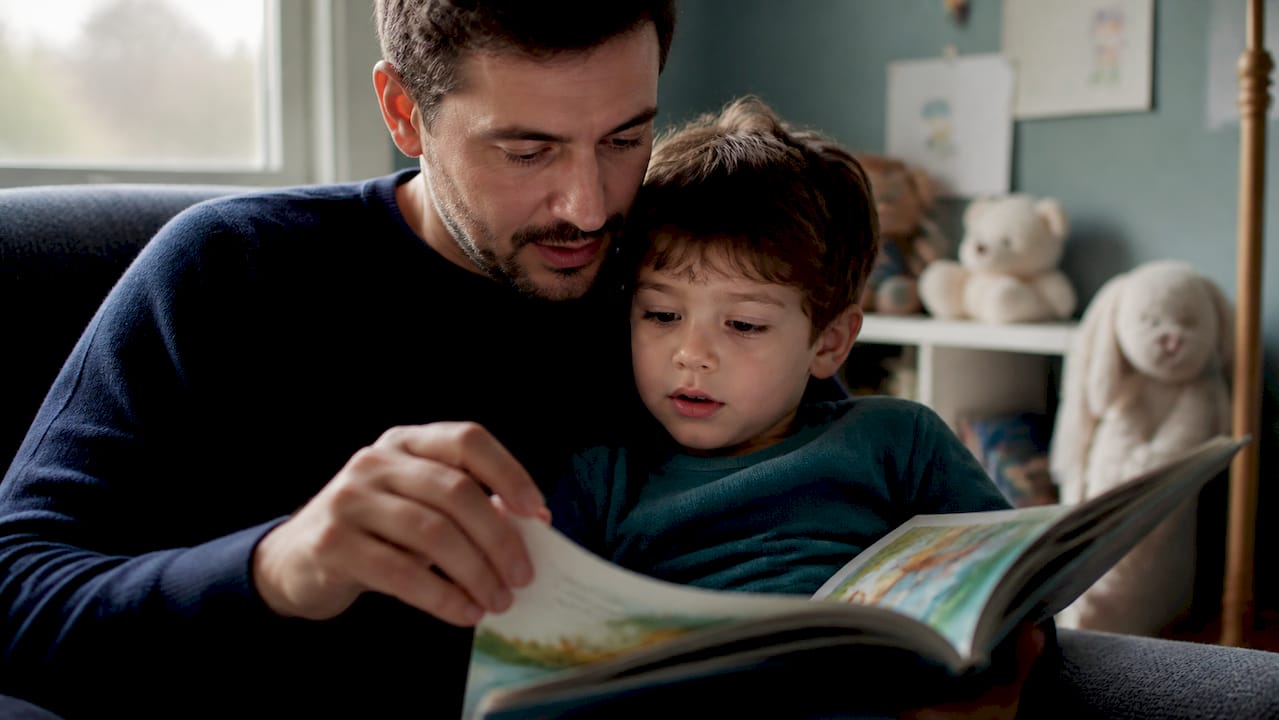
Supporting your child’s learning at home does not require a teaching degree. A consistent homework routine, nightly reading together, and asking your child two or three open questions about their school day are all meaningful partnership activities. These habits signal to children that home and school share the same expectations, which matters more than most parents realize.
Two-way communication
According to NHES/PFI survey data, in 2022-23 school-wide newsletters and emails reached most students’ families, individualized emails or notes reached over half, and phone calls reached a substantial portion. That range shows how much communication still flows in one direction. Genuine two-way communication means parents can also initiate: asking for a meeting, flagging a concern by email, or responding to a teacher’s note with their own observations.
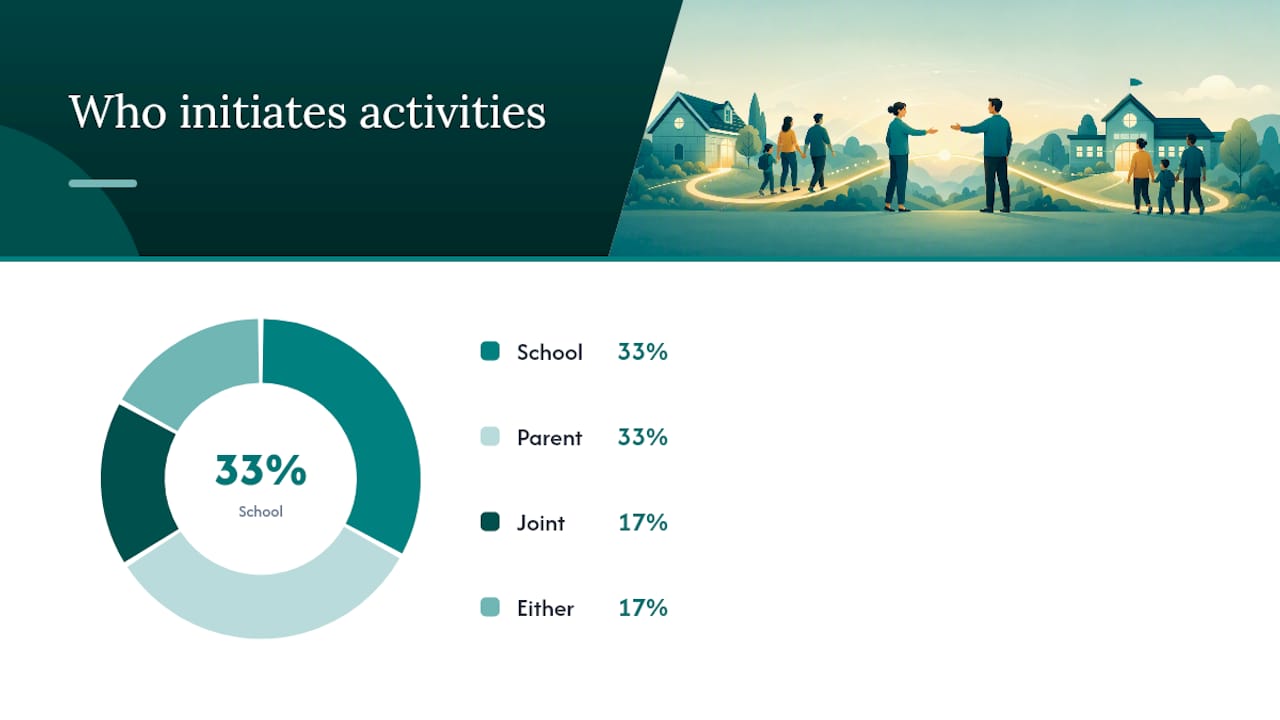
Activity | Who typically initiates | Purpose |
Parent-teacher conference | School | Review progress, set shared goals |
Curriculum night / open house | School | Explain learning content and expectations |
Volunteering in class or events | Parent | Build familiarity, support school programs |
Nightly reading or homework routine | Parent | Reinforce classroom learning at home |
Family learning goal-setting meeting | Joint | Align on priorities for the term |
Two-way messaging via school app | Either | Share observations, flag concerns, celebrate wins |
What principles make these partnerships work?
Effective home-school collaboration does not happen by accident. Six principles consistently appear in the research and implementation literature:
Shared goals: Families and educators agree on what success looks like for the child, not just academically but socially and emotionally.
Trust: Both sides assume good intent and communicate honestly, even when the news is difficult.
Reciprocity: Information and influence flow both ways. Parents bring knowledge of the child that teachers cannot observe; teachers bring professional expertise families can draw on.
Clear roles: Everyone knows what they are responsible for, which prevents overlap and gaps.
Two-way communication: Regular, accessible channels exist for both parties to initiate contact.
Cultural responsiveness: Partnership activities respect families’ languages, schedules, values, and prior experiences with schools.
The cooperation-to-collaboration continuum
Not every partnership needs to operate at the same depth. A useful way to think about this is a three-level continuum:
Cooperation is the lightest level. A parent signs a permission slip; a teacher sends home a weekly update. Both parties are aware of each other and broadly aligned, but interaction is minimal and mostly transactional.
Coordination goes further. A teacher and parent agree on a shared reading goal and check in monthly. They are actively sharing information and adjusting their approaches based on what the other reports.
Collaboration is the deepest level. Families, teachers, and sometimes community partners co-design a learning plan, share decision-making, and evaluate outcomes together. This level requires more time and trust, but it produces the strongest results for children with complex needs or ambitious goals.
Pro Tip: Choose the level that matches your current relationship and available time. Starting at cooperation and building toward coordination over one school term is more sustainable than jumping straight to full collaboration and burning out.
Why does the evidence say this matters?
The research case for parent involvement in education is one of the most consistent in educational science. A 2019 APA review synthesizing hundreds of studies found consistent correlations between parental involvement and improved academic achievement, better classroom behavior, and reduced delinquency, with effects varying by activity type and student age.
The CDC frames parent engagement as a shared responsibility that links children’s health and learning directly, noting that strong parent-school relationships are closely associated with better behavior, higher achievement, and improved social skills.
Statistic to know: In 2022-23, parents reported participating in an average of six school-related activities per student during the school year, yet communication channels still skewed heavily toward school-initiated, one-way formats.
Community partnerships with local businesses, nonprofits, and higher education institutions extend these gains further, with research linking them to improved attendance, motivation, social-emotional development, and academic outcomes.
Where effects are strongest
Context | What tends to work best |
Preschool and early elementary | At-home routines, shared reading, consistent communication |
Upper elementary | Goal-setting conferences, homework support, curriculum alignment |
Middle and high school | At-home encouragement, linking home and school messages |
According to EdWeek’s synthesis of the research, when parent engagement focuses on supporting learning at home and linking home and school messages, effects on achievement and motivation are larger than those from attendance at school events alone. For older students especially, at-home encouragement often matters more than volunteering at school.
How do you build and sustain a partnership?
A sequenced checklist
Parent actions:
Introduce yourself to your child’s teacher within the first two weeks of school, by email or in person.
Ask for one specific goal the teacher has for your child this term.
Set up a consistent homework or reading routine at home and tell the teacher what it looks like.
Respond to school communications within 48 hours, even briefly.
Request a mid-term check-in if you have not heard progress updates.
Teacher and school actions:
Send a warm welcome message to every family before or during the first week.
Share two or three concrete ways families can support learning at home right now.
Offer at least three ways to connect: in-person during school hours, in-person outside school hours, and a remote or digital option.
Create a simple two-way channel (app, email, or paper note) that parents can use to initiate contact easily.
Follow up after every conference with a brief written summary of what was agreed.
Joint actions:
Set one shared learning goal per term and review it together at the midpoint.
Agree on a communication cadence: a brief monthly check-in message and a quarterly 15-minute review meeting.
Sample conversation starters
Parent requesting a meeting: “Hi, I’d love to find 15 minutes to hear how [child’s name] is doing and share a few things I’m noticing at home. When works best for you this week or next?”
Teacher opening office hours: “I set aside time every Thursday from 3:30 to 4:30 PM for informal chats. No agenda needed. You can also message me anytime through the school app and I’ll respond within two school days.”
15-minute check-in agenda: One positive observation from each side, one area to work on together, one agreed next step with a date.
Pro Tip: Track two simple metrics together: how often you communicate (aim for at least once a month) and whether the shared goal is on track. Reviewing these at your quarterly meeting takes five minutes and keeps the partnership from drifting.
For parents new to meeting with teachers, starting with a single clear question is often more productive than a long list of concerns.
What gets in the way, and how do you fix it?
Barrier | Practical solution |
Working parents can’t attend daytime events | Offer evening sessions and a recorded or live-streamed option |
Language differences limit communication | Provide translated materials and access to an interpreter for conferences |
Low trust after a conflict | Schedule a brief restorative check-in (see pro tip below) |
Limited digital access at home | Offer paper alternatives and phone-based options alongside apps |
Parents feel unwelcome or judged | Train staff in culturally responsive communication; use asset-based language |
The Utah/Canyons guidance report recommends that before formalizing any partnership, schools assess needs, agree on shared goals, and create written roles and accountability mechanisms. That structure prevents the most common failure mode: a partnership that starts with enthusiasm and fades because no one owns it.
Pro Tip: After a conflict or misunderstanding, use this short restorative check-in template: (1) “Here is what I observed.” (2) “Here is what I was hoping for.” (3) “What would help us move forward together?” Keeping it to three steps prevents the conversation from becoming a grievance session and focuses both parties on the child.
Where can you find ready-made tools and guidance?
Several authoritative U.S. sources offer free templates, frameworks, and training that parents and educators can use without starting from scratch:
U.S. Department of Education: Federal guidance on family engagement, Title I requirements, and FERPA basics for parents who want to understand their rights.
CDC Parent Engagement Resources: Practical tools linking health and learning, including guidance on creating welcoming school environments.
IES / REL Northwest: Research syntheses and implementation guides on community partnerships and family engagement.
EdWeek: Accessible summaries of research on what works in parent involvement, useful for educators making the case to school leadership.
Templates worth finding
Look for a conference question list (five to eight questions parents can bring to any teacher meeting), a family engagement plan template (a one-page document schools use to set annual goals and activities), and a meeting agenda template for 15-minute check-ins.
Action Teams for Partnerships
An Action Team for Partnerships (ATP) is a small, cross-role group, typically including teachers, administrators, and parent representatives, that creates an annual family engagement plan, assigns measurable goals, and evaluates outcomes at the end of each term. Schools that use ATP-style structures tend to produce more consistent, school-wide engagement than those relying on ad-hoc events. Collaborative approaches to planning family engagement spread ownership across staff and reduce the burden on any single coordinator.
Why this partnership matters more than most people think
The research is clear, but the numbers only tell part of the story. What strikes me most, reading across the evidence and watching how families and schools interact, is how often both sides underestimate what the other brings. Parents assume teachers have everything under control. Teachers assume parents are too busy to engage. Both assumptions are usually wrong, and both cost children something real.
The most meaningful partnerships I have seen are not the ones with the most events or the most elaborate communication systems. They are the ones where a teacher and a parent have agreed, plainly and specifically, on what they are each going to do for a child this term, and then actually check in to see if it worked. That simplicity is harder to achieve than it sounds, especially in schools where family engagement is still treated as a nice-to-have rather than a core part of how learning happens.
At Edu, small class sizes make this kind of genuine, personalized partnership more achievable. When a teacher knows every child deeply, the conversation with families becomes specific rather than generic, and that specificity is what turns a good intention into a real outcome for the child in front of you.
Sources
Parent engagement in schools | Healthy Youth Parent Resources | CDC
Parent and Family Involvement in Education (PFI) Survey summary (NHES:2023)
Establishing effective school-community partnerships (Canyons / Utah guidance report)
Does parent involvement really help students? Here’s what the research says | EdWeek
Recommended
Comments