


Social Emotional Learning: A Practical Guide for Parents
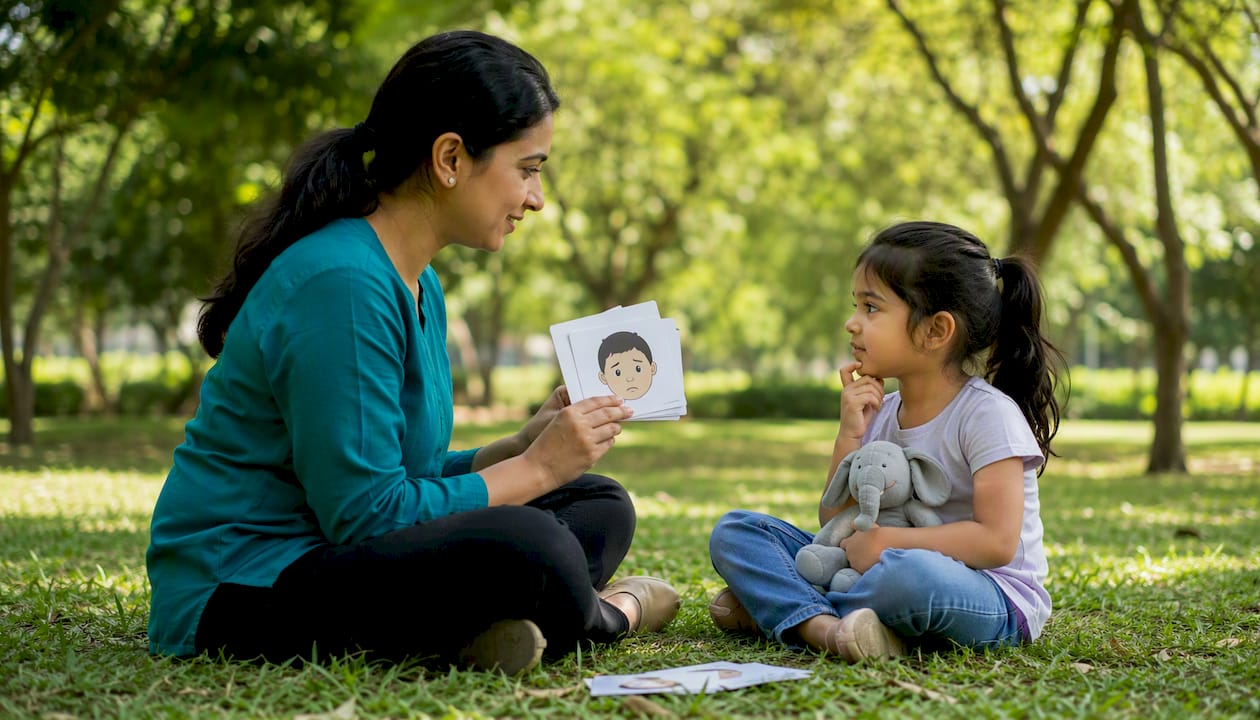
Social emotional learning (SEL) is the process through which children and adults develop the knowledge, skills, and attitudes to manage emotions, build healthy relationships, and make responsible decisions. Recognized by CASEL (the Collaborative for Academic, Social, and Emotional Learning), the Child Mind Institute, and UNESCO as foundational to healthy development, SEL begins at birth and continues across the entire lifespan. The core benefit is straightforward: well-implemented SEL supports academic success, mental health, and the quality of relationships children and adults carry with them for life.
Table of Contents
What is social emotional learning? The five CASEL competencies
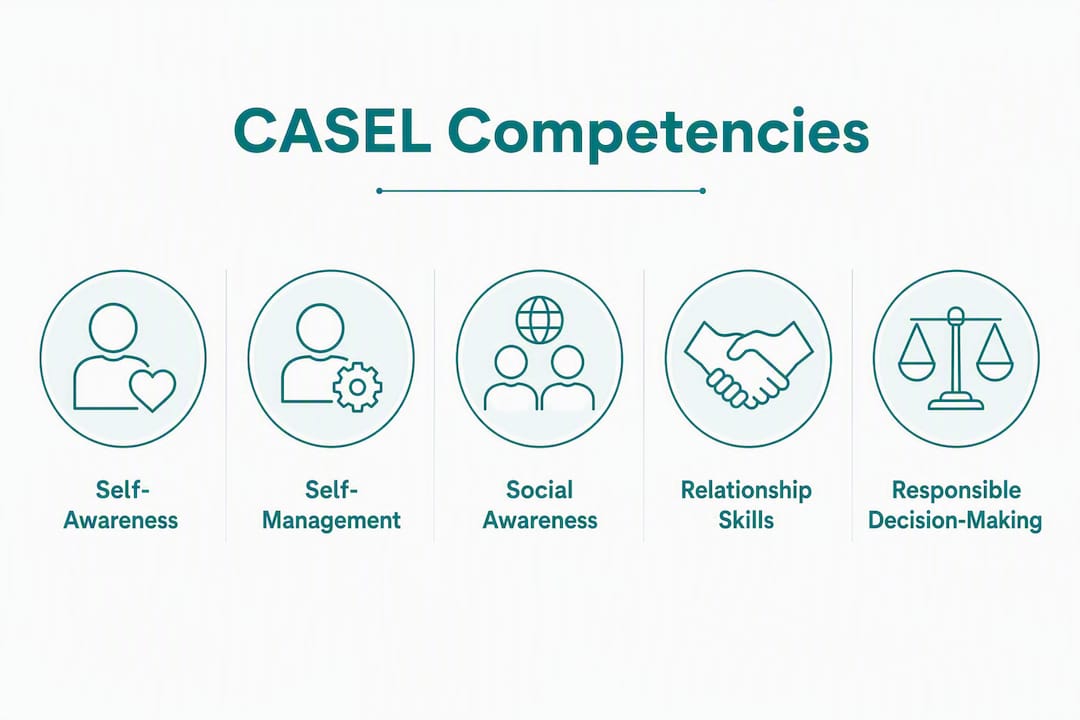
The CASEL framework organizes SEL around five core competencies. Each one builds on the others, and together they form the foundation of healthy social and emotional development.
Self-awareness is the ability to recognize your own emotions, thoughts, and values and understand how they shape your behavior. A four-year-old who says “I’m frustrated because I can’t reach that” is practicing self-awareness. So is an adult who notices tension rising before a difficult meeting.
Self-management means regulating emotions, thoughts, and behaviors effectively in different situations. A second grader who takes three deep breaths before responding to a classmate’s taunt is using self-management. In a workplace context, it looks like a team leader who pauses before sending a reactive email.
Social awareness is the capacity to understand and empathize with people from different backgrounds and cultures. A kindergartner who notices a classmate sitting alone and asks if they want to play is showing social awareness. For adults, it shows up as genuine curiosity about a colleague’s perspective.
Relationship skills include communicating clearly, listening actively, cooperating, and resolving conflict constructively. A middle schooler who mediates a disagreement between friends is drawing on relationship skills. These same skills determine how effectively adults collaborate on teams.
Responsible decision-making is the ability to make caring, constructive choices about personal behavior and social interactions. A child who weighs the consequences before taking someone else’s toy is beginning to practice this. Adults apply it every time they consider how a decision affects others.
These five competencies are not separate silos. Self-awareness, for instance, is the prerequisite for responsible decision-making: you cannot weigh how your choices affect others if you cannot first recognize your own emotional state. The five work as a system, each reinforcing the rest.
How SEL looks in practice: classrooms, homes, and workplaces
Classroom snapshots
Explicit mini-lessons are the most direct entry point. A teacher opens the day with a five-minute “emotion check-in,” asking students to place a sticky note on a feelings chart. The goal is not to fix every emotion but to name it, building the emotion vocabulary that underpins self-awareness. Research supports a mix of approaches rather than a single method, so this kind of brief, explicit instruction works best alongside integrated routines.
Integrated routines weave SEL into existing academic content. A reading lesson on a picture book about fairness becomes a natural space to discuss social awareness and responsible decision-making. A science project that requires students to divide tasks and present findings together builds relationship skills without a separate SEL period. Connecting science activities to children’s lives is one practical way to make this integration feel natural rather than forced.
Project-based learning takes integration further. When students collaborate over several weeks on a community garden or a school newspaper, they practice every CASEL competency in context: negotiating roles (relationship skills), managing frustration when plans change (self-management), and considering how their choices affect the group (responsible decision-making).
At-home supports
Family routines create the predictable, safe environment where emotional skills grow. A consistent bedtime ritual, a shared dinner where everyone shares one good thing and one hard thing, or a weekend walk with no screens gives children regular opportunities to practice naming feelings and listening to others.
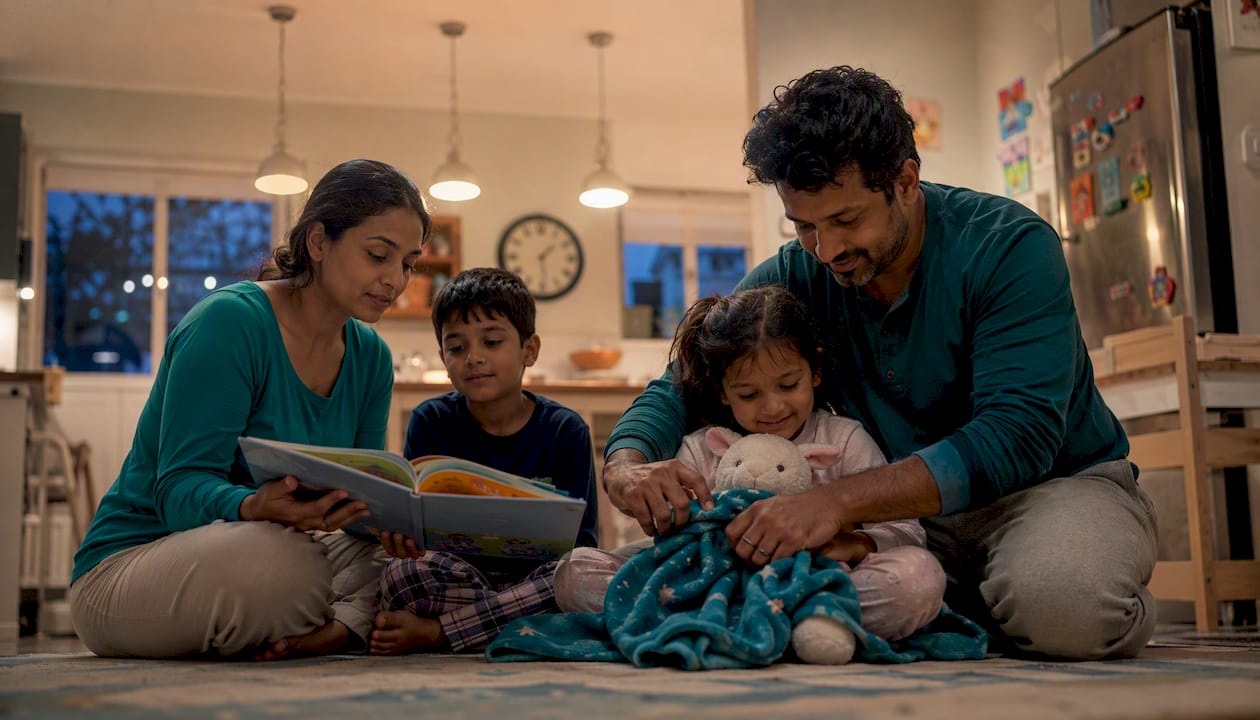
Emotion naming is one of the simplest and most powerful tools parents have. When a child is upset, reflecting the feeling back (“It sounds like you’re really disappointed”) teaches them that emotions have names and that those names are worth knowing. The Child Mind Institute notes that children who lack self-regulation skills often show disruptive behavior, and that building an emotion vocabulary is a proactive way to address the root cause.
Problem-solving conversations turn everyday conflicts into learning moments. When two siblings argue over a toy, a parent who asks “What could you both do so this feels fair?” is teaching responsible decision-making in real time. The key is staying curious rather than directive, guiding children toward their own solutions.
Adult and workplace examples
SEL does not stop at graduation. Adults who can recognize their emotional triggers, listen without interrupting, and repair a strained relationship are drawing on the same competencies children practice in kindergarten. In schools specifically, adult SEL competence is central: when teachers model calm, empathy, and clear communication, students experience those competencies as living examples, not just lesson content.

Three short exercises to try this week
The Feelings Thermometer (5 minutes, ages 4 and up): Draw a thermometer together and label the temperature levels with feelings (calm at the bottom, furious at the top). Ask your child to mark where they are right now and why. The goal is building emotion vocabulary and self-awareness without judgment.
Two Truths and a Wish (10 minutes, ages 7 and up): Each person shares two things that went well today and one thing they wish had been different. This builds social awareness and opens the door to problem-solving conversations without putting anyone on the spot.
The Perspective Swap (15 minutes, ages 9 and up, adaptable for staff meetings): Describe a conflict or dilemma and ask participants to argue the other person’s point of view. This stretches social awareness and responsible decision-making simultaneously, and it works just as well with a team of teachers as with a class of fourth graders.
Pro Tip: In small-class settings, the Perspective Swap works especially well because every child gets a turn to speak. With fewer students, teachers can give individualized feedback on each child’s reasoning, which deepens the learning far beyond what a large-group discussion allows.
What does the research say about SEL’s benefits?
The evidence for SEL is strong and consistent. UNESCO frames SEL as part of a fundamental shift in education toward an ethics of care, and research shows that well-implemented programs produce meaningful improvements in academic achievement, mental health and wellbeing, reduced behavioral issues, and higher graduation rates.
Research highlight: A landmark meta-analysis reviewed by CASEL found that students in SEL programs showed an 11-percentile-point gain in academic achievement compared to students who did not participate in SEL programs.
The Child Mind Institute is clear that SEL should not be reduced to behavior management. It builds underlying competencies — impulse control, empathy, problem-solving — so learners regulate behavior independently rather than simply complying with external rules. That distinction matters for parents and teachers alike: the goal is a child who chooses well, not one who behaves only when watched.
CASEL also emphasizes that SEL advances educational equity by creating learning environments that can interrupt inequitable policies and practices when coordinated across school, family, and community. This is not a peripheral benefit; it is central to why state education agencies from North Carolina to Minnesota have embedded SEL standards into their frameworks.
A note on limitations: Effect sizes vary considerably depending on implementation quality. SEL delivered as a one-off lesson or a single-semester add-on produces far weaker results than SEL embedded across the school day and supported by trained adults. The research is consistent on this point: systemic implementation is what separates meaningful gains from modest ones.
Key references:
CASEL meta-analyses: document academic and behavioral gains across hundreds of studies
UNESCO (2023): frames SEL within a global ethics-of-care approach to education
Child Mind Institute: explains SEL as a preventive, strength-based intervention
NC DPI: defines SEL competencies and recommends school-family-community collaboration
How do schools and communities implement SEL effectively?
Systemic implementation
CASEL advises that SEL works best when it is integrated systemically across classrooms, schoolwide practices, family partnerships, and community settings. A single classroom teacher doing great SEL work in isolation will see results, but a school where every adult models the same competencies and families receive consistent messaging will see transformative ones.
Adult SEL is the often-overlooked piece. Staff training and adult wellbeing programs are strongly linked to consistent classroom outcomes for students. Teachers who can recognize and manage their own emotions create the trusting environments where students feel safe enough to take the emotional risks SEL requires. The role of teachers in early years is especially significant: the habits children form in preschool and primary school shape how they approach relationships and challenges for years.
Program-selection checklist
When evaluating an SEL program or curriculum, ask whether it meets these criteria:
Alignment with your school’s learning goals and existing curriculum
Cultural responsiveness and relevance to your student community
Adequate training and ongoing support for all staff, not just classroom teachers
A clear measurement plan so you can track progress and adjust
Evidence base: peer-reviewed research, not just vendor testimonials
Family engagement components that extend SEL into the home
Questions to ask program vendors
What does the research evidence base look like, and has it been independently reviewed?
How much training do teachers receive before implementation, and what ongoing coaching is available?
How does the program address cultural and linguistic diversity in your community?
What assessment tools does the program include, and how are results used to improve instruction?
How does the program support adult SEL alongside student SEL?
What does fidelity monitoring look like, and who is responsible for it?
How does the program connect families and community partners to school-based SEL?
What does a realistic implementation timeline look like for a school of our size?
Red flags to watch for
Avoid programs that deliver SEL only through stand-alone lessons with no integration into daily routines. Be cautious when a program offers no adult SEL component, no assessment or fidelity checks, and no plan for family engagement. These gaps are the most reliable predictors of weak outcomes.
Where did SEL come from? Historical and theoretical roots
SEL as a named field emerged in 1994, when CASEL was founded by researchers including Daniel Goleman (whose book Emotional Intelligence brought the concept to mainstream audiences) and educators who recognized that academic instruction alone was not preparing children for healthy, productive lives. The theoretical roots run deeper, drawing on developmental psychology (Erik Erikson’s stages of psychosocial development), cognitive-behavioral theory, and the attachment research of John Bowlby and Mary Ainsworth, which established that secure relationships are the foundation of healthy emotional development.
Howard Gardner’s theory of multiple intelligences, introduced in 1983, challenged the narrow definition of intelligence and made space for emotional and interpersonal capacities to be taken seriously in educational settings. Peter Salovey and John Mayer’s formal model of emotional intelligence, published in 1990, gave researchers a framework for studying these capacities empirically. By the time CASEL published its first guide to SEL programs in the late 1990s, the field had a theoretical foundation, a growing evidence base, and an organizational home.
Today, UNESCO, national education departments, and state agencies across the United States treat SEL not as a supplementary program but as a core component of quality education, recognizing that the skills it builds are as foundational as literacy and numeracy.
What are the main criticisms of SEL, and how are they addressed?
SEL has faced several substantive criticisms, and they deserve honest engagement rather than dismissal.
The values concern is the most common: some parents and community members worry that SEL programs impose particular values or emotional norms on children, overstepping the family’s role. This concern is most valid when programs are implemented without family input or cultural sensitivity. The response from CASEL and leading practitioners is that SEL should be developed in partnership with families and communities, not delivered to them. Programs that include robust family engagement and are culturally responsive address this concern directly.
The medicalization concern holds that SEL pathologizes normal childhood emotions and turns teachers into quasi-therapists. Child Mind Institute is explicit that SEL is not therapy and should not be confused with mental health treatment. SEL builds skills; it does not diagnose or treat. Teachers who understand this distinction stay in their lane while still supporting children’s emotional development.
The implementation concern is perhaps the most practically significant: SEL is sometimes reduced to a checklist, a poster on the wall, or a weekly lesson that has no connection to the rest of the school day. Critics who point to weak or inconsistent outcomes are often pointing at weak or inconsistent implementation. The research is clear that fidelity matters enormously, and that poorly implemented SEL can produce negligible results.
The equity concern cuts in two directions. Some argue that SEL programs developed primarily in majority-culture contexts may not reflect the emotional norms and relational practices of all communities. CASEL acknowledges this and has increasingly emphasized culturally responsive SEL as a non-negotiable element of equitable implementation.
How do you measure SEL progress and impact?
Measuring SEL is genuinely more complex than measuring reading fluency or math scores, but it is not impossible. Practitioners and researchers use several complementary approaches.
Direct skill assessments ask students to respond to scenarios and demonstrate specific competencies, such as identifying emotions in facial expressions or generating solutions to a social problem. These assessments capture what students can do, not just what they say they feel.
Self-report surveys ask students to rate their own competencies, confidence, and emotional states. Tools like the DESSA (Devereux Student Strengths Assessment) and the SEARS (Social Emotional Assets and Resilience Scales) are widely used in U.S. schools. Self-report data is useful but should be interpreted alongside other sources, since children’s self-perceptions do not always match observed behavior.
Teacher and parent ratings provide an outside perspective on a child’s social and emotional behavior across settings. When teacher ratings and parent ratings align, that convergence is a strong signal of genuine skill development.
Behavioral and academic indicators such as office discipline referrals, attendance rates, and academic grades serve as indirect measures of SEL impact. A school that implements SEL well typically sees improvements in these indicators over one to three years, though many factors influence them.
Observation protocols allow trained observers to assess the quality of classroom climate, teacher-student interactions, and peer relationships. These are resource-intensive but provide the richest picture of whether SEL is actually alive in the school environment.
The most useful measurement approach combines at least two of these methods and tracks trends over time rather than relying on a single snapshot. Schools that build SEL assessment into their existing data systems, rather than treating it as a separate reporting burden, tend to sustain measurement practices far longer.
Key Takeaways
Social emotional learning builds the five CASEL competencies — self-awareness, self-management, social awareness, relationship skills, and responsible decision-making — and well-implemented SEL programs produce measurable gains in academic achievement, mental health, and long-term outcomes.
Point | Details |
SEL is a lifespan process | It begins at birth and continues through adulthood, shaping relationships and decisions at every stage. |
Five CASEL competencies | Self-awareness, self-management, social awareness, relationship skills, and responsible decision-making form the framework. |
Academic gains are documented | Students in SEL programs showed an 11-percentile-point gain in academic achievement compared to peers without SEL. |
Systemic implementation matters | SEL works best when embedded across classrooms, schoolwide practices, family partnerships, and community settings. |
One action to try now | Start with a five-minute daily feelings check-in; naming emotions is the entry point to every other SEL competency. |
Why SEL may be the most important thing we teach
The conversation about SEL often gets framed as a debate between academic rigor and “soft skills,” as though the two were in competition. That framing misses the point entirely. The research is consistent: children who develop strong self-regulation, empathy, and relationship skills do better academically, not worse. The competencies SEL builds are not a detour from learning; they are what makes learning possible.
What strikes me most, having spent time thinking carefully about how children grow in small, nurturing school environments, is how much the quality of adult relationships determines the quality of children’s SEL outcomes. A child in a classroom where the teacher genuinely knows them, notices their emotional state, and responds with warmth and consistency is getting SEL whether or not the school has a formal program. That is why small class sizes are not just a comfort feature; they are a structural advantage for SEL. When a teacher has twelve students instead of thirty, they can actually see each child. They can notice when something is off, respond in the moment, and build the kind of trust that makes emotional risk-taking feel safe.
If you are a parent, the single most useful thing you can do this week is try one of the short exercises above with your child and simply notice what happens. You do not need a curriculum or a program. You need curiosity and a few minutes of undivided attention. At Astor International School, our curriculum is designed with exactly this in mind: small classes, close relationships, and learning experiences that treat the whole child as the point. If you want to see what that looks like in practice, we would love to show you.
Useful sources and further reading
Source | Why it matters |
CASEL — What Is SEL? | The field’s leading organization; defines SEL, the five competencies, and systemic implementation guidance. |
CASEL SEL Framework | The full framework document, including adult SEL and equity considerations. |
CASEL Fundamentals of SEL | Covers classroom approaches, the 11-percentile-point academic gain finding, and equity applications. |
Child Mind Institute — What Is SEL? | Accessible, parent-friendly explanation of SEL as a preventive, strength-based approach. |
UNESCO — What You Need to Know About SEL | Global framing of SEL within an ethics-of-care approach to education. |
NC DPI — Defining SEL | State-level definition and school-family-community collaboration framework. |
Recommended
Comments