


Why School Awards Matter: A Guide for Parents and Educators
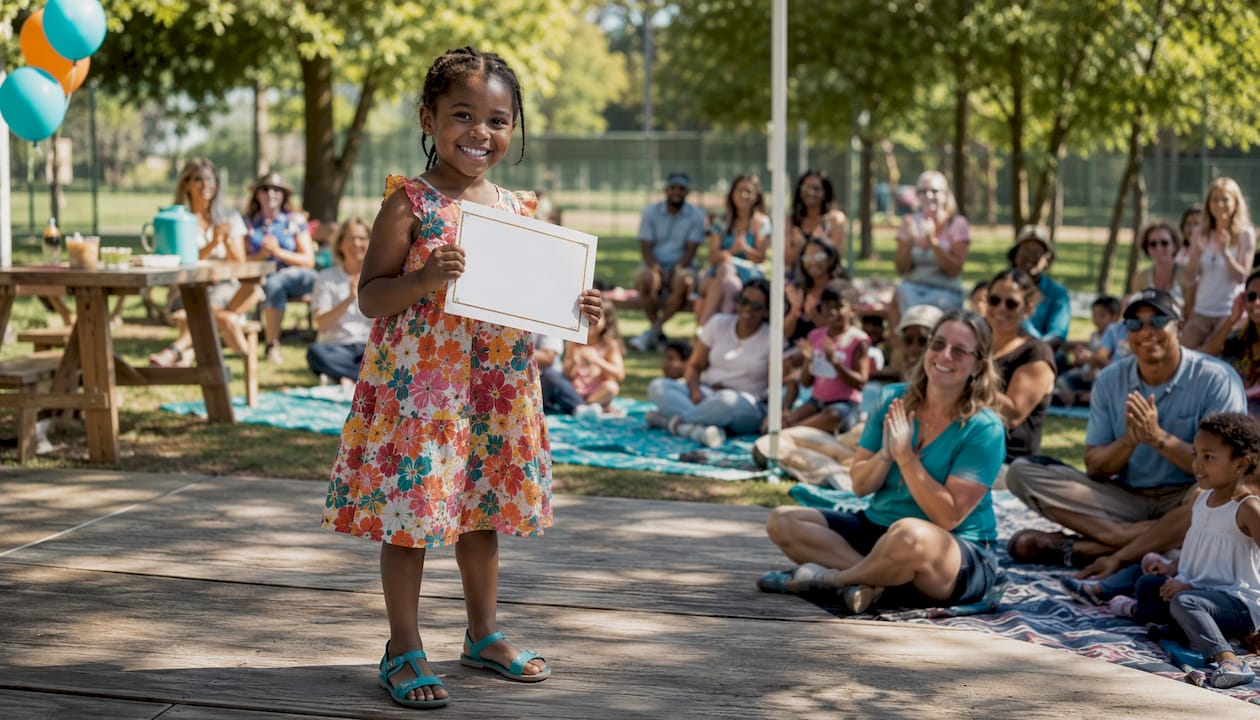
School awards matter. When recognition is designed thoughtfully, it publicly links a child’s effort to their identity and to the values their school community holds dear. That connection does more than make a student smile on ceremony day.
The strongest case for awards: Structured recognition systems correlate with higher academic persistence when criteria are transparent and recognition is ongoing rather than a single annual event. Beyond the individual winner, research on Brazil’s Math Olympiad found that classmates of award recipients showed measurably improved participation and test performance, with peer spillover effects extending to college enrollment decisions.
The main risk to watch: Awards built on opaque criteria or single-winner formats can confirm fixed-mindset thinking, exclude students with invisible disabilities or late-blooming strengths, and reduce intrinsic motivation when the prize becomes the point rather than the learning.
Two authoritative signals anchor this conversation: the National Merit Scholarship Program, which has shaped college access for decades, and Carol Dweck’s growth mindset research, which reframes what schools should actually be recognizing.

Table of Contents
Why schools give awards: intended goals and signals
Schools award students for reasons that go well beyond handing out trophies. Understanding those reasons helps you judge whether the awards at your child’s school are doing what they are supposed to do.
The core intended purposes include:
Motivating effort and persistence by showing students that hard work is noticed and valued by the adults around them.
Signaling academic and character standards to the whole school community, making clear what the school genuinely prizes.
Strengthening school identity by celebrating shared values, whether that is curiosity, kindness, or environmental responsibility.
Engaging families and stakeholders through ceremonies that bring the community together and build pride in the school’s culture.
Opening doors through scholarship-linked awards, which can provide thousands of dollars in financial support and directly affect a student’s postsecondary access.
There is also an important distinction between internal and external signaling. Internally, an award tells a child something about who they are: “You are the kind of person who persists.” Externally, it tells parents, prospective families, and the wider community what the school stands for. Both signals matter, but they call for different design choices. A ceremony that is purely performative for external audiences can feel hollow to the students it is supposed to celebrate.
When awards function instrumentally, as scholarships or selection criteria, the stakes are concrete and financial. When they function communally, as culture-building moments, the stakes are relational and motivational. The best programs do both at once. Edu’s experience as an award-winning school in Singapore reflects exactly this dual purpose: institutional recognition and genuine community pride reinforce each other.
Common types of school awards and what each recognizes
Not all awards are created equal, and the type of award a school chooses sends a message about what it values. Here is a practical overview:
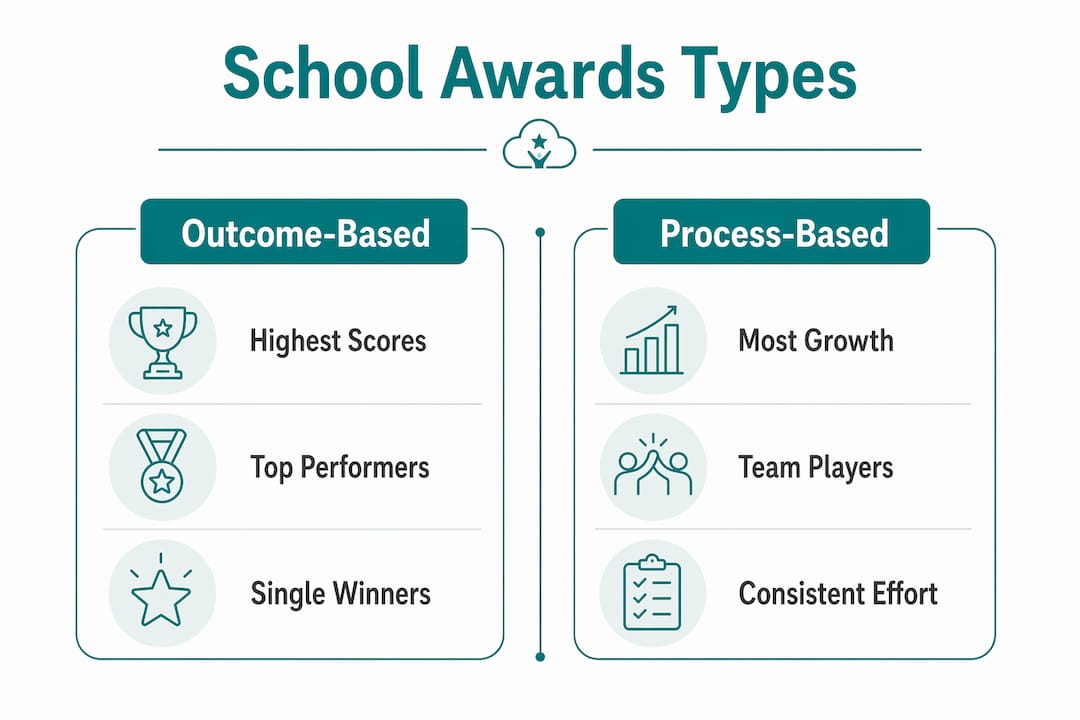
Academic excellence awards recognize top grades or test scores. They emphasize outcome and tend to reward students who were already high performers, which is why they need to be balanced with other categories.
Growth and effort awards recognize measurable improvement over time, regardless of where a student started. These are among the most equitable award types because they reward process, not just result.
Citizenship and character awards honor qualities like kindness, leadership, and community contribution. They are harder to measure but often the most meaningful to recipients and their families.
Arts and sports awards celebrate achievement in non-academic domains, which is critical for students whose strengths do not show up on a report card.
Subject-specific awards (science fair winner, spelling bee champion) recognize depth in a particular discipline and can spark lasting interest in that field.
Scholarship-based awards carry direct financial value and can change a student’s life trajectory, particularly for families with limited resources.
Community impact awards recognize students who have contributed beyond the classroom, through volunteering, environmental projects, or peer support.
The distinction between outcome-based awards (who scored highest) and process-based awards (who grew the most, who helped others) is worth keeping in mind. Symbolic awards, a certificate or a badge, and monetary awards produce different effects. Symbolic recognition works primarily through identity and peer perception; monetary awards add a tangible incentive that can be powerful but also risks making the reward feel transactional. Diversifying recognition types to reach more students is one of the most practical steps any school can take.
How awards can help students and the school community
The benefits of school recognition are real, but they work through specific psychological and social mechanisms. Knowing those mechanisms helps you design programs that actually deliver.
Identity formation is the most powerful mechanism. When a child receives public recognition, it does not just feel good in the moment. It updates how they see themselves. A student who wins a growth award begins to think of herself as someone who improves through effort, and that self-concept carries forward into future challenges. This is the core insight behind Dweck’s growth mindset research: recognition that highlights how a student achieved something, not just that they achieved it, builds a more resilient learner.

Peer spillovers are a less obvious but equally important benefit. In the Math Olympiad study, classmates of narrow award winners increased enrollment in selective colleges by about 10%, and their academic performance rose by a meaningful fraction of the winner’s effect. The award changed the social norm in the room, not just the winner’s trajectory. In a small school setting, where every student knows every other student, this spillover effect is amplified considerably.
Retention and re-engagement are supported by what researchers call the Retention Amplification Effect. Public validation can stabilize a student’s self-concept and help them re-engage after a setback, particularly when recognition is tied to effort and growth rather than a single test score.
Community signaling matters too. When a school recognizes innovation, environmental work, or community service, it tells current and prospective families what the school genuinely stands for. School-level awards extend beyond students to strengthen institutional reputation and stakeholder relationships.
Pro Tip: Focus growth and effort criteria on a specific, observable behavior, such as “improved reading fluency by two grade levels” or “volunteered 20 hours in the school garden,” rather than vague descriptors like “showed great effort.” Specificity makes the recognition feel earned and gives other students a concrete model to aspire to.
Common criticisms and potential harms of awards
A balanced view of school recognition requires taking the criticisms seriously. Several are well-founded and point to real design failures rather than problems with awards in principle.
Perceived unfairness is the most common complaint. When students or parents cannot understand how a winner was chosen, the award loses credibility and can breed resentment.
Fixed-mindset reinforcement happens when awards consistently go to the same students for the same abilities, signaling that talent is fixed and that effort is irrelevant for those who do not already excel.
Social exclusion is a genuine harm. Students who never receive recognition can feel invisible, and repeated exclusion from ceremonies can damage their sense of belonging.
Performative tokenism occurs when schools add a few new award categories without changing the underlying criteria, creating the appearance of inclusion without the substance.
Ceremony stress affects students who are anxious about public attention, and it can overshadow the positive experience for those who do win.
Crowding out intrinsic motivation is a documented risk. When the external reward becomes the focus rather than the learning itself, some students disengage from the activity once the award is no longer available.
Design choices amplify or reduce these harms. Opaque criteria, single-winner formats, and annual-only ceremonies are the three most common structural mistakes.
The single biggest avoidable design mistake is ambiguous or undisclosed criteria. When students and families cannot see how winners are selected, every award becomes a source of suspicion rather than inspiration. Transparent rubrics, shared in advance, are the single most effective structural fix available to any school.
How to design fair, effective award programs
Good award programs do not happen by accident. They are the result of deliberate choices about criteria, process, timing, and language.
Design checklist:
Write and publish transparent criteria before nominations open, not after.
Create multiple recognition pathways: academic excellence, growth, effort, character, arts, community impact.
Use a nomination process that includes evidence, such as a teacher observation log, a student portfolio, or peer nominations with written rationale.
Rotate award types across terms so different students have meaningful opportunities throughout the year.
Include peer-nominated categories to give students agency and broaden the pool of recognized behaviors.
Pair awards with follow-up supports: mentoring, enrichment opportunities, or a conversation with a counselor about next steps.
Implementation steps:
Collect data on who has and has not been recognized over the past two to three years, then use that data to identify gaps.
Diversify award types deliberately, adding at least one effort-based and one community-impact category if they do not already exist.
Introduce micro-recognition between formal ceremonies: weekly shout-outs, digital badges, or a recognition wall in the hallway.
Time formal awards to coincide with natural learning milestones, not just the end of the year, so recognition feels connected to the work.
Link awards to concrete opportunities. Recognition paired with mentoring or enrichment produces better long-term outcomes than a certificate alone.
Sample award scripts:
Academic excellence: “This award recognizes [Name] for consistent intellectual curiosity and a commitment to understanding, not just completing. [Name] asked questions that made the whole class think more deeply.”
Effort and improvement: “This award goes to [Name], who set a personal goal at the start of term and reached it through persistence and a willingness to ask for help. That kind of courage is exactly what learning looks like.”
Citizenship: “This award recognizes [Name] for the quiet, consistent ways they have made our classroom a kinder place. Leadership is not always loud, and [Name] has shown us that.”
Avoid ranking language (“our top student,” “the best in the class”) and exclusive superlatives that imply only one child could ever deserve recognition. Language that highlights what the student did and why it matters is always more powerful than language that positions them above their peers.
Pro Tip: Use a small review panel of two or three staff members, rather than a single teacher’s sole decision, and apply a written rubric to each nomination. This reduces unconscious bias and makes the outcome defensible to any parent who asks.
Equity and inclusion: who benefits and who can be left out
Recognition programs that feel fair to the majority can still systematically exclude specific groups. Identifying those groups is the first step toward fixing the problem.
Groups commonly left out:
Students with invisible disabilities, such as dyslexia or anxiety, who may perform below their actual capability on the metrics most awards use.
Late bloomers, whose growth happens after the recognition window closes.
Multilingual learners, who may excel in ways that English-dominant academic criteria do not capture.
Economically disadvantaged students, who may lack access to the extracurricular activities that feed into arts, sports, and community awards.
Students who are quiet or introverted, who may do excellent work but never self-advocate or attract teacher attention in the ways that lead to nominations.
Practical fixes:
Broaden award categories to include contributions that do not require academic fluency, such as peer support, creative problem-solving, or environmental stewardship.
Create effort-based recognitions with observable, measurable criteria that any student can meet regardless of starting point.
Use anonymized nomination processes for some categories to reduce the influence of teacher-student relationship dynamics.
Build mentor-linked awards that connect recognition to an ongoing relationship, not just a one-time moment.
Invite student and parent voice into criteria-setting at the start of each year, so the community shapes what gets celebrated. Celebrating diverse achievements is not a nice addition; it is what makes recognition meaningful for every child.
Pro Tip: Pilot two or three new award categories for one term, then survey students and parents about whether the recognition felt fair and representative. Use that feedback to refine before making the categories permanent.
Alternatives and complements to traditional award ceremonies
Formal ceremonies are not the only way to recognize students, and for some schools, they are not even the best way. Several alternatives achieve the same goals with fewer of the downsides.
Micro-recognition (weekly classroom shout-outs, a “caught being kind” board, digital badges on a learning platform) reaches far more students than an annual ceremony and keeps motivation consistent throughout the year.
Portfolios and progress displays let students showcase growth over time, making the recognition visible to families without creating a competitive ranking.
Experiential rewards such as a class field trip earned collectively, a project showcase open to the community, or a student-led exhibition celebrate achievement without singling out individuals.
Group-based celebrations recognize a team’s collaborative work, which builds belonging and reduces the social cost of exclusion.
Private acknowledgments, a handwritten note from a teacher, a phone call home, or a one-on-one conversation, can be more meaningful to some students than public recognition, particularly for those who find ceremonies stressful.
The choice between redesigning a traditional ceremony and replacing it with alternatives depends on what the school is trying to achieve; for practical ideas on ceremony formats and trophies, see benefits galelor școlare pentru elevi și profesori. If the goal is community building and stakeholder engagement, a well-designed ceremony still has real value. If the goal is daily motivation and belonging for every student, micro-recognition and celebration days are often more effective. The strongest programs use both: formal recognition for milestone moments and ongoing informal recognition to sustain a culture of appreciation.
What studies say about praise, awards, and student motivation
The research on school recognition is more nuanced than either its advocates or critics usually admit. Here is what the evidence actually shows.
Awards produce measurable gains for winners, but the effect depends heavily on how the award is framed. When recognition signals a stable, positive identity (“you are a persistent learner”), it supports re-engagement after setbacks. When it signals that the award is the reason to do the activity, intrinsic motivation can decline once the award is removed. This perception-dependent effect is one of the most important findings in the motivation literature and explains why two schools can run similar award programs with very different outcomes.
Peer spillovers are real but concentrated. The Math Olympiad study is the most rigorous large-scale evidence available: classmates of narrow winners showed improved performance and higher rates of selective college enrollment. But those spillovers were strongest among classmates who were close in ability to the winner, suggesting that awards work best as social signals when students can genuinely see themselves in the winner’s position.
The Retention Amplification Effect offers a compelling case for effort-based recognition specifically. Public validation that is tied to growth rather than fixed performance helps students re-engage after difficulty, which is precisely when schools most need their students to stay motivated.
The research consensus is not “awards good” or “awards bad.” It is that design determines outcome. Transparent criteria, growth-focused framing, and ongoing recognition produce measurable benefits. Opaque criteria, fixed-ability framing, and annual-only ceremonies produce the harms critics rightly identify.
Recognition that is intentional and measurable increases participation, wellbeing, and self-efficacy across academic and non-academic domains. The evidence is consistent enough that the question for schools is not whether to recognize students, but how.
Key Takeaways
Well-designed school awards strengthen student identity, build peer norms, and support persistence, but only when criteria are transparent, recognition is ongoing, and multiple pathways exist for diverse learners.
Point | Details |
Design determines outcome | Transparent criteria and growth-focused framing produce benefits; opaque, fixed-ability formats produce harm. |
Peer spillovers are real | Classmates of narrow award winners increased enrollment in selective colleges by about 10%, and their academic performance rose by roughly one-fifth of the winner’s effect, especially in small school settings. |
Equity requires active effort | Groups including late bloomers, multilingual learners, and introverted students are systematically underrecognized without deliberate category design. |
Complement ceremonies with micro-recognition | Ongoing informal recognition sustains motivation between formal events and reaches students who won’t stand out in competitive categories. |
Parents play an active role | Ask your school for the award rubric, support your child’s response to both winning and not winning, and advocate for growth-based categories if they are missing. |
A practitioner’s perspective
The most common mistake I see in school award programs is not bad intentions. It is inertia. A school runs the same five award categories it has always run, the same ten students collect certificates every year, and everyone quietly agrees that the ceremony is really for the parents rather than the children.
When a school shifts even one category from “highest grade” to “most measurable growth,” the nominations change. Students who had never been called to the front of the room suddenly are. That shift does not diminish the academic excellence award; it adds a second signal that effort and improvement are also worth celebrating. The students who win the growth award often describe it as more meaningful than any grade they have received, because it recognizes something they actually did, not just something they happened to be good at.
The practical lesson is that equity in recognition does not require dismantling what works. It requires adding pathways for students whose strengths the existing system cannot see. A small review panel, a published rubric, and two or three new categories are enough to change who feels seen in a school community. That change is worth making.
Selected sources and further reading
These are the primary sources and practitioner guides that informed this article. If you are making award program decisions at a school level, consulting the original studies is worthwhile.
A note on using these sources: The research on awards and motivation is rich but sometimes contradictory. Read primary studies alongside practitioner guides to get both the empirical evidence and the implementation reality.
Merit Recognition Systems and Academic Persistence (CFDER) — The most thorough available synthesis on how structured recognition affects long-term academic persistence, including the Retention Amplification Effect.
Math Olympiad Peer Spillover Study — Large-scale empirical evidence on how public recognition of one student affects the academic trajectories of classmates.
Student Recognition: The Complete Guide — Practitioner-facing resource covering program design, micro-recognition formats, and how to pair recognition with follow-up supports.
Frontier Centre: Retaining Academic Awards — Policy perspective on the social mobility stakes of scholarship-linked awards and the case against eliminating academic recognition.
TeacherVision Award Templates — Practical, ready-to-adapt certificate formats and ideas for diversifying recognition types across a school year.
QAHE: The Importance of Awards in Education — Accessible overview of how awards function as motivational and community-building tools in school settings.
KQED MindShift: How a School Ditched Awards — A practitioner case study of one school’s decision to move away from traditional ceremonies and what they learned from the experience.
Alfie Kohn: Rewards and Recognition — The most cited critical perspective on external rewards in education; essential reading for understanding the intrinsic motivation argument.
Recommended
Comments