


Why School Location Matters for Your Family

School location is one of the most consequential decisions a family makes, shaping a child’s academic performance, daily wellbeing, and the entire household’s quality of life. Why school location matters goes far beyond the school’s ranking or curriculum. Research shows that commute time, neighborhood safety, and proximity to resources all directly affect how well children learn and how sustainably families function. A school that looks impressive on paper can quietly drain a child’s energy if the daily travel is exhausting. The right location supports consistent routines, social connections, and a nurturing environment where children genuinely thrive.
Why school location matters for student performance and wellbeing
School location shapes a child’s academic outcomes in ways that most parents underestimate. Commute time influences sleep, stress, family routine, extracurricular activity, and emotional wellbeing. That is not a minor list. Each of those factors compounds the others, meaning a long commute does not just cost time. It costs focus, resilience, and the mental energy children need to engage fully in class.
Long daily commutes drain children’s after-school energy, harming academic focus and emotional regulation. A child who spends 90 minutes traveling each day arrives home depleted. Homework, reading, and creative play all suffer as a result. Over weeks and months, that deficit accumulates into measurable gaps in learning.

Neighborhood safety around a school also plays a direct role. Children who feel unsafe traveling to or from school experience higher anxiety levels, which research consistently links to reduced concentration and lower academic engagement. A school placed in a calm, walkable neighborhood removes that layer of stress before the school day even begins.
Key ways school proximity affects student wellbeing:
Sleep quality: Shorter commutes allow for earlier bedtimes and more consistent sleep schedules, which directly support memory consolidation and attention.
Extracurricular participation: Children who live close to school can join after-school clubs, sports, and arts programs without logistical barriers.
Emotional stability: Predictable, low-stress travel routines reduce morning anxiety and help children arrive at school ready to learn.
Physical activity: Walking or cycling to a nearby school builds daily movement into a child’s routine naturally.
Pro Tip: When evaluating schools, time the actual commute during peak morning hours, not on a quiet weekend. The real-world travel time often differs significantly from map estimates.
What role does school location play in family lifestyle and community integration?
School location shapes far more than the morning routine. It determines how deeply a family connects with its neighborhood, how much time parents spend in transit, and whether children grow up with a genuine sense of community. Schools placed on neighborhood outskirts cause longer travel distances, increased reliance on motorized transport, higher costs, and equity concerns. That pattern affects low-income families most severely, since transportation costs consume a larger share of their household budget.
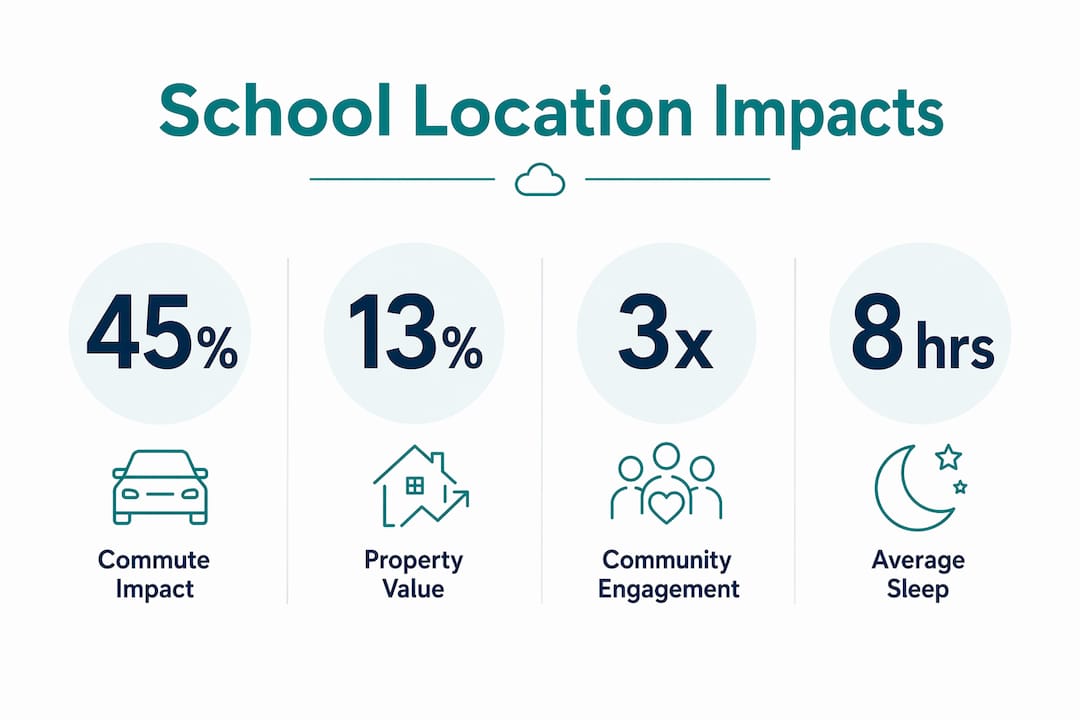
Central school placement fosters walking and cycling, reducing car dependency and promoting equity among low-income families. When children walk to school, they interact with neighbors, develop spatial confidence, and build friendships outside the classroom. Those informal connections are a genuine part of childhood development that a long bus ride cannot replicate.
Schools also function as social infrastructure. A neighborhood school becomes a gathering point for families, a venue for community events, and a symbol of shared investment in children’s futures. Parents who live close to a school are more likely to volunteer, attend events, and form lasting friendships with other families. That social fabric strengthens both the school and the neighborhood around it.
Physical proximity does not equal functional accessibility. Safe, connected routes matter for actual walkability. A school two blocks away behind a busy highway offers far less community benefit than one a kilometer away with dedicated pedestrian paths and crossings.
The importance of school location for community integration is especially visible when schools close. Neighborhoods lose a focal point, social networks fragment, and families who chose their home partly for school access feel the loss acutely. Choosing a school with strong community roots is an investment in your family’s social life, not just your child’s education.
For families new to Singapore, understanding how to navigate school choices for expat kids in an unfamiliar city makes location an even more critical starting point.
How does proximity to quality schools influence housing and economic decisions?
The connection between school quality, proximity, and property values is well documented and financially significant. A 1 percentage point increase in school academic performance is associated with a 9% increase in parents’ willingness to pay a housing premium. That figure reveals how seriously families treat school location when making residential decisions.
Rental markets reflect the same pattern. Each one-standard deviation increase in public school test scores correlates with a 2.7% rise in apartment rents. Landlords and developers in high-performing school districts price that advantage into their listings, whether or not tenants have children. The school’s reputation becomes a neighborhood asset.
The economic risk runs in the opposite direction too. Closure of a local school can trigger a 13% decrease in surrounding residential property values. That is a meaningful financial loss for homeowners who made purchasing decisions partly based on school access. Higher property values and community activity are associated with the presence of neighborhood schools, particularly in smaller communities where the school anchors local identity.
Families considering Singapore’s District 11 can see this dynamic clearly. Residential developments near established schools, such as those near Dunearn House in District 11, reflect the premium that proximity to quality education commands in the market.
Pro Tip: Public school location value is tied strictly to district boundaries. Private and international schools allow broader geographic choice, but transportation costs and commute time still factor into the true cost of attendance.
Economic factor | Impact of school proximity |
Residential property values | Rise significantly near high-performing schools |
Apartment rental rates | Increase with each improvement in nearby school scores |
Property values after school closure | Can fall by up to 13% in surrounding areas |
Family transportation costs | Increase substantially when schools are on neighborhood outskirts |
What practical factors should parents consider about school location?
Choosing a school based on location requires balancing several factors that do not always point in the same direction. Flagship programs, school location, and teacher quality all positively influence parental school selection decisions. The challenge is that parents often prioritize rankings and curriculum while underweighting the daily reality of getting their child there and back.
A useful framework for evaluating school location covers five areas:
Commute time and mode: Aim for a travel time that allows your child to arrive calm and rested. Walking or cycling is preferable when safe routes exist.
Route safety: Assess pedestrian crossings, traffic volume, and lighting on the path between home and school. Distance alone does not determine safety.
After-school access: Consider whether your child can participate in clubs and activities without requiring a parent to make an extra trip.
Neighborhood environment: A school surrounded by parks, libraries, and community spaces extends learning beyond the classroom walls.
Flexibility for family changes: A school that works for your current routine should also work if your work schedule or home address shifts.
The best school for your child in 2026 is not necessarily the one with the highest ranking. It is the one that fits your child’s learning needs and your family’s daily life without creating chronic stress. Parents who choose a prestigious school far from home often find that the academic gains are offset by exhaustion, reduced family time, and limited social integration in the local community.
Physical proximity and functional accessibility are different things. A school close to your home but separated by unsafe roads or unreliable transport offers fewer real benefits than a slightly farther school with a direct, safe route. Evaluate the full journey, not just the distance on a map.
Key Takeaways
School location directly shapes academic outcomes, family wellbeing, and economic decisions. The most effective school choice balances quality, commute sustainability, neighborhood safety, and community connection.
Point | Details |
Commute affects learning | Long daily travel reduces sleep, focus, and extracurricular participation in measurable ways. |
Location drives property value | A 1% rise in school performance links to a 9% increase in parents’ housing premium willingness. |
School closure costs communities | Nearby school closures can reduce surrounding property values by up to 13%. |
Central placement supports equity | Schools near neighborhood centers promote walking, reduce costs, and benefit lower-income families. |
Location is a top parental priority | Parents rank school location alongside teacher quality and flagship programs when choosing schools. |
Location over prestige: what I’ve learned from watching families choose schools
Elena here. After years of observing how families make school decisions, the pattern I see most often is this: parents spend months researching curriculum frameworks and league table rankings, then spend almost no time thinking about what the commute will feel like in week 14 of the school year, when the novelty has worn off and everyone is tired.
The families I have seen thrive are not always the ones who chose the most decorated school. They are the ones who chose a school they could sustain. A child who arrives at school calm, on time, and with energy to spare will outperform a child who arrives exhausted from a 90-minute commute, regardless of which school has the better test scores.
There is also something undervalued about a school that is genuinely part of your neighborhood. When your child’s classmates live nearby, friendships extend beyond school hours. Parents meet at the park, not just at pickup. That social integration is part of what makes childhood feel full and connected rather than fragmented across different parts of a city.
My honest advice: visit the school on a regular Tuesday morning, not an open house Saturday. Walk the route your child would take. Notice whether the neighborhood feels calm and welcoming. The right school will feel right in the body, not just on paper.
— Elena
Astor International School: location and learning working together
Edu’s Astor International School sits in Singapore’s Tanglin area, one of the city’s most accessible and family-friendly neighborhoods. For families weighing the impact of school proximity on daily life, the campus location offers genuine convenience without sacrificing educational quality.

Astor has been recognized as both the best small school and the best affordable international school in Singapore. Small class sizes mean every child receives personal attention, and the school’s IPC curriculum connects academic learning to real-world inquiry in a way that keeps children curious and engaged. For families with younger children, Astor International Preschool in Holland offers a nurturing start with two playgrounds and a blend of outdoor and classroom learning. Location and learning quality do not have to be a trade-off.
FAQ
Why does school location affect academic performance?
School location affects academic performance because commute time directly impacts sleep quality, stress levels, and a child’s readiness to learn. Children with shorter, calmer commutes arrive at school with more energy and focus.
How does school proximity influence property values?
Research shows that a 1 percentage point improvement in school academic performance is associated with a 9% increase in parents’ willingness to pay a housing premium. School closures can reduce nearby property values by up to 13%.
What makes a school location genuinely accessible?
Physical distance alone does not determine accessibility. Safe pedestrian routes, low traffic volume, and reliable transport options all determine whether a child can travel independently and safely.
Should parents prioritize school location over school quality?
Parents should weigh both together. Parental decision-making research shows that location ranks alongside teacher quality and flagship programs as a top priority. A high-quality school with an unsustainable commute often delivers worse outcomes than a slightly less prestigious school nearby.
How does school location affect family community life?
Schools placed centrally in neighborhoods promote walking, social interaction, and community cohesion. Schools on the outskirts increase car dependency, reduce informal social contact, and create equity challenges for families without reliable transportation.
Recommended
Comments