


Best Small Class Size Schools for Parents: Evidence-Backed Guide
- sasha2644
- Aug 2
- 9 min read

The best small class size schools are those that deliberately cap enrollment per classroom, typically between 8 and 15 students, and pair that smaller group with intentional, personalized instruction. This is not just about headcount. The Tennessee STAR experiment, one of the most rigorous randomized studies in education research, compared K–3 classes of 13–17 students against classes of 22–25 and found that children in the smaller groups outperformed peers by the equivalent of roughly three months of additional schooling four years later. The Washington State Institute for Public Policy (WSIPP) reinforces this: early-grade reductions carry a high probability of producing benefits that exceed their costs.
The single most important action for parents: prioritize schools with published class caps of 15 or fewer in the early grades, and verify that teachers use that extra time for genuinely personalized instruction, not just a smaller version of the same whole-class lesson.
The STAR experiment used classes averaging about 15 students for small classes versus about 22 for regular classes.
Leading private programs, such as those with low student–teacher ratios around 9:1, set relatively small class caps designed for personalized learning.
The WSIPP analysis found a very high probability that reducing class size in first grade produces benefits greater than costs.
Benefits are largest in kindergarten through grade 3 and for children from disadvantaged backgrounds.
Table of Contents
What does research say about small class size benefits?
The evidence for small class sizes is stronger in the early grades than almost anywhere else in education policy. The STAR results showed measurable gains on both standardized and curriculum-based tests for students across urban, suburban, and rural schools, and for children of all backgrounds. Those gains were not a short-term blip: they persisted years after children returned to regular-sized classes.
Beyond test scores, the research points to something parents often notice first: the quality of daily life in the classroom. A peer-reviewed overview of academic and non-cognitive outcomes identifies three mechanisms that explain why small classes work: more instructional time per child, more personal academic support, and a stronger sense of class identification and belonging. These translate into better behavior, higher engagement, and closer teacher–student relationships, all of which mediate the academic gains.
Small classes enable a shift from managing a group to delivering personalized instruction. Every child is known by name, and teachers can move fluidly between remediation and extension within a single lesson. This personalized instruction is what produces lasting outcomes, rather than the smaller number alone.
Meta-analyses and STAR-derived results estimate effect sizes of 0.15–0.22 standard deviations when reductions are large and introduced early. For a parent, that translates to a child who is more confident, more curious, and more likely to develop a genuine love of learning in the foundational years. The small class size benefits for non-cognitive development are often visible within weeks of a child starting in a well-designed small-class program.
What counts as a small class? Targets by age and grade
“Small” means different things at different ages. Here is a practical reference:
Age / Grade | Recommended Class Cap | Student–Teacher Ratio |
Preschool (ages 2–4) | 8–15 students | 5:1 to 8:1 |
Kindergarten–Grade 2 | 10–15 students | 9:1 to 13:1 |
Grades 3–5 | 12–18 students | 13:1 to 17:1 |
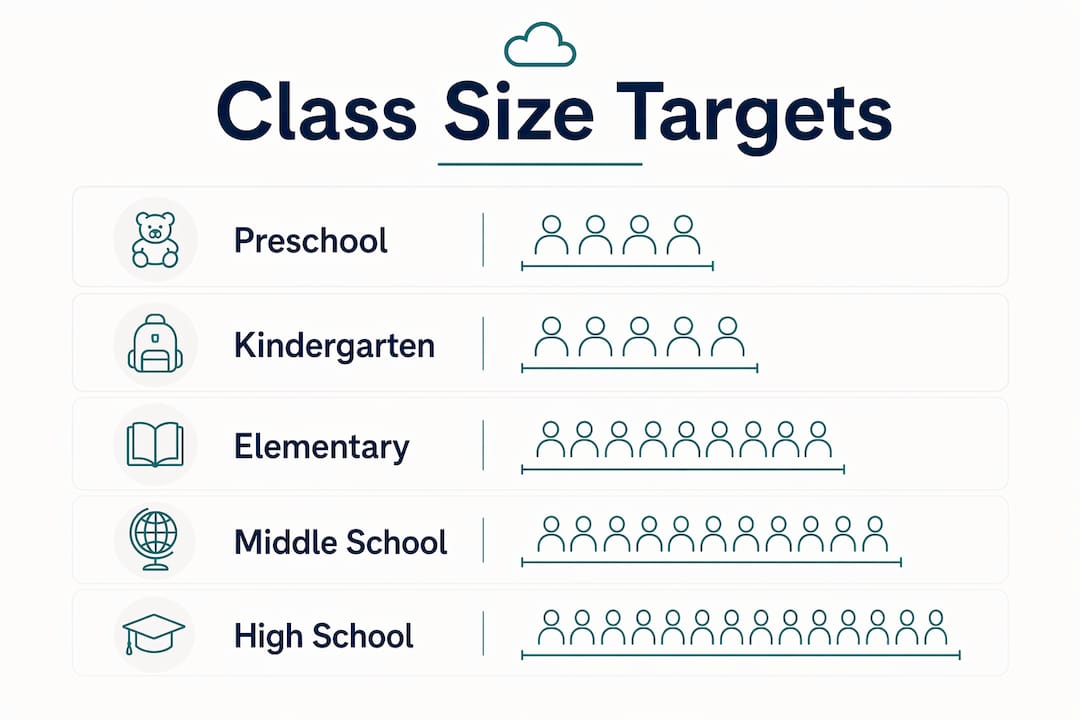
The STAR experiment defined “small” as 13–17 students versus the regular 22–25, and that gap produced the measurable gains. Leading private schools push further: student–teacher ratios near 9:1 with class caps of 8–15 are common in programs that prioritize personalization above all else. Schools like The Academy School in Berkeley cap lower-school classes at approximately 12 students and upper-school classes at 15.
One distinction matters enormously when you are comparing schools: a class cap is the maximum number of children in a single classroom. A school-level student–teacher ratio is calculated across the whole school, including administrators, specialists, and support staff who may never lead a class. A school can advertise a 7:1 ratio while running classrooms of 22. Always ask for the per-classroom cap, not the school-wide ratio.
For preschool parents, the small preschool advantage is especially pronounced: very young children need more adult responsiveness per hour than any other age group, making the per-classroom ratio the single most important number to request.
When do small classes matter most, and what are the trade-offs?
Small classes deliver their biggest returns when the reduction is large (7–10 fewer students), introduced early (kindergarten through grade 3), and paired with experienced teachers. The WSIPP benefit–cost analysis is clear that benefits decline in upper grades and that modest reductions of two or three students produce only modest returns.
Advantages of small class sizes:
Deeper individual attention and faster identification of learning gaps
Better classroom behavior and higher engagement, which benefit every child, not just those who struggle
Stronger teacher–student relationships that support confidence and curiosity
Teachers can differentiate instruction in real time, moving between support and extension
Trade-offs to weigh:
Smaller peer groups mean less social breadth; children interact with fewer classmates
Small-class programs often cost more, either in tuition at private schools or in per-pupil spending at public ones
A school with a small class due to low enrollment rather than intentional design may lack the program breadth, enrichment options, and experienced staff that make small classes work
One persistent misconception is that small classes mainly help struggling students. The research says otherwise: the shift to personalized instruction benefits the full range of learners because every child receives more responsive teaching, not just those who need remediation. High-ability children advance faster; children who need support get it sooner.
How do you evaluate a school on your visit?
Knowing the right numbers is only half the work. Here is a checklist you can use before and during any school visit.
Before you visit:
Request the published per-classroom cap for each grade, not the school-wide ratio.
Ask for average teacher tenure and the school’s professional development policy.
Check whether the school publishes its instructional model and how it uses small-group time.
During the tour, observe:
Are teachers circulating and engaging individual children, or delivering the same lesson to the whole group?
Do children appear engaged and settled, or restless and disconnected?
Is there visible evidence of differentiated work: different tasks, different materials, different pacing for different children?
Can the teacher name every child and speak to each child’s current learning focus?
Questions to ask administrators:
“What is the maximum number of students per classroom in kindergarten and grade 1?”
“How do teachers use the extra time that a smaller class provides?”
“What is your average teacher tenure, and how do you support ongoing professional development?”
“Can you show me an example of differentiated student work from a recent week?”
Red flags:
Small class size is explained by low enrollment, not intentional design
Teachers cannot describe how instruction differs for individual children
No evidence of small-group or one-on-one work during the tour
High teacher turnover or a heavy reliance on newly qualified staff
Trust signals:
Published class caps by grade, not just a school-wide ratio
Documented use of small-group instruction and individualized learning plans
Strong teacher retention and a visible professional development program
Pro Tip: Ask to see a recent week’s lesson plan or examples of differentiated student work. A school that uses small class size intentionally will have these ready and will be proud to share them. A school where small size is incidental will struggle to produce either.
Research confirms that teacher experience and professional development are critical mediators: a class of 20 with a skilled, well-supported teacher can outperform a class of 12 with inexperienced instruction. The student–teacher ratio only delivers its full value when the adults in the room are equipped to use it.

Practical next steps for the next 30–90 days
Timeline:
Now through September: Research schools online, request class-cap data, and shortlist three to five candidates.
October–November: Schedule visits and bring the checklist above.
December–January: Submit applications; most private schools and some charter programs have early-round deadlines.
Cost trade-offs:
The WSIPP analysis found a 94% probability that reducing class size in first grade produces benefits exceeding costs over a child’s life cycle. For families comparing tuition at a small-class private school against a larger public option, the premium tends to be most justified in kindergarten through grade 3, when the research shows the largest returns. You can also explore private school value considerations to weigh program breadth, enrichment, and class size together.
Your to-do list:
Request per-classroom caps (not school-wide ratios) from every school on your list.
Visit at least two schools with your observation checklist in hand.
Ask one teacher: “How does your instruction differ for your most advanced and your most supported learner?”
Compare tuition against the documented class cap and teacher tenure data.
Make a decision before February if applying for the following September.
What should time-pressed parents prioritize?
The research points to one clear hierarchy: early grades + intentional personalization + experienced teachers. A school that hits all three is genuinely rare and worth the premium. If you can only optimize for one factor, make it the per-classroom cap in kindergarten through grade 2, because that is where the evidence for lasting impact is strongest.
Priority list for final decisions:
First: Confirm a per-classroom cap of 15 or fewer in K–2.
Second: Verify that teachers use small-class time for differentiated, personalized instruction.
Third: Check teacher tenure and professional development investment.
Fourth: Assess program breadth: enrichment, outdoor learning, and social opportunities.
Fifth: Evaluate cost relative to the documented class cap and instructional model.
Key Takeaways
Schools with intentional class caps of 13–17 students in the early grades, paired with experienced teachers and personalized instruction, produce the strongest and most lasting academic and non-cognitive outcomes for young children.
Point | Details |
Target class cap | Look for a per-classroom cap of 13–17 students in kindergarten through grade 2. |
STAR evidence | STAR classes of 13–17 students outperformed classes of 22–25 by roughly three months of extra schooling. |
Best timing for investment | The WSIPP analysis shows the largest returns in grades K–3; the premium is most justified in the earliest years. |
Teacher quality matters | Experienced teachers with ongoing professional development are what make small class size deliver its full benefit. |
Edu’s approach | Astor International School offers intentionally small classes, inquiry-based learning, and enrichment programs for children aged 5–12 in Singapore. |
Why small schools and small classes are not the same thing
A small school does not automatically mean small classes, and a large school can run small-class programs within it. What the research rewards is intentional design: a school that builds its pedagogy around the extra adult time that a smaller group creates. The Antioch School and similar programs structure both whole-class and small-group instruction deliberately, so every child moves through content at a pace that fits them.
From my perspective, the most underrated signal during a school visit is not the ratio on the brochure. It is whether the teacher can tell you, without hesitation, what each child is working on right now and why. That level of individual knowledge is only possible when class size is small by design, not by accident. Parents who ask for that specific demonstration during a tour will learn more in two minutes than they will from any admissions presentation.
Schools that treat small class size as a marketing point rather than an instructional commitment tend to look identical on paper to schools that live it every day. The checklist in this article exists precisely to help you tell the difference.
Astor International School: small classes by design, not by default
Astor International School in Singapore offers something genuinely rare: a school that has been recognized as the best small school in Singapore and the best affordable international school in Singapore, with intentionally small classes for children aged 5–12 built around the IPC curriculum. Every classroom is designed so teachers know each child deeply, differentiate instruction in real time, and move fluidly between whole-class, small-group, and individual learning.
The preschool program at Astor, for children from 18 months, extends the same philosophy: two playgrounds, a blend of outdoor and classroom learning, and a nurturing environment where curiosity is met with genuine personal attention, similar to benefits seen in small group language classes that boost engagement and personalized learning. If you are looking for a school where small class size is a deliberate instructional commitment rather than a happy accident of low enrollment, Astor’s IPC curriculum and learning programs are worth exploring. Book a visit and bring your checklist.
Useful sources and further reading
Tennessee STAR research summary (Brookings): The most accessible policy-level summary of STAR findings and what they mean for school choice. Start here for the core evidence.
WSIPP benefit–cost analysis: Rigorous economic analysis of when class-size reductions pay off. Useful for parents weighing tuition costs against long-term outcomes.
Academic and non-cognitive effects of small classes (ScienceDirect): Peer-reviewed overview of the three mechanisms linking small classes to better outcomes. Best source for understanding behavior, engagement, and belonging effects.
Does class size matter? (policy brief): Accessible summary of experimental and quasi-experimental evidence, including effect-size estimates. Good for sharing with co-decision makers.
Nysmith School class-size philosophy: A concrete private-school example of a 9:1 student–teacher ratio and deliberate class caps of 8–15 in practice.
Recommended

Comments