


Examples of Classroom Routines for Young Learners
Classroom routines are structured, repeated procedures that create a predictable environment, directly improving children’s learning and behavior. In early education settings, these daily structures are not optional extras. They are the foundation of a calm, confident classroom. The best examples of classroom routines share three qualities: they are explicitly taught, consistently applied, and age-appropriate. Research confirms that predictable routines reduce anxiety and build the emotional safety children need to learn. For parents of preschool and primary-age children, understanding these routines helps you support your child at home and ask the right questions of your child’s school.
1. Morning entry routines that start the day right
The first five minutes of a school day set the tone for everything that follows. Entry routines capped at 3–5 minutes give children a clear, calm start while freeing teachers to handle administrative tasks. That short window is enough to settle children, store belongings, and begin independent work.
A strong morning entry routine includes several concrete steps:
Door greeting with choices. The teacher stands at the door and offers each child a handshake, high-five, or wave. This brief personal connection signals safety and belonging.
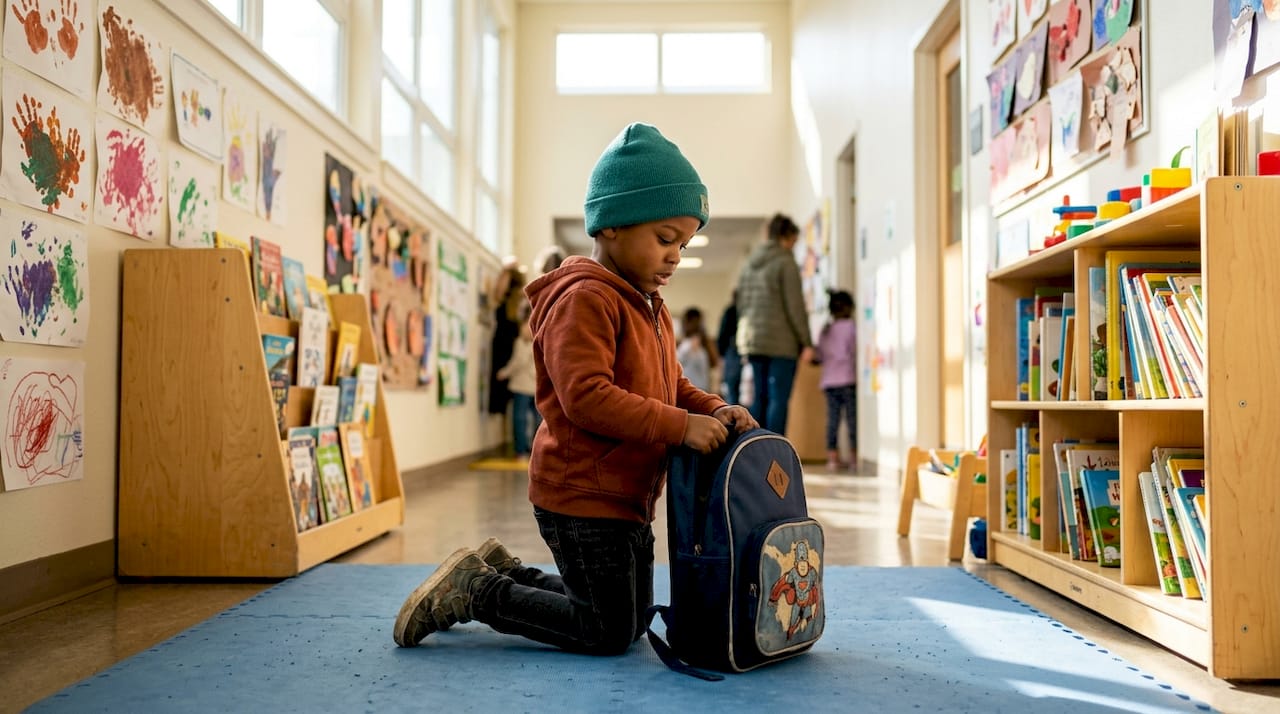
Systematic backpack storage. Each child has a labeled hook or cubby. Knowing exactly where things go removes the chaos of searching and arguing.
Silent bell work or morning question. A 20-second greeting followed by a daily question builds connection and gives children an immediate, low-stakes task to focus on.
Attendance and lunch count. Children check their own name card or move a clip on a chart. This builds responsibility and gives teachers accurate data without interrupting the class.
The goal is that every child walks in, knows what to do, and does it without prompting. That level of independence does not happen by accident. It is the result of the teacher explicitly modeling each step during the first weeks of school.
Pro Tip: Practice the morning entry routine at home before the school year begins. Walk your child through unpacking their bag, hanging it up, and sitting down to start a quiet activity. Familiar steps feel less daunting on day one.
2. Transition routines that keep children moving smoothly
Transitions are the moments between activities, and they are where classroom time most often gets lost. A class of young children moving from circle time to table work can take five chaotic minutes or under one minute, depending entirely on the routine in place.
The most effective transition routines use three tools together:
Attention getters and call-and-response signals. The teacher calls out a phrase, and children respond with a set reply before stopping what they are doing. This captures attention without shouting.
Visual timers. A visible countdown gives children a concrete cue. Transitions capped at 20 seconds with visual timers reduce downtime and maintain classroom order. Children can see the time shrinking, which motivates them to move.
Systematic material distribution. Paper passers and bucket brigades are two proven methods. Bucket brigades take about 60 seconds to distribute materials to a full class. Paper passers take roughly 45 seconds. Both methods are far faster than a teacher distributing materials one by one.
Line formation also matters. Children learn to stand with one arm’s length of space between them, hands to themselves, and voices off. This is not about control for its own sake. It protects children’s physical safety during movement and keeps the group focused.
Pro Tip: Ask your child’s teacher which attention signal they use in class. Practice it at home during transitions between activities. When children hear the same cue at home and at school, they respond faster and with less resistance.
3. Instructional routines that build active learners
The strongest instructional routines shift responsibility from the teacher to the child. This approach, often called student-centered learning, produces measurably better outcomes. Learner-centered practices correlate with higher exam performance compared to instruction-centered models. That finding holds across age groups and subjects.
Effective instructional routines for young children include:
Think-pair-share. The teacher poses a question, children think silently, then discuss with a partner before sharing with the class. This gives every child processing time, not just the fastest responders.
Random and voluntary answering. Teachers alternate between calling on volunteers and selecting children randomly. This keeps all children alert and engaged, not just those with their hands up.
Student explanations of reasoning. Children do not just give an answer. They explain how they got there. This deepens understanding and reveals misconceptions early.
Checklists and task boards. A visual board shows children what to do during independent work time. Children check off tasks as they complete them, building self-management skills.
Gradual release. The teacher models a task, then guides children through it together, then watches as children try independently. This “I do, we do, you do” sequence is a cornerstone of explicit teaching practices.
“Teachers should blend multiple high-impact practices, including goal setting, modeling, guided practice, and timely feedback, to create the strongest learning environment rather than rely on a single routine.”
Positive, specific feedback is woven into every instructional routine. When a teacher says “I noticed you checked your work before moving on,” that comment reinforces the routine and builds the child’s confidence.
4. End-of-day dismissal routines that close the loop
Dismissal is the most underestimated part of the school day. A rushed, disorganized end to the day leaves children anxious and parents frustrated. A calm, predictable dismissal routine does the opposite.
Effective dismissal routines include packing belongings, cleaning desks, and orderly line formation using signals or countdowns. Each step is assigned and practiced so children know exactly what to do without being told repeatedly.
Strong dismissal routines typically include:
Desk and chair check. Children clear their workspace and push in their chair before anything else. This takes 60 seconds and teaches responsibility for shared spaces.
Backpack packing with a checklist. A laminated checklist on each child’s desk lists what goes home each day. Children check it themselves rather than relying on the teacher to remind them.
Work submission. Children place completed work in a designated tray before packing up. This keeps the teacher’s administrative tasks organized and teaches children to follow through.
Countdown to line-up. A visible or audible countdown signals when children should be at the door, quiet and ready. The predictability calms the energy that naturally builds at the end of the day.
A consistent dismissal routine also prepares children for the next morning. When they leave organized, they arrive organized.
5. How routines support behavior and create a positive classroom
Predictability is the single most powerful behavior management tool available to early childhood educators. Explicit teaching of every procedure reduces behavior problems and speeds transitions. Children who know what to expect do not need to test boundaries to find out.
A positive classroom culture grows directly from consistent routines. When children feel safe and know what comes next, they spend their energy on learning rather than on managing uncertainty. Hand signals for common needs, such as a raised fist for a bathroom break or two fingers for a drink of water, reduce interruptions without making children feel ignored.
“Combining explicit teaching and differentiation enriches learning environments, allowing routines to scaffold new learning while addressing diverse student needs.”
Positive reinforcement strengthens routines over time. When teachers acknowledge children who follow procedures correctly, other children notice and follow. This is not about rewards for compliance. It is about making the expected behavior visible and valued.
Pro Tip: Talk with your child about their classroom routines at pickup. Ask specific questions: “What do you do first when you get to school?” or “How does your teacher get everyone’s attention?” These conversations reinforce the routine and show your child that you value what happens in their classroom.
Key Takeaways
Structured, explicitly taught classroom routines are the most reliable way to reduce behavior problems and maximize learning time in early education settings.
Point | Details |
Morning entry sets the tone | Cap entry routines at 3–5 minutes with greetings, organized storage, and immediate quiet tasks. |
Transitions need tools | Visual timers, call-and-response signals, and bucket brigades cut transition time to under 60 seconds. |
Instructional routines build ownership | Think-pair-share and student reasoning explanations shift responsibility to children and improve outcomes. |
Dismissal requires the same care | Checklists, desk checks, and countdowns create calm, organized endings that set up the next morning. |
Routines reduce behavior problems | Explicitly taught, predictable procedures lower anxiety and give children the confidence to focus on learning. |
Why I believe routines are the quiet engine of early education
I have spent years watching classrooms that look effortless from the outside. The children move calmly, transitions happen quickly, and the teacher rarely raises their voice. Parents often assume this is about the teacher’s personality. It is not. It is always about the routines.
What surprises most parents is how early these routines need to start. Preschool-age children are not too young for structure. They are exactly the right age. A three-year-old who knows where to hang their bag and what to do next feels competent. That feeling of competence is the foundation of curiosity and confidence.
The routines I find most undervalued are the tiny ones: how children ask to use the restroom, how they get a teacher’s attention, how they handle a mistake on their work. No task is too small to teach explicitly. Each small procedure adds a layer of predictability that, over time, becomes a child’s sense of how school works and how they fit into it.
My advice to parents is simple. Do not wait for a problem to ask about routines. Visit your child’s classroom in the first weeks of school and notice what structures are in place. Ask the teacher which routines they are still building. Then mirror those routines at home as closely as you can. The children who thrive in school are almost always the ones whose home and school environments speak the same language.
— Elena
Structured learning at Astor International School
At Edu, structured daily routines are built into every classroom from the preschool level upward. Astor International Preschool in Holland Village and Astor International School in Tanglin both use intentional, age-appropriate procedures that give children confidence from their very first day.
Edu’s small class sizes mean teachers can model, practice, and refine each routine with every individual child, not just the group as a whole. The school’s IPC curriculum integrates structured routines with inquiry-based learning, so children develop both independence and curiosity. If you want to see how these practices work in a nurturing, award-winning environment, we invite you to learn more about our curriculum approach and what a typical day looks like for your child at Edu.
FAQ
What are the most important examples of classroom routines?
The six core daily routines are morning entry, turning in work, restroom use, supply management, transitions, and dismissal. Teaching all six explicitly gives children a complete framework for the school day.
How long should a morning entry routine take?
Morning entry routines should take no more than 3–5 minutes. This keeps the day’s momentum going and gives teachers time to handle administrative tasks while children begin independent work.
Why do classroom routines improve children’s behavior?
Predictable routines reduce ambiguity, which lowers anxiety and the need to test limits. When children know what to expect, they spend their energy on learning rather than on figuring out what comes next.
How can parents support classroom routines at home?
Ask your child’s teacher which specific routines they use, then practice the same steps at home. Consistent cues across home and school help children internalize procedures faster and with less resistance.
At what age should structured classroom routines begin?
Structured routines are appropriate from preschool age onward. Three and four-year-olds respond well to predictable sequences, and early exposure builds the self-management skills children need throughout their education.
Recommended
Superbly written article, if only all bloggers offered the same content as you, the internet would be a far better place.. Lucht-lucht warmtepompen
Always so interesting to visit your site.What a great info, thank you for sharing. this will help me so much in my learning Zonnepanelen met batterij
My friend mentioned to me your blog, so I thought I’d read it for myself. Very interesting insights, will be back for more! Lucht-lucht warmtepompen
It's late finding this act. At least, it's a thing to be familiar with that there are such events exist. I agree with your Blog and I will be back to inspect it more in the future so please keep up your act. Warmtepompen
I really loved reading your blog. It was very well authored and easy to understand. Unlike other blogs I have read which are really not that good.Thanks alot! Zonnepanelen installateur