


Flexible Preschool Hours in Singapore: A Working Parent's Guide
If your workday runs 9 to 6 and your child is between 1.5 and 5 years old, full-day childcare and infant care offer the most genuine flexibility of any preschool option in Singapore. These programmes typically run 7:00 AM to 7:00 PM on weekdays, operate year-round, and are built around exactly the kind of schedule most working households live by. Kindergarten, by contrast, usually runs a 3 to 4 hour session and follows the Ministry of Education (MOE) school holiday calendar, which means long stretches when your child needs alternative care.
Here’s the quick breakdown before you go further:
Full-day childcare and infant care: 7:00 AM–7:00 PM, year-round with only public holiday closures
Half-day or part-time childcare: exists at some centres, but availability varies and needs confirming directly
Kindergarten: 3 to 4 hour sessions, MOE term breaks, generally the least flexible option
Governing body: the Early Childhood Development Agency (ECDA), which licenses every preschool and childcare centre in Singapore
Knowing this upfront saves you from touring centres that simply cannot meet a 9 to 6 workday, no matter how appealing the classroom looks.
Key Takeaways
Full-day childcare and infant care under ECDA Class A and B licences give Singapore’s working parents the most realistic path to year-round, workday-length preschool coverage.
Point | Details |
Choose by licence class | Class A and B centres offer full-day, year-round hours; Class C kindergartens run half-day and follow MOE terms. |
Confirm hours in writing | Ask about ad-hoc day fees, late pickup penalties, and holiday coverage before signing a contract. |
Meals signal full-day quality | Full-day childcare typically includes breakfast, lunch, and snacks; kindergarten usually does not. |
Start early for infant care | Begin searching 6 to 12 months ahead, since infant slots and popular centres fill fastest. |
Astor supports flexible schedules | Astor International Preschool (Holland) pairs a small-class, full-day format with outdoor and classroom learning. |
Table of Contents
Flexible Preschool Hours in Singapore: Comparing Your Options
Not every “preschool” in Singapore means the same thing, and the differences matter enormously once you’re mapping hours against your work calendar. Here’s how the four main formats stack up.
Infant care. Covers babies from about 2 months to 18 months old. It runs full-day, typically 7:00 AM to 7:00 PM, and operates year-round with closures limited to public holidays and the occasional staff training day. This is the closest thing to a true year-round, full-workday solution for parents of the youngest children.
Full-day childcare. Serves children roughly 18 months to 6 years old and mirrors infant care’s hours and calendar. If your schedule looks like a standard 9-to-6 job, this format was essentially designed for you.
Half-day or part-time childcare. A smaller slice of the market, offered by select centres for parents who don’t need the full 12-hour window. Session structures vary widely, so you’ll need to ask each centre directly whether they offer mornings-only, afternoons-only, or a set number of days per week.
Kindergarten. Runs 3 to 4 hour sessions, usually in the morning, and follows the MOE academic calendar with its term breaks. It can still work for families with a stay-home parent, a flexible employer, or a grandparent nearby, but it rarely covers a full workday on its own.
What ECDA Licence Classes Mean for Your Child’s Hours
Every legitimate preschool in Singapore operates under an ECDA licence, and the licence class largely determines what hours and calendar you can expect. This isn’t fine print. It’s the single fastest way to verify whether a centre’s marketing claims about “flexible hours” hold up.
Quick fact: ECDA’s own guidance shows that Class A and Class B centres can offer full-day programmes running 7:00 AM to 7:00 PM, with some also permitted to run flexible sessions as short as 3 hours, provided a child attends a minimum of 12 hours per week.
Class A (Infant care): Licensed for children from 2 to 18 months. Typically full-day, year-round.
Class B (Childcare): Licensed for children from 18 months to below 7 years. Offers full-day, and often half-day or flexible-block options within the same centre.
Class C (Kindergarten): Licensed for children generally aged 3 and up. Restricted to half-day sessions and tied closely to the MOE school calendar.
Operating days matter too. Childcare and infant care centres typically run 5 or 5.5 days a week, excluding Sundays and gazetted public holidays, while kindergartens run 5 days a week but shut down for the same school holiday stretches your child’s older siblings get. The practical upshot: if year-round, full-workday coverage is your priority, a Class A or Class B centre will almost always serve you better than a Class C kindergarten, regardless of how attractive either curriculum looks on a brochure.
How to Evaluate a Preschool’s Real Flexibility
Marketing pages love the word “flexible.” Your job is to find out what it actually means at each centre you’re considering. Use this sequence when you call or visit.
Ask about baseline hours first. Confirm opening and closing times, and whether those hours are fixed or seasonal.
Ask about ad-hoc days. Can you book a single extra day if work runs long that week, and how is it billed?
Ask about holiday coverage. If the centre is Class C or runs a kindergarten track, what happens during MOE term breaks?
Ask about late pickup. What’s the grace period, and what’s the penalty fee structure after that?
Request a sample daily timetable. This tells you how much of the day is structured learning versus free play and rest, which matters as much as the hours themselves.
Check staffing ratios and meal provision. Full-day centres should feed your child breakfast, lunch, and snacks as standard.
Get contract terms in writing. Deposit amount, notice period for withdrawal, and cancellation policy should all be spelled out before you sign anything.
Watch for red flags during a visit: vague answers about pickup deadlines, reluctance to show a written fee schedule, or staff who can’t confirm their own centre’s ECDA licence class. Any of these should give you pause.
Pro Tip: Call during drop-off or pickup hours rather than mid-morning. You’ll get a truer sense of how the centre actually runs, and you can often chat briefly with other parents in the lobby.

For a broader framework you can bring to every centre you tour, our practical checklist for choosing a preschool walks through additional questions worth asking beyond hours alone.
Matching Your Work Schedule to a Scheduling Model
Singapore preschools generally offer four scheduling patterns, and picking the right one comes down to being honest about your actual weekly rhythm, not your ideal one.
Full-day, fixed schedule: Same hours, five days a week. Best for two full-time working parents with a predictable commute.
Half-day, fixed schedule: Morning or afternoon only. Works if one parent has flexible hours or family support fills the other half of the day.
Flexible blocks: Some centres let you choose a set number of sessions per week rather than committing to daily attendance, useful for freelancers or shift workers.
Ad-hoc top-ups: Even families on a part-time plan can often add single days when needed, typically at a higher per-day rate than the base package.
Full-day childcare almost always includes meals such as breakfast, lunch, and snacks, while kindergartens usually leave meals to parents since sessions are short. Ask each centre exactly how ad-hoc days are invoiced, whether it’s a flat daily rate or a percentage surcharge on top of your base fee, and get that figure in writing before enrollment.
On timing: start your search 6 to 12 months ahead of your desired start date for infant care, since these slots fill fastest, and earlier still for centres with strong reputations or waitlists. Popular centres near business districts and MRT interchanges tend to book out well in advance of the term you actually need a place.
Why the Flexibility Conversation Misses the Point
Most advice on this topic treats “flexible hours” as a checkbox: does the centre open at 7:00 AM, does it close at 7:00 PM, does it run through the December holidays? Those questions matter, but they miss the bigger trade-off parents actually face, which is whether flexibility comes at the cost of educational quality.
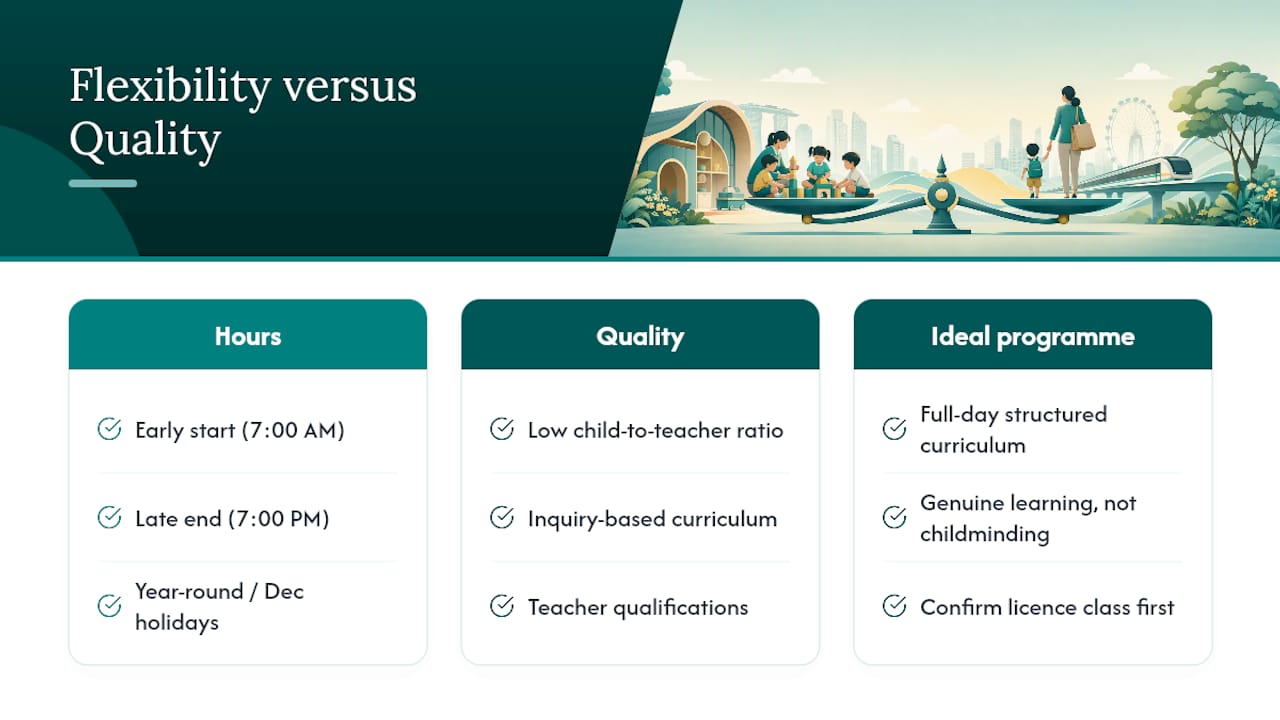
It doesn’t have to. The research is clear that inquiry-based curricula can run just as effectively inside extended-hour, year-round formats as they can inside a traditional half-day kindergarten session. The real mistake I see families make is assuming a longer day automatically means more “childminding” and less genuine learning. A well-structured full-day programme with a low child-to-teacher ratio and a real curriculum, not just supervised play, gives working parents both things at once.
What should you prioritize first? Confirm the licence class, then judge the curriculum on its own merits. Hours are a filter, not the whole decision.
*— Elena
A Small Preschool Built Around How Working Families Actually Live
Astor International Preschool, located in the Holland area, was built with exactly this trade-off in mind. It’s a small preschool by design, with two playgrounds and a deliberate mix of outdoor and classroom learning, so your child gets movement and fresh air without losing structured teaching time during the day.
Small class sizes mean teachers actually know each child’s pace, not just their name, and that carries into enrichment programs in arts, sports, and language that extend the school day meaningfully rather than just filling it. Astor International School, the network’s primary school in Tanglin, has been recognized as one of the best small and most affordable international schools in Singapore, a track record that reflects the same philosophy carried through both campuses. If you’re weighing curriculum depth alongside your need for workable hours, our IPC curriculum overview shows how learning is structured across a full day. From there, reaching out through Astor’s main site is the fastest way to check current availability and schedule options for your child’s age group.
Where to Verify These Details Yourself
Before enrolling anywhere, confirm the specifics directly with official sources and the school itself.
ECDA’s Q&A on operating hours and service types explains how childcare and kindergarten hours differ.
ECDA’s guide to choosing a preschool breaks down licence classes in detail.
Astor’s curriculum page and course overview outline what a school day looks like at each campus.
Sources
Recommended
Comments