


How to Find the Best School for Your Child in 2026

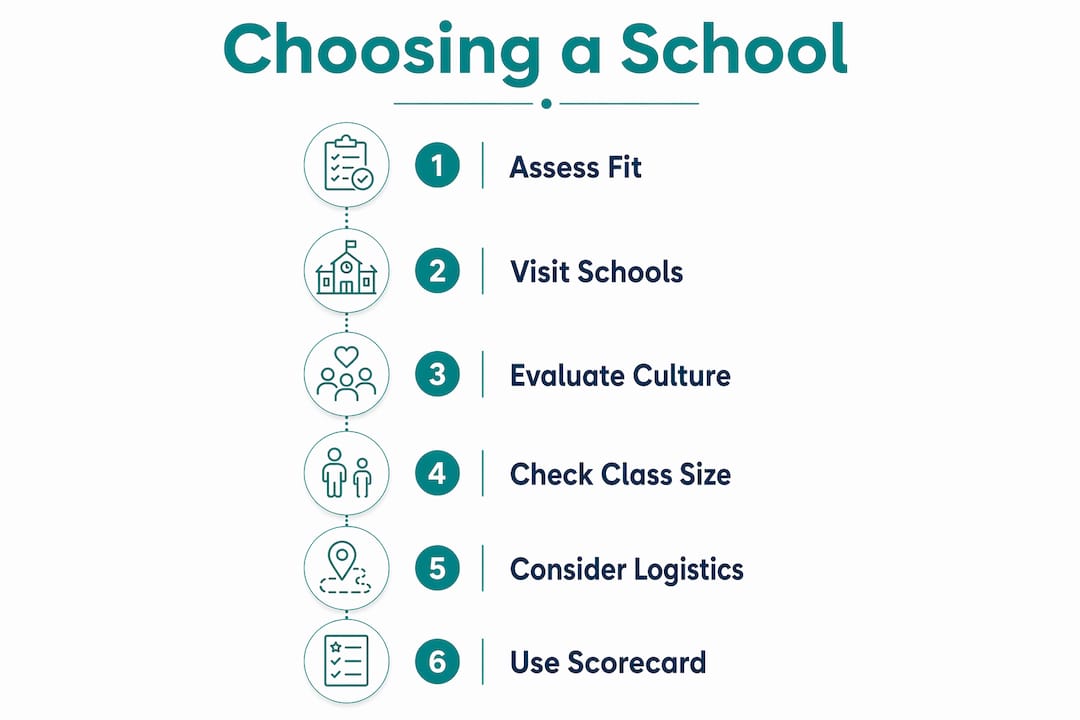
The best school for your child in 2026 is defined not by its ranking or waitlist length, but by how well it fits your child’s temperament, your family’s values, and your daily routine. School selection, the formal process of matching a child’s learning needs to an institution’s culture and teaching approach, is one of the most consequential decisions parents make in early childhood. The key evaluation criteria are class size, student-teacher ratio, school culture, teaching method, and logistics. Getting these right matters far more than chasing prestige. This guide gives you a practical, fit-first framework for how to find the best school in 2026.
How to find the best school in 2026: start with fit
The best school aligns with your child’s temperament, your family’s values, and your daily rhythm. That single principle should anchor every other decision you make. A school with a stellar reputation but a rigid, high-pressure culture can leave a sensitive or creative child feeling unseen. A quieter, smaller school with a nurturing environment may be exactly where that same child thrives.
Child temperament falls into broadly recognized categories: highly sensitive, energetic and social, introverted and reflective, or highly curious and independent. Each type responds differently to classroom structure, noise levels, and teacher interaction styles. Observing your child’s behavior in different settings, at a birthday party, in a quiet library, during a group activity, gives you real data on what kind of environment helps them focus and feel confident.
During school visits, ask specific questions rather than general ones. Instead of “How do you support struggling students?”, ask “Can you walk me through what happened the last time a child in this class needed extra reading support?” Concrete answers reveal actual practice. Vague answers reveal a gap between policy and reality.
Watch how teachers speak to children when they think no one is observing.
Notice whether children look engaged or anxious during classroom time.
Ask whether the school groups children flexibly by ability or keeps fixed groups all year.
Find out how teachers communicate progress to parents beyond formal report cards.
Pro Tip: Visit at least two schools on the same day. The contrast makes differences in energy, warmth, and classroom culture immediately obvious in a way that spaced-out visits rarely achieve.
What makes a great school culture and why it matters

School culture is the daily lived experience of your child, not the mission statement on the website. A genuinely positive culture shows up in how staff handle conflict, how children treat each other, and whether teachers feel supported enough to give their best. Restorative justice practices handle conflict more effectively than traditional punishment. That distinction matters enormously for young children who are still learning emotional regulation.
Anti-bullying policy is another concrete marker. A written policy means little without consistent enforcement. Ask staff directly: “Can you give me an example of how a recent bullying situation was handled?” The specificity of their answer tells you everything. Whole-school approaches that engage leaders, teachers, staff, and families address bullying most effectively. Schools that rely on one teacher or one counselor to manage all conflict are structurally underprepared.
“The best learning happens when every child is truly seen and supported.” Schools that build this into their daily culture, not just their brochures, produce children who are more engaged, more confident, and more willing to take intellectual risks.
A positive classroom culture also directly affects mental health. Children who feel safe at school attend more consistently, participate more actively, and develop stronger relationships with teachers. These outcomes compound over years. Choosing a school with authentic, lived values is not a soft preference. It is a measurable academic and wellbeing advantage.
How does class size affect your child’s learning?
Class size and student-teacher ratio are among the most evidence-backed factors in early education quality. NAIS reports a median K-5 class size of 16 students and a median student-to-teacher ratio of 8.2:1 for small learning communities. Those numbers represent the threshold at which teachers can realistically know each child’s strengths, gaps, and emotional state on any given day.
In larger classes, personalized learning becomes a logistical challenge rather than a teaching philosophy. A teacher managing 28 students cannot consistently adjust reading groups, notice early signs of anxiety, or give meaningful written feedback on every piece of work. A teacher with 14 students can do all three. The difference in teacher-student ratio is not just a number. It determines the quality of attention your child receives every single day.
Ask schools how they personalize learning in practice. Strong schools regularly adjust reading and math groups based on ongoing assessments. Request anonymized work samples to see how groups or supports change following assessments. A school that can show you real examples of adjusted groupings is demonstrating genuine personalization, not just describing it.
Evaluation factor | What to look for | Red flag |
Class size | 15–18 students per class | Over 25 students with one teacher |
Student-teacher ratio | 8:1 to 10:1 | Above 15:1 in early years |
Learning groups | Adjusted regularly by assessment | Fixed groups all year |
Progress communication | Regular, specific, and two-way | Annual report card only |
Pro Tip: Ask the school: “How often do you reassess reading and math groups?” Monthly or termly reassessment signals genuine responsiveness. Annual reassessment signals a system built for convenience, not children.
Why logistics matter more than parents expect
Commute time and daily schedule compatibility are practical factors that parents consistently underestimate during school selection. Commuting 45 minutes to school can consume more than 6 hours weekly, reducing family time and limiting extracurricular availability. For children aged 1.5 to 12, that lost time has real consequences for sleep, play, and family connection.
A school that is slightly less prestigious but 15 minutes closer can deliver a meaningfully better family life over six years of enrollment. The math is straightforward. Here is how to evaluate logistics honestly:
Map the actual commute during school-day traffic, not on a weekend morning.
Check whether the school’s start and end times align with your work schedule.
Confirm whether after-school care is available on-site or requires a separate arrangement.
Assess whether extracurricular activities are accessible without adding a second daily trip.
Factor in school holiday dates and whether they align with your employer’s leave policy.
Logistics are not a compromise on quality. They are a quality factor in their own right. A child who arrives at school rested, on time, and without a stressed parent is already better positioned to learn than one who has spent an hour in traffic.
How to use a weighted scorecard to compare schools
A weighted scorecard gives you a structured way to compare shortlisted schools without letting one impressive open day override months of careful research. Place 30% weight on child-school fit, 25% on culture and values, 20% on teaching approach and class size, 15% on logistics, and 10% on academic track records. This weighting reflects what research shows actually predicts a child’s wellbeing and growth, not what school marketing emphasizes.
Score three to five schools on each factor from 1 to 5. Multiply each score by its weight. Add the totals. The school with the highest weighted score is your strongest candidate, but the process itself is as valuable as the result. It forces you to articulate what you actually prioritize rather than defaulting to reputation or word of mouth.
List your top three to five schools from initial research and open days.
Score each school on fit, culture, teaching, logistics, and academics.
Apply the weights and calculate totals for each school.
Talk to two or three current parents at your top-scoring school before committing.
Observe a live classroom session if the school permits it.
Talking to current parents is the single most underused step in this process. They will tell you things no open day presentation ever will, including how the school handles difficult situations, whether communication is responsive, and whether their child is genuinely happy.
Key Takeaways
The best school for your child in 2026 is the one that fits their temperament, supports their wellbeing, and works within your family’s daily life, not simply the one with the highest ranking.
Point | Details |
Fit beats reputation | Match school culture and teaching style to your child’s temperament before considering rankings. |
Class size is a quality metric | Aim for a student-teacher ratio of 8:1 to 10:1 to get genuine personalized attention. |
Culture requires verification | Ask for specific examples of how conflict and bullying are handled, not just written policies. |
Logistics affect wellbeing | A commute over 45 minutes weekly cuts into family time and extracurricular access significantly. |
Use a weighted scorecard | Weight fit at 30% and culture at 25% to make an objective, evidence-based final decision. |
What parents get wrong about finding the right school
Parents ask me which school has the best reputation. I redirect them every time. Reputation is a lagging indicator. It reflects what a school was, not necessarily what it is today or what it will be for your specific child.
The parents I see make the most confident choices are the ones who shift the question from “Which school is best?” to “Which school will help my child thrive?” That pivot changes everything. It moves the decision from external validation to genuine observation. It also reduces regret, because you are choosing based on your child’s actual needs rather than social comparison.
I have seen children flourish in small, quiet schools that nobody talks about at dinner parties, and I have seen children struggle in highly ranked institutions where the pace and pressure were simply not right for them. The school selection process works best when parents trust what they observe during visits over what they read in ratings guides.
One thing I always tell parents: your instinct during a school visit is data. If you walk into a classroom and feel warmth, curiosity, and calm, that feeling is telling you something real. If you feel anxiety or performance pressure in the air, that is real too. Combine that instinct with a structured scorecard and you have a genuinely strong decision-making process.
— Elena
Astor International School: a school built around your child
Edu, the Astor education network in Singapore, was built on exactly the principles this article describes. Astor International School in Tanglin holds awards for best small school and best affordable international school in Singapore. Its IPC curriculum delivers internationally recognized, theme-based learning in small classes where every child is known by name and supported as an individual.

Class sizes at Astor International School stay small by design, keeping student-teacher ratios in the range that research identifies as genuinely supportive for children aged 5 to 12. The school’s culture centers on curiosity, kindness, and confidence. For families with younger children, the Astor International Preschool in Holland offers a nurturing start with two playgrounds and a blend of outdoor and classroom learning. If you are ready to see what a fit-first school looks like in practice, explore the curriculum and book a visit.
FAQ
What is the most important factor when choosing a school?
Child-school fit is the most important factor. Research shows the best school aligns with your child’s temperament, your family’s values, and your daily routine rather than ranking alone.
What is a good student-teacher ratio for young children?
A ratio of 8:1 to 10:1 is the standard for small learning communities in early education. NAIS reports a median ratio of 8.2:1 for K-5 classes in high-quality small schools.
How do I evaluate school culture during a visit?
Ask staff for a specific example of how a recent conflict or bullying incident was handled. Concrete, detailed answers indicate a school where policy translates into real practice.
How much should commute time factor into my school choice?
Commute time is a significant factor. A daily round trip of 45 minutes or more consumes over 6 hours weekly, which directly reduces family time, sleep, and extracurricular access for young children.
How do I compare multiple schools fairly?
Use a weighted scorecard. Assign 30% to child-school fit, 25% to culture, 20% to teaching and class size, 15% to logistics, and 10% to academic track record. Score each school and compare totals.
Recommended
This is a fantastic website , thanks for sharing. Zonnepanelen Leuven
Hi! This is my first visit to your blog! We are a team of volunteers and new initiatives in the same niche. Blog gave us useful information to work. You have done an amazing job! GoodWe thuisbatterij
I’m excited to uncover this page. I need to to thank you for ones time for this particularly fantastic read !! I definitely really liked every part of it and i also have you saved to fav to look at new information in your site. Zonnepanelen Leuven
Thanks for the best blog. it was very useful for me.keep sharing such ideas in the future as well. Fox ESS Thuisbatterij
Wonderful illustrated information. I thank you about that. No doubt it will be very useful for my future projects. Would like to see some other posts on the same subject! Zonnepanelen