


Why Mixed Age Classrooms Work: Research and 6 Teacher Practices

Mixed-age classrooms deliver real, well-documented social and emotional benefits, and academic outcomes generally hold steady compared to single-age classes. That net positive comes with a catch: it depends almost entirely on whether teachers are trained for it and whether the pedagogy is genuinely designed around mixed ages, not just a room with two grades in it. What follows explains the models, the evidence, and how to tell the difference before you enroll your child.
TL;DR:
Effective mixed-age classrooms rely on deliberate curriculum design, differentiated instruction, teacher training, and assessment methods, not just age mixing.
Children in well-structured programs benefit socially and emotionally through peer modeling, mentoring, reduced competition, and increased cooperation.
Academic outcomes are generally comparable to single-age classes, with success depending heavily on teacher expertise and curriculum alignment.
Risks include social overwhelm, inadequate planning, and reliance on grade-level tests, which can be mitigated through regular progress monitoring and customized assessment.
Parents should observe classrooms for task differentiation, flexible grouping, and ask specific questions about training, planning, and assessment to gauge program quality.
Table of Contents
What Mixed-Age Classrooms Are (and What They Aren’t)
The term “mixed-age classroom” gets used loosely, so it helps to separate what’s actually happening in the room. A multi-age classroom intentionally groups children across a set age or grade span, usually two to three years, as a permanent structural choice rather than a scheduling fix. A multigrade class, sometimes called a composite class in primary schools, groups students from different grade levels together, often because a school doesn’t have enough students to fill separate single-grade classes. Montessori education takes the concept further still, building its entire structure around three-year age cycles as a defining feature of the method rather than an occasional grouping choice, which is part of why Montessori mixed-age classrooms are so hard to compare directly against other multi-age models. The mix of ages is only one variable among many.
The distinction between pedagogical and administrative reasons matters more than most parents realize. A school might combine a Grade 1 and Grade 2 class purely because enrollment numbers are low that year. That’s a split class born of necessity, and it may or may not come with any real change in how lessons are taught. A genuinely designed multi-age program, by contrast, builds its curriculum, materials, and teacher training around the fact that children of different ages and abilities share a room. Research on split classes pros and cons consistently points to this as the deciding factor: placing ages together without changing the pedagogy removes most of the benefit.
Age spans vary by school and philosophy. Common configurations include:
Two-year spans (kindergarten and first grade, or Grades 3 and 4), often used to smooth transitions between developmental stages.
Three-year spans, the Montessori standard, designed so each child experiences a full cycle as the youngest, then the middle, then the oldest in the group.
Wider multigrade spans in smaller rural or international schools, sometimes covering three or more grade levels when enrollment is limited.
If you’re evaluating a program, ask which category it falls into. A well-designed multi-age classroom looks and functions differently than a multigrade class assembled because of a roster shortfall, even if both technically qualify as heterogeneous grouping. Mixed-age arrangements aren’t a modern experiment, either. They trace back to one-room schoolhouses, where multi-age instruction was simply the default because there was no other option, and the model persists today in smaller schools worldwide for reasons that go well beyond nostalgia.
The Social and Emotional Case for Mixing Ages
The strongest, most consistent research finding on mixed-age classrooms isn’t about test scores. It’s about how children treat each other. When you put a seven-year-old and a nine-year-old in the same learning space with the right structure around them, something predictable happens: the older child starts explaining, guiding, and modeling behavior, often without being asked. The younger child, in turn, has a built-in reason to stretch beyond what a same-age peer group might expect of them.
This isn’t a soft, feel-good observation. A synthesis from The Conversation found that mixed-age classrooms provide measurable non-cognitive benefits, including improved attitudes toward school, stronger self-concept, better cooperation, and more mentoring opportunities than same-age settings typically offer. The mechanism is straightforward once you see it: heterogeneity in the room creates natural teaching moments that a same-age class simply doesn’t have as often, because older children get regular chances to facilitate younger children’s behavior and pass along peer teaching almost as a byproduct of the setup, not a special program bolted onto it.
There’s also a quieter benefit that doesn’t show up in most parent conversations: reduced competitive anxiety. In a same-age class, a child who reads more slowly than everyone else feels it constantly. Every worksheet, every reading circle, every “who’s done” moment reinforces the comparison. In a well-run mixed-age room, the acceptable range of performance is wider by design, which lets children focus more on their own growth trajectory than on ranking themselves against a narrow same-age band.
What does this actually look like day to day? A few concrete mechanics show up again and again in effective programs:
Structured peer tutoring, where an older student is assigned to check a specific skill with a younger one, not just “help out” vaguely.
Cross-age buddy systems that pair students for a semester or year, building a relationship rather than a one-off interaction.
Rotating leadership roles, so the “oldest” role isn’t always held by the same handful of confident kids.
Mixed-age project teams, where the task requires different skill levels to contribute in different ways, rather than the older child simply doing the work faster.
For parents wondering whether their child is genuinely benefiting, there are observable signs worth watching for. Does your child mention helping a younger classmate, or being helped by an older one, without prompting? Do they talk about a “buddy” by name over multiple weeks? Has their comfort with not being the best at something in the room actually increased rather than caused distress? These are better indicators than a single quarterly report card comment.
Pro Tip: Ask your child’s teacher not “is my child doing well,” but “who does my child help, and who helps them?” The answer tells you whether the mixed-age structure is actually functioning as designed, or whether the ages are just sharing a room.
This dynamic connects closely to broader social emotional learning practices, and it overlaps significantly with the kind of collaborative work that supports children’s overall development regardless of age composition. The age mix amplifies a mechanism that good teaching would want to build anyway.
What the Research Says About Academic Outcomes
Here’s the finding that surprises most parents: mixed-age classrooms don’t produce worse academic results than single-age classes, on average, and they sometimes produce slightly better ones on select measures. That’s not a marketing claim. It comes from a rigorous best-evidence synthesis.
A comprehensive best-evidence synthesis covering multigrade and multi-age classes found no consistent differences in cognitive achievement between mixed-age and single-grade classrooms, with noncognitive effects that were mixed but sometimes slightly positive for mixed-age students.
That’s a meaningful finding precisely because it cuts against the intuitive worry. Most parents assume that mixing a slower seven-year-old reader with a faster nine-year-old reader must drag one group down or hold the other back. The synthesis doesn’t support that fear as a general pattern. Achievement differences that do show up tend to trace back to something other than the age mix itself.
The moderators matter more than the grouping structure. Teacher expertise is the single biggest lever: a teacher who has been trained to differentiate instruction across ability levels will get very different results than one who was simply handed a combined roster and told to “figure it out.” Curriculum alignment matters too. Programs that map learning outcomes across the full age span, rather than trying to run two parallel single-grade curricula in the same room, tend to see smoother results. And subgroup effects are real: some longitudinal research indicates that outcomes can differ by gender depending on the specific age composition of the class, which is a reminder that “mixed-age classrooms work” is a population-level finding, not a guarantee for every individual child.
Assessment design is the other quiet variable behind the numbers. Schools that assess mixed-age students against fixed grade-level checkpoints sometimes produce misleading data, because a younger child compared against an older cohort’s benchmark will look behind even when they’re progressing exactly on track for their age. Schools that assess by individual learning outcomes get a truer picture, and that assessment choice alone can change how “the research” appears to read.
The honest summary: the age mix itself is not the variable driving outcomes up or down. Teacher skill, curriculum design, and assessment method are.
Where Mixed-Age Classrooms Can Go Wrong
None of this means mixed-age grouping is a guaranteed win. The risks are real, and a parent who ignores them isn’t being cautious, just uninformed.
The most common concern is that younger or less confident children get overwhelmed, either academically outpaced by older peers or socially overshadowed by them. This risk is highest in classes with wide age spans and no deliberate small-group structure, where a nine-year-old and a six-year-old are technically in the same room but functionally living in different worlds. A second real risk sits with teachers, not students: planning for multiple developmental levels at once is genuinely harder than planning for one grade level, and a teacher without adequate training or planning time will often default to teaching to the middle, which shortchanges both ends of the age range. Assessment is the third recurring headache. Standardized, grade-locked tests don’t map cleanly onto a room where children are, by design, at different points on a developmental curve.
Well-run programs address each of these directly rather than hoping they resolve on their own:
Regular progress monitoring at the individual level, not just class-wide benchmarks, catches a struggling or overwhelmed child early.
Flexible small-group rotations based on skill rather than age let a younger child who’s ahead in math work with older peers on that subject specifically.
Dedicated planning time and coaching for teachers, recognizing that differentiated lesson design takes real hours, not goodwill.
Learning-outcome-based assessment rather than strict grade-level checkpoints, so progress is measured against the child, not an arbitrary calendar year.
Parents evaluating a program should ask pointed questions rather than accepting a brochure description at face value. Worth asking directly: How do teachers plan differently for a mixed-age class versus a single-age one? What specific training have teachers received in multi-age or differentiated instruction? How is my child’s progress measured, and against what benchmark? What happens when a child is significantly ahead or behind their assigned age group? Engaging proactively with the school on questions like these, rather than assuming the mixed-age label alone guarantees quality, is one of the strongest predictors of a good outcome. The label tells you the structure. It doesn’t tell you the execution.
How Good Teachers Actually Run These Classrooms
The gap between a mixed-age classroom that works and one that doesn’t almost always comes down to specific, learnable teacher practices, not innate talent or luck of the draw. If you’re touring schools or trying to understand what your child’s teacher is doing differently, these are the practices to look for.
Flexible, skill-based grouping. Rather than treating “age group” as the only way to organize students, effective teachers regroup children by current skill level for specific subjects. A younger child strong in math might join an older skill group for that lesson, then return to an age-based group for a group project later the same day.
Individual learning contracts. Many strong programs give each student a personalized set of goals and tasks for the week, agreed on with the teacher. This lets a room of eight children at four different developmental stages all work productively at once, because the contract, not the calendar, sets the pace.
Independent learning stations. Well-designed stations let students work at their own level with minimal direct teacher supervision, freeing the teacher to run small, targeted instruction with whichever group needs it most that day.
Cross-age collaborative projects. Thematic units that span multiple curriculum levels let a science or history topic be tackled by the whole class together, with roles and expectations scaled to each child’s ability, which is one of the strategies that consistently appears in effective mixed-age programs.
Explicit peer-teaching protocols. Rather than hoping older students spontaneously help younger ones, the strongest teachers build specific, structured roles: “you’re checking these five spelling words with your reading buddy today,” not a vague expectation to “be helpful.”
Outcome-based rather than grade-locked assessment. Progress gets measured against each child’s own learning trajectory and specific skill benchmarks, not a single grade-level test that assumes every child in the room should be at the same point.
None of this happens by accident, and it doesn’t happen with untrained staff either. Teachers running successful mixed-age programs typically need training specific to differentiated instruction, classroom management across developmental stages, and curriculum mapping that spans multiple grade levels simultaneously. Schools that shift to mixed-age grouping without investing in that training are the ones most likely to produce the “just sharing a room” version of multi-age education, where the label exists but the pedagogy doesn’t follow through.
Timetabling and resourcing shift too. A single-grade classroom can run on one curriculum pacing guide. A mixed-age classroom typically needs layered materials at multiple levels, more flexible scheduling blocks to allow for skill-based regrouping, and often a lower overall class size to make individualized attention feasible at all.
If you’re visiting a class as a parent, a short checklist can tell you more in twenty minutes than any prospectus. Watch whether students are working on visibly different tasks, or whether everyone has the identical worksheet regardless of age. Notice whether the teacher circulates to small groups or delivers one lesson to the whole room at once. Ask a child directly (they’re usually candid) whether they ever help someone younger or get help from someone older. And check whether work displayed around the room shows a spread of complexity levels, or a uniform standard that suggests one grade is quietly being taught to and the other is along for the ride.
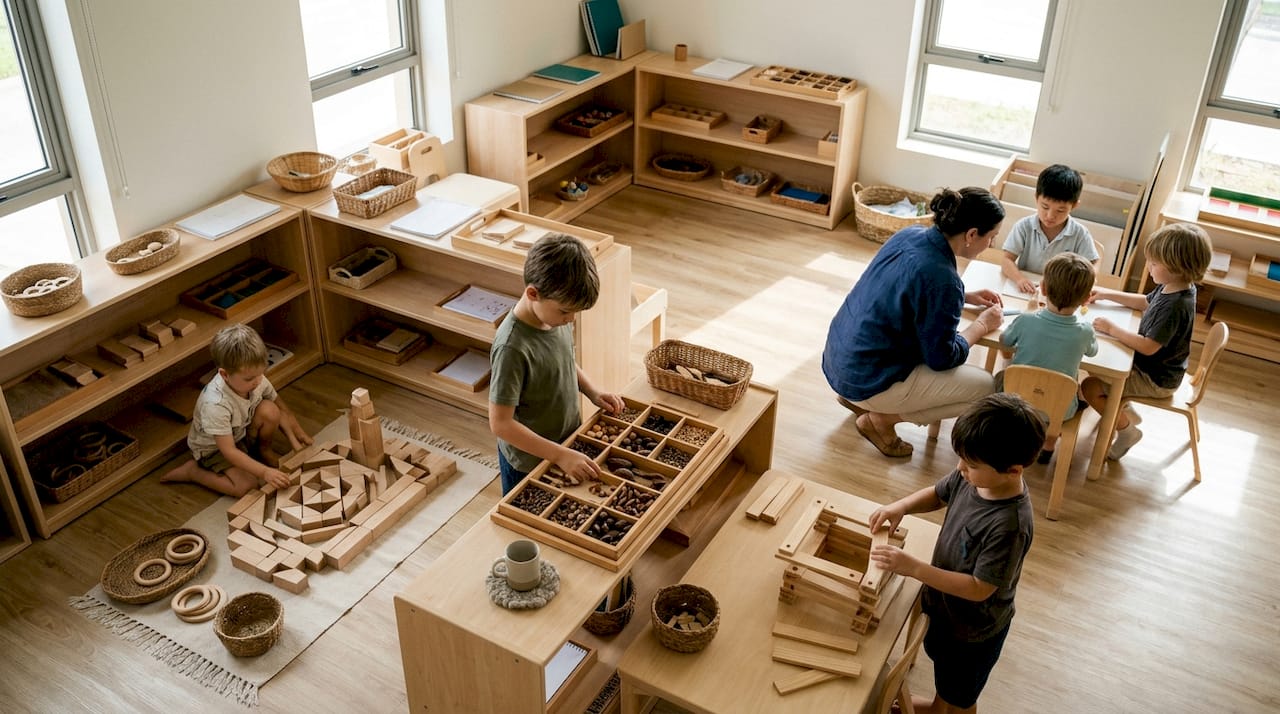
Pro Tip: During a school visit, count how many different activities are happening simultaneously in the room. A genuinely differentiated mixed-age classroom rarely has every child doing the exact same task at the exact same moment.
An Example From a Small International School
At Astor, student-centered practices apply across a 1.5 to 12 age range through deliberately small class sizes rather than one-size lessons delivered to a full grade. Inquiry-based learning gives children room to work at their own pace within a shared classroom community, and differentiated activities let a younger and older student pursue the same broad theme at a level appropriate to each. Astor documents its own reasoning on this in a piece on mixed-age group teaching and learning, alongside practical detail on how differentiated learning plays out both at school and at home.
The signs of deliberate implementation are visible rather than assumed. Teacher lesson plans reference specific skill groupings, not just a single grade-wide activity. Parent communication addresses individual progress against a child’s own learning goals, not a generic class-wide update. And staff training focuses specifically on differentiated, student-centered classroom methods rather than treating a mixed-age roster as a scheduling detail to work around.
Where Mixed-Age Teaching Actually Comes From
Mixed-age classrooms aren’t a recent pedagogical trend borrowed from progressive education theory. They’re closer to the historical default. Before graded school systems existed, one-room schoolhouses grouped children of every age together simply because a small community couldn’t justify separate classrooms for each age. A single teacher managed six-year-olds and sixteen-year-olds in the same space, out of necessity rather than philosophy.
The graded classroom model, sorting students strictly by age into separate rooms, is actually the newer invention, spreading widely through the nineteenth and twentieth centuries as school systems industrialized and standardized around efficiency and administrative convenience. It solved real problems: it made staffing, curriculum planning, and assessment far more predictable at scale.
Montessori education, developed in the early 1900s, deliberately pushed back against that trend, building three-year age cycles into its core structure as an intentional philosophical choice rather than a practical necessity. Rudolf Steiner’s Waldorf schools took a related approach in some contexts, and various progressive education movements throughout the twentieth century revisited mixed-age grouping as they questioned whether strict grade-level sorting actually served children’s developmental needs.
Today, mixed-age classrooms persist for a mix of the old reason and the newer one. Small rural schools and smaller international schools still form multigrade classes partly out of enrollment necessity, echoing the one-room schoolhouse logic. At the same time, a growing number of schools choose multi-age grouping deliberately, for the developmental and social reasons the research increasingly supports. Both paths lead to a classroom with mixed ages in it, but only one starts from an intentional design.
How Different School Systems Approach Mixed-Age Policy
There’s no single global standard governing mixed-age education, and that’s worth understanding before assuming any one country’s approach is universal. National education ministries generally leave the choice between single-age and mixed-age structures to individual schools or districts, rather than mandating one model system-wide.
In many public school systems, composite or split classes form primarily as an administrative response to enrollment numbers rather than a chosen pedagogy, and policy guidance in those contexts tends to focus on ensuring curriculum coverage across the combined grade levels rather than mandating a specific multi-age teaching method. Rural and small-town public schools worldwide fall into this category most often, simply because they don’t have enough students at each single grade to justify separate classrooms.
Montessori-accredited schools operate under a different logic entirely: the three-year mixed-age cycle is a core requirement of the method itself, tied to accreditation standards from Montessori organizations rather than any single national education ministry. A school can’t call itself Montessori-accredited while abandoning that structure.
International and independent schools, including small private schools, generally have more flexibility to design mixed-age programs deliberately, since they aren’t bound by the same large-scale administrative constraints as national public systems. This flexibility cuts both ways: it allows for genuinely well-designed, intentional multi-age pedagogy, but it also means quality varies more widely from one school to the next, with less external oversight ensuring the pedagogy behind the age mix is sound. For a family evaluating any school under this kind of independent structure, that’s precisely why asking direct questions about training and curriculum design, rather than trusting the “mixed-age” label alone, matters more than in a system with uniform government mandates.
Real Examples of Mixed-Age Models Working Well
The clearest evidence that mixed-age grouping works comes not from theory but from decades of programs that have refined the model in practice. Montessori schools remain the most widely recognized example, having run three-year age-cycle classrooms globally for more than a century, with the age mix treated as inseparable from the rest of the method rather than an add-on feature.
One-room and small rural schools offer a less glamorous but equally instructive example. Many of these schools, still operating today in remote regions worldwide, have decades of accumulated practical experience managing wide age spans within a single teacher’s classroom, often relying heavily on structured peer tutoring simply because there’s no alternative with only one adult in the room.
Reggio Emilia-inspired programs, largely in early childhood settings, provide another working model, grouping young children across ages within project-based, inquiry-driven classrooms where the mixed ages support rather than complicate the collaborative project structure.
Smaller international schools represent a newer but increasingly documented category, applying differentiated, student-centered pedagogy across wider age ranges than a typical single-grade international school would attempt, often specifically because smaller enrollment numbers make flexible, cross-age grouping both necessary and pedagogically workable. What separates the successful examples from the cautionary ones in every category is consistent: deliberate curriculum design and trained staff, not the age mix itself.
Building a Curriculum That Actually Fits Multiple Ages
A single-grade curriculum can’t simply be stretched across a mixed-age classroom and expected to work. It has to be built differently from the ground up, and that design choice shows up in a few consistent features across effective programs.
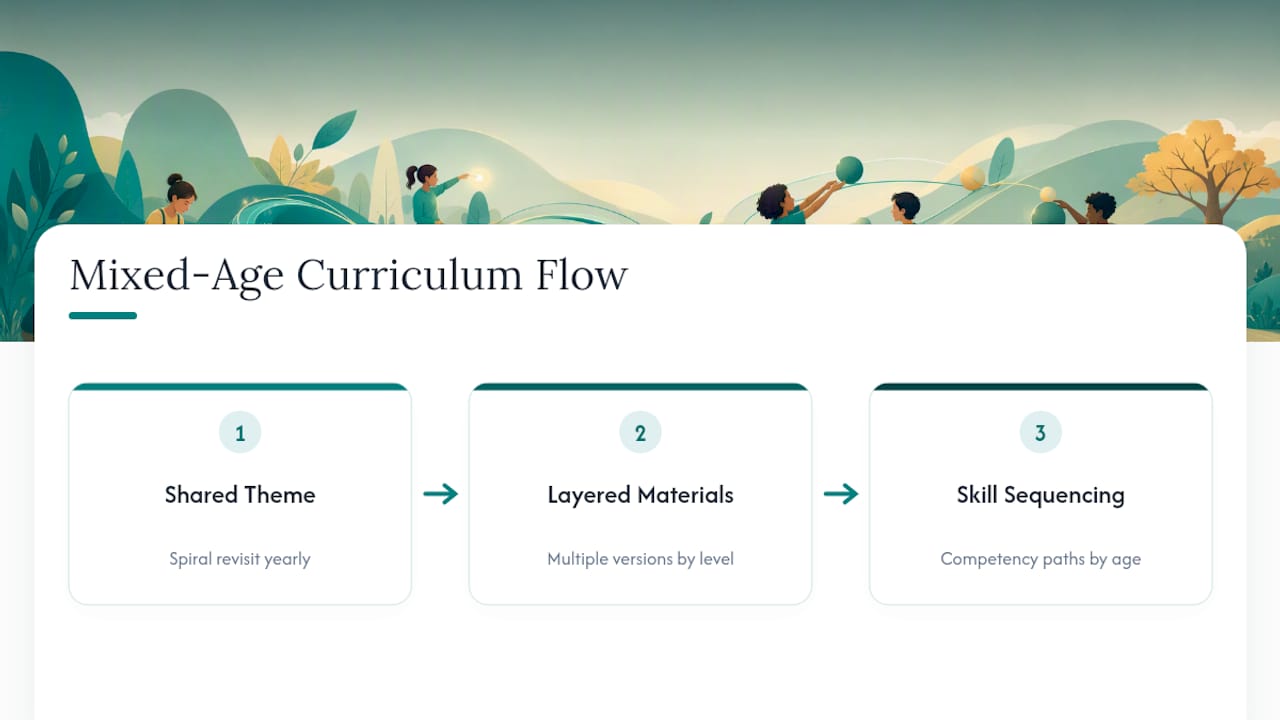
Thematic, spiral curriculum design tends to work better than a strictly sequential one. Rather than teaching a topic once at one grade level, effective mixed-age curricula revisit core themes across multiple years at increasing depth, so a returning student encounters the same theme again but engages with it at a more advanced level the second or third time around. This lets one thematic unit serve an entire multi-age classroom simultaneously, with each child working at their own depth within the same shared topic.
Layered materials matter just as much as the theme structure. Strong programs stock multiple versions of core resources, matched to different skill levels, rather than one textbook per grade, which is what makes flexible grouping actually possible in practice rather than aspirational.
Skill-based rather than grade-based sequencing rounds out the picture. Curriculum maps in effective mixed-age programs track specific skills and competencies across the full age span, letting a teacher place any given child at the right point on that skill map regardless of their chronological age, echoing the strategies for combining thematic units with flexible small-group rotations that show up repeatedly in effective programs. Programs offering structured group classes built around differentiated instruction, such as language learning environments, use very similar logic even outside the general classroom setting.
Rethinking Assessment for a Room With No Single Grade Level
Standardized, grade-locked testing is arguably the worst fit for a mixed-age classroom, and schools that force it tend to produce assessment data that misrepresents what’s actually happening with individual children.
The better approach measures each child against their own learning trajectory rather than a single fixed benchmark tied to age or grade. A seven-year-old working two levels ahead in reading and a nine-year-old working at grade level can both be “on track” in a properly designed mixed-age assessment system, even though a standardized grade-level test would flag one of them as behind.
Portfolio-based assessment, tracking a child’s work samples and skill demonstrations over time, tends to capture growth more accurately than a single snapshot test in these settings. Individual learning contracts, the same tool used for instructional planning, double as an assessment framework: progress gets measured against the specific goals set for that child, not against a grade-wide average.
Formative, ongoing checks, brief regular skill assessments woven into daily activities rather than concentrated into a single testing period, let teachers catch a child drifting off pace early, whether that child is falling behind or racing ahead of their assigned age group. This is one of the practical strategies that consistently appears in effective mixed-age programs: assessment by learning outcome rather than strict grade-level checkpoint. Parents reviewing a school’s assessment approach should ask specifically how progress reports translate a child’s individual growth into something meaningful, rather than accepting a single letter grade that implies a fixed grade-level comparison the classroom structure doesn’t actually use.
Making the Call for Your Own Child
A mixed-age classroom tends to be a strong fit for a child who’s socially adaptable, who responds well to being both a helper and a helped party at different moments, and who doesn’t need rigid same-age peer comparison to feel motivated. It’s a weaker fit for a child already anxious about social standing, or one whose specific learning needs require intensive same-age, same-level instruction that a differentiated room can’t easily provide alongside everything else happening in it.
The practical next step isn’t reading another summary. It’s visiting the actual classroom, watching whether the day looks differentiated or uniform, and asking the teacher direct questions about grouping and assessment. From there, the ongoing work is collaboration: staying in contact with your child’s teacher about what’s working, what feels like a stretch, and where the classroom’s flexibility can bend toward your child’s specific pace. Programs that support this kind of personalized learning planning between home and school tend to see the benefits described throughout this piece show up most reliably.
— Elena
Why Astor Builds Around This Model
Families who want the mentoring, confidence, and individualized pacing described throughout this piece don’t have to choose between a large school with rigid grade tracks and an unstructured, ad hoc split class. Astor gives you a third option: small class sizes purpose built for differentiated, mixed-age-friendly teaching across the 1.5 to 12 age range, with the training and planning behind it that this article has argued matters more than the age label itself.

Astor’s curriculum overview walks through how differentiated, student-centered practices get applied day to day, while the International Primary Curriculum page details how thematic, cross-level units work in practice for primary-aged children. If your child is younger, the enrichment and course offerings on the courses page outline how arts, sports, and language programs layer into the broader learning model. The most useful next step is simple: book a visit or reach out to Astor’s admissions team directly through the main site to see a mixed-age-friendly classroom in action and ask the specific questions this article has equipped you to ask.
Sources
Recommended
Comments