


What the MYP Learner Profile Means for Your Child's Growth
- sasha2644
- 1 hour ago
- 6 min read

The MYP learner profile is the set of 10 attributes the International Baccalaureate uses to describe the kind of learner it hopes every student becomes, and the Middle Years Programme is where those attributes get put to daily work through Approaches to Learning (ATL) skills and the Personal Project. Each attribute is a quality your child practices, not a grade they earn.
The 10 attributes are:
Inquirers — curious, self-directed learners
Knowledgeable — able to explore ideas across disciplines
Thinkers — apply critical and creative thinking to problems
Communicators — express ideas confidently in more than one language or form
Principled — act with integrity and honesty
Open-minded — seek and evaluate other perspectives
Caring — show empathy and commitment to service
Risk-takers — approach uncertainty with resourcefulness
Balanced — attend to intellectual, physical, and emotional wellbeing
Reflective — thoughtfully assess their own learning and growth
Key Takeaways
The MYP learner profile works best when families and teachers treat its 10 attributes as practiced habits, reinforced through ATL skills, unit design, and consistent reflection, rather than fixed personality traits.
Point | Details |
Ten attributes, one framework | Inquirers, Thinkers, Communicators, and seven other traits form a shared IB structure across programmes. |
ATL skills are the mechanism | Communication, research, and self-management skills are how the profile gets built into daily units. |
Personal Project consolidates growth | MYP-5 students draw on nearly every attribute at once through research, planning, and reflection. |
Reflection drives improvement | Structured weekly reflection turns scattered effort into measurable attribute growth. |
Risk-taker and Balanced are misunderstood | Neither means recklessness or equal time everywhere; both describe thoughtful, adjustable habits. |
Explore how project choice, class routines, and reflective habits come together in Astor’s approach to personalized learning, or book a virtual school tour with founder Elena to see the learner profile in action.
Table of Contents
What Are the 10 IB Learner Profile Attributes in MYP Terms?
For a student aged 11 to 16, these attributes need less abstraction and more everyday translation. Here is what each one looks like when a real MYP kid is actually doing it, not just naming it.
Inquirers ask a follow-up question during a unit on ecosystems instead of stopping at the textbook answer. This shows up constantly in inquiry-based unit design.
Knowledgeable students connect a history lesson on migration to a current-events article they found themselves.
Thinkers work through a math problem three different ways before settling on the cleanest solution.
Communicators present a science finding to classmates in French, then again in a one-page infographic.
Principled students admit when a group project shortcut was unfair and propose a fix without being asked.
Open-minded learners actively seek out a classmate’s opposing opinion during a debate unit rather than dismissing it.
Caring shows up in Service as Action projects, like organizing a food drive tied to a humanities unit on inequality.
Risk-takers choose the harder Personal Project topic because it is unfamiliar, not because it is easy to finish.
Balanced students protect time for sleep and sport during exam weeks instead of grinding straight through.
Reflective learners revise a piece of writing after reading peer feedback and can explain what specifically changed.
Most of these traits surface most visibly inside ATL skill categories, Service as Action logs, and the MYP-5 Personal Project, where a student has to demonstrate several attributes at once rather than one in isolation.
How Does the MYP Intentionally Build the Learner Profile?
The MYP does not teach the learner profile as a separate subject. It builds attributes into the structure of every unit through ATL skills, which cover communication, self-management, research, social, and thinking skills. Those five ATL categories are essentially the “how” behind the profile’s “what.”
Unit planners reinforce this by anchoring lessons to global contexts and an inquiry cycle, so a geography unit on urbanization is also, quietly, a Communicator and Open-minded unit. Attributes get embedded through curriculum design rather than taught as standalone content.
The Personal Project in MYP-5 is where it all converges. Students choose a topic, manage a process journal, and present findings, drawing on nearly every attribute at once, from Risk-taker (choosing an ambitious goal) to Reflective (documenting what went wrong and why).
Schools typically observe profile development at a few key checkpoints:
Formative feedback during unit work
Process journal entries and e-portfolio uploads
Personal Project supervisor check-ins
Service as Action reflections
Pro Tip: Ask your child’s teacher which ATL skill a specific assignment is targeting. If they can name it, the unit is doing its job.
Classroom and Home Activities That Build Each Attribute
Turning definitions into habits works best with short, repeatable activities rather than one big project.
Inquirers: Start a “question jar” at home where your child adds one curiosity a week.
Thinkers: Try a family debate night on a low-stakes topic, arguing both sides.
Communicators: Have your child explain a school topic to a younger sibling in their own words.
Caring + Communicator + Principled: A neighborhood cleanup project that requires planning, persuading others to join, and following through, hits three attributes at once.
Balanced + Reflective: A weekly “energy check” where your child rates sleep, activity, and stress, then adjusts one thing.
Risk-taker: Encourage trying an unfamiliar elective or hobby for one term, win or lose.
For younger MYP students, keep activities to 15 to 20 minutes. Older students can handle multi-week projects tied directly to Personal Project practice.
Common Misunderstandings About the Learner Profile
Risk-taker does not mean reckless. It means approaching new or difficult challenges with forethought and resilience, like trying a harder Personal Project topic on purpose.

Balanced does not mean equal time everywhere. It means noticing when one area (usually screens or study) is crowding out sleep or movement, and adjusting.
Avoid using the profile as fixed personality labels (“she’s just not a risk-taker”). Every attribute is a skill a student practices and improves, not a trait they either have or lack.
How Schools and Families Track Learner Profile Growth
Schools typically assess attribute development through rubrics embedded in project criteria, e-portfolio reflections, and direct teacher observation rather than separate report card grades. Much of this happens invisibly, folded into the assessment of communication clarity or ethical collaboration inside standard project rubrics.
At home, a simple weekly checklist works well: note one moment your child showed an attribute, and one they want to build. MYP supervisors consistently point out that students who skip structured reflection struggle to convert effort into visible improvement.
A simple 3-step self-assessment sequence for students:
Name the attribute you used this week and describe the moment.
Rate how confident you felt on a scale of 1 to 5.
Write one specific action to strengthen it next week.
A Small-School Example of the Profile in Daily Practice
In small international-school settings, the profile shows up less in posters and more in routine choices. A class pet rotation, for instance, quietly builds Caring and Responsible habits daily rather than through a one-off lesson, an approach reflected in how Astor structures its classroom care routines. Outdoor learning blocks and student-led project choice work the same way, giving Inquirer and Risk-taker traits room to develop without forcing them.
The learner profile only sticks when a child can point to a specific Tuesday and say, “that’s when I did the thing.”
Pro Tip: Ask your child to describe one specific moment each week, not a general feeling. Specificity is what makes reflection useful.
Why Treating the Learner Profile as a Training Plan Works
Students improve fastest when they treat the profile as a set of trainable habits rather than an abstract ideal, identifying a weak attribute and deliberately practicing behaviors that strengthen it. Pick one attribute this month. Design a two-week practice plan around it, and reflect at the end.
Frequently Asked Questions
What is the MYP learner profile in simple terms? It is a set of 10 attributes, like Inquirer, Thinker, and Reflective, that the IB expects Middle Years Programme students to practice and develop across every subject, not just in one class.
How many attributes are in the MYP learner profile? There are exactly 10 attributes: Inquirers, Knowledgeable, Thinkers, Communicators, Principled, Open-minded, Caring, Risk-takers, Balanced, and Reflective.
Does the learner profile apply only to the MYP? No. The profile is shared across IB programmes. The MYP typically serves ages 11 to 16, while the Diploma Programme continues developing the same attributes for ages 16 to 19.
What does Risk-taker actually mean in MYP? It means approaching unfamiliar or difficult tasks with resourcefulness and courage, not physical recklessness. A student choosing a harder Personal Project topic on purpose is demonstrating this attribute.
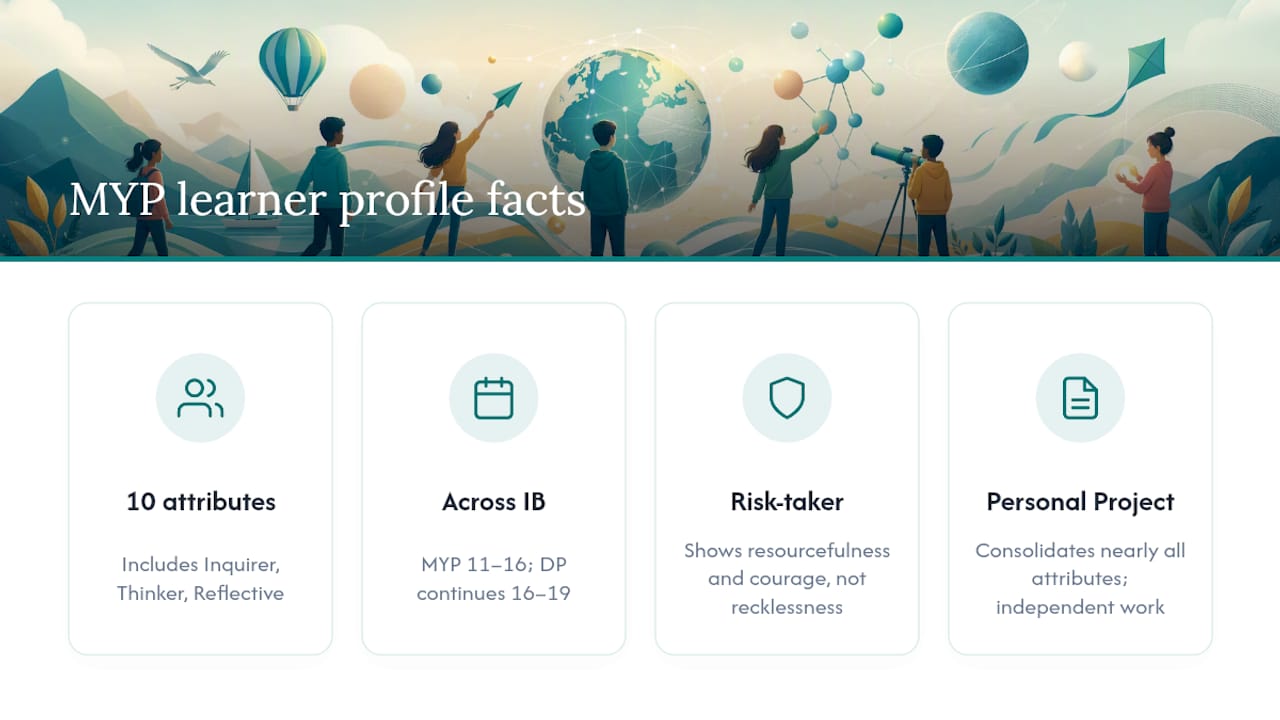
How is the Personal Project connected to the learner profile? The Personal Project in MYP-5 requires students to research, plan, and reflect independently, drawing on nearly all 10 attributes at once, which is why supervisors treat it as the profile’s biggest consolidation point.
Sources
Recommended

Comments