


Preschool Admission Process for Parents: 2026 Timeline

The preschool admission process follows a short, predictable sequence: shortlist, apply, confirm a place, then complete the LifeSG subsidy form within the required deadline once the preschool triggers it. Three names matter here, and you’ll see them repeatedly: ECDA (Early Childhood Development Agency), LifeSG (the government app that handles subsidy applications), and MOE (Ministry of Education, which runs its own kindergarten registration track). Getting familiar with all three now saves you from scrambling later.
Here’s what to do in the next 48 hours:
Start shortlisting three to five preschools based on location, hours, and curriculum fit.
Check whether you already have a Singpass account, since you’ll need it to complete LifeSG forms the moment a preschool offers your child a place.
Key Takeaways
The preschool admission process succeeds when parents apply early to multiple centers, confirm enrolment before touching the LifeSG subsidy form, and complete that form within 14 calendar days.
Point | Details |
Start early | Begin shortlisting 6 to 12 months ahead for competitive MOE or private preschools. |
Apply broadly | Submit to three or more preschools at once to offset waitlists at popular centers. |
Track the 14-day window | Complete the LifeSG subsidy form within 14 calendar days of your preschool triggering it. |
Prepare documents early | Have birth certificates, NRIC, proof of address, and income proof ready before enrolment day. |
Consider a small-school option | Astor International Preschool in Holland offers small class sizes and two playgrounds for individualized learning. |
Table of Contents
What Are the Different Types of Preschools in Singapore?
Not every preschool follows the same admission process, so knowing which category you’re applying to changes your timeline and your budget. Infant care covers children aged two to eighteen months. Childcare centers take children from eighteen months to six years, often bundling kindergarten years (K1 and K2) into one continuous program. MOE Kindergarten (MOE MK) centers are government run, follow fixed registration windows, and tend to be significantly cheaper. Private and international preschools set their own intakes, sometimes rolling admissions throughout the year, and usually charge more.
Some kindergartens also participate in KiFAS (Kindergarten Fee Assistance Scheme), which lowers fees for eligible families, while childcare centers fall under the ECDA subsidy structure instead. The category you choose determines:
Whether admissions run on fixed calendar windows (MOE MK) or continuous intake (many private centers).
Whether you’ll face a waitlist, which is common at popular MOE and anchor operator centers.
Which subsidy scheme applies, since LifeSG subsidies cover infant care and childcare, while KiFAS supports kindergarten-only programs.
When Should You Start the Preschool Application Timeline?
Competitive preschools fill up fast, so start researching six to twelve months before your target start date if you have your eye on a popular MOE Kindergarten or a well-known private center. For many other private preschools, three to six months of lead time is usually enough.
MOE Kindergarten registration runs through specific channels, including Open Admissions and Existing Preschool/Anchor Operator priority windows, published each year on the MOE Kindergarten registration page. Missing a registration phase there often means waiting for the next intake cycle entirely.
A realistic sample timeline looks like this:
Six to twelve months out: Shortlist preschools, check MOE registration phases if relevant.
Three to six months out: Book center visits, submit applications.
One to two months out: Confirm your place, pay any deposit, receive your enrolment date.
Within 14 calendar days of enrolment confirmation: Complete the LifeSG subsidy form once your preschool triggers it.
That 14-day window is not flexible. Miss it, and the subsidy application is automatically withdrawn, meaning you’d need to restart the process from scratch.
How Do You Move From Shortlist to Confirmed Place?
The step-by-step admission process rewards parents who stay organized rather than parents who move fast. Here’s the sequence that actually works:
Build your shortlist. Rank preschools against your non-negotiables (location, hours, curriculum, budget), then track each application in a simple spreadsheet with columns for deadline, status, and required documents. Our related guide on choosing a preschool walks through this in more detail.
Visit before you apply. Watch how teachers respond to a crying toddler, ask about the daily schedule, and notice whether the outdoor space gets real use or sits empty.
Submit applications and prepare for assessments. Some private and international preschools run brief parent interviews or informal play observations rather than formal tests. Respond to offer deadlines quickly. Most centers give you a window measured in days, not weeks.
Accept the offer and confirm. This usually means paying a deposit or acceptance fee, signing enrolment forms, and locking in a start date.
Pro Tip: Apply to at least three preschools at once, even if one is your clear favorite. Popular centers routinely run waitlists, and a polite email asking for a 48-hour extension on a deposit deadline is a reasonable request most admissions teams will grant if you’re transparent about weighing multiple offers.
What Do Preschool Fees and Subsidies Actually Cost?
Fee bands vary widely by type. MOE Kindergarten programs sit at the affordable end, private preschools charge more, and international preschools sit at the top of the range. Most centers ask for a deposit or acceptance fee at confirmation, which is typically credited against your first month’s tuition.
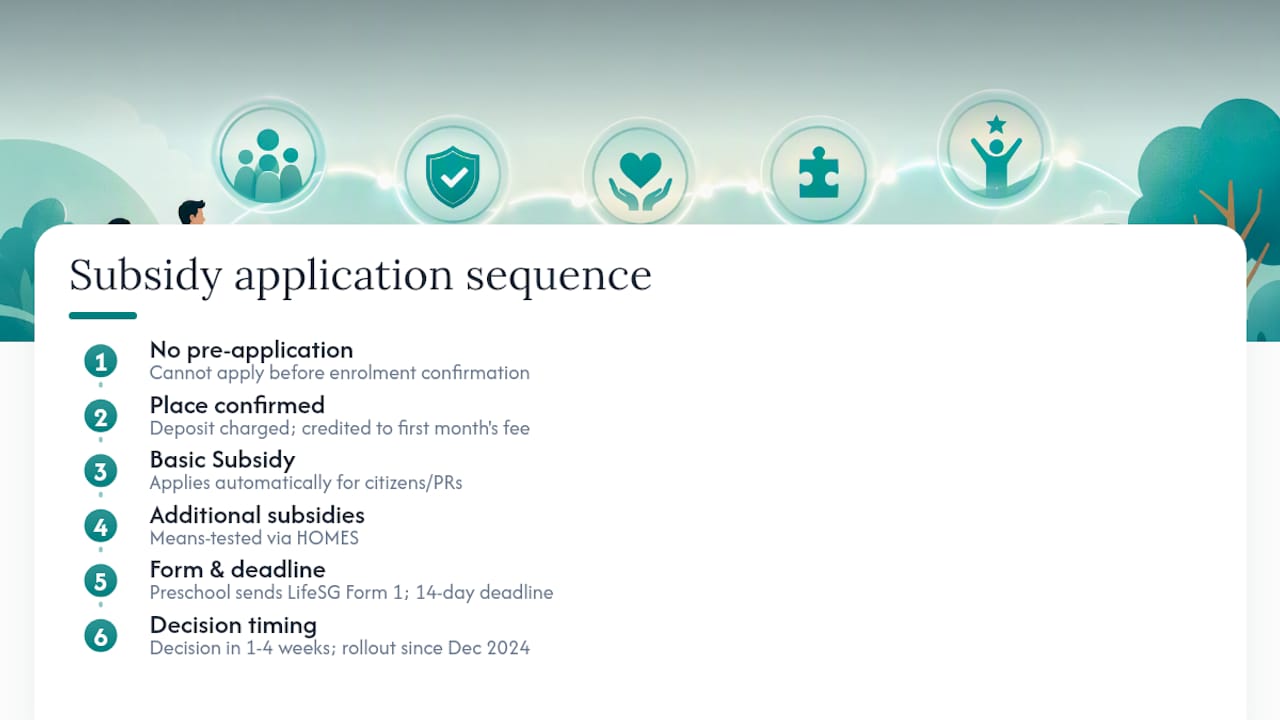
Once your child’s place is confirmed, ECDA’s Basic Subsidy applies automatically for eligible Singaporean citizens and Permanent Residents, providing support for infant care and childcare. Additional subsidies stack on top of that, means-tested through HOMES (the Household Means Eligibility System), so lower-income households can receive considerably more support.
Here’s the sequence that catches parents off guard: you cannot apply for the subsidy before enrolment is confirmed. The preschool must first trigger LifeSG Form 1, and only then do you have 14 calendar days to complete it. ECDA has been rolling out this digital process progressively since December 2024, with nationwide coverage expected across centers by now. Outcomes typically arrive within one to four weeks. If your child attends a kindergarten-only program, ask about KiFAS and CCFA eligibility separately, since those run through slightly different channels. For a deeper breakdown of fee bands by preschool type, see our guide to affordable preschool education.
What Documents Do You Need for Enrolment Day?
Prepare these ahead of time so enrolment day moves quickly: your child’s birth certificate, immunization records, your NRIC or passport, proof of address, and proof of employment or income if you’re applying for subsidies. Bring passport-sized photos too, since many centers still require them for physical student files.
On the day itself, you’ll sign enrolment forms, pay the deposit, and the preschool will confirm your place in its system, which is what triggers the LifeSG form. Before that appointment, log into Singpass and check your MyInfo details for accuracy, since the LifeSG form pulls that data automatically. If anything is outdated, flag it to the preschool immediately rather than after the subsidy form goes out.
What Should You Look for When Choosing a Preschool?
Rank preschools by teacher-to-child ratio and hygiene standards first, then curriculum fit, location, hours, and net cost after subsidies. Don’t overlook how well a center’s approach supports the transition into Primary 1 later on.

Watch for red flags during visits: vague answers about behavior management, reluctance to share curriculum documents, or communication that feels inconsistent between staff members. Ask directly how they handle a child’s first weeks of separation anxiety, and how often you’ll get updates on your child’s day. Our curriculum comparison guide is a useful companion for this stage.
What if Your First-Choice Preschool Doesn’t Work Out?
Applying to multiple preschools at once is standard practice, not a backup plan, since admissions specialists routinely recommend it given how often popular centers run waitlists.
Pro Tip: If your first choice waitlists you, ask politely for your position number and expected timeline, then accept a backup offer with a shorter deposit hold. Interim childcare or a later intake at your preferred center almost always beats leaving a gap in care.
Why Small Preschools Change What Admission Feels Like
Astor’s preschool campus in the Holland area runs small class sizes across two playgrounds, blending outdoor and classroom learning:
A smaller preschool means your child is known by name, not by number. Every teacher knows which child needs extra reassurance at drop-off and which one is ready for more of a challenge.
Parents choosing a small preschool over a larger center should expect more individualized attention and faster, more direct communication with teachers.
A Publisher’s Note on the Admissions Process
Parents most often stumble by applying too late or to only one center. Starting your shortlist early and applying broadly solves both problems at once.
Astor International Preschool: A Small-School Option Worth Visiting
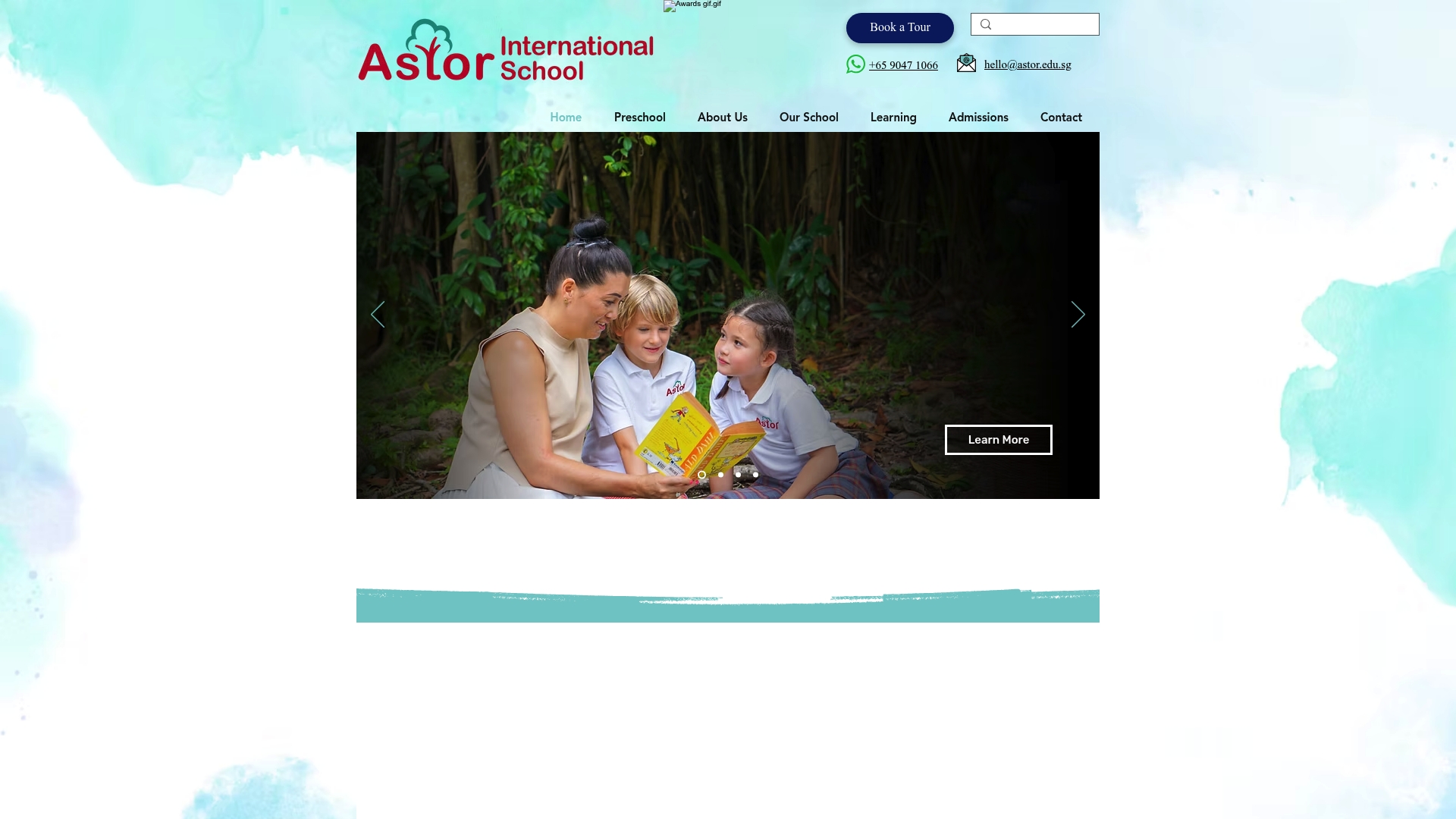
If you’re weighing a small preschool against a larger operator, Astor’s Holland-area campus is built around a simple idea: children learn best when they’re genuinely seen, not just supervised.
A few things worth knowing before you book a visit:
Small class sizes mean your child gets more one-on-one attention from teachers who know their name and their pace.
Two playgrounds support a real mix of outdoor and classroom learning, not just indoor time with occasional outdoor breaks.
The Holland-area location suits families looking for a quieter, community-feel campus rather than a large institutional setting.
Astor’s education network has been recognized for its small-school model at the primary level, a philosophy that carries through to the preschool.
If you’d like to see the campus and ask questions about curriculum fit, explore the IPC curriculum offering or browse the full learning programs page to book a visit and check current availability for your child’s age group.
Frequently Asked Questions
At what age can a child start preschool in Singapore? Infant care typically starts at two months and runs to eighteen months, while childcare and kindergarten programs cover eighteen months through six years.
Is K1 or K2 kindergarten compulsory? No. Kindergarten years are not compulsory, though most families enroll children to prepare for Primary 1 registration and routines.
How much does preschool typically cost after subsidies? Costs vary by preschool type, but the ECDA Basic Subsidy provides $600 monthly for infant care and $300 for childcare, with additional means-tested support on top.
Can I apply for the LifeSG subsidy before my child is enrolled? No. The subsidy application is strictly a post-enrolment step. Your preschool must confirm the place and trigger the LifeSG form before you can apply.
What happens if I miss the 14-day LifeSG deadline? The subsidy application is automatically withdrawn, and you’ll need to request that your preschool trigger a new form to restart the process.
Sources
Recommended
Comments