


Sibling Discounts at Singapore International Schools

Yes, some international schools in Singapore still offer sibling discounts, though the landscape has narrowed considerably. When available, savings typically fall between 5% and 15% off tuition for a second or third child, with a handful of schools structuring tiered discounts that climb higher for a fourth sibling. Many top-tier, capacity-constrained schools have quietly reduced or eliminated these discounts since 2022, so you can no longer assume a discount exists just because a school has one on record from a few years back.
Your first move should be simple: pull up the school’s official fees page or email admissions directly and ask for a written, multi-child cost breakdown. Don’t rely on word of mouth or outdated forum posts. Policies change, and the number that matters isn’t the discount percentage. It’s the total amount you’ll pay across all your children, every term, for the whole time they’re enrolled.
Key Takeaways
Sibling discounts in Singapore’s international schools have narrowed since 2022, and total family cost, not the discount percentage, determines whether a school is genuinely affordable.
Point | Details |
Typical discount range | Expect 5% to 15% off tuition for a second or third child, with tiered schedules occasionally reaching 15% for a fourth sibling. |
Discounts rarely cover everything | Enrollment fees, capital levies, and enrichment programs are usually excluded from the reduced rate. |
Compare total cost, not percentage | A lower base tuition with no discount can beat a high-tuition school offering a generous sibling reduction. |
Get it in writing | Request a written multi-child cost summary from admissions before enrolling to confirm exact terms. |
Astor’s approach | Astor is recognized as a best small and affordable international school, with continuity across preschool and primary that benefits families with multiple children. |
Table of Contents
How Sibling Discount Programs Work at International Schools
Most sibling discount programs follow a familiar shape, even though the fine print varies wildly from one school to the next. Understanding the mechanics helps you read a fees page correctly instead of taking a headline percentage at face value.

The discount almost always applies to the younger or newer-enrolled sibling, not the eldest. If your first child is already paying full tuition, your second child typically receives the reduced rate, and a third child (where schools offer tiered structures) receives a steeper discount still. Hibiscus International School, for example, publishes a schedule where the second child receives 5% off, the third receives 10%, and the fourth and beyond receive 15%, with the schedule often tied to whether you pay termly or annually.
Timing rules matter just as much as the percentage itself. Schools generally distinguish between:
Concurrent enrollment, where discounts apply only while two or more siblings are enrolled at the same time, in the same school year.
Consecutive enrollment, where a discount might carry over even if siblings start a year or two apart, though this is less common and usually capped at a defined window.
Reapplication triggers, where a discount lapses if an older sibling graduates or withdraws, requiring the family to reconfirm eligibility annually.
Discounts almost never touch the full invoice. Application fees, enrollment or registration fees, and one-off capital or building levies are commonly excluded, meaning the discount applies to recurring tuition only. Enrichment programs, such as after-school arts or sports add-ons, usually sit outside the discount entirely, so exploring best Spanish learning resources in Singapore for every learner can offer additional enrichment options beyond standard tuition discounts.
The most reliable place to confirm all of this is the school’s own published fees table or admissions handbook, not a marketing brochure or a parent forum thread. If a school’s website doesn’t spell out sibling terms clearly, treat that as a signal to ask admissions directly before you budget around an assumption.
What Sibling Discount Rates Look Like in Singapore
The range you’ll actually encounter sits mostly between 5% and 15%, with occasional outliers on either end. Broader aggregator research on the Singapore and regional market found that sibling discounts have declined across many top-tier schools since 2022, and where schools still offer them, discounts of 20% or more are now rare rather than typical.
A few real-world structures illustrate the spread:
Modest tier (around 5%): often the entry point for a second child, sometimes the only discount a school offers at all.
Mid tier (10% to 15%): common for a second or third sibling at schools with more enrollment capacity to fill.
Tiered structures: Westbourne College in Singapore lists 10% off for one additional sibling and 15% off for two or more, a model several schools in the region mirror.
A quick statistic worth sitting with: on an annual tuition fee of $30,000, a 5% sibling discount saves about $1,500 per year for that child. Push the discount to 10%, and the saving doubles to roughly $3,000. At 15%, you’re looking at $4,500 annually, or well over $50,000 across a full primary-to-secondary journey for one child alone. Multiply that by two or three siblings and the gap between “discount exists” and “discount is generous” becomes a genuinely large number over a decade of schooling.
The catch: several of Singapore’s most sought-after, capacity-constrained schools have stopped offering sibling discounts altogether. When a school has more applicants than seats, there’s little commercial incentive to discount tuition for existing families. That’s part of why capacity-constrained Tier 1 schools are less likely to offer sibling concessions than schools still building enrollment. If a school you’re considering sits in that highly selective category, don’t budget for a discount until admissions confirms one in writing.
What Details Should You Confirm Before Counting on a Discount?
A headline percentage tells you almost nothing until you’ve confirmed the details underneath it. Before you build a family budget around any advertised sibling rate, work through this checklist:
Does the discount cover tuition only, or other fees too? Most schools apply the reduction to recurring tuition alone. Application fees, one-time enrollment charges, and capital or development levies are commonly excluded from any sibling reduction.
Is enrollment concurrent or consecutive? Confirm whether both siblings need to be enrolled in the same academic year, and whether the discount lapses the moment an older child graduates.
What payment schedule triggers the discount? Some schools, including Hibiscus’s published structure, tie the reduced rate to termly or annual prepayment rather than monthly installments.
How does the school define “sibling”? Biological, step, half, and adopted siblings aren’t always treated the same way. Ask for the school’s exact definition in writing.
Do discounts stack with bursaries or scholarships? Many schools cap total concessions per family, meaning a sibling discount and a merit scholarship may not combine the way you’d hope.
How does the discount actually appear on your invoice? Ask to see a sample invoice or fee schedule showing the discount applied line by line, not just described in prose.
A few of these items sound like formalities until they cost you money. A family that assumes a discount applies to registration fees, transport, or enrichment classes, when the policy only covers tuition, ends up with an unpleasant surprise on the first invoice.
How to Calculate Your Family’s Total School Cost
Comparing schools by discount percentage alone is one of the most common mistakes affordability-minded parents make. The only number that matters is total family cost, not the headline percentage.
Here’s a repeatable method:
List base tuition and mandatory fees for each child separately. Include annual tuition, registration, and any compulsory capital levy, since these vary by school and by grade level.
Apply the sibling discount exactly as the policy states it, per child, not as a blanket reduction across the family total. If the policy gives 10% to the second child and 15% to the third, calculate each child’s fee independently before summing.
Add optional recurring costs, such as school bus transport, lunch programs, and enrichment classes, since these rarely receive any sibling reduction.
Sum everything across all children for one full academic year, then multiply forward across the number of years you expect to stay, to see the real multi-year commitment.
Pro Tip: Ask admissions for a written multi-child cost summary before you enroll. A five-minute email request now can save you from a fee surprise on your first invoice, and it gives you a document to reference if a discount doesn’t apply the way you expected.
A worked example makes the gap obvious. School B charges $27,000 in annual tuition with no sibling discount at all. Two children there cost $54,000 flat. Despite School A’s discount, School B is nearly $6,800 cheaper per year for the same family, a gap that compounds fast across multiple years of enrollment.
Before you sign anything, request a written multi-child cost schedule from admissions at every school on your shortlist. It’s the single fastest way to compare real numbers instead of marketing percentages, and it becomes your reference point if a discount is applied incorrectly later.
How Do You Apply for and Document Sibling Discounts?
Sibling discounts are rarely automatic. You typically need to notify the school and provide documentation at a specific point in the enrollment process, and missing that window can mean losing the discount for an entire term or year.
The right time to raise it is usually at application or at re-enrollment for an existing family, not after your child has already started classes. Ask admissions directly whether the discount is applied automatically once two siblings are confirmed, or whether you need to submit a formal request each academic year.
Documents schools commonly request include:
Birth certificates or official documents confirming the sibling relationship.
Enrollment confirmation or offer letters for both children.
Proof of shared household or guardianship, particularly for blended or non-traditional family structures.
Once approved, the discount should appear as a clearly labeled line item on your invoice or enrollment contract, not folded silently into a lump sum. If you don’t see it itemized, ask the finance office to reissue the invoice with the discount shown separately.
If a discount you expected is denied, ask for the specific policy clause in writing before escalating. Most disputes come down to a technicality: a missed enrollment window, a sibling definition that didn’t match your family structure, or a payment schedule requirement you weren’t told about upfront. Our smart admissions tips guide covers timing pitfalls worth reading before you submit any application.
Why Astor Is a Practical Choice for Families With Multiple Children
Astor International School has been recognized as one of Singapore’s best small schools and as one of its best affordable international schools, a distinction that matters directly if you’re weighing total family cost across multiple children rather than a single discount line. Small class sizes mean your children get attention that’s genuinely personalized, not just promised in a brochure.
Because Astor operates both an international preschool and a primary school within the same network, families with children spanning ages 1.5 to 12 can move a child from preschool into primary without switching philosophies, staff relationships, or campus culture. That continuity reduces the friction that often comes with juggling siblings across different schools entirely.
A small school built around continuity across preschool and primary years means the transition from one sibling’s classroom to the next feels familiar rather than disruptive, both for the child and for the parent managing two sets of school logistics.
If you’re comparing multi-child costs across schools, a few starting points are worth bookmarking:
Review Astor’s curriculum overview to see how the program is structured across age groups.
Check the IPC curriculum page for details on the inquiry-based approach used across primary years.
Request a written multi-child cost summary directly from Astor’s admissions team for your specific family situation.
Do Sibling Discounts Vary by Curriculum Type?
Curriculum type shapes sibling discount policy more than most parents expect. Schools running the International Baccalaureate tend to have higher base tuition across all grade levels, particularly at the Diploma Programme stage, which means even a generous percentage discount still leaves a large dollar figure on the table.
British curriculum schools, often following an International Primary Curriculum or Cambridge-aligned structure, sometimes offer more predictable, tiered sibling schedules similar to the 5/10/15% model published by Hibiscus International School. This tends to reflect a broader enrollment base and less capacity pressure than schools running IB Diploma tracks exclusively.
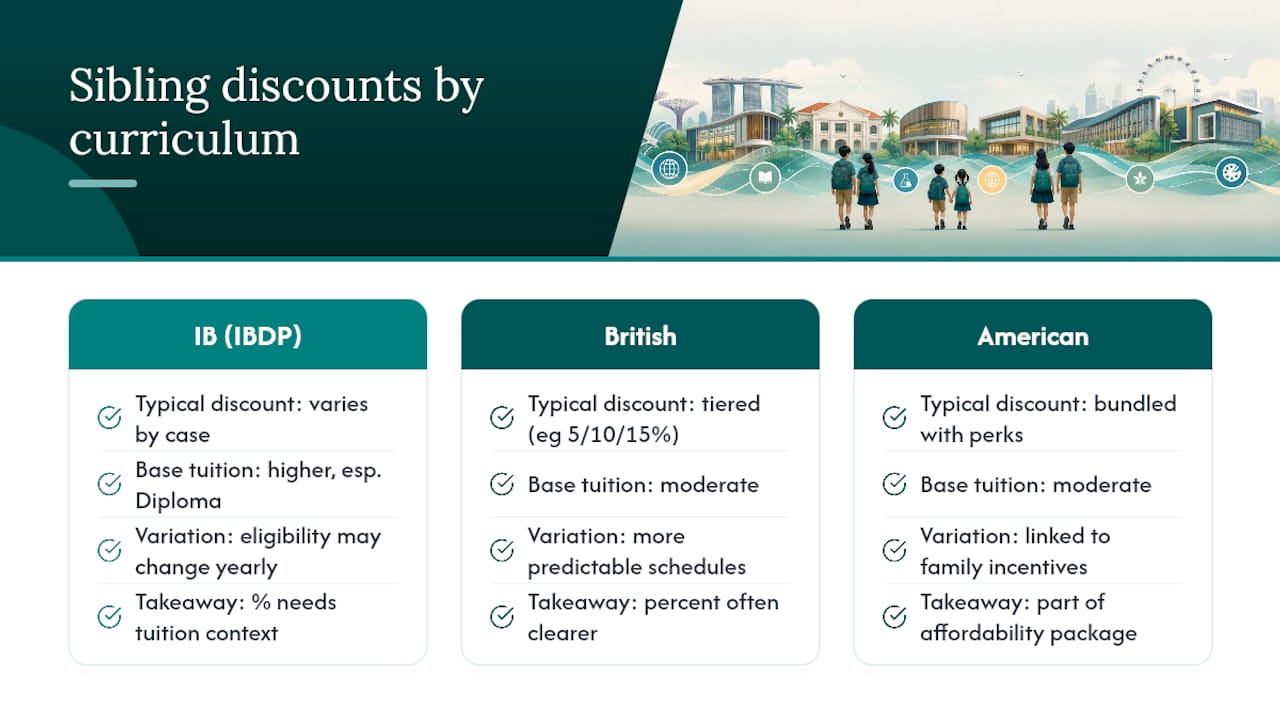
American curriculum schools frequently bundle sibling discounts with broader family enrollment incentives, sometimes as part of a wider affordability push aimed at competing for expatriate families who are comparing several curriculum types at once.
None of this means one curriculum guarantees a better discount. It means the discount percentage alone tells you very little without knowing the base tuition it’s calculated against, and without confirming whether the school’s specific curriculum track changes eligibility rules year to year. Always ask for the current published rate tied to the exact program your child will attend, not a generic percentage quoted for the school as a whole.
Does a Sibling Discount Affect Financial Aid Eligibility?
This is one of the most overlooked details in sibling discount policy, and it can genuinely change your total savings. Many schools cap the total concession a family can receive, meaning a sibling discount and a need-based bursary or merit scholarship don’t always stack the way parents assume.
Some schools treat sibling discounts and financial aid as entirely separate pools, allowing a family to receive both without either reducing the other. Others explicitly state that the sibling discount is the maximum concession a family can receive, full stop, regardless of financial need or academic merit demonstrated by a different child.
Before you count on receiving both, ask the finance or admissions office a direct question: “If we qualify for both a sibling discount and a bursary, do they combine, or does one replace the other?” Get the answer in writing, ideally referenced against the specific policy clause, rather than relying on a verbal assurance from an admissions counselor who may not handle financial aid decisions directly.
This matters most for families who are relying on aid to make a specific school affordable at all. If a sibling discount effectively caps out your total concession, a school with a smaller sibling discount but a more generous, separately calculated bursary program might actually deliver a lower total family cost.
How Have Sibling Discount Policies Changed Since COVID-19?
The pandemic reshaped enrollment economics across Singapore’s international school sector, and the ripple effects are still visible in sibling discount policy today. During the pandemic years, some schools expanded discounts and flexible payment terms to retain expatriate families who were weighing relocation, since empty seats meant lost revenue at a time when international mobility slowed sharply.
That pattern reversed as expatriate demand rebounded. Many capacity-constrained schools have pulled back or removed sibling discounts entirely since 2022, as waitlists returned and the financial incentive to retain families through discounting weakened.
The schools most likely to still offer meaningful sibling discounts today tend to be those with spare enrollment capacity, newer campuses still building their student base, or a deliberate positioning around affordability rather than exclusivity. If a school’s marketing still references a sibling discount policy from a few years back, verify it’s still active. Discount schedules published in 2022 or 2023 are not a reliable guide to 2026 policy, and several schools have quietly revised or sunset the terms without a prominent announcement.
How Do These Discounts Compare to Local Singaporean Schools?
Local Singaporean government schools operate on an entirely different fee structure, which makes a direct comparison useful mostly as context rather than a real alternative for expatriate families. Singapore Citizens and Permanent Residents pay heavily subsidized fees at local schools, with structures set by the Ministry of Education rather than by individual school administration, and sibling discounts in the international school sense don’t really exist because base fees are already low and standardized.
International schools operate in a fundamentally different market. Fees reflect private facility costs, expatriate-oriented curricula, smaller class sizes, and international teaching staff, which is why total costs run many multiples higher than local school fees even after a sibling discount is applied. The sibling discount conversation only really matters for families who have already decided an international curriculum is the right fit, whether for continuity with an international career path, curriculum alignment with future overseas study, or a preference for the smaller class sizes many international schools offer.
For families weighing both paths, the honest comparison isn’t discount percentage. It’s whether the total value of an international curriculum, including class size, teaching approach, and continuity across preschool and primary years, justifies the cost gap against a subsidized local alternative. That’s a values and logistics question as much as a financial one, and no discount schedule changes the underlying calculation.
The Editorial Take: Stop Chasing the Discount Number
Here’s the uncomfortable truth conventional advice skips: chasing the highest sibling discount percentage is one of the least useful ways to compare schools with multiple children. The percentage is marketing. The total invoice is the truth.
What actually matters is asking for that written multi-child cost summary before you commit to anything, then running the real arithmetic across every year you expect to stay enrolled. Most parents skip this step because it feels like extra homework during an already stressful admissions season. It’s the single highest-leverage thing you can do before signing a contract.
If affordability is genuinely your priority, and not just a discount headline, look at schools built around lower baseline costs and real continuity across your children’s ages, rather than schools relying on a shrinking discount to make an inflated fee feel reasonable.
A Small School Built for Families With More Than One Child
Astor is a practical alternative to schools that lean on discount percentages to soften a high base tuition. As one of Singapore’s recognized best small schools and best affordable international schools, Astor’s pricing is built to be reasonable from the start, so you’re not depending on a sibling concession to make the numbers work.
Because Astor spans preschool through primary in one connected network, siblings aged 1.5 to 12 can grow through the same educational philosophy, teaching team familiarity, and small class culture without a jarring switch between schools. That continuity is worth real money in reduced admissions overhead and fewer transition disruptions for your family, not just goodwill.
If you’re comparing total family cost across your shortlist, take a look at Astor’s curriculum approach and request a written multi-child fee summary directly from admissions. It’s the same document you should be asking every school for, and it’s the fastest way to see exactly what enrolling more than one child at Astor would actually cost your family this year.

Frequently Asked Questions About Sibling Discounts
Do all international schools in Singapore offer a sibling discount? No.
Which child receives the sibling discount? Usually the younger or more recently enrolled sibling, while the first child continues paying full tuition, though a handful of schools apply tiered discounts across three or more children.
Does a sibling discount apply to enrollment fees and transport costs? Generally no. Most schools apply the discount to recurring tuition only, excluding one-off enrollment fees, capital levies, transport, and enrichment programs.
Can a sibling discount combine with a scholarship or bursary? It depends on the school’s policy. Some cap total family concessions at whichever benefit is larger, so always confirm in writing whether the two combine or replace each other.
What’s the best way to compare schools with multiple children? Calculate total family cost across all children and all mandatory fees for a full academic year, rather than comparing sibling discount percentages alone, since base tuition differences often outweigh the discount itself.
Sources
Recommended
Artikel yang sangat informatif. Saya setuju bahwa orang tua sebaiknya tidak hanya melihat persentase sibling discount, tetapi juga menghitung total biaya pendidikan idebet, termasuk biaya pendaftaran, transportasi, dan kegiatan tambahan. Informasi mengenai hal-hal yang perlu dikonfirmasi kepada pihak sekolah juga sangat membantu sebelum membuat keputusan.