


Small Preschool Advantage: What Parents Need to Know
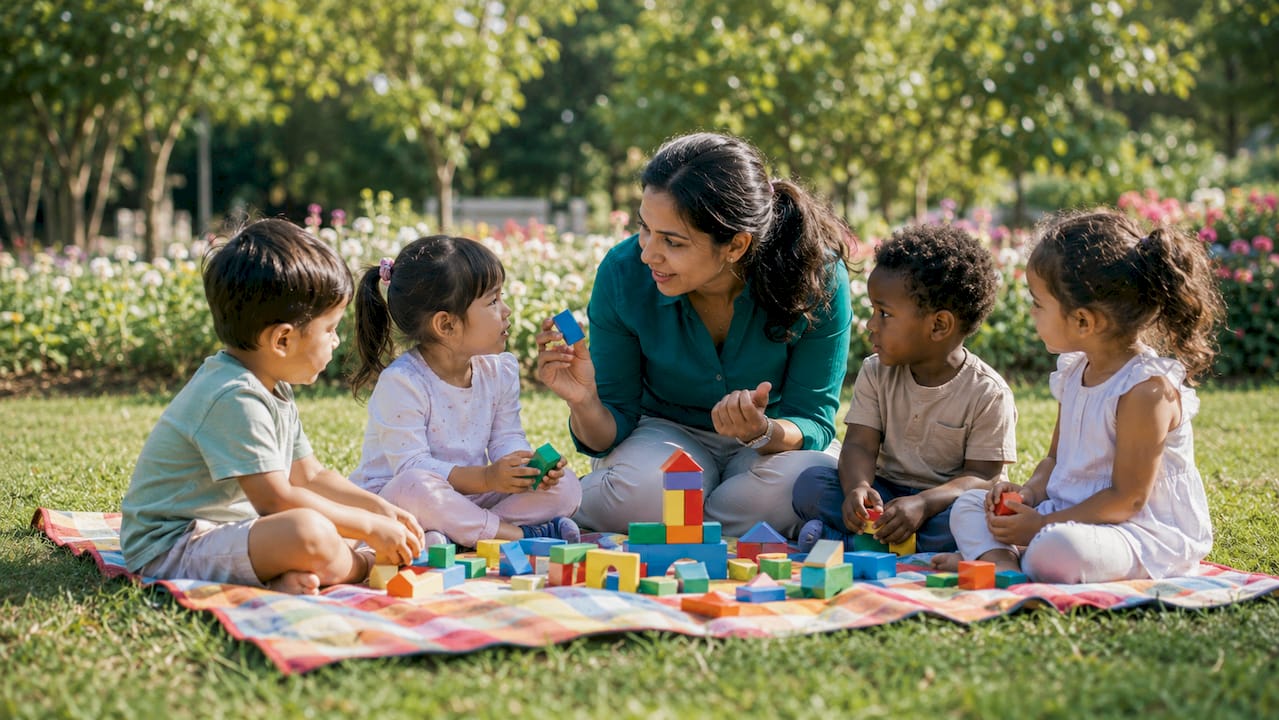
The small preschool advantage is defined as the measurable developmental and educational gains children aged 1.5 to 5 years receive when they attend preschools with smaller class sizes and lower student-to-teacher ratios. Research from Learning to Flourish and St. Peter Christian School confirms that these settings produce stronger academic engagement, more secure emotional attachments, and better kindergarten readiness than larger childcare centers. The difference is not subtle. When your child’s teacher knows every name, every learning style, and every emotional trigger in the room, the quality of care changes entirely. This guide explains exactly what that advantage looks like, why it matters for your child’s brain development, and how to find the right fit.
What is the small preschool advantage for academic learning?
Children in smaller preschool classes receive significantly more direct instructional time. Research shows an 80% engagement rate in small classes compared to just 67% in larger ones. That 13-percentage-point gap translates to real minutes of learning lost every single day in an overcrowded room.
The academic gains go beyond engagement. Teachers in small classrooms spend 25–38% more time on individualized instruction rather than managing group behavior. That shift means your child gets corrective feedback on letter formation, number recognition, and language development before small gaps become lasting habits.
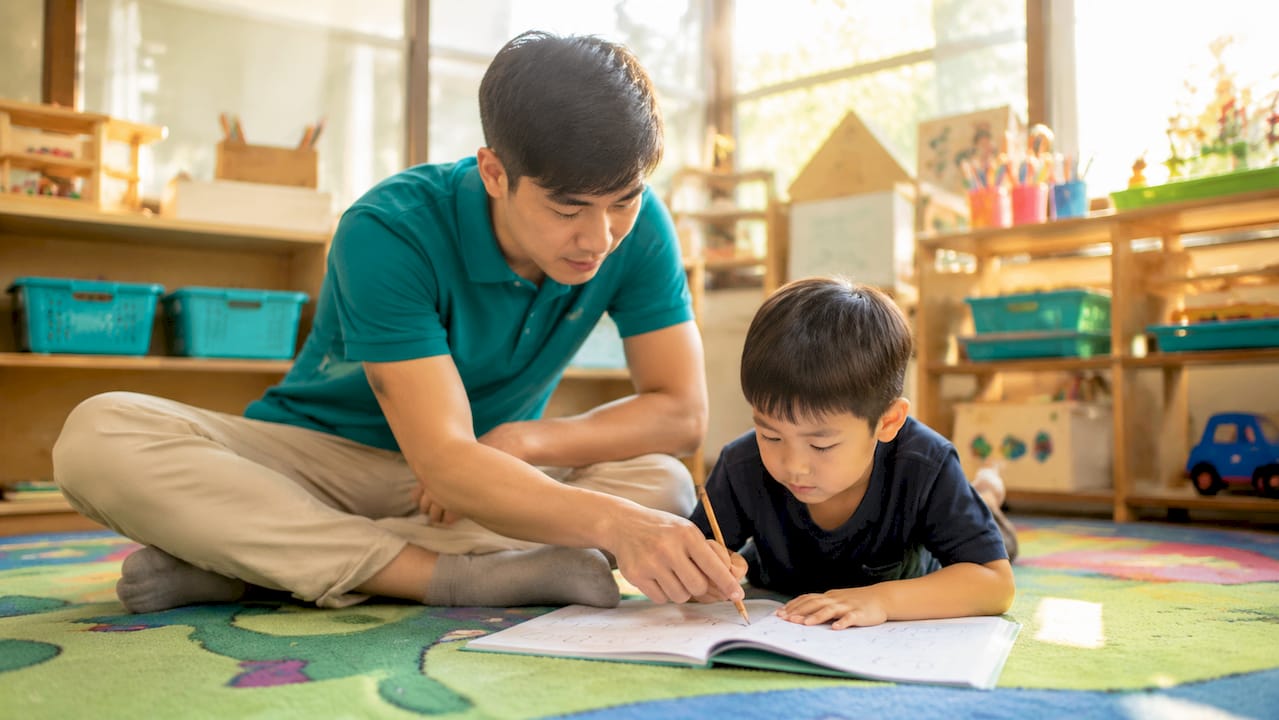
The results show up in measurable outcomes. Reducing class size produces an average improvement of 0.20 standard deviations in student achievement, moving the average child from the 50th to the 58th percentile. For a three-year-old building foundational literacy and numeracy skills, that kind of head start compounds over years of schooling.
Small preschools also maintain a healthier balance between direct instruction and guided play. The 70/30 or 80/20 instructional balance that early childhood educators recommend is far easier to achieve when a teacher manages eight children rather than twenty-five.
Children receive more corrective feedback on literacy and numeracy tasks
Teachers can adapt lesson pacing to each child’s readiness level
Guided play sessions stay purposeful rather than chaotic
Transitions between activities happen calmly and on schedule
Pro Tip: When you visit a preschool, ask the director what percentage of the day is spent on direct instruction versus free play. A well-run small preschool can answer this question specifically, not vaguely.
How do small preschools support social and emotional development?
Small preschools build the secure attachment relationships that brain development requires during the critical window of ages 1.5 to 5 years. When a child knows their teacher well and trusts that adult consistently, the brain’s stress response stays regulated. That regulation is the foundation for curiosity, risk-taking, and learning.
Social-emotional growth in a small setting looks different from what you see in a large center. A teacher who knows your child’s temperament can step in during a conflict over a toy and guide both children through negotiation rather than simply separating them. That kind of personalized guidance builds empathy and communication skills that no worksheet can replicate.
“Social-emotional development is not a soft skill. It is the infrastructure on which all academic learning is built.” This reflects the consensus among early childhood researchers who study outcomes from ages 3 through 8.
Shy or reluctant children benefit most visibly. Small class sizes encourage participation and give quieter children the space to voice opinions without being drowned out by louder peers. A child who finds their voice at age three carries that confidence into kindergarten and beyond.
The benefits of small preschools for social development include:
Stronger empathy through consistent, guided peer interactions
Better cooperation skills developed through small-group activities
Improved verbal communication as children feel safe to speak up
Emotional regulation supported by predictable routines and trusted adults
Small preschools vs. larger centers: what sets them apart?
The differences between small and large preschool settings are concrete and consistent across research. This comparison covers the factors that matter most to parents choosing between the two.
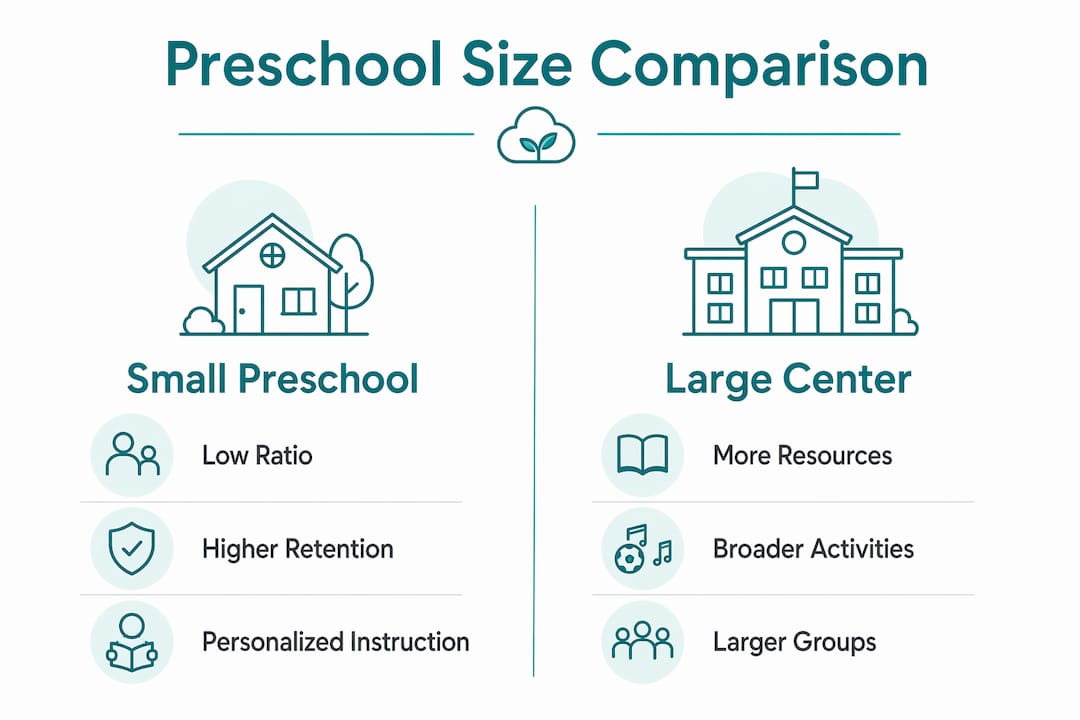
Factor | Small preschool | Large center |
Teacher-to-child ratio | Typically 1:6 to 1:8 | Often 1:15 or higher |
Individualized attention | High, daily, consistent | Limited, reactive |
Teacher retention | Higher, supporting routine | More turnover, less consistency |
Transition management | Proactive and calm | Reactive, often stressful |
Participation for shy children | Actively encouraged | Easily overlooked |
Academic engagement rate | Up to 80% | As low as 67% |
Teacher retention deserves special attention. Small preschools provide superior teacher consistency, which directly supports children’s emotional regulation and sense of routine. When your child sees the same warm face every morning for two years, that stability becomes a developmental asset.
Transitions between activities are another telling difference. In small classrooms, teachers manage schedule changes proactively, reducing the stress that toddlers feel when moving from one activity to the next. In larger centers, transitions often become chaotic moments that spike anxiety and derail the learning that follows.
Larger centers do offer some advantages worth acknowledging. They often have more resources, broader extracurricular options, and greater peer diversity. For some families, the extended hours or lower fees of a large center are practical necessities. The honest answer on small preschool pros and cons is that small settings win on depth of care, while large centers sometimes win on breadth of resources.
Pro Tip: Ask any preschool you visit to walk you through a typical daily transition, such as from outdoor play to lunch. How the staff handles that five-minute window tells you more about the environment than any brochure.
How to evaluate if a small preschool is the right fit
Choosing the right preschool starts with knowing what questions to ask and what to observe. Here is a practical framework for parents of children aged 1.5 to 5 years.
Ask about class size and ratio. Request the exact number of children per teacher, not a range. A genuinely small preschool will answer with a specific number, typically under ten per class.
Inquire about teacher qualifications and tenure. Ask how long the current teachers have been at the school. High turnover is a warning sign regardless of class size.
Observe classroom interactions. During your visit, watch whether the teacher makes eye contact with individual children, uses their names frequently, and responds to emotional cues. These behaviors signal a nurturing small preschool learning environment.
Ask about the instructional balance. A quality small preschool follows an 80/20 or 70/30 split between structured learning and guided play. If the director cannot explain their approach, that is worth noting.
Watch how conflicts are handled. A small group setting should allow teachers to guide children through disagreements rather than simply redirecting them. Personalized conflict resolution is one of the clearest benefits of small preschools.
Check the outdoor learning environment. Physical space matters for children aged 1.5 to 5 years. A preschool with dedicated outdoor play areas supports gross motor development alongside classroom learning.
Understanding the small class benefits for your specific child also means reflecting on their temperament. A highly social child may thrive anywhere, but a sensitive or introverted child will flourish most visibly in a small, predictable, nurturing setting.
Pro Tip: Schedule your visit during a transition time, not during free play. The way a school manages structured-to-unstructured shifts reveals the true quality of its daily routine.
Key Takeaways
The small preschool advantage is real, measurable, and most powerful for children aged 1.5 to 5 years who need secure attachments and personalized attention to build the foundations of lifelong learning.
Point | Details |
Higher academic engagement | Small classes produce an 80% engagement rate versus 67% in larger settings. |
More individualized instruction | Teachers spend 25–38% more time on one-on-one teaching in smaller classrooms. |
Stronger emotional development | Secure attachments in small settings regulate stress and support brain development. |
Better teacher consistency | Higher teacher retention in small preschools gives children stable, trusted relationships. |
Practical evaluation matters | Observing transitions and asking about instructional ratios reveals true classroom quality. |
Why I believe small preschools are worth prioritizing
I have spent years reading research on early childhood education and speaking with educators across Singapore and beyond. The evidence for small preschool settings is not ambiguous. What surprises most parents is how quickly the benefits show up, not in test scores years later, but in the way a child walks into the classroom on a Tuesday morning.
Confidence is visible. A child who is truly known by their teacher moves through the day with less anxiety and more curiosity. That is not a feeling. It is a measurable shift in behavior that researchers at institutions like The Crenshaw Academy and Learning to Flourish have documented consistently.
The insight that stays with me most is this: small classes only benefit children when teachers use the extra time for personalized teaching rather than simply managing fewer behavior problems. The class size is the opportunity. The teacher is the delivery. Both have to be right.
Parents sometimes worry that a small preschool means fewer social opportunities. My experience says the opposite is true. Deeper, more guided peer relationships in a small group build social skills faster than surface-level contact in a crowd. The best learning happens when every child is truly seen and supported. That is not a slogan. It is what the research keeps confirming.
— Elena
Discover Astor’s small preschool programs in Singapore
Astor International Preschool in Holland, Singapore, is built around everything this article describes. Small class sizes, two dedicated playgrounds, and a blend of outdoor and classroom learning give children aged 1.5 to 5 years the personalized, nurturing environment where the small preschool advantage becomes real every day. Astor International School in Tanglin, recognized as the best small school in Singapore and the best affordable international school in Singapore, extends that same philosophy through to age 12. If you are ready to see what a genuinely small, caring school looks like in practice, explore the IPC curriculum or visit holland.astor.edu.sg to learn more about the preschool program.
FAQ
What is the small preschool advantage in simple terms?
The small preschool advantage is the set of developmental benefits children gain from attending a preschool with a low student-to-teacher ratio and a small class size. These benefits include more personalized instruction, stronger emotional attachments, and better academic engagement.
What class size counts as a small preschool?
Most early childhood educators consider a class of 8–12 children with one or two teachers to be a small preschool setting. Ratios of 1:6 to 1:8 are considered optimal for children aged 1.5 to 5 years.
How does a small preschool help shy children?
Small class sizes encourage shy children to participate and voice their opinions in a student-centered environment. With fewer peers and a trusted teacher, quieter children find it easier to speak up and build confidence.
Are small preschools better for social development?
Yes. Small preschools provide more opportunities for guided peer interaction, personalized conflict resolution, and consistent adult support. These conditions build empathy, cooperation, and communication skills more effectively than larger group settings.
How do I know if a small preschool is right for my child?
Observe a classroom visit, ask about the teacher-to-child ratio, and watch how transitions are managed. Children who are sensitive, introverted, or new to group settings typically benefit most from the nurturing environment that small preschools provide.
Recommended
This post is very simple to read and appreciate without leaving any details out. Great work! Hard Drive Prices UK