


The Role of Playgrounds in Learning for Young Children
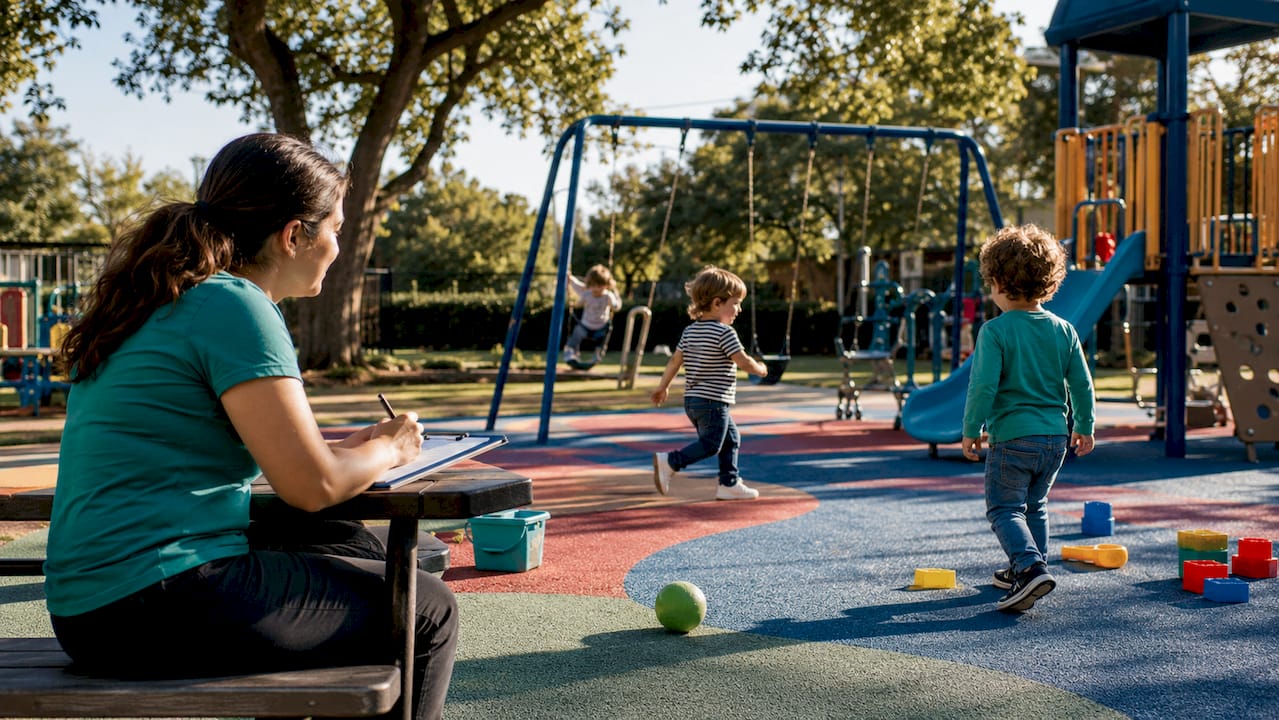
Playgrounds are defined learning environments where children build cognitive, physical, and social-emotional skills through structured and unstructured play. The role of playgrounds in learning extends far beyond physical activity. Research from the University of Exeter, the California Childcare Health Program, and a 2025 Frontiers meta-analysis all confirm that outdoor play shapes brain development, emotional regulation, and school readiness in ways that classroom instruction alone cannot replicate. For parents and educators, understanding what happens on a playground changes how you design, schedule, and supervise play time.
How do playgrounds support physical and motor skill development?
Playgrounds are the most accessible motor skill training environment available to young children. Every time a child climbs a ladder, balances on a beam, throws a ball, or pumps their legs on a swing, they are practicing fundamental movement skills (FMS). These skills are the physical building blocks for later academic learning.
The connection between movement and thinking is direct. A Frontiers meta-analysis found that fundamental motor skill interventions produce significant gains in executive function, with a standardized mean difference of 0.40. Executive function covers working memory, attention control, and cognitive flexibility. These are the same skills children need to follow instructions, solve problems, and regulate their behavior in a classroom.
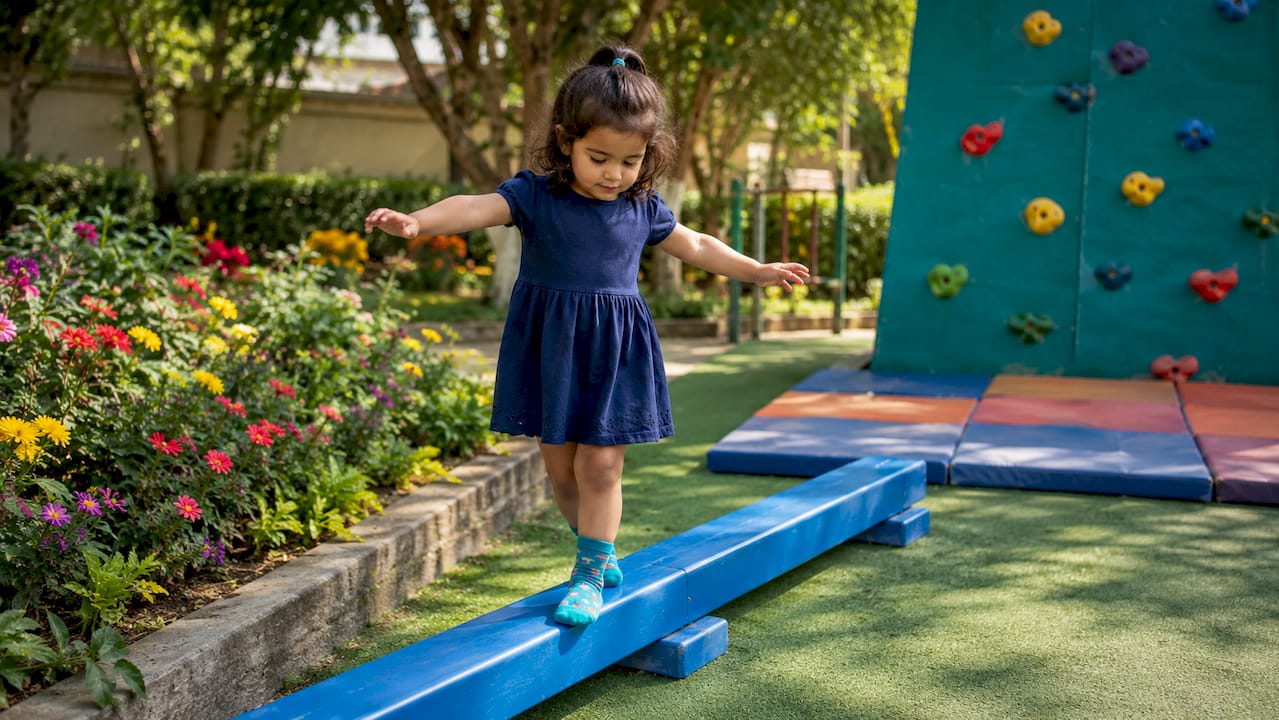
The gains are not automatic. Motor-to-cognition benefits are dosage-sensitive, requiring more than two sessions per week, each lasting at least 30 minutes. A single weekly playground visit is not enough to produce measurable cognitive improvement. Frequency and repetition are what drive the change.
The types of motor challenges matter too. Playgrounds that offer varied physical tasks produce broader skill development than flat open spaces. Consider what each piece of equipment demands:
Climbing structures build upper body strength, spatial reasoning, and risk assessment.
Balance beams and stepping stones develop proprioception and concentration.
Ball play areas practice hand-eye coordination and turn-taking.
Open running spaces support cardiovascular fitness and gross motor control.
Sensory surfaces like sand or grass stimulate tactile awareness and sensory integration.
Pro Tip: Schedule playground sessions in blocks of at least 30 minutes and repeat them daily. Rotating the physical challenges each week, such as focusing on climbing one week and balance the next, builds a broader motor skill base and sustains children’s curiosity.
What cognitive and social-emotional benefits do playgrounds offer?
Playgrounds are where children learn to think alongside other people. The cognitive and social-emotional benefits of outdoor play are well-documented and closely linked to how children interact during play, not just what equipment they use.
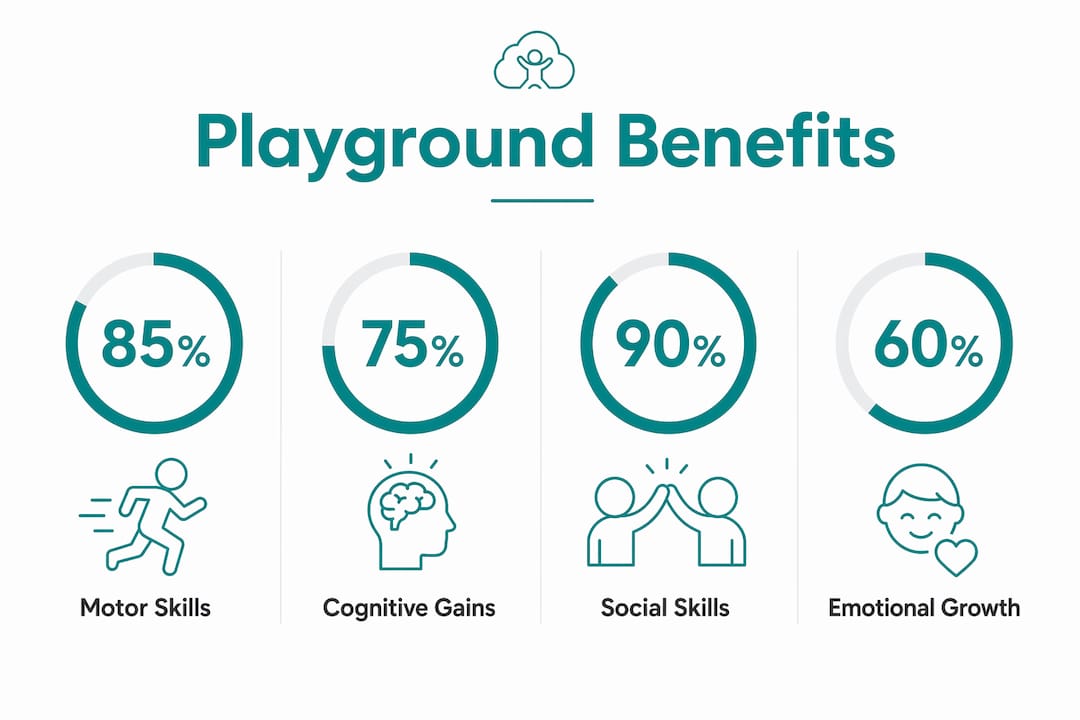
A playgroups intervention study found that children who participated in structured play interventions showed higher scores on reasoning measures. Caregivers also reported improved positive social relations. This means playground play, when intentionally designed, produces measurable gains in both thinking skills and how children relate to peers and adults.
Here is how those gains develop in practice:
Problem-solving through play scenarios. When children negotiate who plays which role in a game, they practice reasoning, perspective-taking, and compromise. These are the same cognitive processes used in academic tasks.
Emotional regulation through peer conflict. Disagreements on the playground are not problems to eliminate. They are opportunities for children to practice managing frustration, expressing needs, and repairing relationships.
Language development through social play. Role play and cooperative games require children to communicate clearly, listen actively, and adjust their language to their audience.
Confidence building through physical challenge. Successfully climbing a structure or mastering a new skill builds a child’s belief in their own ability to learn. That confidence transfers to classroom learning.
Adult involvement shapes how much children gain from these interactions. A scoping review of 51 studies confirmed that play-based learning produces cognitive, academic, and social-emotional benefits, but adult scaffolding is the key variable. Scaffolding means asking open questions, narrating what you observe, and gently extending a child’s thinking without taking over the play.
Pro Tip: When you observe children playing, resist the urge to solve their conflicts immediately. Give them 60–90 seconds to work through disagreements independently. Step in only when safety is at risk or the situation has stalled. This builds the social reasoning skills that learning through play research consistently identifies as foundational.
Why does outdoor play frequency matter for developmental outcomes?
The timing and consistency of outdoor play during the preschool years directly shapes long-term health and development. This is not about occasional playground visits. It is about building a regular habit during a critical developmental window.
University of Exeter research found that more outdoor play between ages 2 and 4 significantly improves mental health profiles through age 8. Each additional day of outdoor play associates with a 6%–14% increased likelihood of low-symptom mental health outcomes. That is a meaningful effect from a simple, low-cost change in daily routine.
The California Childcare Health Program recommends that preschoolers receive 60–90 minutes of outdoor play spread across 2–3 sessions per day, with a total target of 90–120 minutes of moderate-to-vigorous physical activity. These guidelines reflect the dosage needed for physical, cognitive, and emotional benefits to accumulate.
Recommendation | Guideline |
Daily outdoor play duration | 60–90 minutes total |
Number of daily sessions | 2–3 sessions |
Moderate-to-vigorous activity target | 90–120 minutes per day |
Minimum session length for cognitive gains | 30 minutes per session |
Frequency for executive function benefits | More than 2 sessions per week |
Practical scheduling tips for preschool settings and home routines:
Morning sessions take advantage of cooler temperatures and higher energy levels in young children.
Post-lunch sessions support digestion and prevent the sedentary slump that follows meals.
Consistent timing helps children anticipate outdoor play, reducing transition resistance.
Weather-adapted play keeps the routine intact. Light rain gear and shaded areas extend outdoor time across seasons.
The importance of outdoor play is not just physical. Consistent outdoor time during ages 2–4 builds the mental health foundation children carry into primary school and beyond.
How can parents and educators maximize learning through playground play?
Having a playground does not automatically produce learning. The quality of what happens on that playground determines the developmental outcome. This distinction matters enormously for both parents and educators.
A common gap in early childhood settings is the assumption that children will learn simply by being given free access to outdoor equipment. Play-based learning research identifies adult scaffolding and intentional play design as the key factors that separate high-benefit play from low-benefit play. Passive supervision produces far less developmental gain than responsive, observant adult involvement.
Comparing playground setups by learning affordance
Playground type | Primary learning benefit | Adult role |
Balanced challenge structures | Motor skill development, risk assessment | Encourage, observe, narrate |
Sensory play zones (sand, water, texture) | Sensory integration, curiosity, language | Ask open questions, extend exploration |
Social play areas (open space, group games) | Cooperation, communication, conflict resolution | Facilitate, model, step back |
Nature-based areas (gardens, loose parts) | Problem-solving, creativity, scientific thinking | Co-explore, introduce vocabulary |
Effective adult roles in playground learning include light scaffolding, observation, and responsive support. The goal is not to direct the play but to extend it. Ask “What do you think will happen if…?” rather than “Do it this way.” Narrate what you see: “You figured out how to balance on one foot. That took real concentration.” This language builds metacognition, the ability to think about one’s own thinking.
The active movement in schools research reinforces that structured outdoor activity, when paired with educator-led integration, produces the strongest developmental outcomes. Movement and learning are not separate activities. They are the same activity at this age.
Pro Tip: Before each playground session, set one simple intention. It could be “today we notice textures” or “today we practice taking turns on the slide.” This gives the session a light cognitive frame without removing the freedom of play. Children benefit from purposeful play without feeling directed.
Key takeaways
Playgrounds are the most powerful multi-domain learning tool available in early childhood education, and their impact depends on frequency, intentional design, and adult scaffolding.
Point | Details |
Motor skills drive cognitive gains | Regular playground activity builds executive function, attention, and working memory in young children. |
Frequency is non-negotiable | Children need more than two outdoor sessions per week, each at least 30 minutes, for measurable developmental benefits. |
Adult scaffolding multiplies outcomes | Responsive adult involvement during play produces far greater cognitive and social gains than passive supervision. |
Social play builds emotional skills | Peer interaction on playgrounds develops emotional regulation, communication, and conflict resolution in real time. |
Mental health benefits start early | Consistent outdoor play between ages 2 and 4 associates with significantly better mental health outcomes through age 8. |
Why I believe we underestimate what playgrounds actually do
After working closely with early childhood educators and families, I have seen one pattern repeat itself: playgrounds are treated as a break from learning rather than a core part of it. That framing costs children real developmental opportunity.
The research is clear. Policy recommendations from the University of Exeter study call for integrating outdoor play spaces into public health and education funding. That is not a minor suggestion. It reflects how seriously researchers now take the mental health and developmental stakes of playground access.
What I find most compelling is the dosage finding. Parents often assume that any outdoor time counts equally. It does not. Consistent, frequent, and varied outdoor play during ages 2–4 is what produces lasting benefit. A birthday party at a playground once a month is not the same as 30 minutes of active outdoor play every day.
The other thing I would push back on is the safety-versus-risk debate. Many well-meaning adults remove challenge from playgrounds to prevent injury. But toddler development research shows that appropriate risk-taking builds confidence, resilience, and judgment. A child who never climbs higher than they feel comfortable with is a child who never learns to assess their own limits. That skill matters far beyond the playground.
Invest in quality outdoor play. Schedule it deliberately. Show up as a curious, observant adult rather than a passive bystander. The returns are measurable and they last.
— Elena
How Astor International Preschool approaches playground learning

At Astor International Preschool in Holland, Singapore, two dedicated playgrounds sit at the heart of the daily program. Outdoor and classroom learning are woven together intentionally, not treated as separate activities. Educators schedule outdoor sessions aligned with the California Childcare Health Program guidelines, giving children the frequency and duration that research shows produces real developmental gains.
Astor International School in Tanglin builds on this foundation through the International Primary Curriculum, which integrates physical, cognitive, and social development across all year groups. Small class sizes mean every child is genuinely seen and supported, both indoors and out. If you are looking for a nurturing environment where outdoor play is taken as seriously as classroom learning, explore Astor’s full curriculum to see how play-based development is built into every school day.
FAQ
What is the role of playgrounds in early childhood learning?
Playgrounds support cognitive, physical, and social-emotional development through active, motor-rich, and social play. Research confirms that regular outdoor play improves executive function, reasoning, emotional regulation, and long-term mental health.
How much outdoor play do preschoolers need each day?
The California Childcare Health Program recommends 60–90 minutes of outdoor play across 2–3 daily sessions, with a total of 90–120 minutes of moderate-to-vigorous physical activity per day.
Do playgrounds improve children’s mental health?
Yes. University of Exeter research found that each additional day of outdoor play between ages 2 and 4 associates with a 6%–14% increased likelihood of low-symptom mental health outcomes through age 8.
What types of preschool playgrounds best support development?
Playgrounds that combine challenge structures, sensory zones, open social spaces, and nature-based areas produce the broadest developmental benefits by engaging motor, cognitive, and social skills simultaneously.
How should adults support learning on the playground?
Adults should use light scaffolding: asking open questions, narrating observations, and offering responsive support rather than directing play. A scoping review of 51 studies confirms that adult involvement is the key variable in play-based learning outcomes.
Recommended
Comments