


The Role of STEM in Primary Education Explained
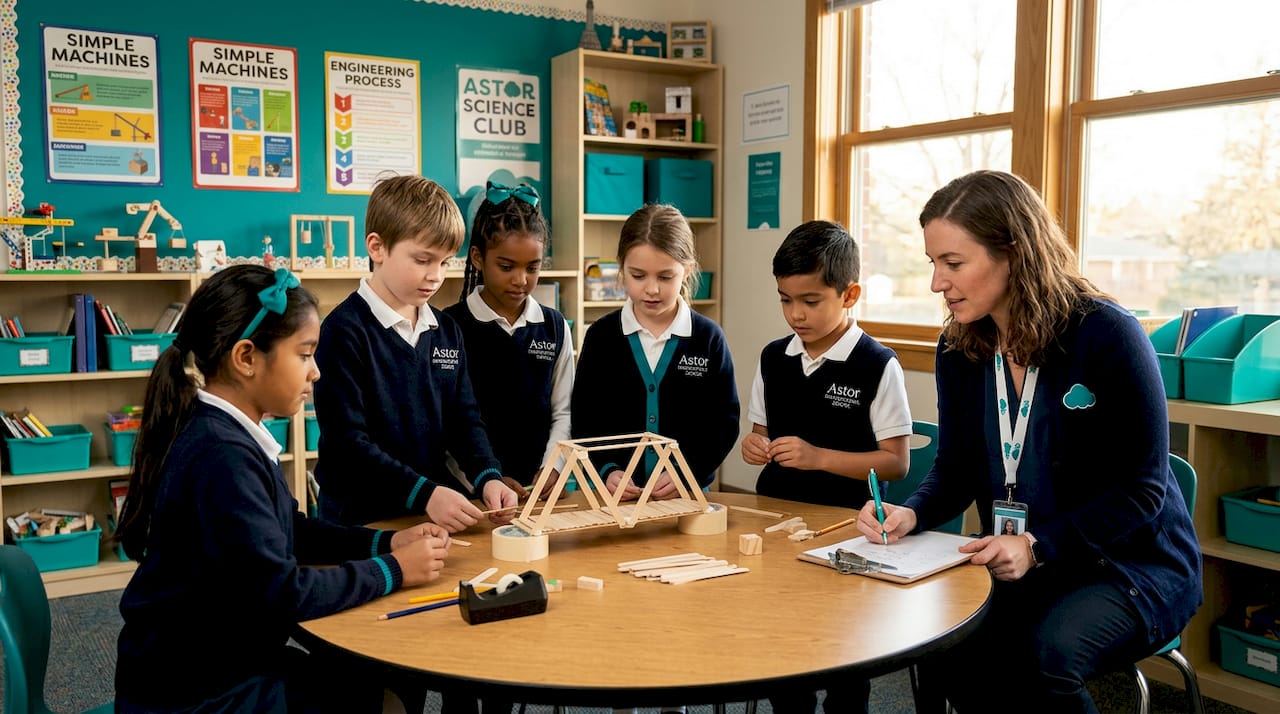
STEM gets misunderstood constantly. Many parents and educators picture it as extra science drills or coding electives added on top of the regular curriculum. The real role of STEM in primary education is something far more meaningful: it is an integrated approach that teaches children how to think, ask questions, solve real problems, and work alongside others. This article walks you through what genuine STEM integration looks like in primary classrooms, the broad developmental benefits research supports, the real challenges schools face, and concrete strategies you can act on today.
Table of Contents
Key Takeaways
Point | Details |
STEM is interdisciplinary by design | True STEM education connects science, technology, engineering, and math around authentic problems, not separate lessons. |
Broad skills grow alongside content knowledge | Meta-analysis evidence shows STEM programs significantly develop critical thinking, creativity, and collaboration in young children. |
Teacher preparation is the linchpin | How educators are trained to teach STEM determines whether integration actually happens or stays superficial. |
Equity must be planned from the start | Resource gaps and gender disparities need systemic attention before STEM integration can benefit every child equally. |
Families and schools share the role | Parents who encourage curiosity and inquiry at home meaningfully reinforce what well-designed STEM programs build in school. |
What the role of STEM in primary education actually means
STEM stands for Science, Technology, Engineering, and Mathematics. At the primary level, these are not meant to operate as four separate subjects. The defining feature of good STEM education is integration: children explore a genuine question or challenge that requires knowledge and skills from multiple disciplines at once.
Think of a class of seven-year-olds investigating why plants near their classroom window grow differently from those in a shaded corner. They are observing and recording data (science), measuring growth with rulers and tracking results in charts (mathematics), designing a controlled experiment with materials (engineering thinking), and sometimes using digital tools to document findings (technology). No single subject owns the activity. That is the point.
Here is how integrated STEM differs from traditional subject teaching:
Traditional approach: Each subject is taught in its own time slot with its own textbook. A math lesson is math. A science lesson is science. Connections between them are rarely made explicit.
Integrated STEM: A single project or problem threads through multiple disciplines. Children see how a math concept like measurement directly supports scientific observation, which informs an engineering solution.
STEAM variation: Some schools add Arts to the acronym, recognizing that design thinking, communication, and creativity are not separate from STEM but integral to it. At Astor, STEAM in the IPC curriculum shows how this works in practice across history-rich topics.
Authentic STEM projects for young learners include building bridges from popsicle sticks to meet a weight challenge, programming simple robots to navigate a course, or designing water filtration models using everyday materials.
Pro Tip: When evaluating any STEM program for your child, ask the teacher: “What problem are the children trying to solve?” If the answer is a specific, open-ended challenge rather than a lesson objective, you are likely looking at genuine integration.
The benefits that reach beyond academic knowledge
The case for STEM in primary schools is often framed around future careers. That framing undersells it. The real argument is what STEM does for children right now, at ages five through twelve.
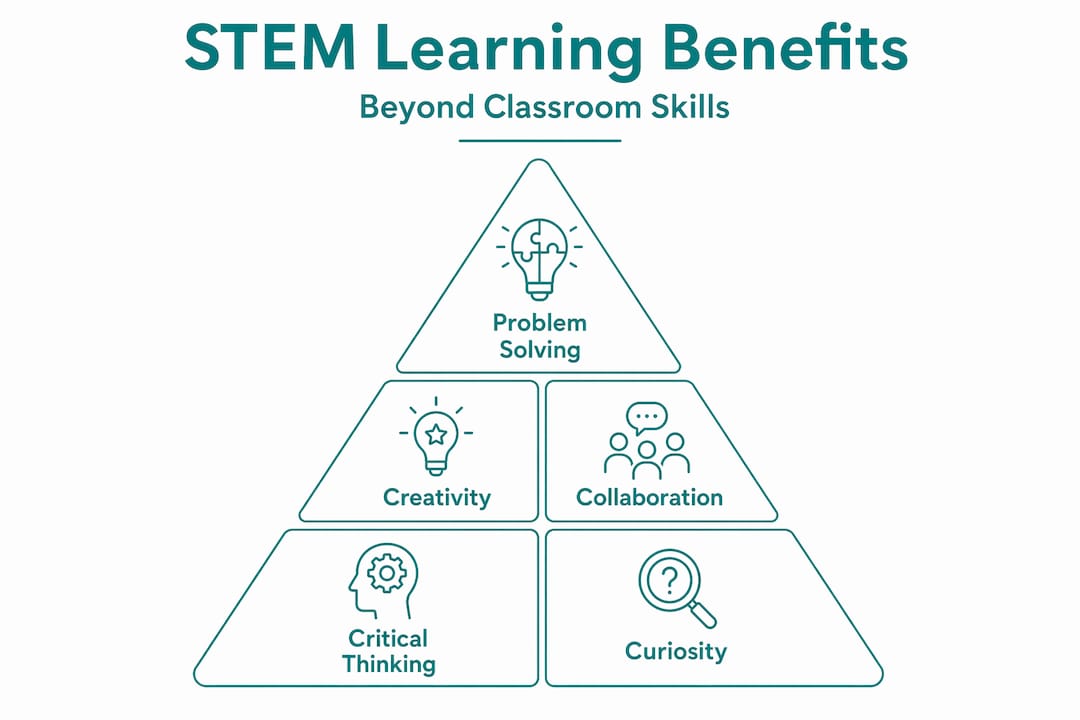
A meta-analysis of 38 empirical studies found that STEM programs produced large, statistically significant improvements in what researchers call the 6Cs: critical thinking, creativity, communication, collaboration, character, and citizenship. These are not soft extras. They are the cognitive and social foundations children need to learn anything well.
Here is what that looks like in a primary classroom:
Critical thinking: Children learn to question assumptions, test ideas, and revise their thinking when evidence changes. A child who builds a structure that collapses is practicing failure as information, not failure as defeat.
Creativity: Open-ended STEM challenges have no single correct answer, which means children must generate and evaluate their own solutions rather than reproduce a procedure from the board.
Communication: Presenting a project to classmates, explaining a design choice, or writing up an experiment develops articulate thinking at an early age.
Collaboration: Most STEM tasks are designed for small teams. Children negotiate roles, resolve disagreements, and share credit. These are social skills built through practice, not instruction.
Character and citizenship: Projects connected to real-world issues, such as reducing waste or improving a school garden, give children a sense that their thinking matters beyond the classroom.
“Parents and educators should expect STEM education to build broad 21st century skills, not just discrete STEM knowledge.” The Effects of STEM Programs on Students’ 21st Century Skills
Cognitive benefits extend to how children process and retain information. Early STEM integration supports stronger academic outcomes across subjects, including literacy, because inquiry-based learning requires reading, reasoning, and precise communication simultaneously. When you connect interactive science activities to children’s real experiences, engagement rises and retention deepens.
Challenges to honest STEM integration
Recognizing the promise of STEM is easy. Understanding the obstacles that prevent genuine integration is what separates thoughtful educators and informed parents from those who accept surface-level programs as the real thing.
Teacher preparation gaps. An analysis of seven teacher-preparation programs found that integrated STEM preparation received limited emphasis at the primary level. Most teachers are trained as subject specialists, not as facilitators of multidisciplinary inquiry. When teachers are not confident crossing subject boundaries, STEM becomes a workshop add-on rather than a curriculum philosophy.
Resource inequities. Access to materials, technology, and physical space varies dramatically between schools. A school without reliable internet, adequate science supplies, or flexible classroom furniture cannot implement the same STEM experiences as a well-resourced counterpart. Affordable tools like UNESCO’s microscience kits exist precisely to address this, but they require deliberate procurement and training.
Gender and inclusion gaps. Research consistently shows that girls and children from underrepresented groups engage less with STEM when the culture of a classroom is not deliberately inclusive. Equity in STEM does not happen automatically. It requires curriculum design that presents diverse role models, avoids gendered framing of tasks, and monitors participation actively.
Systemic support requirements. Individual enthusiastic teachers cannot sustain integrated STEM alone. Schools need timetabling flexibility, leadership support, and ongoing professional development structures.
Pro Tip: If you are a parent considering a school’s STEM offering, ask how teachers are trained and supported for STEM delivery. A genuine program will have a clear answer. A superficial one will point you to a robotics club.
Practical strategies for parents and educators

The good news is that you do not need a fully resourced specialist facility to make STEM work well. What you need is intentional design and a commitment to inquiry over instruction.
For educators, the most effective approaches share a few characteristics. They begin with a driving question that connects to children’s real experiences. They allow students multiple pathways to a solution. They build in time to reflect, revise, and present. Research confirms that both project-based and non-project-based STEM programs develop 21st-century skills effectively, which means flexibility in design does not reduce impact.
Strategy | Best for | Example |
Inquiry-based projects | Building critical thinking and collaboration | Bridge-building challenge with weight testing |
Digital tools and robotics | Developing technology literacy | Programming a small robot to complete a maze |
Outdoor learning | Connecting STEM to real-world context | Measuring plant growth across different environments |
Open-ended math challenges | Deepening mathematical reasoning | Open-ended math problems with multiple valid solutions |
Cross-subject projects | Modeling true integration | Designing a sustainable garden (biology, measurement, planning) |
For parents, the strategies are simpler but no less powerful:
Ask your child how they solved something rather than what the answer was. This shifts focus to process and reasoning.
Encourage tinkering at home. Building, constructing, and testing with everyday objects mirrors the engineering design cycle.
Visit learning outside the classroom experiences like nature walks, science museums, and maker spaces to reinforce STEM curiosity beyond school hours.
Advocate for professional development time at your child’s school. Teachers who receive ongoing STEM coaching implement integration more confidently and consistently.
Interactive technologies like robotics kits and 3D printing, when paired with trained teachers, show measurable gains in student engagement. The technology alone is not the answer. The pedagogy surrounding it is.
My honest take on what actually matters
I have spent years watching STEM programs launched with great enthusiasm and then quietly reduced to a weekly coding session or a once-a-term science fair. The pattern is frustrating, because the evidence for what STEM can do is genuinely strong.
In my experience, the schools that get STEM right share one thing: they treat it as a teaching philosophy, not a subject. They do not ask “When is STEM time?” They ask “How do we bring scientific thinking and problem-solving into everything we do?” That shift in framing changes everything from timetabling to teacher conversations to how children are assessed.
I’ve also seen how devastating underprepared teachers can be for STEM outcomes. How teacher education is designed determines whether true integration happens. A teacher who is not confident bridging disciplines will retreat to what they know, which is single-subject delivery. This is not a failure of individual educators. It is a systemic failure of preparation and ongoing support.
What I find most compelling about the research is the equity angle. Phased, inclusive approaches that monitor participation from the start are the only way to make sure STEM benefits every child, not just the ones who already feel confident in science or math. Schools that skip this planning almost always end up widening gaps rather than closing them.
My take: STEM in primary education is not a trend to adopt. It is a commitment to developing children who can think clearly, work with others, and approach uncertainty with curiosity rather than anxiety. That is worth getting right.
— Elena
How Astor supports integrated STEM learning
At Astor International School in Singapore, STEM is woven into the fabric of daily learning rather than treated as a separate program. Located in the Tanglin area and recognized as one of Singapore’s best small schools, Astor’s small class sizes mean every child receives the individual attention that genuine inquiry-based learning requires. Teachers know their students well enough to personalize challenges, ask the right questions, and notice when curiosity is ready to be stretched.
The school’s IPC curriculum integrates science, technology, engineering, and mathematics through meaningful, cross-disciplinary topics that connect learning to the real world. For families who want to understand more about the full picture, Astor’s curriculum overview offers a clear view of how STEM principles shape primary education at every level. If you are looking for a nurturing environment where your child’s curiosity is genuinely seen and supported, Astor is worth exploring.
FAQ
What is the role of STEM in primary education?
STEM in primary education provides an integrated approach to learning that develops critical thinking, creativity, and collaboration through real problem-solving across science, technology, engineering, and math. It goes well beyond academic content to build the broad 21st-century skills children need throughout life.
At what age should children start STEM learning?
STEM learning can begin as early as preschool through age-appropriate inquiry, building, and exploration activities. The earlier children engage with open-ended problem-solving, the more naturally curiosity and scientific thinking develop as habits of mind.
How is integrated STEM different from just teaching science?
Integrated STEM connects multiple disciplines around a single authentic challenge, so children apply math, design thinking, and technology alongside science simultaneously. Traditional science teaching addresses one subject in isolation, without the cross-disciplinary problem-solving that defines true STEM education.
How can parents support STEM learning at home?
Parents support STEM development by encouraging questions, allowing children to tinker and build with everyday materials, and asking about the process of solving problems rather than just the answer. These habits reinforce the inquiry mindset that good STEM programs build at school.
Does STEM education benefit all children equally?
STEM benefits all children when programs are intentionally designed for inclusion. Research shows that without deliberate equity planning, gender and resource disparities can reproduce existing gaps rather than reduce them, making inclusive curriculum design a necessity from the start.
Recommended
I've been looking for info on this topic for a while. I'm happy this one is so great. Keep up the excellent work Fertigpools
I definitely enjoying every little bit of it and I have you bookmarked to check out new stuff you post. Zwembad aanleggen
I read your post and I found it amazing! thank! Poolbau NRW
Wow! Such an amazing and helpful post this is. I really really love it. It's so good and so awesome. I am just amazed. I hope that you continue to do your work like this in the future also. Airco Leuven
A debt of gratitude is in order for giving late reports with respect to the worry, I anticipate read more. Swimmingpools