


What Is School Accreditation: A Parents' Guide
- sasha2644
- Aug 8
- 9 min read

School accreditation is a voluntary, independent quality review in which a recognized non-governmental agency evaluates whether a school meets established standards for curriculum, faculty, governance, and student outcomes. For students and families, three things follow directly from that definition:
Federal financial aid eligibility. Higher education institutions must hold accreditation from a U.S. Department of Education recognized agency for students to access federal grants and loans.
Credit transferability. Colleges generally accept transfer credits from accredited schools far more readily than from unaccredited ones, protecting the time and money your family invests.
Employer and licensure recognition. Many professional licensing boards and graduate programs require a degree or diploma from an accredited institution. Graduating from an unaccredited school can quietly close doors years later.
To verify any school’s current status, jump to the verification steps in the section on U.S. recognition bodies below.
Table of Contents
What is school accreditation, and what types exist?
Accreditation in the U.S. falls into two broad categories: institutional and programmatic (also called specialized). Understanding the difference matters because a school can hold one without the other.
Institutional accreditation covers the entire school or college as a single entity. Reviewers look at governance, financial health, student support services, and overall educational effectiveness. Programmatic accreditation evaluates a specific department or field of study, such as engineering, business, or teacher preparation, regardless of the broader institution’s status.
You may also hear the terms “regional” and “national” accreditation. These labels reflect historical geography but are less decisive today than whether the accreditor itself is recognized by the U.S. Department of Education or the Council for Higher Education Accreditation. Recognition status is the signal that actually determines federal aid eligibility and credit portability.
Dimension | Institutional accreditation | Programmatic accreditation |
Scope | Entire school or college | Specific program or department |
What is evaluated | Governance, finances, curriculum, student support, outcomes | Curriculum alignment, faculty credentials, field-specific outcomes |
Typical outcomes | Accredited, warning, probation, or loss of accreditation | Program approval, conditional approval, or denial |
Common program areas | All disciplines across the institution | Engineering/technology, business, teacher education, health professions |
Why does accreditation matter for students and families?
The most immediate benefit is access to federal student aid. Colleges and universities must be accredited by an ED-recognized agency for students to qualify for Pell Grants, federal loans, and work-study programs. Without that link, a family’s financing options shrink considerably.
Credit transfer is the second pressure point. When a student moves from one school to another, or from community college to a four-year university, receiving institutions typically scrutinize the source. Credits from accredited schools transfer with far less friction, protecting years of coursework and tuition dollars already spent.
Accreditation also shapes what happens after graduation. Licensing boards for nursing, engineering, teaching, and law often require a degree from a program holding specific accreditation. Graduate admissions offices apply similar filters. The credential you earn is only as portable as the institution behind it.
For institutions themselves, accreditation drives continuous improvement and public accountability. Schools must demonstrate evidence of student learning, responsible resource management, and responsiveness to recommendations throughout the accreditation cycle, not just at review time. That ongoing pressure tends to raise the floor on educational quality.

One honest caveat: accreditation signals that a school meets a defined quality threshold. It does not guarantee job placement, automatic credit acceptance at every receiving institution, or a perfect program fit for every student. Treat it as a necessary condition, not a complete answer.
For K–12 families, the stakes look slightly different. In many U.S. states, K–12 accreditation is voluntary. Yet certain programs, memberships, and university admissions processes may require graduation from an accredited high school. IB authorization and College Board participation, for example, often depend on it.
How does the accreditation review process actually work?
The accreditation process follows a structured cycle rather than a single audit. Think of it as a living relationship between the school and the accrediting body, with checkpoints built in throughout.
Stage | Duration | Who is involved | Key deliverables |
Candidacy and preparation | Several years | School leadership, accreditor staff | Eligibility application, gap analysis |
Self-study and reporting | Several years | Faculty, administrators, committees | Self-study document, evidence portfolio |
Peer review and site visit | A few days on-site | Volunteer peer educators, commission staff | Site-visit report, preliminary findings |
Commission decision | Several weeks after the visit | Accrediting commission | Accreditation status, conditions, or denial |
Ongoing monitoring | Ongoing monitoring | School and accreditor | Interim reports, progress documentation |
During the self-study phase, schools compile curriculum maps, assessment results, faculty credentials, governance documents, financial statements, and student-support metrics. The goal is evidence of student learning and institutional effectiveness, not paperwork for its own sake.
The site visit itself relies on peer review: volunteer educators from comparable institutions conduct the on-site assessment and produce recommendations the school then integrates into its improvement plan. That collaborative dynamic is one of the more underappreciated features of the process.
Commission decisions carry real weight. Full accreditation confirms the school meets standards. A warning or probation signals specific deficiencies requiring corrective action within a defined timeframe. Loss of accreditation, or denial of an initial application, means students at that institution lose access to federal aid and face the credit-transfer barriers described above.
Pro Tip: If a school you are considering has received a warning or probation notice, request the commission’s public action letter. Accreditors are required to publish these, and reading the specific findings tells you far more than a school’s own marketing materials.
Who recognizes accreditors, and how can you verify a school’s status?
Two bodies provide oversight of accrediting agencies in the United States. The U.S. Department of Education recognizes accreditors whose standards meet federal criteria, which is the gateway to federal student aid eligibility. The Council for Higher Education Accreditation (CHEA) is a private nonprofit that recognizes accreditors meeting its own quality standards, covering a broader range of institutions and programs. Both maintain public directories, and checking both gives you the fullest picture.
To verify a school’s accreditation status, follow these steps:
Search the OPE Accreditation database on the U.S. Department of Education’s website to confirm the school or program is listed under a recognized accreditor.
Cross-check the CHEA directory at chea.org to see whether the accreditor holds CHEA recognition as well.
Confirm the accreditation type and scope. An institution may be accredited as a whole while a specific program you care about is not.
Review the accreditor’s public action history for any warnings, probations, or show-cause notices associated with the school.
Contact the accreditor or the school’s registrar directly and ask for a copy of the accreditation certificate and the most recent commission action letter.
Watch for these red flags:
Recent sanctions, probation, or show-cause notices that the school has not addressed publicly
Expired accreditation status or a lapse between cycles
An inability or reluctance to produce the accreditation certificate on request
Claims about accreditation scope that do not match what the accreditor’s own directory shows
How does a school actually earn accreditation?
Pursuing accreditation is a multi-year commitment, and families benefit from understanding the effort behind it because that effort is part of what the credential signals.
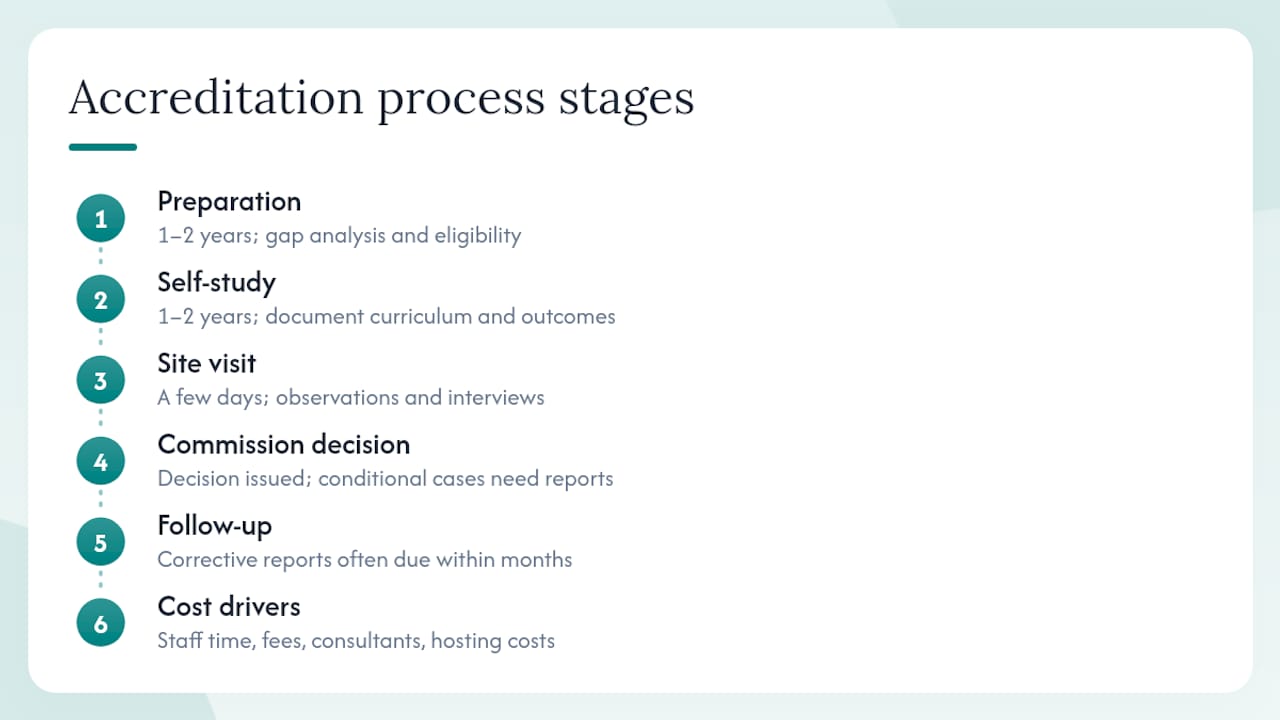
The process typically begins with a preparation phase lasting one to two years, during which school leadership conducts a gap analysis against the accreditor’s published standards, assembles committees, and submits an eligibility application. This phase alone requires significant staff time and often the guidance of an external consultant familiar with the accreditor’s expectations.
The self-study follows, usually taking another one to two years. Faculty and administrators document every dimension of institutional life: curriculum alignment, assessment practices, governance structures, financial health, and student outcomes. The resulting document is submitted to the accrediting commission before the site visit is scheduled.
Hosting the visiting team is a concentrated, intensive few days. Peer reviewers interview staff, observe classrooms, and examine records. Their report goes to the commission, which then issues a formal decision. Schools receiving conditional accreditation must submit follow-up reports demonstrating corrective action, sometimes within months.
Cost drivers vary by institution size and accreditor, but the main categories are staff time (often the largest), accreditor application and annual fees, external consultant fees, and the logistical costs of hosting the visiting team. The full cycle from preparation through first accreditation decision commonly spans multiple years.
Pro Tip: Align your self-study directly with your school’s existing strategic improvement plan. Schools that treat accreditation as a parallel process to their regular planning cycle tend to produce stronger evidence portfolios and find the ongoing monitoring far less burdensome.
What happens when a school is not accredited?
Operating without accreditation is legal in most U.S. states. Many schools function under state authorization alone and serve students perfectly well in certain contexts. The practical barriers, however, are real and worth understanding before enrollment.
For students, the consequences can include:
No access to federal financial aid, including Pell Grants, subsidized loans, and federal work-study
Difficulty or outright rejection when attempting to transfer credits to accredited institutions
Exclusion from graduate programs that require an undergraduate degree from an accredited school
Skepticism from professional licensing boards in fields such as nursing, engineering, and education
Reduced employer confidence, particularly in regulated industries or government roles
Institutions face their own set of limitations. Without accreditation, a school cannot participate in federal student aid programs, which affects both enrollment and revenue. Recruiting qualified faculty becomes harder when candidates weigh institutional prestige and stability. Membership in certain academic consortia, authorization to offer specific programs like IB, and eligibility for some private grants may all require accredited status.
The nuance worth holding onto: an unaccredited school is not automatically a bad school. But the practical barriers it creates for students are significant, and families deserve to understand them before signing an enrollment agreement.
Which major U.S. accreditors will you encounter?
These are the accrediting bodies you are most likely to see referenced in school literature, organized by type.
Institutional accreditors cover entire colleges and universities. The Higher Learning Commission (HLC) serves degree-granting institutions across a 19-state region in the North Central U.S. The Middle States Commission on Higher Education (MSCHE) covers colleges and universities in the Mid-Atlantic region, including Delaware, Maryland, New Jersey, New York, and Pennsylvania. The New England Commission of Higher Education (NECHE) accredits institutions in the six New England states. The WASC Senior College and University Commission (WSCUC) covers four-year institutions in California, Hawaii, and the Pacific. The Southern Association of Colleges and Schools Commission on Colleges (SACSCOC) serves degree-granting institutions across 11 Southern states and Latin America.
Programmatic accreditors evaluate specific fields of study, regardless of which institution houses them. ABET accredits programs in engineering, technology, computing, and applied science. AACSB (the Association to Advance Collegiate Schools of Business) accredits business and accounting programs and is widely regarded as the gold standard in business education. CAEP (the Council for the Accreditation of Educator Preparation) accredits teacher education programs.
Recognition by ED or CHEA is the decisive signal for federal aid eligibility. A programmatic accreditor like ABET or AACSB may not trigger federal aid on its own, but it carries enormous weight with employers and licensing boards in its field. Always check both the institutional and programmatic accreditation status when evaluating a specific program.
Key Takeaways
School accreditation is a voluntary, independent quality review that directly determines a student’s access to federal financial aid, credit portability, and recognition by employers and licensing boards.
Point | Details |
Core definition | Accreditation is a voluntary third-party quality review by an independent agency against established educational standards. |
Student impact | Accredited status unlocks federal aid, smoother credit transfer, and stronger standing with licensing boards and graduate programs. |
Two recognition bodies | The U.S. Department of Education and CHEA both maintain public directories; check both before trusting a school’s claims. |
Verification action | Search the OPE database and the CHEA directory, then review the accreditor’s public action history for any sanctions. |
K–12 consideration | Even where accreditation is voluntary, unaccredited high schools may limit access to IB programs, College Board participation, and certain university admissions. |
Why accreditation should be near the top of your school checklist
Parents often ask whether accreditation really matters if a school has strong teachers, a caring community, and a curriculum they believe in. My honest answer: those qualities matter enormously, and accreditation does not replace them. But for any pathway tied to federal aid, credit transfer, or professional licensure, accreditation is the structural condition that makes those other qualities count in the wider world.
The verification step most families skip is checking the accreditor’s public action history, not just the directory listing. A school can appear in a directory while simultaneously serving a probation notice. Checking the commission’s published actions takes five minutes and tells you whether the quality standard is being maintained or contested.
For families weighing how to identify quality education for their child, accreditation is one signal among several, but it is the one with the most concrete downstream consequences. Pair it with a close look at teacher qualifications and curriculum depth, and you have a genuinely complete picture.
Useful sources for verification and deeper reading
These resources are the most reliable starting points for verifying accreditation status and understanding how the system works.
U.S. Department of Education OPE Accreditation Database (ope.ed.gov/accreditation) lists all ED-recognized accreditors and the institutions they cover. This is the primary verification tool for federal aid eligibility.
ED’s Institutional Accrediting Agencies page (ed.gov) provides policy guidance and the official list of recognized institutional accreditors, useful for understanding the regulatory framework behind recognition decisions.
CHEA Directory (chea.org) covers a broader set of recognized accreditors than ED alone and is particularly useful for verifying programmatic accreditors and institutions outside the federal aid system.
NEASC Accreditation Handbook provides detailed procedural guidance on the self-study, peer review, and site-visit process, written for practitioners but readable by informed parents who want to understand what a rigorous review actually involves.
EBSCO Research Starters: School Accreditation offers a concise, well-sourced overview of the accreditation process and its consequences for students, useful as a neutral third-party explainer.
If documentation from a school or accreditor is unclear or inconsistent with what you find in these directories, contact the accrediting body directly. Every recognized accreditor maintains a public affairs or institutional relations contact for exactly this purpose.
Recommended

Comments