

Affordable Preschool Education in Singapore: 2026 Guide

Affordable preschool education refers to early childhood programmes with low tuition fees made accessible through government funding and income-based subsidies, enabling Singaporean families to give their children quality learning from ages 1.5 to 5. In Singapore, the most recognized low-cost preschool programs include MOE Kindergartens, Anchor Operator childcare centres, and Partner Operator preschools, all of which benefit from government fee caps and subsidy schemes like KiFAS, MOE FAS, and the Additional Subsidy. Understanding how these programmes work, and how your household income affects what you actually pay each month, is the clearest path to finding quality preschool on a budget.
What is affordable preschool education in Singapore?
Affordable early childhood education in Singapore is defined by two things: capped tuition fees and government subsidies that reduce what families pay out of pocket. The government structures this through three main programme types, each with different fee levels and eligibility rules.
MOE Kindergartens are the most affordable option for Singapore citizens. MOE Kindergarten monthly fees are S$160 for citizens and S$320 for permanent residents in 2026. These kindergartens are co-located within primary schools, which gives children a meaningful head start on Primary 1 readiness. That fee structure makes MOE Kindergartens the clearest benchmark for what “affordable” means in the Singapore context.

Anchor Operator and Partner Operator preschools cover the childcare segment, which serves children from 18 months through kindergarten age. Full-day childcare fees are capped at S$610 for Anchor Operators and S$650 for Partner Operators in 2026, representing a 15% reduction since 2020. Anchor Operators receive heavier government funding and maintain stricter fee caps, while Partner Operators have slightly more flexibility in curriculum design. Both are significantly more affordable than private preschools, which can charge S$1,500 to S$3,000 or more per month without subsidy support.
Private preschools sit outside the subsidy framework in most cases, though some families with qualifying income levels may still access certain assistance schemes. For most budget-conscious families, private preschools are a secondary consideration unless the curriculum or location is a specific priority.
MOE Kindergartens: half-day programme, S$160/month for citizens
Anchor Operator childcare: full-day, capped at S$610/month before subsidies
Partner Operator childcare: full-day, capped at S$650/month before subsidies
Private preschools: no fee cap, typically S$1,500 and above
Pro Tip: If your child only needs a half-day programme and you are a Singapore citizen, MOE Kindergartens offer the lowest base fees of any structured preschool option in the country. Pair that with MOE FAS eligibility and your monthly cost could drop to near zero.
How do government subsidies make preschool education affordable?
Singapore’s subsidy framework is what transforms a capped fee into a genuinely low cost for many families. Three major schemes do most of the work: the MOE Financial Assistance Scheme (MOE FAS), the Kindergarten Fee Assistance Scheme (KiFAS), and the Additional Subsidy for childcare centres.
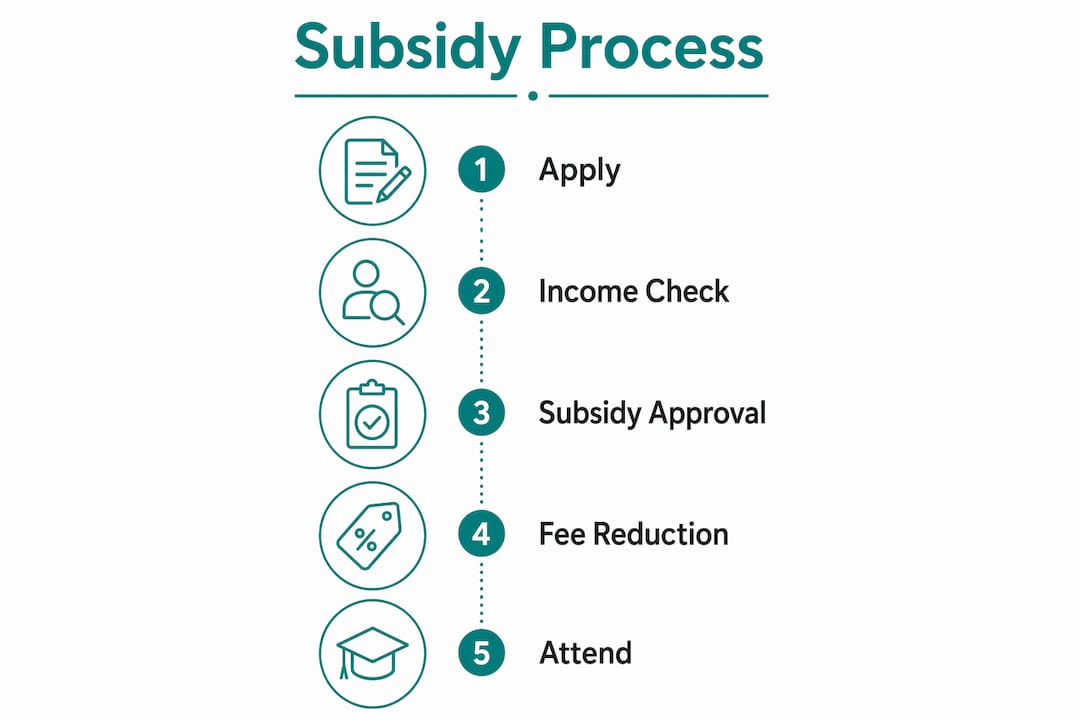
The MOE FAS applies to MOE Kindergartens. From AY2026, eligibility changes to a gross household income (GHI) of S$4,000 or below, or a per capita income (PCI) of S$1,000 or below. This update allows an additional 31,000 students to benefit annually. That is a meaningful expansion, and it means families who previously fell just outside the threshold should recheck their eligibility for AY2026.
KiFAS and the Additional Subsidy apply to Anchor and Partner Operator childcare centres. The steps below show how the subsidy process works in practice:
Confirm citizenship status. Subsidies are tiered by citizenship. Singapore citizens receive the highest subsidy amounts, followed by permanent residents. Employment pass holders generally do not qualify for KiFAS or the Additional Subsidy.
Calculate your gross household income. The income ceiling for KiFAS will increase to S$15,000 from January 2027, expanding access to more middle-income families. A median-income household earning S$12,500 with two children sees out-of-pocket childcare fees drop by 35% under the 2027 rules.
Apply through your preschool centre. Subsidies are not automatic. You must submit income documents and apply directly through the centre. The centre processes your application with the relevant government agencies.
Factor in household size. Per capita income calculations divide total household income by the number of family members. Larger families often qualify for higher subsidy tiers even at the same gross income level.
Review eligibility annually. Subsidy thresholds change over time, and your qualification can shift year to year even if your income stays the same. Checking each academic year protects you from missing out on assistance you are entitled to.
The practical result is that a Singapore citizen family earning S$3,000 per month could pay as little as S$3 per month for a full-day childcare place at an Anchor Operator after all subsidies are applied. That figure illustrates why understanding the subsidy framework matters as much as knowing the base fee.
What hidden costs affect the real price of preschool?
The base tuition fee is only part of what you will pay each month. Preschool programmes described as affordable can carry extra costs for extended hours, holiday care, or special schedules that parents often miss during initial comparisons.
For MOE Kindergartens, the most common add-on is KCare, which provides full-day childcare on top of the half-day kindergarten programme. KCare maximum monthly fees are approximately S$415 in 2026, and fees apply during the June and December school holidays as well. A parent who budgets only for the S$160 base fee and then adds KCare is looking at a combined monthly cost of up to S$575 before any subsidies. That is a significant difference from the headline figure.
Other costs to verify before enrollment include:
Meal charges: Some centres include meals in the fee; others charge separately for breakfast, lunch, and afternoon snacks.
Registration and deposit fees: One-time costs at enrollment that are not always prominently advertised.
Activity or material fees: Certain programmes charge for art supplies, excursions, or enrichment activities on top of tuition.
Holiday programme fees: Full-day care during school holidays may be charged at a different rate from term-time care.
Income documentation during enrollment is also critical because subsidy and priority status are determined at this stage. Families who delay submitting income documents may lose their subsidy tier for that enrollment period.
Pro Tip: Ask each preschool centre for a full monthly cost breakdown that includes meals, holiday fees, and any activity charges before you compare programmes. Two centres with the same base fee can have very different true monthly costs once all extras are included.
How to choose the best affordable preschool for your family
Choosing the right preschool comes down to matching your child’s care needs, your work schedule, and your household income against the available programme types. The process is straightforward when you follow a structured approach.
Start with your care schedule. If you work full-time, a half-day MOE Kindergarten alone will not cover your needs. You will need either a full-day Anchor or Partner Operator childcare place, or an MOE Kindergarten with KCare. Knowing this upfront narrows your options immediately.
Shortlist by base fee category. Treat affordability in two steps: first identify programmes within your base fee range, then verify subsidy eligibility. Income ceiling changes like the KiFAS adjustment planned for 2027 can alter what programmes your family can afford year to year.
Check subsidy eligibility before you commit. Contact the Ministry of Social and Family Development (MSF) or use the Child Development Account portal to estimate your subsidy tier. Do not assume you qualify or do not qualify based on last year’s criteria, since eligibility thresholds change with each academic year.
Request a full cost breakdown from each centre. Ask specifically about holiday fees, meal charges, and any activity costs. A preschool curriculum guide can also help you compare what each programme type actually delivers academically, so you are assessing value alongside cost.
Prepare your documents early. Subsidy applications require income statements, CPF contribution records, and identity documents. Centres process applications in order of submission, and some subsidy-funded places are limited. Early preparation protects your child’s spot and your subsidy tier.
Consider location and primary school alignment. MOE Kindergartens offer priority admission to the co-located primary school, which is a long-term planning advantage worth factoring into your decision alongside the fee structure.
For families exploring international preschool options alongside government-linked programmes, understanding the fee and curriculum differences helps you make a genuinely informed comparison rather than choosing by price alone.
Key takeaways
Affordable preschool education in Singapore is defined by government-capped fees and income-based subsidies, and the families who benefit most are those who understand both the base fee structure and the subsidy framework before enrolling.
Point | Details |
MOE Kindergarten fees | S$160/month for citizens in 2026, the lowest base fee of any structured programme. |
Anchor and Partner Operator caps | Full-day childcare capped at S$610 and S$650 respectively, with subsidies reducing costs further. |
MOE FAS expansion in AY2026 | New GHI threshold of S$4,000 allows an additional 31,000 students to access financial assistance. |
KiFAS income ceiling rising | Ceiling increases to S$15,000 from January 2027, cutting fees by up to 35% for median-income families. |
Hidden costs matter | KCare, holiday fees, and meal charges can add S$400 or more per month beyond the base tuition fee. |
Why subsidy literacy is the real affordability skill
I have spoken with many Singapore parents who chose a preschool based on the advertised monthly fee, then felt blindsided when the actual invoice arrived. The gap between the headline fee and the real monthly cost is almost always explained by three things: KCare or extended care add-ons, holiday month charges, and meal fees. None of these are hidden in a deceptive sense. They are disclosed. But they are easy to overlook when you are comparing programmes quickly.
What I find genuinely encouraging about Singapore’s preschool system is how much the subsidy framework can do for families who engage with it properly. A family earning S$6,000 per month with two young children can access meaningful fee reductions through KiFAS and the Additional Subsidy, bringing a full-day childcare place to well under S$200 per month. That is real affordability. But it only materializes if parents apply, submit the right documents, and check their eligibility each year as thresholds shift.
The MOE Kindergarten route deserves more credit than it sometimes gets. The co-location with primary schools is not just a logistical convenience. It gives children genuine familiarity with the school environment and culture before Primary 1, which research consistently links to smoother transitions and stronger early academic confidence. For citizen families who need only a half-day programme, it is the most cost-effective and educationally purposeful option available.
My honest advice is this: treat subsidy research as part of the enrollment process, not an afterthought. The Working Mother’s Child Relief is another financial tool working parents should explore alongside preschool subsidies, since the combined effect on household education costs is substantial.
— Elena
Discover nurturing, affordable preschool at Astor
At Astor, we believe every child deserves a preschool experience that is both nurturing and genuinely within reach for families. Astor International Preschool in Holland Village offers a warm, small-school environment with two playgrounds, a blend of outdoor and classroom learning, and a curriculum designed to build curiosity and confidence from the earliest years. Our approach aligns with Singapore’s subsidy framework, and our team is happy to walk you through fee assistance options during your visit. For families who value an internationally minded curriculum without the international school price tag, explore our IPC curriculum to see how we make meaningful early learning accessible. You can also learn more about our full curriculum approach and what sets a small, caring preschool apart from larger centres.
FAQ
What is affordable preschool education in Singapore?
Affordable preschool education refers to early childhood programmes with government-capped fees and income-based subsidies that reduce out-of-pocket costs for families. In Singapore, MOE Kindergartens, Anchor Operator, and Partner Operator childcare centres are the primary affordable options.
How much does MOE Kindergarten cost in 2026?
MOE Kindergarten monthly fees are S$160 for Singapore citizens and S$320 for permanent residents in 2026. Optional KCare full-day childcare adds up to approximately S$415 per month, including during June and December holidays.
Who qualifies for KiFAS and the Additional Subsidy?
Singapore citizen and permanent resident families enrolled in Anchor or Partner Operator childcare centres can apply for KiFAS and the Additional Subsidy based on gross household income. From January 2027, the income ceiling rises to S$15,000, expanding eligibility to more middle-income families.
What documents do I need to apply for preschool subsidies?
You typically need income statements, CPF contribution records, and identity documents for all household members. Applications are submitted through your preschool centre, which processes them with the relevant government agencies.
Are there affordable international preschool options in Singapore?
Yes. Some smaller international preschools offer internationally minded curricula at fees closer to the Partner Operator range, particularly when combined with available financial assistance. Comparing the advantages of affordable international schools alongside government-linked options helps families make the right choice for their child.
Recommended
Comments