


Moving with Kids to Singapore: Your School-First Checklist

Relocating to Singapore with children aged 5–12 is one of the most rewarding moves a family can make, and the single decision that shapes everything else is securing international school placement first Before you sign a lease, book a shipping container, or finalize your move date, your child’s school placement should be confirmed. Relocation experts consistently advise locking in school first, then choosing housing within a manageable commute, because commutes longer than what is typically manageable each day are common when families reverse that order. Here is your complete checklist for moving with kids to Singapore, built around that priority.
Your core checklist at a glance:
Secure international school placement 6–9 months before your move date
Gather school reports, birth certificates, and passport copies early
Apply for Employment Pass first, then Dependant’s Pass for children and spouse
Choose housing based on school location, not the other way around
Arrange private health insurance for all Dependant’s Pass holders before arrival
Open a local bank account promptly after arrival for school fees and daily expenses
Prepare your children emotionally with open, age-appropriate conversations about the move
Pro Tip: Apply to 3–5 international schools simultaneously. Singapore’s top schools operate waiting lists of two to three years, and spreading applications protects your child’s placement timeline.
Table of Contents
How do you secure international school placement for children aged 5–12?
How should you plan logistics once school placement is confirmed?
What do you need to know about visas and spouse work rights?
How can you support your children’s emotional transition to Singapore?
How do you register with a pediatrician and healthcare services in Singapore?
What immunizations does your child need for school admission?
How do Singapore’s school terms and curricula differ from what you know?
Astor International School: A Nurturing Home for Your Child in Singapore
How do you secure international school placement for children aged 5–12?
Singapore’s international school market is genuinely competitive. Applying 6–9 months before your intended start date is the baseline; for the most sought-after schools, 12–18 months ahead is more realistic. Annual fees typically range from SGD 25,000 to SGD 55,000 or more depending on year level, so aligning your budget early matters too.
Apply to multiple schools. Target 3–5 schools simultaneously to maximize your child’s chances of a confirmed place.
Match curriculum to your child. Options include IB, British IGCSE, American AP, and Australian curricula. Consider your child’s learning style and your family’s likely future moves when choosing.
Prepare documents in English. School reports, teacher references, and any educational assessments should be in English or accompanied by a certified translation.
Be transparent about learning support needs. Education consultants recommend disclosing any special needs from the very first contact. Full transparency speeds up assessment and leads to a better fit.
Connect with heads of year, not just admissions. Speaking directly with year-level teachers gives you a far clearer picture of classroom culture and support structures.
Factor in commute. School location should directly influence your housing search. A school in Tanglin, for example, makes the surrounding districts the natural starting point for your home hunt.
Curriculum | Year group name (age 5) | Year group name (age 12) | Academic year start |
British | — | — | August |
IB | KG | — | August |
American | KG2 | — | August |
Australian | KG | — | January |
Pro Tip: When your child transfers between curriculum systems, placement is assessed individually. A child moving from a US school may be placed differently in a British curriculum school. Ask admissions directly rather than assuming year group equivalency.
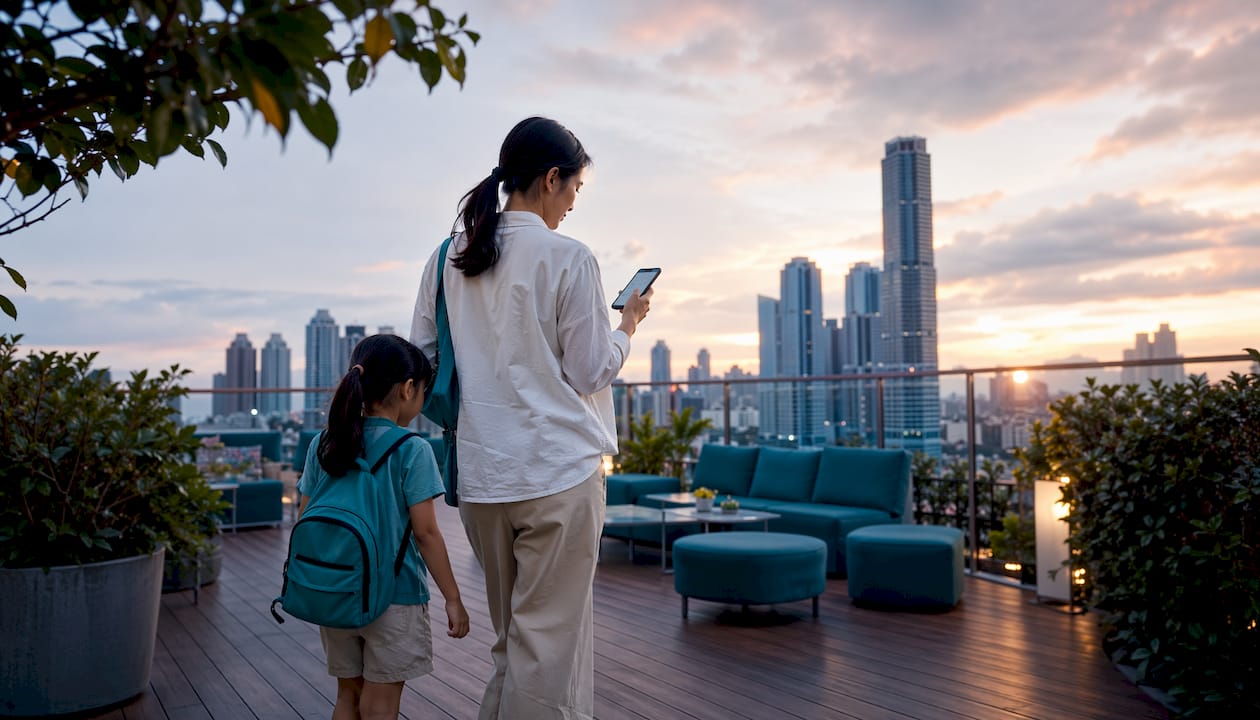
How should you plan logistics once school placement is confirmed?
With a confirmed school place in hand, every other logistical decision becomes clearer. Housing is the most immediate. Leases typically require a confirmed Employment Pass In-Principle Approval (IPA) before signing, and most run 12–24 months with break clauses tied to pass cancellation. Sign only after your IPA is in hand.
Choose your neighborhood based on school location. Proximity to school protects your child’s energy and your own daily rhythm.
Arrange private health insurance before arrival. Healthcare coverage for Dependant’s Pass holders must be arranged separately from the Employment Pass holder’s policy. Family coverage typically costs SGD 3,000 to SGD 8,000 per year.
Plan school supplies and uniforms early. Most international schools have specific uniform requirements and preferred supplier lists. Budget time and money for these alongside bus fees and activity costs.
Open a local bank account promptly. School fees, utilities, and daily expenses in Singapore are most efficiently managed through a local account. This should be one of your first tasks after arrival.
Register all eligible family members for SingPass. SingPass accounts streamline access to healthcare, banking, and government services for every family member.
Plan household goods shipping. Sea freight takes 4–10 weeks; air freight is 5–10 days but significantly more expensive. Work backward from your school start date.
Pro Tip: If your long-term home won’t be ready on arrival, book a serviced apartment near your child’s school. Keeping the school commute short during the settling-in period reduces stress for everyone.
What do you need to know about visas and spouse work rights?
Understanding Singapore’s pass system early prevents costly delays. The Employment Pass (EP) is the anchor document for the whole family’s relocation. Everything else follows from it.
EP approval comes first. Your employer applies for your Employment Pass before any Dependant’s Pass applications can be submitted.
EP holders earning SGD 6,000 or more per month can sponsor Dependant’s Passes for children and spouses. The DP IPA letter is required for school enrollment.
A Dependant’s Pass does not grant work rights. Spouses who wish to work must apply separately for a Letter of Consent or an independent work pass.
Processing times vary. Dependant’s Passes for EP holders typically take within 3 weeks for most cases. A Letter of Consent generally takes 2–4 weeks on top of that.
Set up SingPass early. Every eligible family member should register as soon as passes are issued. SingPass is the gateway to healthcare registration, banking, and school administration platforms.
Keep all documents organized. Passports, birth certificates, marriage certificates, and IPA letters should be in a single accessible folder, physical and digital.
How can you support your children’s emotional transition to Singapore?
The logistics of a move are manageable. The emotional side, for children especially, deserves just as much care and planning. Children aged 5–12 are perceptive; they pick up on parental stress and need honest, age-appropriate conversations about what is changing and what will stay the same.
Talk openly about the move. Explain what Singapore is like, what the new school will feel like, and what excites you about the adventure. Curiosity is contagious.
Involve children in school preparation. Letting your child choose their stationery, backpack, or water bottle gives them a sense of ownership over the transition. Getting your child ready for a new school year is as much about confidence as it is about supplies.
Encourage clubs and activities from day one. Social integration through school clubs, sports teams, and community activities builds friendships faster than classroom time alone.
Check for EAL and learning support. If English is not your child’s first language, or if your child has any additional learning needs, confirm the school’s support structures before enrollment.
Connect with expat parent communities. Singapore has a well-established network of expat families. Online groups and school parent associations are genuinely helpful for practical advice and social connection.
Maintain home culture. Keeping familiar foods, traditions, and routines at home gives children a stable anchor while they adapt to everything new around them.
Pro Tip: Small schools with small class sizes, like Astor International School in Tanglin, make it easier for children to be truly seen and supported by their teachers from the very first week. That personal attention can make a meaningful difference during the settling-in period.
What does a realistic relocation timeline look like?
Timeframe | Key milestones |
9–12 months before move | Research schools, begin applications, gather documents |
6–9 months before move | Submit school applications, employer initiates EP application |
3–5 months before move | Confirm school placement, plan housing search, book shipping |
— | Sign lease (after EP IPA), finalize shipping, arrange insurance |
Arrival month | Register SingPass, open bank account, attend school orientation |
First month in Singapore | Register with pediatrician, set up utilities, join school activities |
How do you register with a pediatrician and healthcare services in Singapore?
Singapore’s healthcare system is excellent, but Dependant’s Pass holders access it primarily through private clinics rather than the public subsidized system. Register with a family clinic or pediatrician within your first two weeks of arrival. Many international schools maintain a list of recommended clinics near the school, which is a practical starting point.
Private health insurance for your children should be active before they arrive. Coverage typically includes outpatient consultations, specialist referrals, and hospitalization. Confirm that your policy covers dental and mental health support, both of which matter during a transition period.
What immunizations does your child need for school admission?
Most international schools in Singapore require proof of standard childhood immunizations before enrollment. The core vaccines expected include MMR (measles, mumps, rubella), varicella (chickenpox), hepatitis B, and DTP (diphtheria, tetanus, pertussis). Some schools also request a recent health declaration or medical examination form.
Bring your child’s complete vaccination records from the United States. If records are not in English, arrange certified translations before you apply. Singapore’s Health Promotion Board publishes the national immunization schedule, which most international schools align with. Contact your chosen school’s admissions office for their specific requirements, as these can vary slightly by institution.
How do Singapore’s school terms and curricula differ from what you know?
If your children have been in the American school system, a few differences will feel significant. The academic year at most international schools in Singapore runs August to June, not September to June. Terms are divided into four quarters rather than two semesters.
Year group naming also differs by curriculum. A child who was in 5th Grade in the US would typically enter Grade 5 in an IB school or Year 6 in a British curriculum school at age 10. The year group guide by curriculum is worth reviewing carefully before applications, since placement is assessed individually when children move between systems. For families considering education options for expat children, understanding these differences early prevents surprises at enrollment.
Singapore also has a dual system: local MOE schools and international schools operate side by side. Singapore citizens, including dual nationals, face specific Ministry of Education restrictions on international school enrollment from age six to seven. If your child holds dual citizenship, seek advice from both the school and Singapore MOE directly.
Key Takeaways
Securing international school placement before housing is the single most important step in a successful family relocation to Singapore.
Point | Details |
School placement comes first | Lock in school before signing a lease to avoid commutes longer than what is typically manageable each day. |
Apply early and broadly | Submit applications 6–9 months ahead and target 3–5 schools simultaneously. |
Dependant’s Pass does not include work rights | Spouses must apply separately for a Letter of Consent, which takes an additional 2–4 weeks. |
Private health insurance is required | Arrange family coverage before arrival; annual costs typically range from SGD 3,000 to SGD 8,000. |
Emotional preparation matters | Open conversations, familiar routines, and school clubs help children aged 5–12 settle with confidence. |
Astor International School: A Nurturing Home for Your Child in Singapore
Astor International School, located in the Tanglin area of Singapore, is built for exactly the kind of family described in this guide. Small class sizes mean every child aged 5–12 is genuinely known by their teachers, not just enrolled. Astor has been recognized as both the best small school and the best affordable international school in Singapore, two distinctions that reflect a commitment to quality without compromise.
For younger children, Astor International Preschool in the Holland area offers a warm, play-centered environment with two playgrounds and a blend of outdoor and classroom learning. It is a natural first step before primary school.
Explore Astor’s IPC curriculum and discover how a boutique international school experience can give your child the confident, curious start they deserve in Singapore.
Recommended


Your site is truly cool and this is an extraordinary moving article. Airco Limburg
Great Information sharing .. I am very happy to read this article .. thanks for giving us go through info.Fantastic nice. I appreciate this post. Thuisbatterij
I am a new user of this site so here i saw multiple articles and posts posted by this site,I curious more interest in some of them hope you will give more information on this topics in your next articles. Zonnepanelen met batterij
Thanks for sharing this information. I really like your blog post very much. You have really shared a informative and interesting blog post with people.. Thuisbatterij Huawei
I want to say thanks to you. I have bookmark your site for future updates. Thuisbatterij Huawei