


Singapore Parents: Practical Homework Rules from International Schools

Most international primary schools in Singapore set homework to be purposeful, age-appropriate, and generally limited to short daily periods varying by grade level. The strongest policies favor quality over quantity, tie every task to a clear learning goal, and expect parents to support routines rather than complete the work. School-specific details, including exact time norms and communication channels, sit in each school’s published policy or your child’s teacher.
TL;DR:
Most international primary schools in Singapore assign purposeful homework aligned with curriculum goals and provide timely feedback, prioritizing quality over quantity.
Homework time norms typically range from 30 minutes to 2 hours daily, depending on the grade, with weekly totals offering flexibility for families.
The four main homework categories are daily practice, revision, projects, and digital tasks, each requiring different levels of parental involvement.
Parents can support children best by establishing routines, asking guiding questions, and avoiding completing tasks for them, rather than hovering or taking over.
Schools usually communicate homework expectations through multiple channels, with clear protocols for addressing heavy workloads or misunderstandings directly with teachers.
Table of Contents
What Guides Homework Policy in International Schools in Singapore?
Homework exists for a handful of specific reasons, and a good policy names them rather than leaving parents to guess. Most Singapore international schools frame homework around four purposes: reinforcing what was taught that day, building study habits like planning and time management, giving teachers feedback on where a child stands, and occasionally extending a strong student’s thinking beyond the classroom.
Behind those purposes sit a few shared principles. Homework should be purposeful, meaning every task connects to something taught that week rather than filling time. It should be curriculum-aligned, which matters more in international schools since many follow the IB framework or Cambridge International’s programs, both of which favor understanding over repetition. It should respect a reasonable time limit for the child’s age, include varied task types instead of endless worksheets, and come back to the child with real feedback, not just a checkmark.
These principles show up almost word for word in Singapore’s own mainstream primary schools, and international schools tend to mirror that thinking even when their curriculum looks different on paper. A few things to look for in any school’s written policy:
A stated purpose for homework, not just a list of subjects
Reference to age-appropriate time limits
A commitment to feedback, not just assignment and collection
Some acknowledgment that quality matters more than volume
Research on international-school policy backs this up directly: purposeful, curriculum-linked homework paired with timely feedback outperforms heavy volume almost every time. If a school’s homework looks like busywork with no clear reason behind it, that’s worth raising directly with the teacher.
How Much Homework Should Your Child Actually Be Doing?
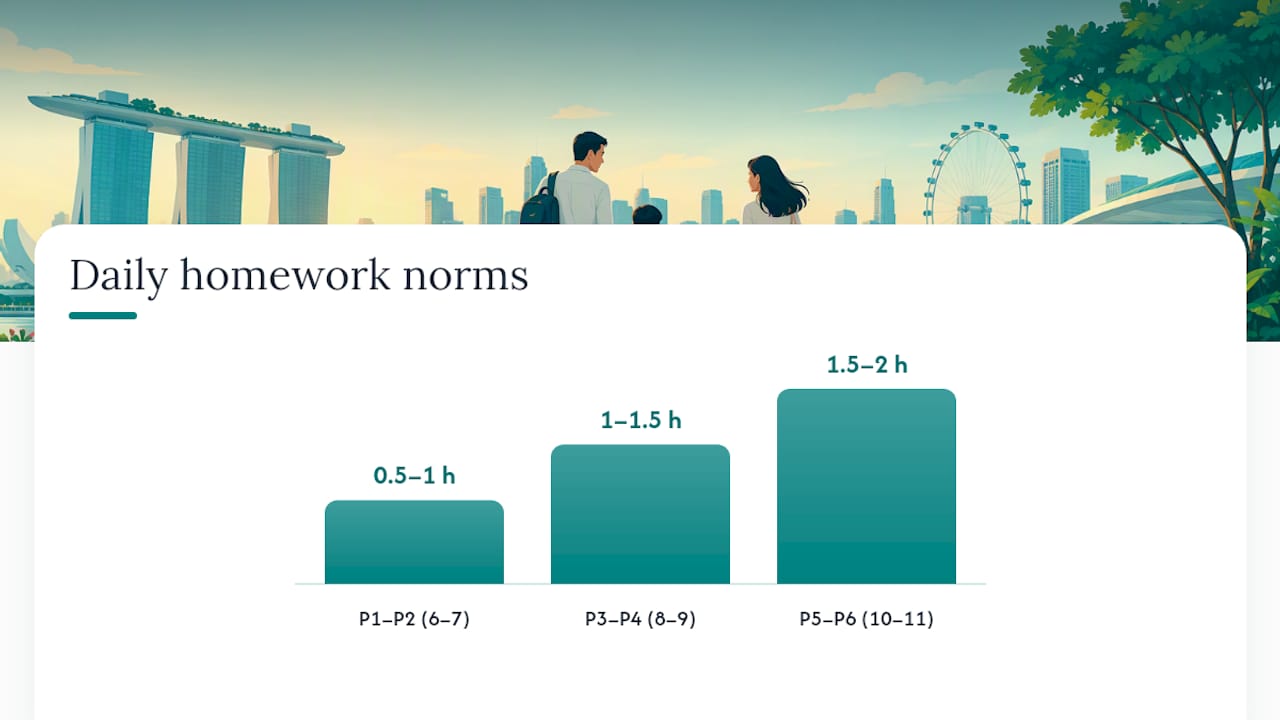
Singapore’s mainstream primary schools publish some of the clearest homework time norms in the region, and many international schools reference similar ranges when setting their own expectations. A commonly cited breakdown from Tampines Primary School’s policy looks like this:
P1–P2 (roughly ages 6–7): about 0.5 to 1 hour per day
P3–P4 (roughly ages 8–9): about 1 to 1.5 hours per day
P5–P6 (roughly ages 10–11): about 1.5 to 2 hours per day
Pro Tip: If your child’s homework consistently runs 30 minutes past these ranges, time it for a full week before raising it with the teacher. A clear log (“Tuesday: 52 minutes for two worksheets”) gets a faster, more useful response than “homework feels heavy.”
Some schools translate the daily figure into a weekly total instead, which gives families more flexibility across the week. Pei Tong Primary School’s published policy, for example, proposes weekly norms of 3 to 7 hours for P1 to P2, 6 to 10 hours for P3 to P4, and 9 to 13 hours for P5 to P6. That structure lets a family move a task from a heavy Tuesday to a lighter Thursday without breaking the spirit of the policy.
Weekends and school holidays usually work differently. Many schools either pause homework entirely during festive periods or scale it back to light review only, and schools like Admiralty Primary School build that pause directly into their written policy. Term time tends to run heavier near assessment windows and lighter in the first and last weeks of a term.
If your child consistently exceeds the expected time for their level, that’s rarely a motivation problem. It’s usually a fit problem, whether that’s reading level, unclear instructions, or a workload that hasn’t been checked against what other subjects assigned the same day. Flag the pattern early rather than assuming it will resolve on its own.
What Kinds of Homework Will Your Child Bring Home?
International primary schools tend to assign four broad categories of homework, and each one calls for a different kind of parent involvement.
Daily reading and practice. This is the bread and butter of primary homework: a reading log, spelling words, math fact drills, or a short worksheet reinforcing that day’s lesson. It should take minutes, not hours, and mostly needs a parent to check it happened, not to teach the content.
Revision tasks. Ahead of an assessment or unit test, teachers often assign review packets or practice questions. These run heavier for a week or two, then drop back to normal, and it’s worth checking the school calendar so a heavy revision week doesn’t blindside you.
Projects and research tasks. These stretch over one to three weeks and usually ask a child to research a topic, build something, or prepare a short presentation. Your role here is logistics and questions, not content: helping source materials, checking the timeline, and asking “what have you found out?” rather than writing captions for a poster.
Digital and platform-based tasks. More international schools now run homework through a learning management system rather than a paper planner. Systems similar to ManageBac give parents and students a shared calendar across every subject, which helps flag when three teachers have unintentionally assigned work due the same Friday. It works best when teachers actually coordinate deadlines through it, so ask whether your school’s platform gets used that way or just as a digital drop box.
Understanding which category a task falls into tells you exactly how much to step in and how much to step back.
How Parents Can Support Homework Without Taking Over
The single most useful thing a parent can do is build a routine, not supervise every worksheet. A consistent time and a quiet, dedicated space, even a corner of the kitchen table used the same way every day, does more for homework completion than any amount of hovering.
Good support looks like asking questions rather than supplying answers: “What do you think the first step is?” instead of “It’s like this.” Guidance from Singapore primary schools is explicit on this point: parents who prompt and check build a child’s self-regulation, while parents who complete the task themselves quietly undermine it, even when the intention is purely to reduce stress.
A few practical habits worth adopting:
Set a fixed daily homework window, even if the actual amount of work varies
Check for understanding, not just completion, by asking your child to explain one problem back to you
Keep a rough weekly log of time spent, especially in the first term at a new school
Read the school’s own homework guidelines before assuming your child’s load is unusual
For deeper strategies on building these routines at home, practical approaches to supporting learning in Singapore cover this in more depth than a single section can.
Contact the teacher directly when a pattern repeats for more than a week or two: consistently late nights finishing homework, a child who says they don’t understand the instructions rather than the content, or workload that looks out of step with what classmates report. A short, specific email beats a vague concern raised at pickup.
How Schools Communicate Homework and Progress
Most international schools in Singapore use two or three channels at once rather than relying on a single method. A weekly newsletter typically covers what’s coming up across the term, a classroom whiteboard or take-home planner tracks day-to-day assignments, and a digital platform holds the master calendar and any attached files.
Timely feedback is part of what separates a strong policy from a weak one. A task returned two weeks later with no comment teaches a child nothing about how they did. Look for schools that commit to feedback within a set window, whether that’s a quick teacher comment, a follow-up conversation, or a rubric attached to a project.
When instructions are missing or unclear, the fastest fix is usually direct and specific:
Check the digital planner or LMS first, since instructions sometimes post there before the paper version goes home
Ask your child to describe the task in their own words before assuming the instructions themselves are the problem
Email the teacher with the exact assignment name rather than a general “we’re confused about homework” note
Loop in the year-level coordinator if the same issue happens across more than one subject
Clear communication protocols reduce the back-and-forth that eats into everyone’s evening, parents included.
Accommodations for Wellbeing and Individual Needs
No homework policy should be so rigid that it ignores a child who’s sick, overloaded with extracurriculars, or working with a learning difference that makes standard tasks harder. Reasonable accommodations are a normal part of how good schools operate, not a special favor.
Common adjustments include extended deadlines after an illness or family disruption, a reduced scope on a project rather than an automatic zero, and differentiated tasks for children with an individual learning plan or documented need. None of these require dramatic intervention. Most start with a short conversation.
To request one:
Email the teacher early rather than after the deadline has already passed
Be specific about what’s needed: more time, a modified task, or a temporary pause
Expect a follow-up meeting for anything longer-term, especially where a learning need is involved
Keep any relevant documentation, such as a doctor’s note or an existing support plan, on hand
Sleep and downtime deserve equal weight here. A child juggling swim training, a music exam, and a heavy homework week is not building resilience. They’re running a deficit that shows up in mood and focus within days. If enrichment activities and homework are colliding regularly, that’s a scheduling conversation worth having with the school rather than something to just push through.
How Astor Approaches Homework and Learning Support
Astor International School runs small classes, capped at 20 students with an average closer to 15, which changes what homework can look like in practice. A teacher who knows each child’s reading level and attention span can assign work that actually fits, rather than a single sheet handed to thirty students at once.
Astor’s inquiry-based IPC curriculum shapes that further: tasks lean toward exploration and applied thinking rather than repetitive drilling, which lines up with how the IB and Cambridge frameworks approach homework more broadly. Combined with a preschool-to-primary pathway across Astor International Preschool and Astor International School, families get a consistent approach to workload and feedback as a child moves up through the years. Parents weighing school options can review Astor’s curriculum directly for grade-specific detail.
Getting the Balance Right
The homework debate usually gets framed as more versus less, and that framing misses the point. What actually predicts whether a child does well isn’t the minute count, it’s whether the task connects to something they’re learning and whether someone gives them real feedback on it. A shorter, sharper assignment beats a long one every time.
If your child’s homework feels off, start with the school’s written policy, not your gut sense of “too much.” Set a routine, log the time for a week, and if the pattern holds, book a short meeting with the teacher. That single conversation resolves more homework stress than any amount of worrying at home.
— Elena
A Practical Option for Families Weighing Their Choices
If you’re comparing schools based on how they handle workload and individual attention, look closely at class size and curriculum structure, not just the homework policy on paper. Astor’s classes stay small by design, capped at 20 students with an average of 15, which makes it realistic for teachers to adjust tasks to a child rather than a whole grade level.

Families can choose between Option A, Flexi Fees, at $17,580 SGD per year, or Option B, Fixed Fees, at $23,650 SGD per year, depending on which billing structure suits their household. The Astor Enquiry Based Course for Years 1 through 7 runs on the same inquiry-driven approach discussed above, and families preparing for a transition into another international school can look at the Astor Preparatory Course for International School. Beyond the core program, enrichment classes give children targeted extra practice in specific skills without turning every evening into more homework. If any of this fits what you’re looking for in a child’s day-to-day workload, the fastest next step is reviewing current fees and available spots directly on Astor’s fees page.
Sources
FAQ
What Is a Reasonable Amount of Homework for a Singapore Primary Student?
Most schools target roughly 30 minutes to 2 hours a day depending on grade, with P1-P2 students at the lower end and P5-P6 students at the upper end. Some schools set weekly rather than daily totals, so check whether your child’s school uses one method or the other.
Do International Schools in Singapore Reduce Homework During Holidays?
Many do, either pausing homework entirely or scaling it down to light review during festive periods, a practice documented in policies like Admiralty Primary School’s. It’s worth confirming your specific school’s holiday approach each term, since practices vary.
Should Parents Help With Homework or Let Kids Do It Alone?
Parents should prompt, question, and check rather than complete the work, which school guidance directly recommends to build self-regulation. A fixed routine and a quiet space matter more than active supervision of every task.
How Does Astor’s Class Size Affect Homework?
Astor caps classes at 20 students, averaging 15, which lets teachers assign tasks suited to each child rather than a single sheet for the whole class. This ties directly into Astor’s inquiry-based IPC curriculum, where homework tends to focus on applied thinking over repetition.
What Should I Do if My Child’s Homework Load Feels Too Heavy?
Log the time spent for about a week to see if it’s a pattern rather than a one-off heavy day. If it holds steady above your school’s stated norms, raise it directly with the teacher using specific examples rather than a general complaint.
Recommended


Comments