

Primary school curriculum in Singapore: Your complete guide
Choosing a primary school in Singapore feels straightforward until you realize how many genuinely different educational paths exist for your child. Most parents assume that “school is school,” but Singapore actually offers a fascinating range of approaches, from the nationally structured Ministry of Education (MOE) curriculum to inquiry-based international frameworks like the International Primary Curriculum (IPC) and the International Baccalaureate Primary Years Program (IB PYP). Each path shapes your child’s daily experience, academic habits, and confidence in very different ways. Understanding these differences before you decide can save you years of second-guessing.
Table of Contents
Core structure of Singapore’s national primary school curriculum
International school curricula: IPC, IB PYP, and alternative approaches
Academic performance, creativity, and student well-being: Benchmarks and critiques
Choosing the right primary curriculum for your child: Practical factors
Our perspective: The real balancing act for Singapore parents
Key Takeaways
Point | Details |
MOE curriculum structure | Singapore’s national curriculum features core subject coverage and a spiral progression for strong academic foundations. |
International curriculum diversity | IPC and IB PYP schools offer thematic, inquiry-based learning to encourage creativity and global perspectives. |
High achievement, wellbeing gap | Singapore leads academically but faces challenges around mental health, class sizes, and student creativity. |
Choosing the right fit | Parents should weigh exam focus, creativity, support, and class environment before making a curriculum choice. |
Practical next steps | Explore school offerings and ask key questions to match your child’s needs with the most suitable curriculum path. |
Core structure of Singapore’s national primary school curriculum
With a clearer understanding that multiple approaches exist, let’s start by unpacking the MOE curriculum that most Singaporean children experience.
Singapore’s national MOE curriculum covers Primary 1 through Primary 6, targeting children aged 7 to 12. According to the MOE Primary Curriculum, the core subjects taught are English Language, Mother Tongue Language (MTL), Mathematics, Science (introduced from Primary 3), Social Studies, Character and Citizenship Education (CCE), Physical Education, Art, and Music. That’s a genuinely broad slate of learning areas, and many parents are surprised by how much is covered even in the early years.
The MOE uses what educators call spiral progression, meaning concepts are introduced early and then revisited with greater complexity as children advance through each grade. A child who learns basic fractions in Primary 3 will meet the same concept again in Primary 5, but this time with far more nuance and application. This approach builds long-term retention and helps children connect ideas across years of learning.
One of the most significant structural features is Subject-Based Banding (SBB). As the MOE Curriculum Syllabus explains, from Primary 4 onward, students are recommended for either Standard or Foundation levels in certain subjects based on their exam results. Foundation level offers a simplified version of the content and caps a student’s Primary School Leaving Examination (PSLE) Achievement Level at 8, while the Standard level allows for the full range of scores. This is a meaningful fork in the road for families to understand early.
Here’s a summary of the MOE subject structure by primary level:
Level | Key subjects introduced | Notable milestone |
P1 to P2 | English, MTL, Math, CCE, PE, Art, Music | Foundation building, no exams |
P3 | Science and Social Studies added | First formal subject assessments |
P4 | SBB recommendation made | Standard vs Foundation pathway begins |
P5 to P6 | Full subject load with SBB levels | PSLE preparation phase |
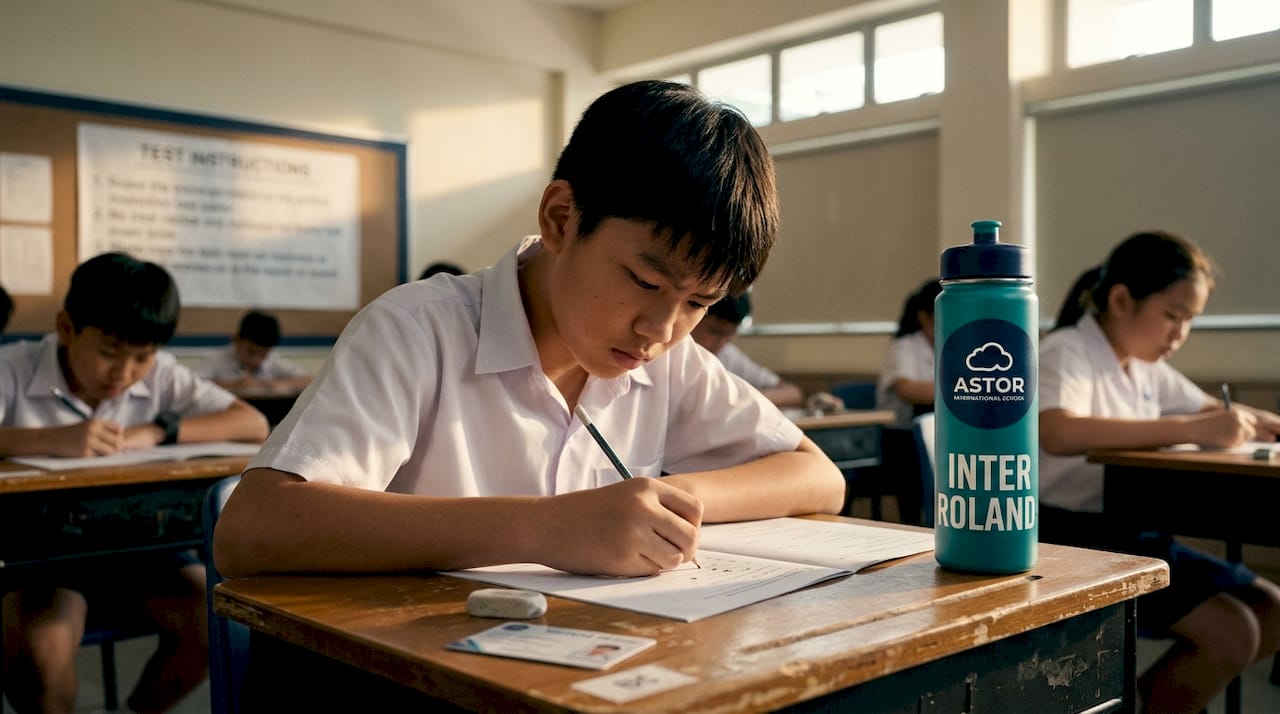
The PSLE, taken at the end of Primary 6, determines which secondary school a child qualifies for. Its stakes feel very real to most families. Some parents find that the exam-driven structure motivates and prepares their children well, while others worry about pressure. Both reactions are completely valid, and understanding this honestly is part of making a good school decision.
Pro Tip: Even within the MOE system, individual schools differ significantly in culture, enrichment programs, and teaching approaches. Visiting a school and talking to current parents gives you a much richer picture than league tables alone.
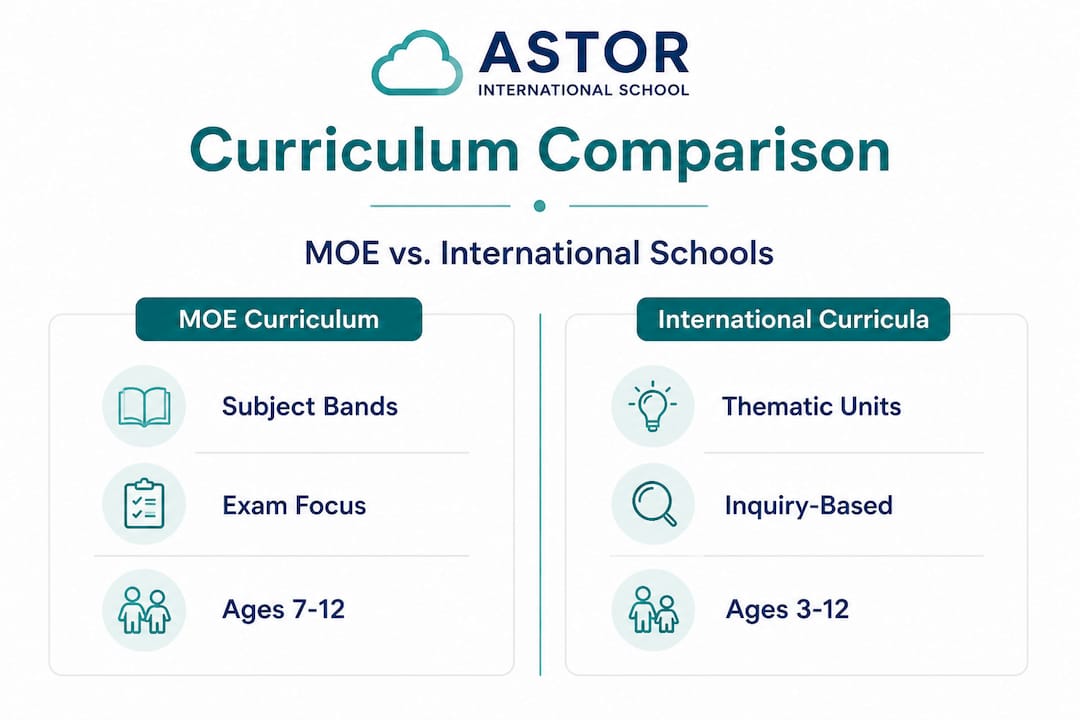
You can compare how national and international schools differ structurally through a curriculum structure comparison that helps parents visualize the practical differences. For ideas on how teachers support varied learners within any curriculum, classroom strategies are worth exploring.
International school curricula: IPC, IB PYP, and alternative approaches
While the MOE curriculum provides structure and clear benchmarks, international schools offer educational philosophies that emphasize creativity and inquiry. Let’s examine how these alternatives work.
Two frameworks dominate the international primary school landscape in Singapore: the International Primary Curriculum (IPC) and the IB Primary Years Program (IB PYP). Both are genuinely different in spirit and structure from the MOE model, and understanding how they work day-to-day helps parents decide if they’re a good fit for their child.
The IPC at International Schools describes the IPC as thematic and inquiry-based, aligning with the UK National Curriculum alongside Singapore Math. Schools like Astor International School use the IPC to organize learning into cross-subject units, each with Entry Points that spark curiosity and Exit Points where children demonstrate what they’ve learned. A unit on “Water” might connect science, geography, art, and literacy all at once, making learning feel cohesive rather than siloed.
The IPC is organized into three Mileposts that roughly correspond to ages 5 to 7, 7 to 9, and 9 to 11. Each Milepost has both International Learning Goals, focused on developing global awareness, and Personal Learning Goals, which build skills like adaptability, resilience, and communication. These are qualities that exam scores alone can’t capture.
The IB PYP takes a similarly broad approach, organizing learning around six transdisciplinary themes: “Who We Are,” “Where We Are in Place and Time,” “How We Express Ourselves,” and others. As the MOE Curriculum Syllabus notes, both frameworks prioritize a learner profile over rote memorization, encouraging children to be inquirers, thinkers, and communicators.
Here’s a practical comparison of the three primary frameworks:
Feature | MOE | IB PYP | IPC |
Age range | 7 to 12 | 3 to 12 | 5 to 11 |
Structure | Subject-based, spiral | 6 transdisciplinary themes | 3 Mileposts, thematic units |
Assessment style | Formal exams, PSLE | Portfolio, ongoing reflection | Entry and Exit Points |
Math approach | Singapore Math | Varied by school | Singapore Math |
Class emphasis | Academic achievement | Learner profile | Personal and international goals |
What makes inquiry-based programs feel different in practice comes down to the classroom experience itself. In an IPC school, your child might spend a morning building a model to represent a historical event, then write about the experience in English. Learning is connected, child-led, and genuinely engaging. For parents who value creativity, curiosity, and confidence alongside academic skills, this approach resonates deeply.
Pro Tip: Ask international schools specifically how they assess individual progress outside of formal exams. Strong IPC and IB PYP schools can clearly show you how they track each child’s growth over time and communicate it to parents.
Reading an IPC parent guide can help you understand what a typical week looks like in an IPC classroom. And if you’re still early in the decision process, international school selection tips offer a helpful framework for narrowing down your choices.
Academic performance, creativity, and student well-being: Benchmarks and critiques
Beyond curriculum structure, it’s crucial to explore the real-life impact on student performance and well-being.
Singapore’s academic results are genuinely extraordinary by global standards. In PISA 2022, Singapore ranked first in the world, with Math scores of 575, Reading at 543, and Science at 561. The OECD averages for the same year were 472, 476, and 485 respectively. That’s not a small gap. It represents years of intentional curriculum design, teacher training, and national commitment to academic excellence.
Yet the same data tells a more complex story. While Singaporean students score exceptionally in reasoning and mathematical self-efficacy, only 47% report creative self-efficacy compared to the OECD average of 61%. That gap is striking and worth pausing on. Strong academic performance and creative confidence are not the same thing, and children need both to thrive in modern, fast-changing environments.
There are other pressures worth acknowledging openly. National primary schools average about 40 students per class, compared to international schools where class sizes typically run between 20 and 23 students. A teacher managing 40 children has limited time for individual attention, no matter how skilled they are. This structural reality shapes how feedback is given, how quickly struggling learners get support, and how confident children feel about asking questions.
Tuition reliance is also a widely discussed reality in Singapore’s education culture. Many families supplement school with private tutoring from early primary years, adding both cost and time pressure to children’s schedules. This isn’t a failure of any individual family. It reflects a system where exam stakes are high and competition is real.
“The best learning happens when every child is truly seen and supported,” and in large classes under exam pressure, that support can be genuinely hard to deliver consistently.
On the positive side, the holistic education debate is very much alive in Singapore. There is growing recognition among educators and policymakers that well-being, creativity, and resilience belong in the conversation alongside grades. Parents reading widely about supporting their child’s learning often find that the most impactful changes happen at home, regardless of which school their child attends. Resources like e-books focused on well-being also show how children’s confidence and emotional literacy can be nurtured outside the classroom.
The small class size benefits are well-documented and go beyond comfort. Smaller groups allow teachers to spot learning gaps early, personalize their approach, and build genuine relationships with each child, all of which correlate strongly with better outcomes over time.
Choosing the right primary curriculum for your child: Practical factors
Now that you understand the options and their impacts, here’s how to use this knowledge in your decision-making as a parent.
No single curriculum is universally superior. The right choice depends on your child’s learning style, your family’s values, your long-term plans, and what kind of daily school experience you want your child to have. MOE excels academically with structured, exam-focused spiral learning, while IB and IPC frameworks emphasize inquiry and creativity in ways that produce genuinely different kinds of learners.
Here are the most important practical factors to weigh:
Learning style. Does your child thrive with clear structure, routines, and defined goals? The MOE model may suit them well. Is your child more curious, imaginative, and energized by open-ended projects? An inquiry-based approach could be a better match.
Family plans. If you plan to relocate internationally in the coming years, an IPC or IB PYP education transfers more smoothly to schools abroad than a PSLE-focused pathway.
Class size and attention. Consider how much individual support your child needs. A child with specific learning differences, shy tendencies, or high curiosity will flourish differently in a class of 20 versus a class of 40.
Exam pressure tolerance. Be honest about how your child and your family handle high-stakes testing. Some children are motivated by clear targets; others experience significant anxiety that affects their overall well-being and love of learning.
Values alignment. What do you want your child to walk away with after primary school? Academic credentials, creative confidence, global awareness, and social-emotional skills are all legitimate goals, but different curricula prioritize them differently.
A practical approach is to create a simple shortlist of your three most important priorities, then ask each school directly how they address those specific areas. Visit in person whenever possible. Watch how teachers interact with children and how freely students ask questions.
Pro Tip: Ask to see examples of student work and assessment records during a school tour. How a school tracks and communicates progress tells you a great deal about how much they truly know each individual child.
Exploring the IPC learning goals can help clarify what international schools are actually measuring. And if you’re comparing multiple schools, school selection tips offer a step-by-step process for making a confident, informed choice.
Our perspective: The real balancing act for Singapore parents
Here’s something we’ve seen time and again in our years working with families in Singapore: parents often arrive with the question “which curriculum is better?” but leave with a much more useful question: “which environment will help my child grow into who they’re meant to be?”
Exam scores matter. We would never pretend otherwise. But scores tell you where a child performed on a specific day under specific conditions. They don’t tell you whether a child trusts their own ideas, recovers from setbacks, or feels genuinely excited to learn on Monday morning. These qualities take years to build, and they’re deeply connected to daily school experience, not just outcomes at the end of primary school.
What we’ve learned from conversations with parents and teachers is that the most resilient, confident learners tend to come from environments where they were both challenged and known. They were pushed academically, and they also had teachers who noticed when something was wrong, who remembered their interests, and who celebrated their individual growth.
The tension in Singapore’s education conversation is real: the system produces outstanding academic results, but creative confidence lags behind international peers. That’s not a reason to dismiss the MOE, and it’s not a reason to assume international schools are automatically the better choice. It’s a call to ask deeper questions and to look at the full picture.
The good news is that classroom strategies for balance can be applied in any learning environment. Parents who stay engaged, who create space for curiosity at home, and who choose schools where teachers genuinely know their children, tend to produce confident, capable learners regardless of which curriculum framework is on the wall.
Explore curriculum options at Astor International School
If you’re at the stage where you want to move from research to real-world exploration, Astor International School in the Tanglin area of Singapore offers exactly the kind of learning environment this article has been describing.
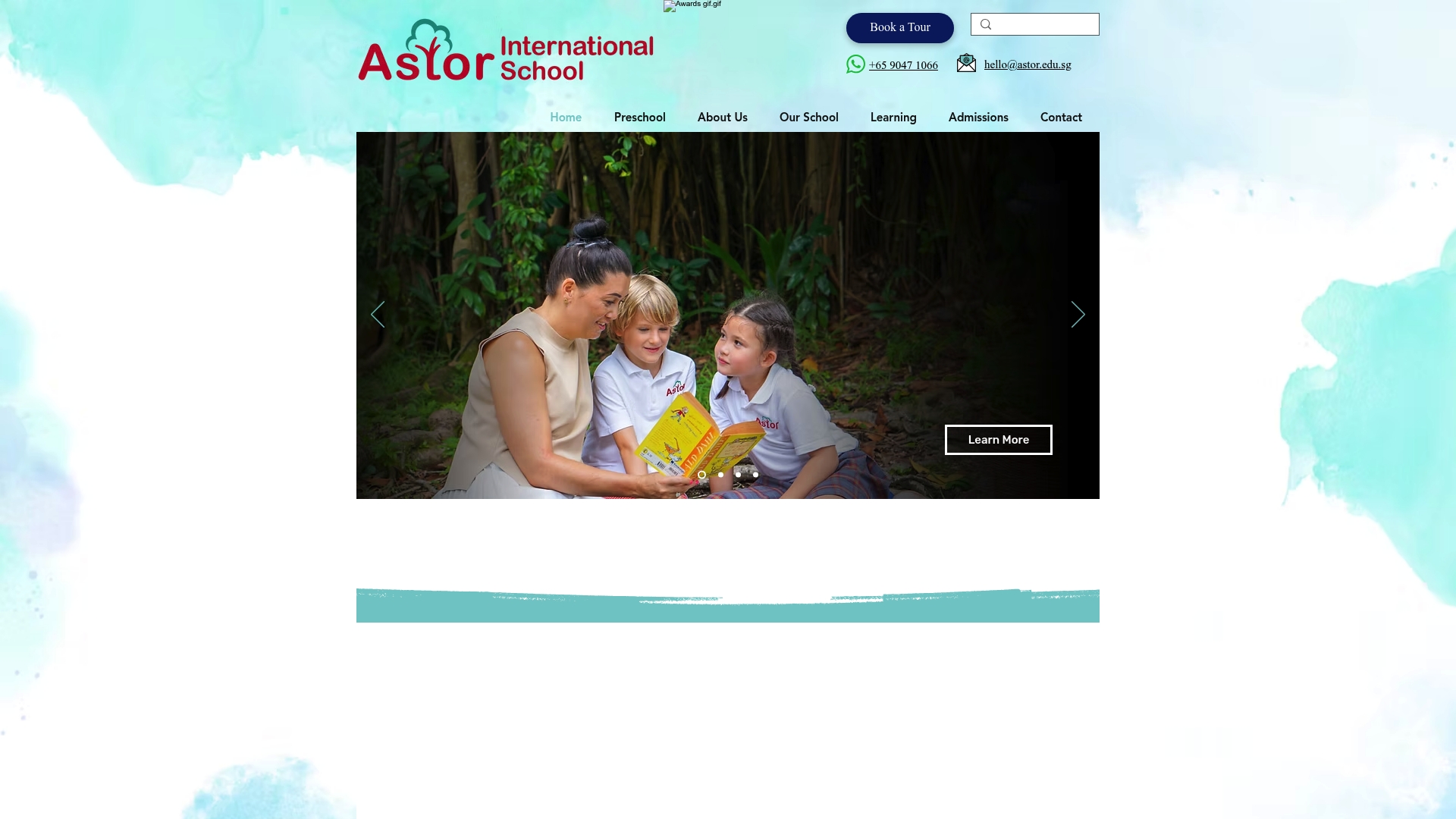
Astor is a small but mighty school, recognized as both the Best Small School in Singapore and the Best Affordable International School in Singapore. We use the IPC approach to create engaging, thematic learning experiences for children aged 5 to 12, paired with Singapore Math to ensure strong academic foundations. Our small class sizes mean every child is genuinely known by their teacher. You can explore our full school curriculum details online, or reach out to arrange a personal tour. We’d love to show you what learning looks like here.
Frequently asked questions
What is the main difference between MOE and international primary school curricula?
MOE is structured and exam-focused, following a spiral progression toward the PSLE, while international programs like IPC or IB PYP emphasize inquiry-based, thematic, and creative learning with ongoing portfolio-style assessment.
What subjects are taught in Singapore’s primary schools?
Singapore’s MOE primary schools teach English Language, Mother Tongue Language, Mathematics, Science, Social Studies, Character and Citizenship Education, Physical Education, Art, and Music across Primary 1 to 6.
How do international schools in Singapore approach primary education?
International schools use frameworks like the IPC, which is thematic and inquiry-based, aligning with Singapore Math alongside UK National Curriculum elements, and organizing learning into creative units built around personal and international goals.
Are class sizes in Singapore’s primary schools larger than in international schools?
Yes. National schools average around 40 students per class, while international schools typically have classes of 20 to 23, allowing for more individual attention and personalized support.
What should parents consider when choosing a primary school curriculum?
Parents should weigh academic priorities alongside creative development, student well-being, class size, exam pressure, and whether the school’s values genuinely align with how their child learns best.
Recommended
Comments