

Understanding preschool curriculum in Singapore: a parent's guide
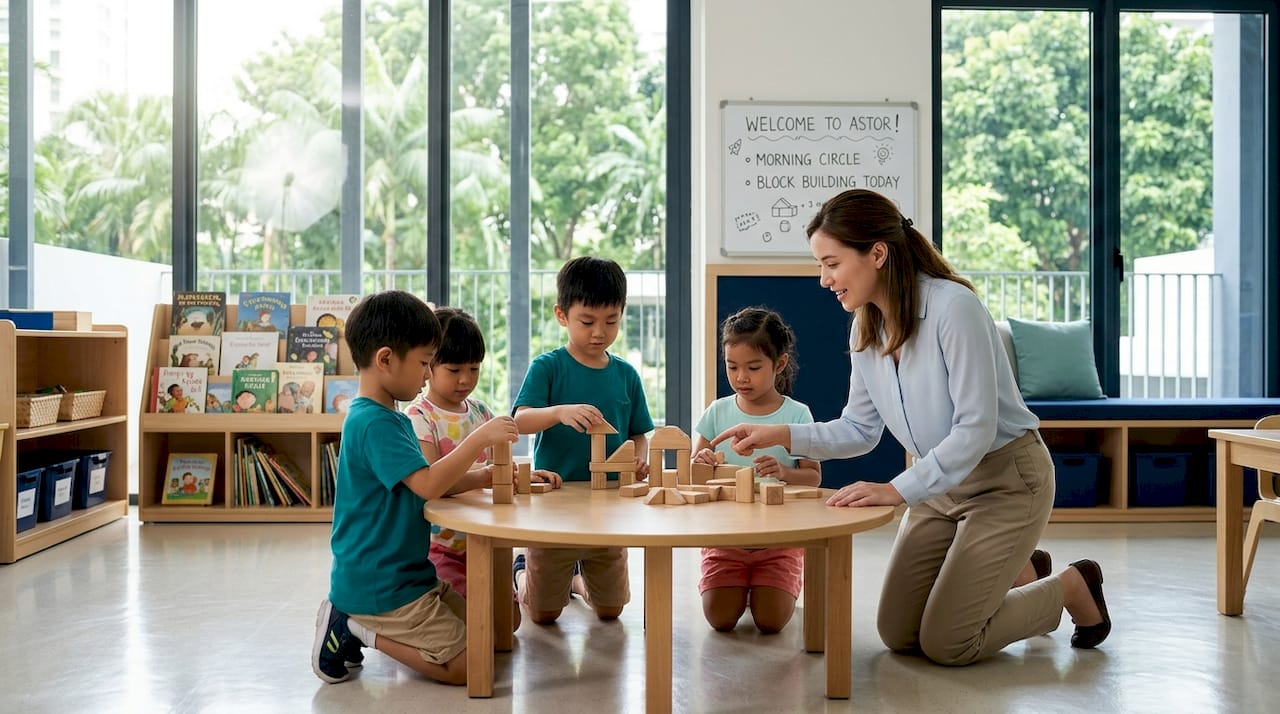
Choosing a preschool in Singapore feels straightforward until you realize that not all preschools teach the same way. One school calls itself “play-based,” another follows Montessori, and a third mentions the NEL framework. Suddenly, what seemed like a simple decision becomes a maze of approaches, philosophies, and unfamiliar acronyms. The truth is, Singapore’s frameworks for preschool blend play-based learning with holistic development in ways that are genuinely thoughtful and research-backed. This guide will walk you through what a preschool curriculum really means, how different models compare, what quality looks like, and how to find the right fit for your child.
Table of Contents
Key Takeaways
Point | Details |
Singapore’s frameworks | Preschools follow NEL and EYDF, which focus on holistic and play-based development. |
Popular methods | Montessori, Reggio Emilia, play-based, and hybrid curriculums are common, each with distinct strengths. |
Quality assurance | The SPARK framework and strong teacher-child relationships help ensure program effectiveness. |
Choosing fit | Consider your child’s temperament, family needs, and observe classrooms when deciding on a curriculum. |
Purposeful play advantage | Flexible, play-driven learning prepares children for school and life better than rote academics. |
What is a preschool curriculum?
Many parents assume a preschool curriculum is simply a list of subjects, maybe some phonics, simple math, and art on Fridays. In reality, it is much richer than that. A preschool curriculum refers to the planned experiences, learning environments, and intentional activities designed to support a child’s growth across every dimension of who they are, not just their academic readiness.
In Singapore, this is guided by two national frameworks. The NEL Framework (Nurturing Early Learners) covers children ages 4 to 6, while the EYDF (Early Years Development Framework) covers birth to 4 years. Both frameworks share a common vision: to nurture children who are curious, confident, and ready to engage with the world. They emphasize holistic development, meaning learning is never reduced to worksheets and memorization.
The six key learning areas covered across these frameworks include:
Language and literacy for communication and early reading foundations
Numeracy for number sense and problem-solving thinking
Motor skills development across both fine and gross motor areas
Discovery of the world through science, social studies, and environmental exploration
Aesthetics and creative expression through music, art, and movement
Social and emotional development for self-awareness, empathy, and resilience
“The best learning happens when every child is truly seen and supported, not just moved through a program.”
Central to these frameworks is the idea of play-based learning, where children construct knowledge through doing, exploring, and interacting rather than passive listening. The iTeach principles embedded in the NEL further encourage teachers to see children as active participants, co-constructors of their own learning experiences. This is a meaningful shift from traditional teaching, and it shapes everything from how classrooms are arranged to how teachers ask questions.
Learning area | Key focus | Example activity |
Language and literacy | Vocabulary, storytelling, early reading | Shared book reading, role play |
Numeracy | Counting, patterns, basic operations | Sorting games, measuring objects |
Discovery of the world | Curiosity, science, environment | Nature walks, simple experiments |
Aesthetics | Creativity, self-expression | Drawing, singing, dance |
Social-emotional | Empathy, self-regulation | Group games, feelings discussions |
Motor skills | Coordination, physical confidence | Outdoor play, craft activities |
Understanding these foundations helps you ask better questions when visiting any preschool. Rather than asking “do they teach phonics?”, you can ask how the school supports language development across the day, through play, through conversation, and through rich storytelling environments.
Popular curriculum models in Singapore preschools
With the frameworks in mind, let’s explore the different curriculum models you’ll find in Singapore’s preschools and what sets them apart. The good news is that Singapore’s preschool landscape is genuinely diverse. Popular options include Montessori, Reggio Emilia-inspired, play-based, and hybrid programs, most of which are designed to align with NEL and EYDF goals.
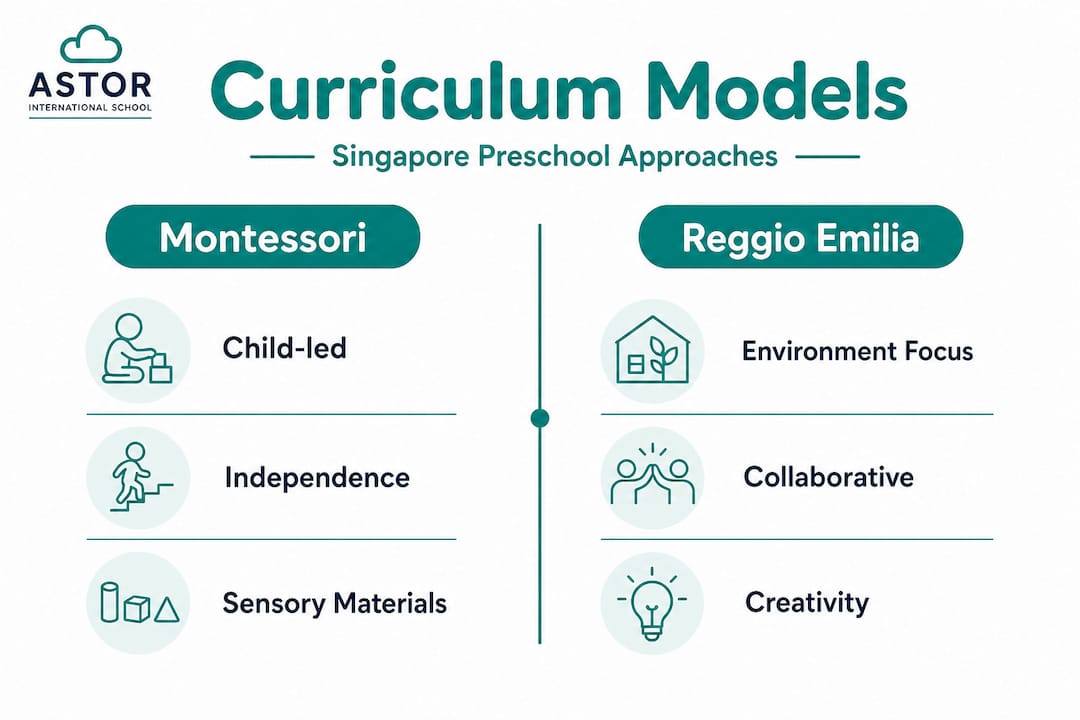
Montessori is probably the most recognized name in early childhood education worldwide. It emphasizes child-led learning, independence, and hands-on sensory materials. Children in Montessori classrooms typically work at their own pace across mixed-age groups, choosing activities from carefully prepared materials. The teacher acts as a guide rather than a direct instructor. This model suits children who are self-motivated, independent, and curious by nature.
Reggio Emilia-inspired programs take a different path. Here, the environment itself is considered the “third teacher,” meaning classroom spaces are intentionally designed to spark curiosity and investigation. Projects emerge from children’s interests, and collaborative inquiry is celebrated. Art, documentation, and storytelling are central tools. Children who thrive in social, creative environments tend to flourish in Reggio-inspired settings.
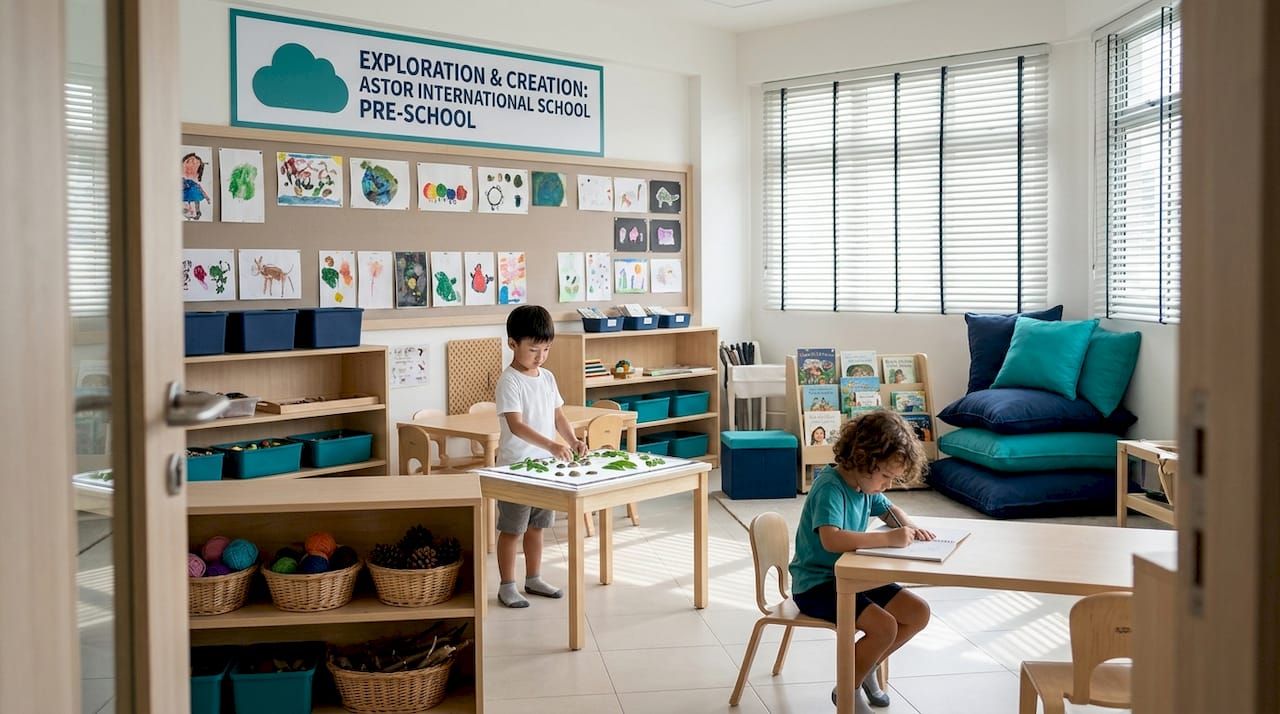
Play-based programs offer more flexibility. They integrate academic concepts into both free and structured play, which is closely aligned with learning through play as described in Singapore’s NEL framework. A child might practice counting during a pretend market game or develop literacy through puppet storytelling. This model often feels the most intuitive to young children because it mirrors how they naturally explore and make sense of the world.
Most Singapore preschools today use hybrid models, blending elements from several approaches to create a curriculum that is both responsive and practical. This blended approach allows schools to honor a child’s need for play and creativity while still building readiness for Primary 1 and beyond.
Model | Core philosophy | Best suited for |
Montessori | Child-led, independence, sensory materials | Self-motivated, independent learners |
Reggio Emilia | Collaborative inquiry, arts, environment as teacher | Social, creative, expressive children |
Play-based | Academic concepts through structured and free play | Active, curious, hands-on learners |
Hybrid | Blend of approaches, aligned to NEL/EYDF | Most children, versatile by design |
Understanding these models helps you see that Montessori independence, Reggio creativity, and play-based engagement are not competing philosophies. They all point toward the same goal: a joyful, meaningful early childhood where children develop at their own pace with support, not pressure.
Pro Tip: During a school visit, ask the teacher to describe a typical morning. If they can walk you through how different subjects are woven naturally into activities rather than separated into rigid time slots, that is a strong indicator of an integrated, child-centered approach.
Also consider your family’s priorities. If bilingual immersion matters deeply to you, look for schools with structured Mandarin or mother tongue integration across the day. If hands-on math learning is a priority, look for schools where manipulatives and real-world numeracy tasks are evident in every classroom.
How Singapore assures preschool quality and teacher impact
Once you understand the curriculum types, you’ll want to know how Singapore ensures quality, and why the teacher relationship is just as crucial as the curriculum model itself.
Singapore uses the SPARK framework (Strengthening Preschool Accountability through Rating and Knowhow) to assess and assure quality across all licensed preschools. The SPARK quality framework evaluates preschools across seven areas including curriculum, teaching and learning, child assessment, leadership, partnerships, health and safety, and environment. It operates across three key stages: registration, self-appraisal by the school, and external validation by assessors.
This matters enormously to you as a parent because SPARK accreditation is a visible signal that a school has been independently reviewed against rigorous standards. When a preschool holds SPARK status, it means the school actively reflects on its own practices and welcomes external feedback.
Here is what quality looks like in practice, across five observable dimensions:
Responsive teacher interactions where educators listen actively and build on what children say
Inclusive classroom environments that accommodate children with diverse learning needs
Clear communication with families about children’s progress and daily experiences
Purposeful learning spaces designed to invite curiosity and exploration
Differentiated instruction that adjusts pacing and approach to suit individual readiness
Research confirms that teacher-child closeness and differentiated instruction significantly predict early learning gains, even more so in Singapore’s context where child-to-teacher ratios can be higher than ideal. A warm, consistent relationship with a caring teacher is one of the most powerful learning tools a young child can have. No curriculum model can replace that.
“A warm and responsive teacher can make any curriculum come alive. The relationship is the foundation.”
The benefits of small class sizes become very clear here. In smaller groups, teachers can genuinely know each child, track their growth, adapt their approach, and build the kind of trusting relationships that allow children to take risks and grow. This is something we believe deeply at Astor, and it shapes how we structure learning from the earliest years.
Pro Tip: When visiting a preschool, watch how teachers respond when a child makes a mistake or struggles. Do they redirect gently and stay patient? That moment tells you more about program quality than any brochure can.
How to choose the right curriculum for your child
Knowing what makes a curriculum effective, here’s how to decide which one best suits your child and family circumstances. There is no single right answer, but there is definitely a right fit for your child.
Start by thinking about your child’s temperament and natural tendencies. Matching curriculum to temperament is one of the most practical steps you can take. Independent, self-directed children often thrive in Montessori environments. Social, expressive children tend to love Reggio-inspired settings. High-energy, tactile learners usually do best in play-based or hybrid programs with ample outdoor time.
Next, consider these practical factors:
Bilingual immersion if you want your child to develop strong Mandarin or another mother tongue alongside English
Location and commute because a tired, stressed drop-off affects a child’s readiness to learn
Class size and teacher ratios since smaller classes generally allow more personalized support
Fees and program flexibility including full-day, half-day, and wrap-around care options
For children with diverse learning needs, Singapore offers strong inclusive guidance. The inclusive preschool practice guide/curriculum-frameworks/teaching-and-learning-resources/inclusive-preschool-practice-guide) from ECDA outlines how schools should adapt practices for children with disabilities, developmental differences, or multilingual home backgrounds. When visiting a school, ask directly how they support children who may learn differently or who speak a different language at home.
Reviewing classroom learning strategies used by the school can also reveal how flexible and responsive their teaching team really is.
During your school visit, ask these key questions:
How do teachers communicate with parents throughout the week?
How is progress tracked and shared with families?
What happens when a child is struggling socially or academically?
How much outdoor time is built into every day?
How are children’s interests incorporated into lessons?
The answers will tell you far more than looking at the classroom walls.
What most parents miss when choosing a preschool curriculum
After reviewing frameworks, comparing models, and checking quality markers, here is what experience tells us matters most, but often gets overlooked entirely.
Most parents spend a great deal of time evaluating curriculum brand names. They compare Montessori to play-based, or check whether a school has an international or local curriculum. That research is useful. But the biggest mistake is treating curriculum selection like buying a product, as if the brand itself guarantees outcomes.
The most successful early learners we see are not necessarily children who attended the most structured program or the most academically rigorous preschool. They are children who loved going to school. Who felt safe to try, fail, and try again. Who had at least one teacher who truly knew them. That emotional foundation is what play-based methods in NEL and EYDF are designed to build, and research consistently shows that these approaches outperform rigid academic drilling for long-term outcomes.
There is an ongoing debate worth acknowledging. Some educators and parents favor highly structured programs for Primary 1 readiness, with explicit phonics sequences and numeracy drills. Others lean toward fully child-led alternatives. The honest answer, supported by research and practice, is that purposeful play, well-designed curriculum, and strong teacher-child relationships consistently produce better long-term outcomes than either extreme.
What we encourage parents to look for is adaptability. A school that listens to your child, responds to their changing needs, and never stops observing and reflecting is far more valuable than one that rigidly follows a script. Look for personalized approaches in preschool that honor who your child is right now, not just who you hope they’ll be by Primary 1.
The best preschool for your child is one where they feel seen, supported, and genuinely joyful most of the time. That is not soft advice. That is the science of early childhood development.
Explore quality preschool options with Astor International School
Ready to see how a modern, holistic preschool curriculum looks in practice? Here’s an option for Singapore families.
At Astor, we believe every young child deserves a preschool experience that is warm, engaging, and genuinely responsive to who they are. Astor’s preschool curriculum is built on the principles of Singapore’s NEL and EYDF frameworks, blended with international best practices to create a learning environment that nurtures the whole child, not just academic performance. Our preschool in Holland features two playgrounds, a natural mix of outdoor and classroom learning, and small class sizes that make meaningful relationships possible every day.
For families thinking ahead to primary years, Astor’s learning philosophy carries through our international school in Tanglin, where we hold the distinction of being named both best small school and best affordable international school in Singapore. Our curriculum also draws on the globally recognized International Primary Curriculum, giving children a truly purposeful educational journey from their earliest years onward. We warmly invite you to visit and experience our community for yourself.
Frequently asked questions
What is the difference between NEL and EYDF in Singapore preschools?
NEL covers ages 4 to 6 and focuses on holistic, play-based learning including language, numeracy, and social-emotional growth. EYDF is designed for birth to 4 years, with the same emphasis adapted for the developmental needs of younger children.
Is play-based learning effective for preparing my child for primary school?
Yes. Singapore’s NEL demonstrates that play-based methods align with global best practices, supporting creativity, social skills, and academic readiness more effectively than rote learning or rigid drills over the long term.
What should I look for during a preschool visit?
Focus on observing teacher-child interactions, the warmth of the classroom environment, the quality of learning materials, and ask about frameworks like the SPARK quality assurance process or how the school practices differentiated instruction.
Are there inclusive options for children with special needs or different home languages?
Absolutely. Singapore provides clear inclusive and differentiated guidance/curriculum-frameworks/teaching-and-learning-resources/inclusive-preschool-practice-guide) for preschools to support children with disabilities, developmental differences, and multilingual home backgrounds across all licensed programs.
Recommended

Overall, the article provided a thorough overview of Singapore's preschool curriculum. Honestly, I was just doing some quick research and while digging into this I ended up on https://uschi-disl.de, the layout's pretty clean. I felt like the structure helped clarify how these programs are designed and implemented.