


Curiosity with purpose: how inquiry-based learning works
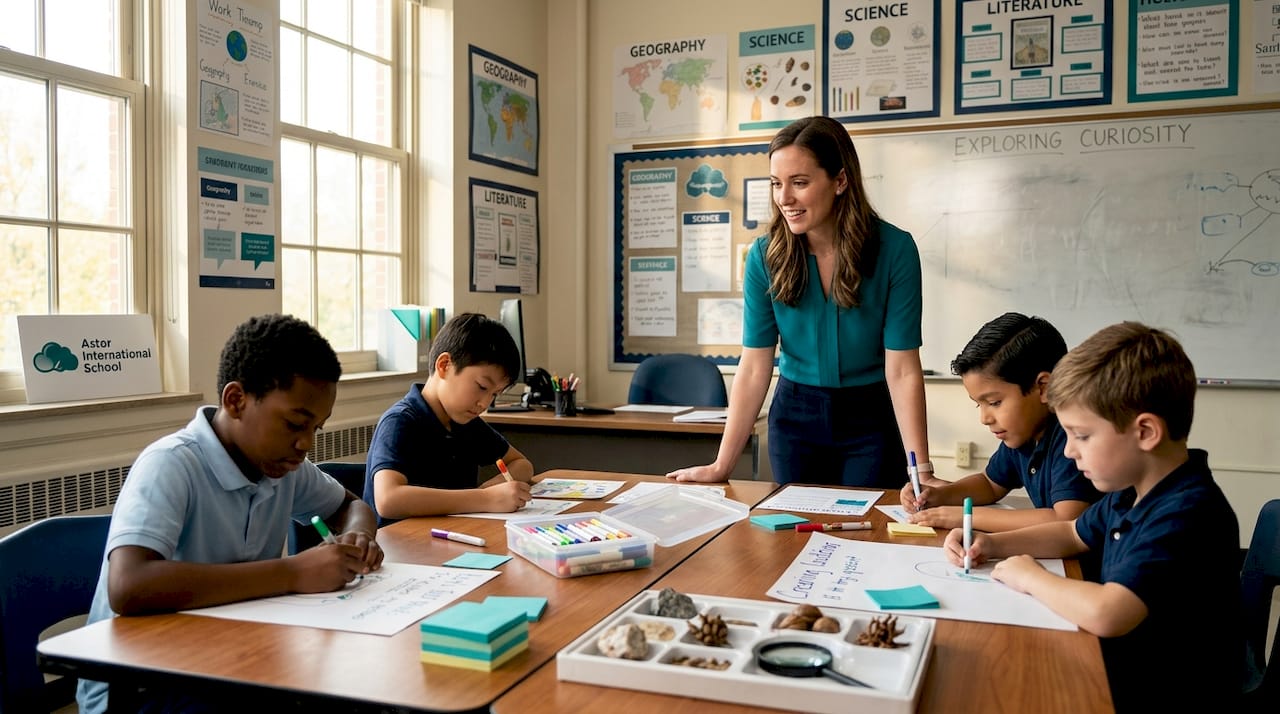
Many parents wonder whether letting children “explore freely” is truly the best path to deep learning, or whether structured teaching still has an essential role. The truth is more nuanced. Well-designed inquiry-based approaches can strengthen critical thinking and improve outcomes, but the results vary significantly depending on how carefully the method is designed and guided. As an expat parent in Singapore, understanding this distinction helps you make smarter, more confident choices for your child. This article will clarify what inquiry really means inside a modern classroom, why teacher guidance is everything, and what truly effective inquiry looks like in practice.
Table of Contents
Key Takeaways
Point | Details |
Guided inquiry works best | Children thrive when inquiry-based learning includes thoughtful guidance and feedback. |
Boosts critical thinking | Well-designed inquiry helps children develop analysis, reasoning, and problem-solving skills. |
Parental insight matters | Parents should look for classrooms with active facilitation, not just buzzwords about inquiry. |
Misconceptions need attention | Even successful inquiry approaches require teachers to address learning gaps directly. |
Singapore schools can excel | Effective Singapore international schools blend global approaches with local expertise in inquiry learning. |
What is inquiry and why does it matter?
With the stage set, let’s look at what inquiry-based learning really means for your child in a modern classroom.
Inquiry-based learning (IBL) is a teaching approach where children are encouraged to ask genuine questions, investigate real problems, and build their own understanding through direct experience. Rather than simply listening to a teacher deliver facts, students become active participants in constructing knowledge. They observe, hypothesize, test ideas, and reflect on what they discover.
It helps to understand how IBL differs from other common approaches:
Approach | Teacher’s role | Student’s role | Structure level |
Traditional | Delivers information | Receives and memorizes | High, teacher-directed |
Discovery learning | Steps back | Explores freely | Low, student-directed |
Inquiry-based | Facilitates and guides | Questions, investigates, reflects | Balanced and scaffolded |
This distinction matters enormously. Discovery learning sounds appealing in theory, but without direction, younger children can miss key concepts or form incorrect ideas. IBL sits in the productive middle ground, giving children agency while keeping a skilled teacher actively involved.
Inquiry-based approaches can improve learning outcomes and higher-order thinking skills, though the degree of benefit depends heavily on instructional design. The core skills children build include:
Asking precise questions rather than accepting surface-level answers
Evaluating evidence instead of guessing
Making connections across subjects and real-life experiences
Communicating reasoning clearly, both verbally and in writing
One important misconception to clear up early: inquiry does not mean the absence of structure. In fact, the opposite is true. As one educator put it well: “The teacher’s role in inquiry is not to disappear but to become a more thoughtful presence, one who knows when to step forward and when to step back.” That balance is where the real skill lies, and it’s exactly what you want to see in your child’s school.
Reading resources also play a supportive role here. Research into e-books and learning suggests that interactive, curiosity-driven formats can reinforce the inquiry mindset beyond the classroom, which is worth keeping in mind when you think about how learning happens at home too.
How inquiry fuels engagement and deeper thinking
Having established what inquiry is, let’s look at what the evidence shows about its benefits for engagement and thinking skills.
When inquiry is properly scaffolded, something noticeable happens: children stop waiting to be told what to think and start genuinely wanting to find out for themselves. That internal motivation is one of the most valuable things a school can nurture, and it’s also one of the hardest to generate through traditional instruction alone.
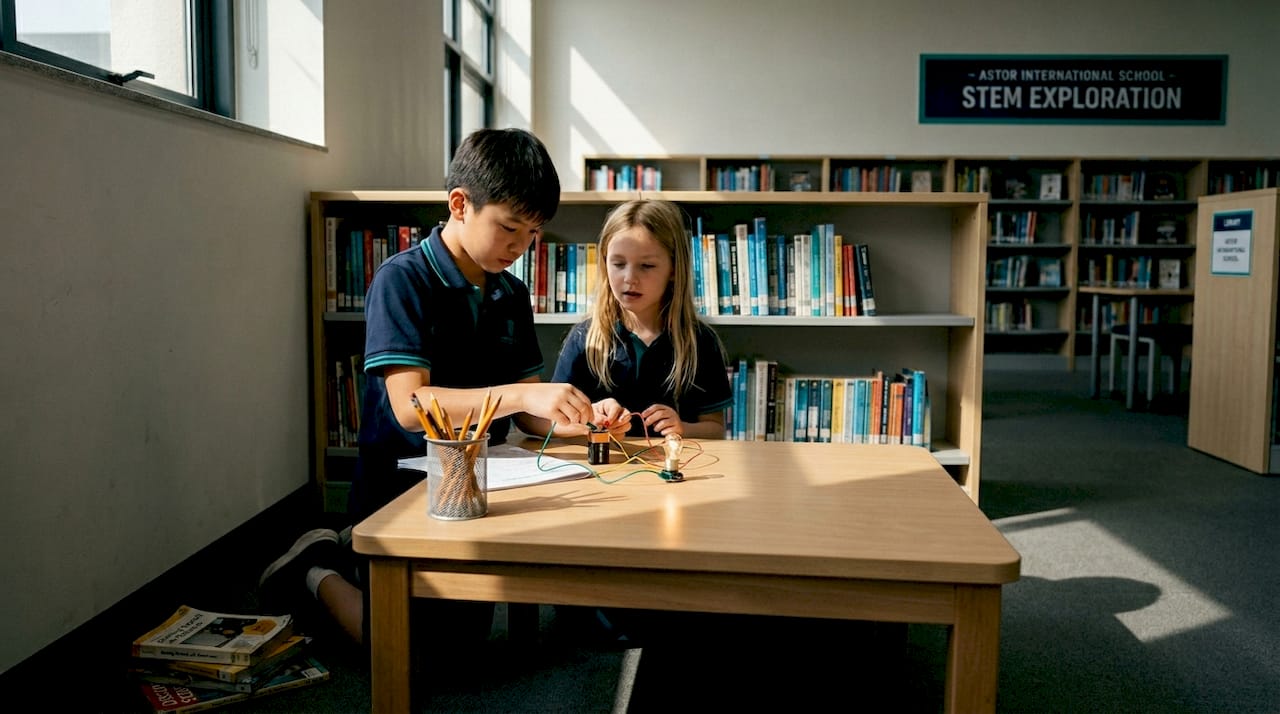
Empirical studies show positive benefits for conceptual understanding and motivation in inquiry-based, scaffolded settings, though misconceptions can still persist if feedback is absent. This is encouraging, but it comes with an important caveat. Motivation alone is not enough. Children need guided opportunities to check their thinking against accurate information.
Here are four practical examples of what scaffolded inquiry looks like in primary classrooms:
Science experiments with structured reflection: Children design a simple experiment, record observations, and then discuss as a class what the results mean, with the teacher asking probing questions to clarify thinking.
Open-ended project work: Students choose a topic connected to a theme (such as ecosystems or community) and research it using multiple sources, then present their findings to peers.
Outdoor learning investigations: Exploring a school garden or nearby park to observe, collect data, and formulate questions about the natural world, then returning to the classroom to make sense of what they found.
Game-based inquiry: Using strategy games or simulations that require children to problem-solve, test ideas, and adapt their approach, which builds the same questioning mindset as formal inquiry tasks.
The data on outcomes is also worth noting. Here is a simplified summary of findings from research into guided inquiry environments:
Outcome measured | Traditional instruction | Guided inquiry |
Conceptual understanding | Moderate | Higher |
Science motivation | Low to moderate | Significantly higher |
Critical thinking skills | Moderate | Higher, with good scaffolding |
Misconceptions resolved | Often addressed | Depends on feedback quality |
Key insight: The biggest gains in inquiry-based settings come when teachers are actively facilitating, not simply observing. Engagement rises when children feel their questions are genuinely valued and carefully guided toward deeper understanding.
What this means for you as a parent is straightforward: look for schools where inquiry activities are followed by structured reflection, class discussion, and specific teacher feedback. Exploration without sense-making is where the method often falls short.
Guidance vs. pure discovery: what really works?
Research points to a critical distinction. It’s not just about whether a school uses inquiry, but how that inquiry is structured.
The appeal of pure discovery learning is understandable. The idea that children learn best when left to find answers completely on their own is an attractive one. But the evidence tells a different story, particularly for younger or less experienced learners. Minimal guidance approaches can be less effective for novices, and guided instruction with scaffolding often produces stronger results unless learners already have substantial prior knowledge.
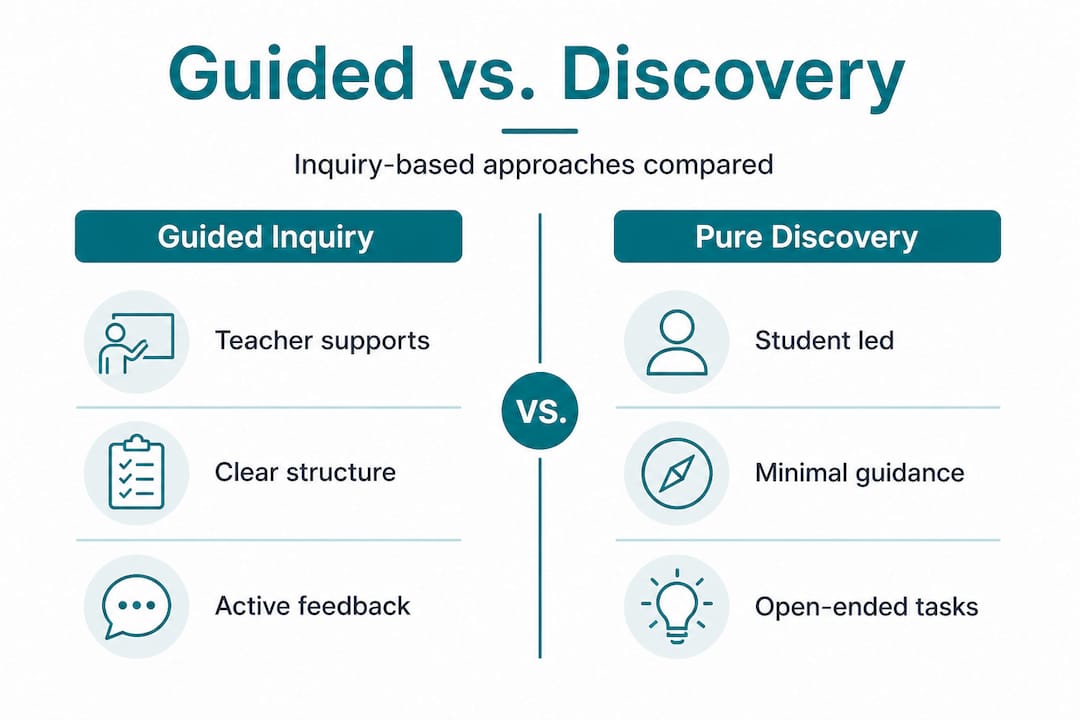
This makes intuitive sense. A child exploring fractions for the first time does not have the mental framework to make sense of what they find without some direction. Give that same child clear guidance, well-timed prompts, and opportunities to check their understanding, and the inquiry becomes genuinely productive.
The teacher’s role in effective inquiry can be described through these key behaviors:
Modeling curiosity: Showing children what it looks like to ask a good question and think through it carefully
Providing scaffolding: Offering structured steps, sentence starters, or guiding questions that support but do not replace independent thinking
Monitoring understanding: Circulating, listening, and adjusting instruction in real time based on what students say and do
Facilitating, not dictating: Encouraging children to reach conclusions through their own reasoning rather than simply providing answers
Student-centered classrooms operationalize exactly this kind of dynamic. The teacher remains a highly active presence but shifts focus from delivering information to building the conditions in which children can think well.
The IPC approach used at Astor International School reflects this philosophy beautifully. The International Primary Curriculum integrates guided inquiry across subjects, giving children structured pathways through thematic, curiosity-driven learning while ensuring teachers stay closely involved throughout every stage.
Pro Tip: When visiting a school, do not just ask “do you use inquiry-based learning?” Ask instead: “How do teachers support a child who gets stuck or forms the wrong idea during an inquiry task?” The specificity of the answer will tell you a great deal about whether guidance is genuinely built into the approach.
Pitfalls and practical tips for parents: inquiry done right
Even with research-backed approaches, effective inquiry depends on careful classroom design, and parents play a key role in assessing this.
One of the most important cautions is this: misconceptions can persist without structured feedback and targeted instruction, even in well-intentioned inquiry-rich settings. A child who explores an idea and arrives at an incorrect conclusion may leave the classroom with that misunderstanding intact if the teacher does not actively address it.
This is not a reason to avoid inquiry. It is a reason to ask good questions about how it is implemented. Here are five practical things to look for when assessing a school’s approach:
Evidence of feedback loops: Are children regularly asked to explain, justify, and revise their thinking? Does the teacher respond to student ideas with probing questions rather than just “good job”?
Balance of structured and open tasks: The best inquiry classrooms blend structured activities with more open exploration. An entirely open classroom is just as concerning as a completely teacher-directed one.
Visible celebration of effort and revision: Schools that encourage mistakes in the classroom as part of learning signal a healthy inquiry culture. Children should feel safe to be wrong and confident that support is available.
Cross-subject integration: Strong inquiry classrooms often link questions across subjects. A theme around “water” might touch science, math, literacy, and social studies simultaneously. Look for open-ended math inquiry as a positive sign.
Teacher language and questioning style: During open days or classroom visits, listen to how teachers phrase their questions. “What do you think?” and “How did you figure that out?” signal active facilitation. “Here is the answer” signals something quite different.
A word of caution: If a school frequently uses the phrase “free inquiry” without being able to explain specifically how teachers guide and support students, treat it as a red flag. The language of inquiry can become a marketing term disconnected from actual classroom practice.
Pro Tip: Ask to see a sample lesson or a description of a recent inquiry project. Schools that genuinely practice guided inquiry will be able to describe what the teacher did at each stage, not just what the children explored.
Signs of effective inquiry-based learning in Singapore schools
As a final practical step, let’s look at on-the-ground signs of effective inquiry-based learning in an international school context.
Parents in Singapore navigating a busy international school market often encounter the word “inquiry” used in very different ways. Knowing what to look for on the ground saves time and builds confidence in your decision. Here are the clearest positive indicators:
Teachers ask more than they tell: During class observations, you should see teachers asking questions far more often than providing direct explanations.
Children explain their thinking: If students can articulate why they reached a conclusion, not just what the conclusion is, inquiry is working well.
Visible evidence of iteration: Projects that show multiple drafts, revised hypotheses, or changed conclusions demonstrate that reflection and sense-making are part of the process.
Mixed-age group teaching opportunities: When older and younger children collaborate on inquiry tasks, it deepens understanding for both groups and models mature thinking in natural ways.
Cross-curricular connections: Strong inquiry programs connect learning across subjects so children see knowledge as connected rather than compartmentalized.
Structured debate and inquiry activities: Classrooms where children are asked to argue for a position, defend a finding, or question a peer’s reasoning demonstrate a mature inquiry culture.
There is also an important warning sign. If parents hear “free inquiry” as a primary description of a school’s approach, it is worth probing further. Research and experience both suggest a gap can exist between educators who espouse inquiry ideals and what actually happens day to day in classrooms. Schools with genuinely strong inquiry programs are confident in explaining the structures and supports behind their methods, not just the philosophy.
The advantage of small class sizes in this context cannot be overstated. When a teacher is responsible for fewer students, they can monitor each child’s understanding far more closely, respond to misconceptions in real time, and tailor their guiding questions to where each child actually is. This is the kind of personal attention that turns good inquiry into truly transformative learning.
Why the right mix of guidance makes all the difference
Having covered what to look for in schools, let’s reflect on what our experience reveals about truly effective inquiry.
After working closely with international families and primary-age children in Singapore, one pattern stands out clearly: the schools that produce the most confident, curious learners are not the ones that simply let children loose to explore. They are the ones that build careful scaffolding around every inquiry experience, ensuring that a child’s natural curiosity leads somewhere meaningful rather than somewhere confusing.
The “magic” of inquiry does not come from freedom alone. It comes from the tension between genuine student-driven questions and the skilled guidance of a teacher who knows when to intervene and when to wait. That balance is genuinely difficult to achieve, and it requires both professional skill and a deep commitment to knowing each child individually.
Parents who prioritize finding schools where this balance exists, where further thoughts on inquiry translate into daily classroom practice rather than mission statement language, tend to report far greater satisfaction with their child’s progress and confidence over time.
What works in theory often fails when guidance is stripped away. A child left to “discover” multiplication on their own will likely not discover it at all. But a child asked “what pattern do you notice?” by a teacher who already knows exactly what to do with the answer? That child is building mathematical thinking that will last.
The uncomfortable truth is that truly effective inquiry requires more from teachers, not less. It demands deep knowledge of content, skill in questioning, and the patience to let a child work through confusion with support rather than rescuing them too quickly. When you find a school that gets this right, it is worth recognizing as something genuinely special.
Explore inquiry-driven learning at Astor International School
Ready to give your child the best of both worlds? Here is how Astor International School brings inquiry learning to life.
At Astor International School in Singapore’s Tanglin area, we have designed our learning environment around exactly the kind of guided, purposeful inquiry described in this article. Our small class sizes mean every child’s questions are heard, every misconception is caught early, and every teacher can truly know each student as an individual.
Our curriculum integrates structured inquiry across every subject, supported by the international IPC framework that connects learning thematically and meaningfully. Beyond core classes, our enrichment programs give children even more opportunities to explore, question, and build real confidence. As Singapore’s awarded best small school and best affordable international school, we believe the best learning happens when every child is truly seen and supported. We warmly invite you to visit and see our approach in action.
Frequently asked questions
Why is guidance important in inquiry-based learning for young children?
Guidance ensures children construct accurate understanding and avoid confusion, as minimal guidance approaches can leave knowledge gaps unresolved, especially for novice learners.
Does inquiry-based learning eliminate all misconceptions?
No, misconceptions can persist without structured feedback and targeted instruction, even in inquiry-rich settings where students are highly engaged.
What should parents look for in an effective inquiry-based classroom?
Look for active teacher facilitation, regular questioning, and visible feedback cycles rather than unstructured activities. If a school relies heavily on the phrase “free inquiry” without describing specific supports, ask for clarification.
How can inquiry-based learning benefit expat children in Singapore?
Inquiry-based learning helps children from diverse backgrounds build confidence, adaptability, and critical thinking by encouraging them to explore ideas actively and make connections across cultures and subjects.
Is inquiry-based learning compatible with international curricula like IPC?
Yes, the IPC framework integrates guided inquiry across subjects, supporting holistic and meaningful learning for primary students aged 5 to 12 in a structured, curiosity-rich environment.
Recommended

Comments