


Why Flexible Learning Spaces Matter for Your Child
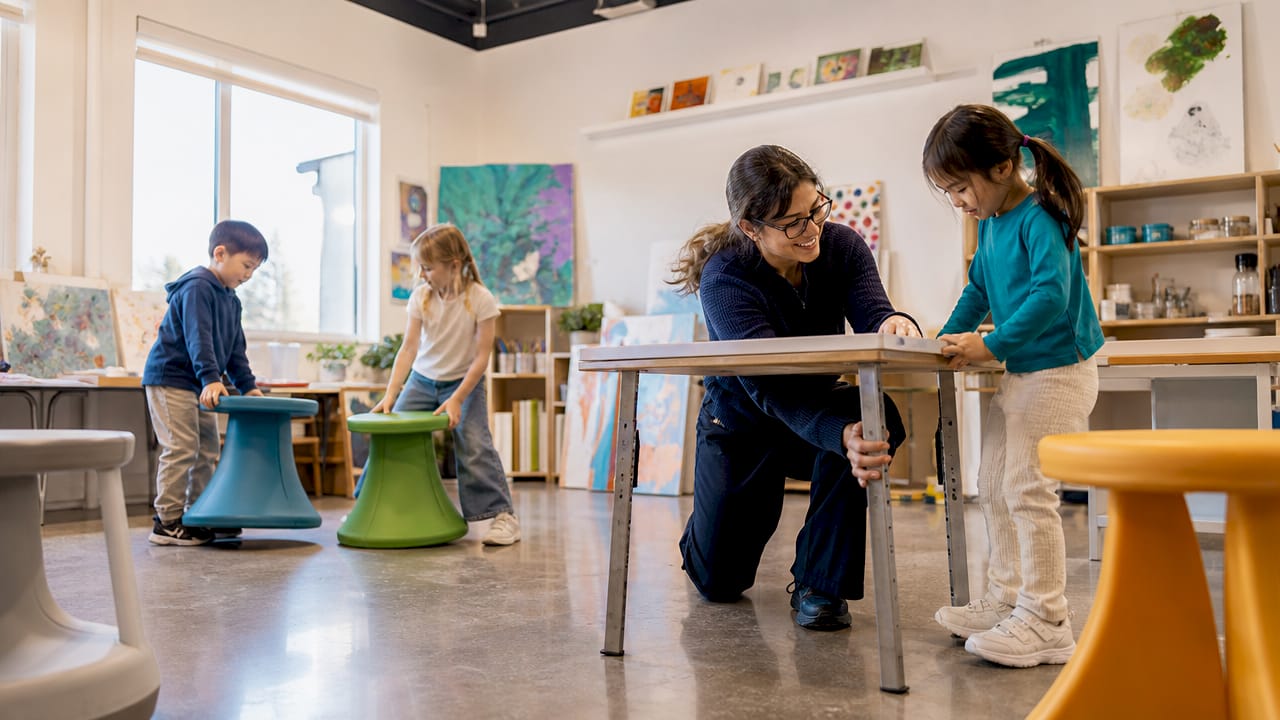
Flexible learning spaces are defined as adaptable, learner-centered environments where the physical layout, furniture, and teaching methods shift to meet the needs of each student. These spaces move away from fixed rows of desks and one-size-fits-all instruction. Research confirms that flexible spaces improve engagement, participation, and academic achievement while reducing sedentary behavior. For parents and educators asking why flexible learning spaces deserve attention, the answer is clear: they create the conditions where children can think, collaborate, and grow with genuine confidence.
Why flexible learning spaces improve student engagement
Student engagement rises when children have a say in how and where they learn. Flexible classrooms build autonomy and ownership, two of the strongest drivers of motivation and critical thinking. When a child can choose to work at a standing desk, move to a quiet corner, or join a group table, they take responsibility for their own learning process. That sense of agency is not a small thing. It shapes how children approach challenges for years to come.
A 2026 study of 98 high school students found that flexible classrooms significantly improve peer interaction and motivation. That result matters because motivation is the engine behind sustained academic effort. When students feel energized by their environment, they participate more, ask more questions, and retain more of what they learn.
Flexible environments also develop psychological flexibility alongside physical adaptability. This means children practice managing emotions, shifting focus, and thinking in new ways. These are 21st-century skills that no textbook can teach in isolation. The classroom itself becomes the training ground.
Key benefits of flexible spaces for engagement include:
Student choice: Children select seating and work arrangements that suit their focus style.
Peer collaboration: Group zones encourage discussion, teamwork, and shared problem-solving.
Active participation: Movable furniture supports movement in the classroom, reducing the fatigue that comes from sitting still for hours.
Emotional regulation: Varied zones give children space to self-manage when they need a quieter moment.
Pro Tip: If your child’s school uses flexible seating, ask the teacher how students choose their spots. Schools that guide this choice intentionally see far better results than those that leave it entirely unstructured.
What design elements make a learning space truly flexible?
Physical design is the foundation of any effective flexible learning environment. The most impactful spaces share several core features, and each one serves a specific educational purpose.
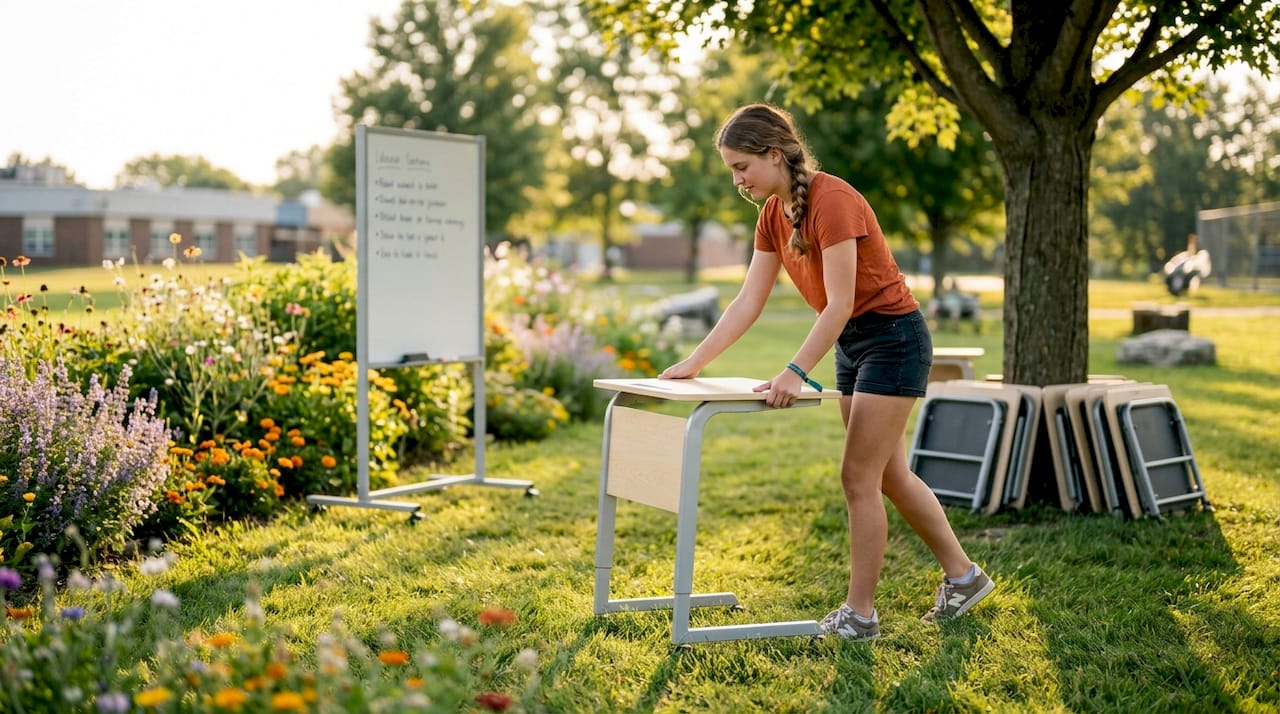
Architectural design using movable walls and multi-purpose rooms encourages experiential learning and higher academic results. When walls can open or close, a single room becomes a lecture space, a workshop, and a quiet study zone within the same school day. That physical responsiveness mirrors the way real learning actually happens: in bursts, in groups, and sometimes in solitude.
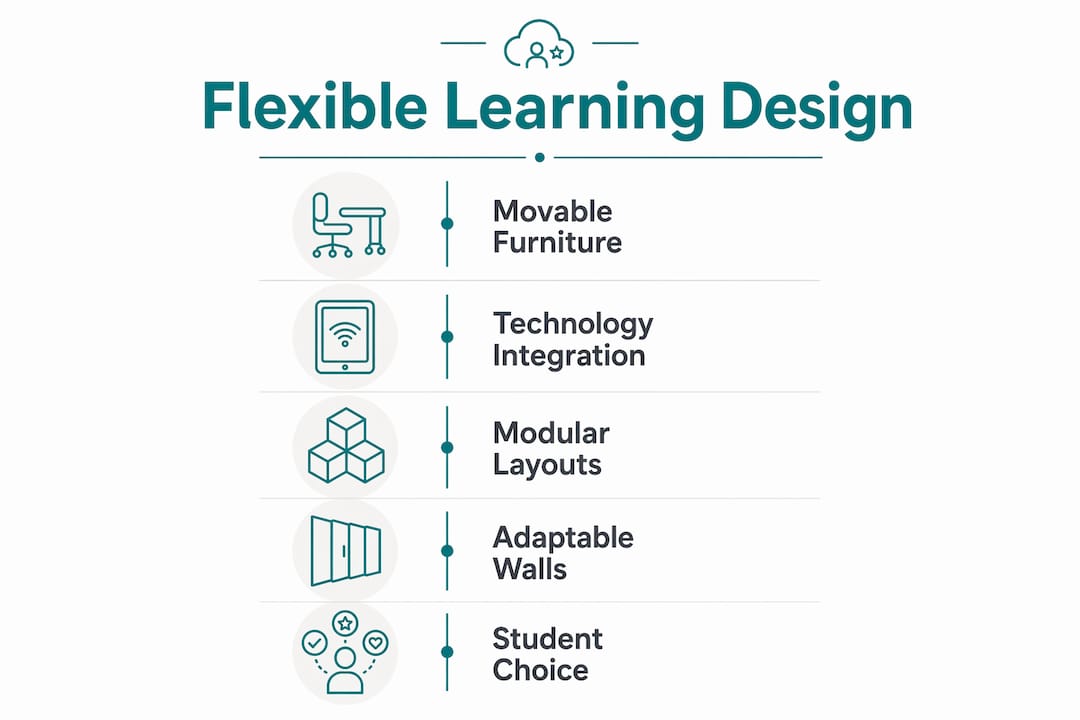
Adaptable furniture is the most visible element. Lightweight desks that cluster into groups or spread into individual stations let teachers respond immediately to what students need. Furniture and storage design directly enhance engagement, though poorly managed physical elements can restrict teaching rather than support it. This is why design choices must be intentional, not decorative.
Technology integration is the third pillar. Interactive displays, portable devices, and accessible power points allow students to research, present, and create without being tethered to one spot. In resource-limited settings, technology-enhanced instruction combined with flexible physical arrangements still produces measurable gains in attention and academic performance.
Design feature | Educational benefit |
Movable desks and chairs | Supports group work, individual focus, and quick transitions |
Writable walls or whiteboards | Encourages visual thinking and collaborative note-taking |
Quiet zones | Provides space for concentration and emotional regulation |
Multi-purpose rooms | Enables varied activities without changing buildings |
Accessible technology | Supports research, presentation, and creative projects |
Pro Tip: When evaluating a school’s learning environment, look beyond the furniture. Ask how often the layout actually changes and whether teachers are trained to use the space in different configurations.
Why pedagogy must align with the physical space
Physical flexibility alone does not produce better learners. Flexible classrooms must be pedagogically aligned. Without matching teaching methods, even the most beautifully designed space will underperform. This is the single most important nuance that parents and educators need to understand.
Constructivist and student-centered teaching approaches work best in flexible environments. These methods ask students to build knowledge through experience, discussion, and reflection rather than passive listening. When a teacher uses project-based learning in a space designed for collaboration, the results compound. The room and the method reinforce each other.
The transition is not always smooth. Research warns that expecting instant change from a new physical space without teacher training is a common mistake. Teachers need support to rethink classroom management, lesson structure, and how they give feedback. Students also need time to adjust to greater autonomy. The adjustment period is real, and schools that acknowledge it upfront see far better long-term outcomes.
Distraction is a genuine risk in poorly managed flexible spaces. Without clear routines, accessible storage, and visual anchors like whiteboard walls, an open classroom can feel chaotic. Structure and flexibility are not opposites. The best flexible classrooms are organized with intention, giving children freedom within a clear framework. This connects directly to differentiated learning approaches that honor each child’s pace and style.
How do flexible spaces support different ages and learning needs?
The benefits of adaptive learning spaces are not identical across every age group. Research shows that student age and academic level shape how children perceive and benefit from flexible environments. High school students show clear gains in motivation and peer interaction. Younger children benefit strongly from varied zones that support sensory regulation and hands-on exploration.
For children aged 5–12, the range Astor International School serves, flexible environments are particularly powerful. At this stage, children are building foundational learning habits. A space that lets them move, choose, and collaborate teaches them that learning is active, not passive. That belief, formed early, shapes how they approach education for life.
Inclusivity is a core advantage of well-designed flexible spaces. Children with different learning styles, attention profiles, or physical needs all find more support in an environment that can adapt. A child who thinks best while standing, a student who needs a quieter corner to focus, and a learner who thrives in group discussion can all be accommodated in the same room at the same time.
Key considerations for different learner profiles include:
Younger children (ages 5–8): Benefit most from sensory-rich zones, open floor space, and clear visual boundaries between activity areas.
Middle childhood (ages 9–12): Gain from collaborative tables, presentation spaces, and technology access that supports project-based work.
Students with diverse needs: Require quiet zones, predictable layouts within flexible designs, and teacher awareness of individual triggers.
High-achieving students: Use flexible spaces to pursue deeper inquiry and peer teaching, which reinforces their own understanding.
Practical steps for parents and educators to support flexible learning
Parents and educators do not need to wait for a full school renovation to support flexible learning. Small, deliberate changes create meaningful impact.
Advocate with evidence. When speaking to school leadership, reference the 2026 research showing that peer interaction and motivation improve in flexible classrooms. Decision-makers respond to evidence, not just enthusiasm.
Start with furniture. Lightweight, stackable chairs and tables are affordable and immediately change how a room can be used. Many schools begin here before committing to larger renovations.
Create zones at home. A reading corner, a craft table, and a desk for focused work give children the same sense of choice that flexible classrooms provide. This supports personalized learning beyond school hours.
Encourage student voice. Ask children where they focus best and what kind of environment helps them think. Their answers are often surprisingly specific and always worth acting on.
Connect with teachers. Ask how the classroom layout changes across the week. Teachers who vary their setup regularly are already practicing flexible pedagogy, and knowing this helps you reinforce the approach at home.
Student-centered classrooms work best when families understand and support the philosophy behind them. Your engagement as a parent is part of the learning environment too.
Key Takeaways
Flexible learning spaces produce their strongest results when physical design and teaching methods work together to give children genuine agency over their learning.
Point | Details |
Engagement rises with choice | Student autonomy in seating and work style directly increases motivation and participation. |
Design must be intentional | Movable furniture, quiet zones, and technology access each serve a specific educational purpose. |
Pedagogy drives outcomes | Physical flexibility without aligned teaching methods fails to deliver meaningful gains. |
Age shapes the benefit | Younger children and high school students gain differently; spaces must be tailored accordingly. |
Parents play an active role | Advocating for flexible design and creating choice-rich home environments reinforces school-based learning. |
What I have seen that most articles miss
I have spent years watching schools invest in beautiful flexible furniture and then wonder why nothing changed. The honest answer is almost always the same: the room changed, but the teaching did not.
The adjustment period is real and often underestimated. Teachers who have spent a decade managing rows of desks need genuine support, not just a weekend workshop, to feel confident in an open classroom. Students who have always been told exactly where to sit and what to do next need time to build the self-regulation that flexible spaces require. Rushing this process produces the chaos that critics of flexible classrooms point to as evidence that the whole idea does not work.
What I find genuinely exciting is the psychological dimension. When children learn to manage their own attention, choose their environment, and regulate their focus, they are building skills that matter far beyond school. A child who knows how they learn best is a child who will keep learning long after the lesson ends. That is the real promise of flexible spaces, and it is worth every bit of the effort it takes to get there.
— Elena
How Astor International School brings flexible learning to life
At Astor International School in Singapore, flexible learning is not a design trend. It is built into the IPC curriculum, which structures learning around themes, projects, and collaborative inquiry. Small class sizes mean every child gets the space and attention to work in the way that suits them best. Astor has been recognized as the best small school in Singapore, and that recognition reflects a commitment to environments where every child is truly seen.
Astor’s classrooms are designed to shift between group work, individual focus, and hands-on exploration within a single school day. If you are a parent looking for a school where the physical environment and the teaching philosophy genuinely align, explore Astor’s learning approach to see how these principles work in practice for children aged 5–12.
FAQ
What are flexible learning spaces?
Flexible learning spaces are educational environments designed to adapt physically and pedagogically to support diverse learning styles, collaboration, and student autonomy. They typically feature movable furniture, varied activity zones, and integrated technology.
Do flexible classrooms actually improve academic results?
Research confirms that flexible spaces combining adaptable layouts and technology improve student engagement, participation, and academic achievement. The gains are strongest when teaching methods align with the physical design.
At what age do children benefit most from flexible learning environments?
Children of all ages benefit, though in different ways. High school students show clear gains in motivation and peer interaction, while younger children aged 5–12 build foundational learning habits through movement, choice, and hands-on exploration.
What is the biggest risk of flexible classroom design?
The biggest risk is distraction when the space lacks clear routines and organization. Without structured guidance, open classrooms can feel chaotic. Strong classroom management and intentional design features like quiet zones and whiteboard walls address this directly.
How can parents support flexible learning at home?
Parents can create choice-rich home environments with distinct zones for reading, creative work, and focused study. Asking children where they focus best and encouraging them to take ownership of their learning space reinforces the same skills flexible classrooms develop.
Recommended
Super site! I am Loving it!! Will return once more, Im taking your food likewise, Thanks. Prijs thuisbatterij
Just pure brilliance from you here. I have never expected something less than this from you and you have not disappointed me at all. I suppose you will keep the quality work going on. Prijs thuisbatterij
Your work is very good and I appreciate you and hopping for some more informative posts Prijs thuisbatterij
Very nice blog and articles. I am realy very happy to visit your blog. Now I am found which I actually want. I check your blog everyday and try to learn something from your blog. Thank you and waiting for your new post. Thuisbatterij Huawei
Wow, happy to see this awesome post. I hope this think help any newbie for their awesome work. By the way thanks for share this awesomeness from Thuisbatterij Huawei