


The Role of Inclusive Teaching for Ages 1.5–12

Every child in your classroom or home brings a different way of thinking, communicating, and learning. The role of inclusive teaching is to meet each of those children where they are, not where a standardized curriculum assumes they should be. Many parents and educators worry that designing for diverse needs means lowering the bar for everyone. Research says the opposite is true. Inclusive teaching raises expectations, builds student agency, and creates learning environments where every child, regardless of ability or background, has a genuine chance to thrive.
Table of Contents
Key Takeaways
Point | Details |
Inclusion raises standards | Inclusive classrooms set higher, clearer expectations for all learners without diluting academic rigor. |
UDL is the foundation | Universal Design for Learning builds variability into curriculum from the start, reducing the need for reactive fixes. |
All students benefit | Children without disabilities develop stronger empathy, communication, and collaboration skills in inclusive settings. |
Play is a learning tool | Play-based approaches support both social and academic inclusion, especially for children aged 1.5 to 6. |
Collaboration sustains inclusion | Shared ownership between general and special education teachers is what makes inclusive classrooms work long term. |
Core principles behind inclusive teaching
What is inclusive teaching, exactly? At its core, it is the practice of designing learning experiences that account for the full range of how children think, move, communicate, and engage. It is not about giving struggling students a watered-down version of the curriculum. It is about building the curriculum so that every learner can access it fully from the beginning.
Three frameworks shape modern inclusive teaching. The first is Universal Design for Learning (UDL), which draws on neuroscience to argue that curriculum designed for variability is more effective and sustainable than retrofitting supports after the fact. UDL asks teachers to offer multiple ways to represent information, multiple ways for students to engage, and multiple ways for students to show what they know.
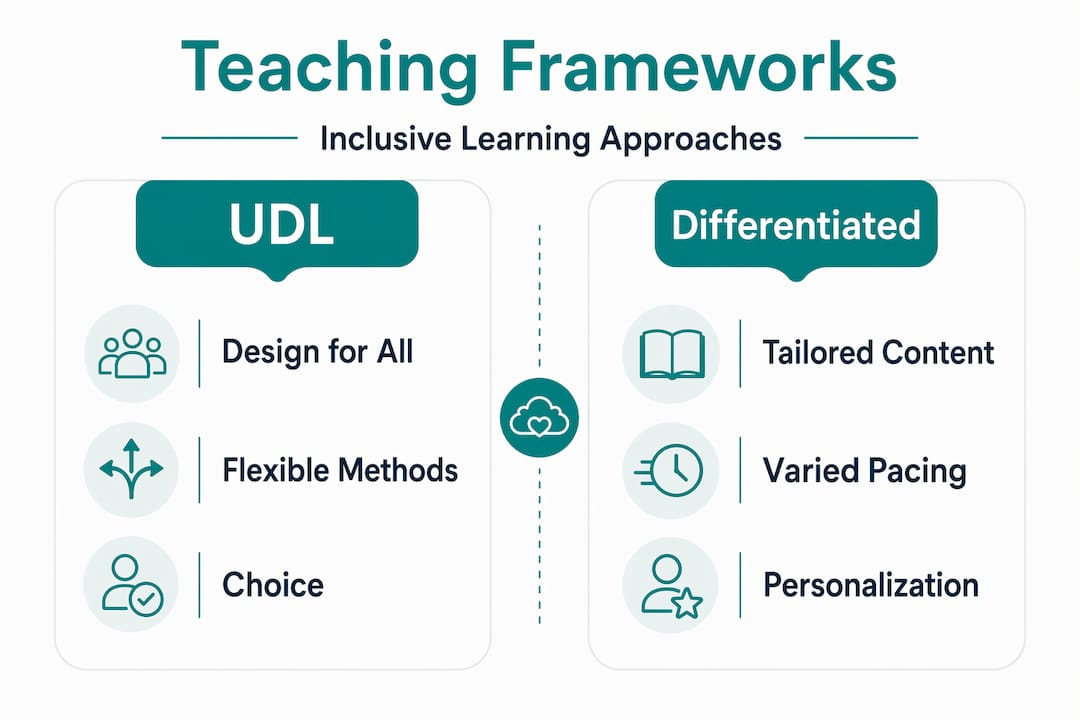
The second is differentiated instruction, which tailors pacing, content, and the complexity of tasks to individual learners within the same classroom. The third is culturally responsive pedagogy, which recognizes that a child’s cultural identity, home language, and lived experience are assets, not obstacles.
Framework | Core idea | Best applied when |
Universal Design for Learning | Design for all learners from the start | Planning new units or curricula |
Differentiated Instruction | Adjust tasks, pacing, and content by learner need | Responding to real-time student performance |
Culturally Responsive Pedagogy | Use students’ identities as learning assets | Building classroom culture and selecting materials |
Social Inclusion Theory | Belonging and emotional safety drive learning | Shaping classroom relationships and routines |
Pro Tip: When planning a lesson, ask yourself: “If a child with limited verbal communication joined this class tomorrow, could they still participate meaningfully?” If the answer is no, the lesson design has room to grow.
Benefits of inclusive education for every child
One of the most persistent misconceptions about inclusive education is that it primarily benefits children with disabilities. The evidence tells a richer story. Students without disabilities in inclusive classrooms consistently show greater empathy, patience, and the ability to compromise. These are skills that matter in every classroom, career, and relationship they will ever have.
“Inclusive education reduces bullying and promotes positive social interactions, giving all students tools they will carry into life well beyond school.” — Special Olympics Research
Here is what the benefits of inclusive education look like across a mixed classroom of children aged 1.5 to 12:
Stronger social awareness. Children learn to recognize and respect differences in ability, communication style, and background as a natural part of daily life.
Higher academic expectations. Inclusive environments set clearer expectations for all learners, including those who might otherwise be underestimated.
Greater communication skills. Children learn to express themselves in different ways when they are surrounded by peers who communicate differently.
More independence. When students with disabilities are supported to participate alongside peers, they build confidence and self-direction that segregated settings rarely produce.
A genuinely positive community. Inclusive classrooms tend to have fewer incidents of teasing and social exclusion because diversity becomes normalized from an early age.
The importance of inclusive teaching is not just academic. It shapes how children understand the world and their place in it.
Practical inclusive teaching strategies
Knowing the theory is one thing. Applying it in a real classroom with 15 children aged 5 to 10, each with different needs and energy levels, is another. These strategies are practical and tested, not aspirational.
Design your physical space with flexibility in mind. Arrange seating so children can work alone, in pairs, or in small groups without major disruption. Quiet corners, movement zones, and open floor space serve different sensory needs without singling anyone out.
Use multimodal materials. Present concepts through visuals, audio, hands-on activities, and digital tools together, not sequentially. A child who struggles to read a printed instruction card might thrive when that same instruction is shown as a short video or a physical demonstration.
Incorporate play as a teaching method. For children aged 1.5 to 6, play fosters social inclusion and academic participation in ways that structured tasks cannot replicate. Peer support during play, guided by an adult, is one of the most powerful tools early childhood educators have.
Give students genuine choice. Allow children to demonstrate learning through drawing, building, speaking, writing, or performing. Choice is not just motivating. It also gives you far more accurate information about what a child actually understands.
Build co-teaching into your model. When a general education teacher and a special education teacher share ownership of a classroom, both sets of expertise serve every child. This is not a support service. It is a teaching partnership.
Invest in your own ongoing learning. Neuroscience-informed UDL professional development leads to lasting improvements in inclusive teaching capacity, especially when paired with long-term mentorship rather than one-time training.
Pro Tip: Try differentiated learning approaches at home as well as in class. When a child can choose how they practice a skill, their engagement and retention both improve noticeably.
You can also explore student-centered classroom practices to see how putting the learner at the center of the experience translates across subjects and age groups.

Challenges in inclusive teaching and how to address them
Inclusive teaching is not without real difficulties. Acknowledging them honestly is what separates sustained change from short-lived enthusiasm. Here are the most common challenges, along with what actually helps.
Teacher burnout is real, and it is preventable. When inclusion is treated as an add-on, teachers carry an impossible load. When curriculum is designed for all learners from the start, reactive accommodations decrease and joyful interactions increase. The design approach is the difference.
The fear that standards will drop is widespread but unfounded. Many educators and parents worry that accommodating diverse needs means giving some children easier work. In practice, inclusion requires a mindset shift about what rigor looks like. A child demonstrating understanding through a model or a verbal explanation is meeting the same standard as one who writes a paragraph. The output looks different. The expectation does not.
Training gaps remain a significant barrier. Many teachers received little to no preparation in inclusive teaching methods during their initial certification. This is why inclusive teaching as a collaborative process matters so much. It is not something one teacher solves alone. Schools need coaching structures, shared planning time, and a culture that treats pedagogical uncertainty as growth, not failure.
Additional pressures worth naming:
Inconsistent resourcing and policy support across school systems
Lack of shared planning time between general and specialist educators
Insufficient family communication and partnership structures
High student-to-teacher ratios that reduce individual attention
The UK government’s £3.7 billion investment in developing inclusion-based schools and improving accessibility in 2026 signals that this is a policy priority, not just a pedagogical preference. Systemic support matters, and advocating for it is part of every educator’s role.
Technology and accessibility in inclusive classrooms
Accessible technology is not a niche accommodation. When designed thoughtfully, it is the most powerful differentiator in a modern inclusive classroom.
Tool feature | Who it primarily helps | Who else benefits |
Text-to-speech | Students with dyslexia or visual impairment | Students learning in a second language |
Adjustable text size | Students with low vision | Students reading in noisy environments |
Captioning and transcripts | Students with hearing loss | All students reviewing complex content |
Multimodal output options | Students with motor or communication differences | Kinesthetic learners |
Accessibility features embedded proactively in educational tools benefit all learners, not just those with identified needs. Real-time scaffolding, adaptive input options, and multimodal content delivery reduce teacher workload because they anticipate variability rather than respond to it one student at a time.
Involving neurodiverse students in the selection and setup of digital tools is also worth noting. Neurodiverse voices in tech implementation signal genuine commitment to inclusion and tend to surface features that benefit the entire class. Standards like the Web Content Accessibility Guidelines (WCAG) provide a helpful benchmark when evaluating any new digital content for your classroom.
Pro Tip: Before adopting a new edtech tool, check whether it meets WCAG 2.1 AA standards. If it does not, keep looking. Accessible tools designed for the margins often turn out to be the best tools for the middle too.
You can explore more about technology in learning to see how digital approaches connect to broader inclusive classroom practices.
My honest take on inclusive teaching
I will be direct with you. When I first encountered inclusive teaching frameworks, my instinct was skepticism. It sounded like an idealistic policy goal dressed up in pedagogical language. What changed my view was watching what actually happened in classrooms where teachers genuinely committed to designing for every learner rather than the imaginary average student.
What I have learned is that the discomfort teachers feel early on is not a sign of failure. It is a sign they are actually trying. Pedagogical uncertainty is, as the research confirms, a natural part of developing real inclusive teaching expertise. The educators who grow the most are the ones who stay curious and keep asking their students what is working.
I have also seen what happens when inclusive teaching is treated as one teacher’s responsibility rather than a shared school commitment. It collapses under the weight of that expectation. The schools where inclusion genuinely works are the ones where creating a positive classroom culture is a whole-school value, not a single teacher’s side project.
If you are a parent reading this, the most meaningful thing you can ask a school is not “do you include?” but “how do you sustain it?” The answer will tell you everything.
If you are an educator, I want to encourage you. Inclusive teaching is not about being perfect from day one. It is about continuous growth, genuine curiosity about your students, and the courage to keep redesigning until every child feels genuinely seen and supported.
— Elena
How Astor supports inclusive teaching every day
At Astor International School in Singapore, inclusive teaching is not a policy statement. It is built into how we teach, plan, and connect with every family. Our International Primary Curriculum is designed to give every child multiple ways to engage with learning, demonstrate understanding, and build genuine confidence. Small class sizes mean that teachers can truly know each student, not just their test scores.
Our teachers collaborate regularly, sharing ownership of each child’s progress across general and specialist learning contexts. Whether your child is 18 months old at our Holland preschool or nine years old at our Tanglin campus, the commitment to nurturing each learner as an individual stays constant. We invite you to explore our curriculum and see how inclusive practices come to life in a school that has been recognized as both the best small school and the most affordable international school in Singapore.
FAQ
What is inclusive teaching in simple terms?
Inclusive teaching means designing learning so that every child, regardless of ability, background, or learning style, can fully participate and progress. It builds accessibility into the curriculum from the start rather than adding supports afterward.
Does inclusive teaching lower academic standards?
No. Research shows that inclusive classrooms set higher expectations for all students, not lower ones. Rigor looks different for different learners, but the expectation of genuine understanding remains.
How does inclusive teaching benefit children without disabilities?
Children in inclusive classrooms develop stronger empathy, communication skills, and the ability to collaborate with peers who think and work differently. These are among the most transferable skills any child can build.
What are the most practical inclusive teaching strategies for young children?
Flexible seating, multimodal materials, play-based learning, and genuine student choice are the most accessible starting points, especially for children aged 1.5 to 6. Play in early childhood settings is particularly powerful for both social and academic inclusion.
How can parents support inclusive teaching at home?
Offer your child multiple ways to practice skills, let them choose how they show you what they have learned, and model curiosity about different ways of thinking. Inclusive teaching at home and in class reinforces each other in meaningful ways.
Recommended
Comments