


The Role of Teachers in Early Years: A Parent's Guide
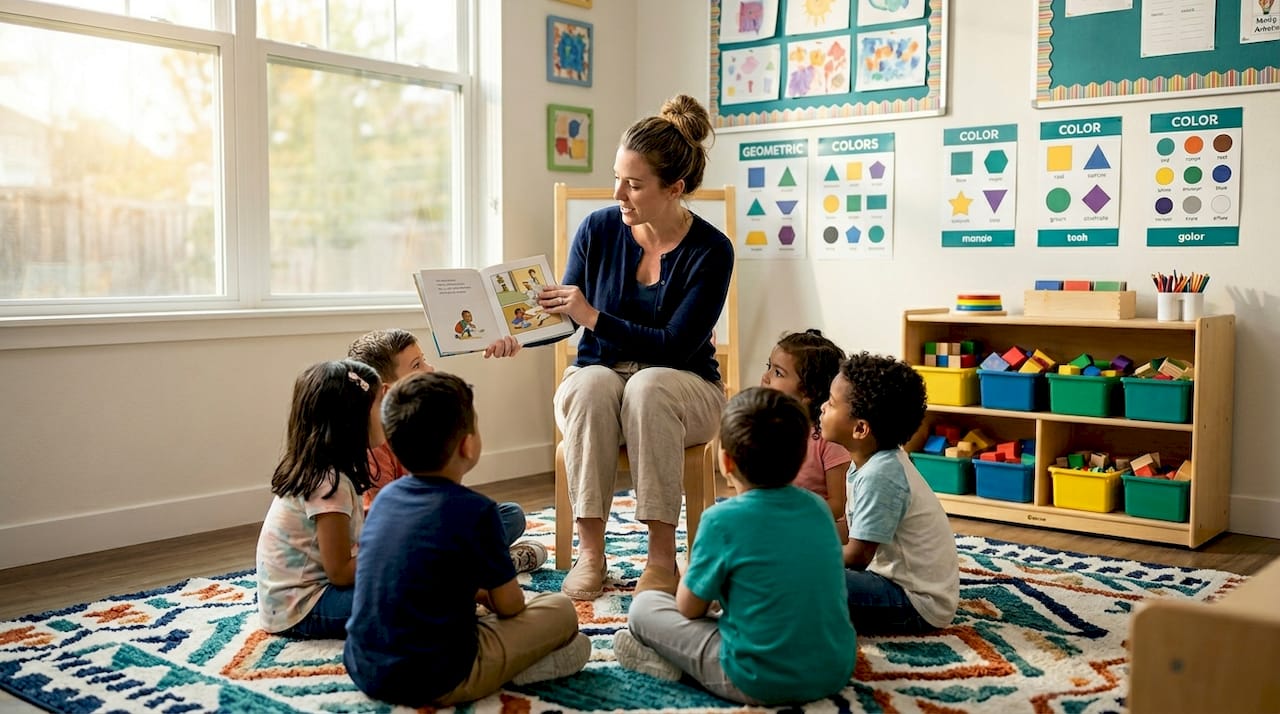
The role of teachers in early years education is to intentionally support young children’s cognitive, social, and emotional development through observation, tailored activities, and nurturing relationships. For children aged 1.5 to 5, this is not simply about supervision. Early childhood educators, guided by frameworks like the Queensland Curriculum and Assessment Authority (QCAA) and research from institutions like RAND and NAEYC, shape the very foundations of how children think, connect, and grow. Understanding what your child’s teacher actually does each day gives you the insight to choose the right program and become a genuine partner in your child’s learning.
What is the role of teachers in early years education?
Early years teaching is a professional practice built on observation, planning, and responsive interaction. Teachers in this field are trained to notice what a child can do, identify the next developmental step, and create conditions where that step becomes possible. This is called intentional teaching, and it is the defining feature of high-quality early childhood education.
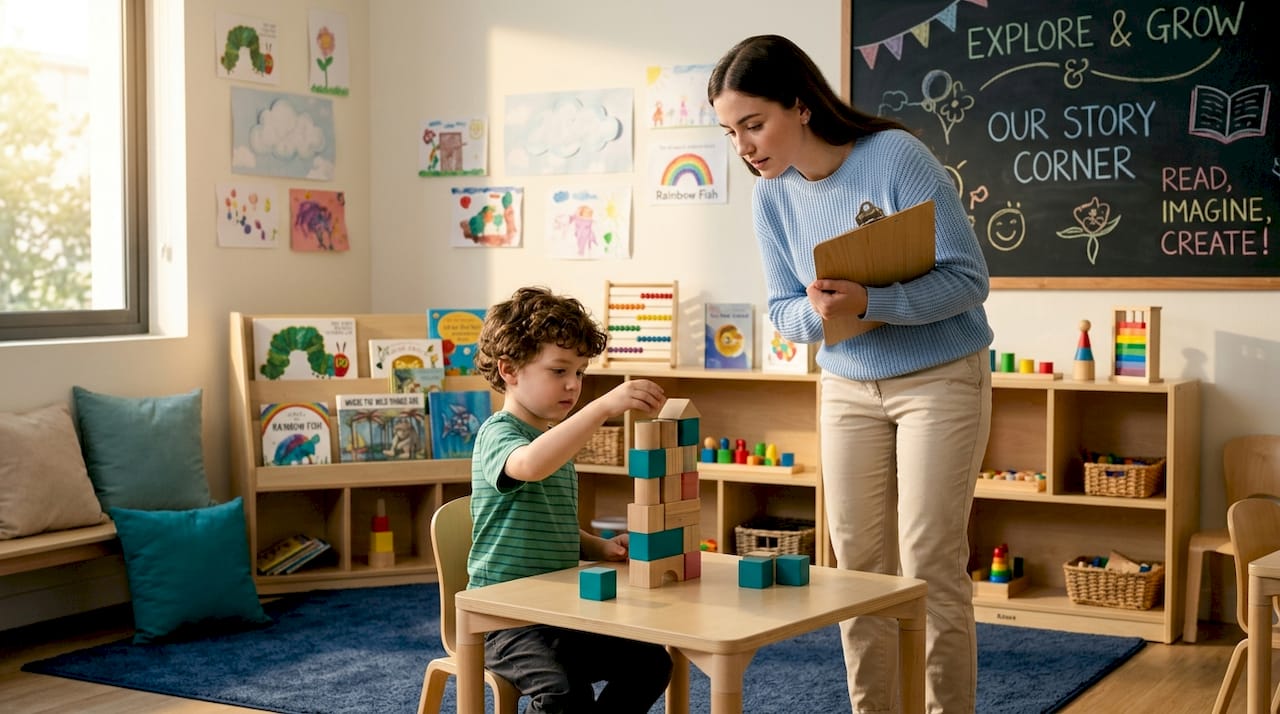
The importance of teachers in early education extends across every developmental domain. A well-trained early years teacher supports language acquisition, early numeracy, emotional regulation, and social skills simultaneously, often within a single play activity. A child building a block tower is not just playing. The teacher observing that moment is assessing spatial reasoning, fine motor control, persistence, and problem-solving in real time.
Early childhood education degree programs, such as those offered by the University of Mount Olive, prepare educators with research-based instructional strategies that integrate child development theory, practicum experience, and family engagement skills. This preparation means your child’s teacher arrives in the classroom with far more than good intentions. They bring a structured understanding of how children aged 1.5 to 5 learn and what they need at each stage.
How do early years teachers assess and plan for children’s learning?
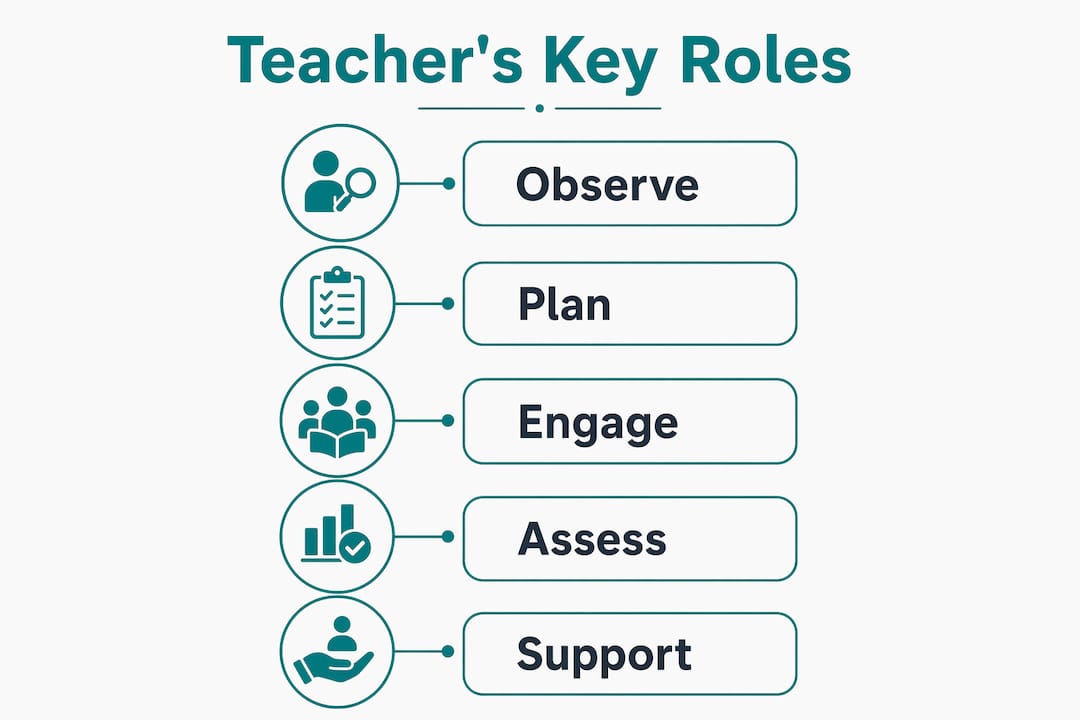
Assessment in early childhood is not a test. It is a continuous cycle of watching, recording, interpreting, and responding. The QCAA describes a planning-and-monitoring cycle where educators gather data about each child’s skills and interests, set individualized goals, and track progress visually across developmental areas throughout the year.
Here is how that cycle typically works in practice:
Observation: The teacher watches a child during free play, group time, or a structured activity and records what they notice, such as how the child communicates, solves problems, or interacts with peers.
Documentation: Notes, photos, and work samples are compiled into an assessment profile that tracks developmental milestones over time.
Goal setting: Based on the profile, the teacher identifies the child’s next learning goals and plans activities designed to support those specific areas.
Intentional teaching: Some activities are planned in advance to target identified goals. Others arise spontaneously when a teachable moment presents itself during the day.
Team review: Teachers discuss observations with colleagues to build a shared understanding of each child’s progress and refine their approach together.
Parents should expect teachers to explain how observations translate into goals and how those goals shape daily classroom activities. If your child’s teacher cannot articulate this connection, that is a meaningful signal about program quality. You can explore how individualized learning works in practice to understand what personalized planning looks like for children in Singapore.
Pro Tip: Ask your child’s teacher at the next parent meeting: “What is one learning goal you are currently working on with my child, and what does that look like in the classroom?” The answer will tell you a great deal about the depth of their practice.
What instructional materials and approaches do early years teachers use?
Early years teachers rarely rely on a single curriculum. A RAND survey from the 2024 to 2025 school year found that about 85% of U.S. public pre-K teachers use multiple instructional materials, averaging three types per classroom. This means your child’s teacher is likely combining district-provided resources, commercial programs, and materials they create themselves. That combination is intentional and reflects professional judgment, not improvisation.
The table below shows how different material types serve different purposes in an early years classroom:
Material type | Primary purpose | Example |
Publisher or commercial programs | Structured skill-building sequences | Phonics workbooks, math manipulatives |
Domain-specific resources | Targeted concept development | Science exploration kits, story-based literacy sets |
Teacher-created materials | Filling gaps for diverse learners | Adapted activity sheets, visual schedules |
Play-based learning environments | Holistic development through exploration | Block corners, dramatic play areas, sensory bins |
Language and literacy materials dominate most early years classrooms, but numeracy resources are equally important for building early math confidence. The RAND research also found that about half of teachers report gaps in material adequacy for children with disabilities and English language learners. This is where teacher creativity becomes critical.
Effective early years educators act as what researchers call “material translators.” They adapt existing resources and create new ones to meet the specific needs of every child in the room. This includes:
Simplifying instructions for children still developing English
Adding visual supports for children who process information differently
Extending activities for children who are ready for more challenge
Incorporating culturally familiar stories and objects to build connection
Play-based learning sits at the center of all of this. It is not a break from learning. It is the primary vehicle through which children aged 1.5 to 5 develop curiosity, confidence, and the ability to work with others. You can read more about how inclusive teaching strategies support diverse learners across the early years.
How do teachers build relationships that shape social and emotional development?
The quality of the relationship between a teacher and a young child is one of the strongest predictors of developmental outcomes in the early years. Research published in the Early Childhood Education Journal in 2025 shows that teacher attachment orientations and reflective function directly influence the sensitivity and warmth of their interactions with children. Teachers who are more self-aware and less anxious in their caregiving role create measurably better classroom climates.
This matters because young children, especially those under three, rely on their relationship with a consistent caregiver to develop emotional regulation and social skills. A teacher who responds predictably and warmly becomes a secure base from which a child can explore, take risks, and learn. The same 2025 Springer study found that lower child-to-teacher ratios and fewer total teachers per room predict higher quality interactions, beyond what any individual teacher’s personality alone can achieve.
When evaluating an early years program, consider these relational factors:
Staff continuity: Does your child have the same primary teacher across the year, or do staff rotate frequently?
Class size: Smaller groups allow teachers to notice and respond to each child’s emotional cues more consistently.
Teacher training: Are educators trained in attachment-informed caregiving and emotional coaching?
Reflective practice: Does the program support teachers with supervision and professional development to maintain their own wellbeing?
Understanding the importance of teacher-student relationships helps you ask the right questions when visiting a preschool or early years program.
Pro Tip: When you visit a classroom, watch how the teacher responds when a child is upset. A warm, calm, and immediate response is the clearest sign of a high-quality relational environment.
What are the key responsibilities of an early years teacher day to day?
The day-to-day work of an early years teacher covers far more ground than most parents realize. Engage Education describes the core responsibilities as a balance of environment design, facilitated play, family communication, and continuous assessment. Here is what that looks like in practice:
Designing the learning environment: Teachers arrange physical spaces to invite exploration, support independence, and minimize unnecessary stress. Every corner of a well-designed early years classroom is purposeful.
Facilitating play with intention: Teachers do not simply watch children play. They ask open-ended questions, introduce new materials, and gently extend thinking to deepen learning within the play itself.
Observing and documenting continuously: Throughout the day, teachers note what children say, do, and create. These observations feed directly into planning and parent communication.
Communicating with families: Regular updates, whether through daily notes, apps, or parent meetings, keep families informed and create opportunities for home-school alignment.
Balancing planned and spontaneous moments: A skilled teacher follows the curriculum plan but also recognizes when a child’s unexpected question or discovery is the richest teaching moment of the day.
The roles of educators in preschool extend into the emotional life of the classroom as well. Teachers model how to manage frustration, celebrate effort, and treat others with respect. Children at this age learn as much from watching their teacher as they do from any planned activity.
How can parents collaborate with early years teachers?
Your involvement in your child’s early education is not optional. It is one of the most significant factors in how well your child develops during these years. The good news is that collaboration does not require expertise in child development. It requires curiosity, consistency, and open communication.
Here are practical ways to build a strong partnership with your child’s teacher:
Ask about current learning goals. Understanding what the teacher is working on with your child helps you reinforce the same skills at home through everyday activities like cooking, reading, or outdoor play.
Share observations from home. Teachers only see your child for part of the day. Information about your child’s interests, sleep patterns, or emotional state at home gives teachers context that improves their planning.
Attend parent meetings with specific questions. Rather than asking “How is my child doing?” ask “What is one thing I can do at home to support what you are working on in class?”
Engage with the curriculum. Ask your child’s teacher to explain the program’s approach to literacy, numeracy, and social-emotional learning. Understanding the framework helps you speak the same language as the classroom.
Support social-emotional skills consistently. When teachers and parents use the same language around emotions and behavior, children internalize those skills faster and more deeply.
For more ideas on how to reinforce learning outside the classroom, explore effective ways to support your child’s learning in Singapore.
Key takeaways
The role of teachers in early years education is defined by intentional observation, adaptive teaching, nurturing relationships, and genuine partnership with families.
Point | Details |
Assessment drives planning | Teachers use ongoing observation profiles to set individualized goals and shape daily activities. |
Material adaptation is a core skill | Effective teachers combine multiple resource types and create custom materials to meet every child’s needs. |
Relationships predict outcomes | Lower ratios, stable staffing, and teacher reflective practice directly improve interaction quality and child development. |
Daily responsibilities are wide-ranging | Teachers design environments, facilitate play, document progress, and communicate with families every single day. |
Parent collaboration amplifies impact | Sharing home observations and aligning on learning goals creates a consistent environment that accelerates development. |
Why the teacher in front of your child matters more than the curriculum on paper
I have spent years reading research on early childhood education, and the finding that stays with me most is this: the curriculum document matters far less than the person delivering it. A 2025 study in the Early Childhood Education Journal confirmed what experienced educators have long known. Teacher reflective function and ongoing professional development are cornerstones of quality care, not just nice-to-haves.
What this means for you as a parent is that the most important question you can ask when choosing an early years program is not “What curriculum do you use?” It is “How do you support your teachers?” Programs that invest in reflective supervision, professional training, and manageable class sizes are the ones producing the best outcomes for children. The teacher in front of your child is the program.
I also think parents underestimate how much their own engagement shapes the experience. Teachers who feel genuinely partnered with families bring more energy and insight to their work. When you show up curious and communicative, you are not just helping your child. You are contributing to the quality of the entire classroom.
Advocate for small class sizes. Ask about staff turnover. Find out whether teachers receive ongoing training. These structural factors, not just warmth and enthusiasm, determine whether your child’s early years experience becomes a genuine foundation for lifelong learning.
— Elena
Discover how Astor supports early childhood learning
At Astor International Preschool in Holland Village, Singapore, every element of the program reflects what research says matters most in the early years. Small class sizes, experienced teachers, and a blend of outdoor and classroom learning create the conditions where children aged 1.5 to 5 can truly thrive. Teachers at Astor use observation-based planning, play-based approaches, and regular family communication to personalize each child’s experience. The best learning happens when every child is truly seen and supported. Explore our curriculum approach to see how Astor brings these principles to life, or visit Astor International School to learn more about enrollment.
FAQ
What is the main role of a teacher in early years?
The main role is to intentionally support children’s cognitive, social, and emotional development through observation, play-based learning, and responsive teaching. Teachers plan activities based on individual developmental goals and adjust their approach continuously as children grow.
How do early years teachers assess young children?
Teachers use ongoing observation, documentation, and assessment profiles to track each child’s progress across developmental milestones. The QCAA planning-and-monitoring cycle is one recognized framework that guides this process from data gathering through to goal setting and activity planning.
Why does the teacher-to-child ratio matter in preschool?
Lower child-to-teacher ratios allow teachers to respond more sensitively and consistently to each child’s emotional and learning needs. A 2025 Springer study found that smaller ratios directly predict higher quality teacher-child interactions, beyond individual teacher traits alone.
How can parents support what teachers do in early years?
Parents can reinforce classroom learning by asking teachers about current goals, sharing observations from home, and using consistent language around emotions and behavior. Regular, open communication between home and school creates a unified environment that supports faster and deeper development.
What makes an early years teacher effective?
Effective early years teachers combine strong child development knowledge, reflective practice, and the ability to adapt materials for diverse learners. Research from RAND and NAEYC shows that professional judgment, ongoing training, and emotional self-awareness are the defining qualities of high-quality early childhood educators.
Recommended
Comments