


What Is Foreign Student Support? A Parent's Guide

Foreign student support is defined as the comprehensive range of institutional programs and services designed to help international students succeed academically, maintain legal status, adjust culturally, and thrive personally throughout their education. As a parent, understanding what these services cover gives you real confidence in your child’s ability to settle, grow, and flourish far from home. The integrated support systems available in 2026 span academic tutoring, immigration advising, mental health counseling, financial guidance, and social integration programs. Together, they form a holistic safety net that addresses every dimension of your child’s experience, not just what happens inside the classroom.
What is foreign student support and why does it matter?
International student assistance is the recognized industry term for what parents often call “foreign student support.” Both phrases describe the same thing: a structured, institution-wide system that accompanies your child from the moment they apply to the day they graduate. The best support systems act simultaneously as a safety net and a launching pad, improving retention rates and giving students the confidence to perform at their best.
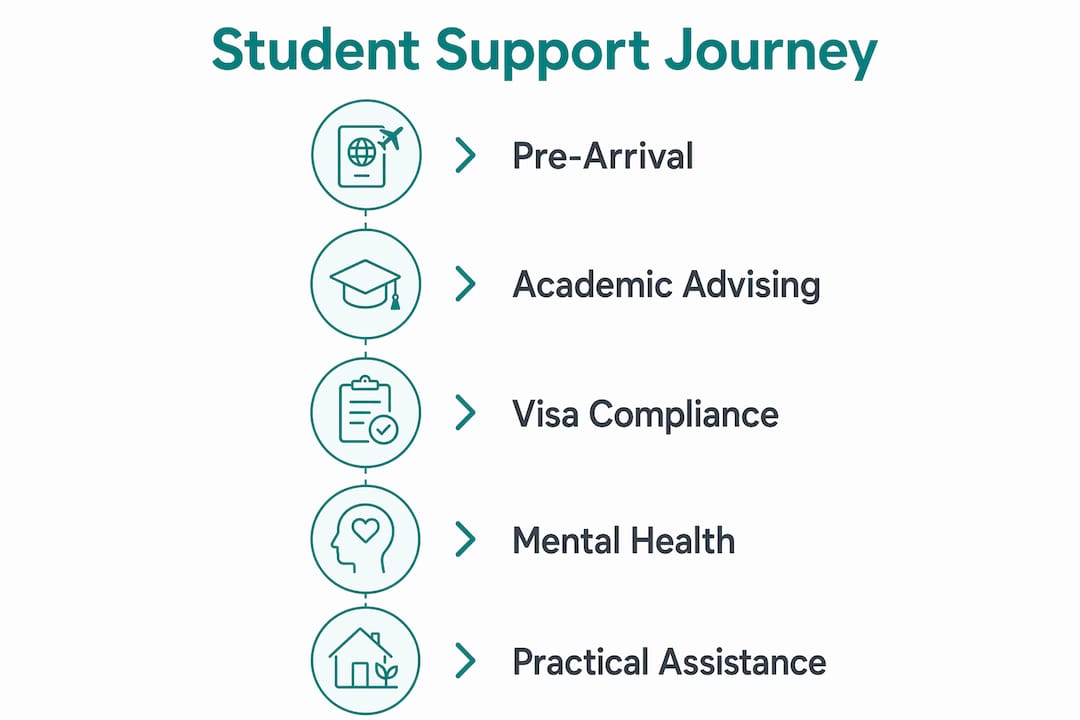
The core service categories are academic assistance, immigration and visa compliance, mental health and wellbeing, financial and health documentation, and cultural integration. Each category addresses a specific pressure point that international students face. When these services work together, students experience smoother transitions, stronger academic outcomes, and a genuine sense of belonging. For parents, knowing that each of these pillars is in place transforms worry into trust.

What academic support services do foreign students typically receive?
Academic support for foreign students goes well beyond extra tutoring. Schools and institutions tailor their offerings to the specific challenges international learners face, including language barriers, unfamiliar curricula, and different learning styles from their home countries.
The most common forms of academic assistance include:
English as a Second Language (ESL) support: Structured language classes and conversation groups that build vocabulary, reading comprehension, and writing skills in parallel with core subjects. Astor International School, for example, offers dedicated ESL support to help students gain fluency without falling behind in other subjects.
Subject-specific tutoring: One-on-one or small-group sessions targeting mathematics, science, or humanities, matched to the student’s current curriculum level.
Enrichment classes: Programs that extend learning beyond the standard timetable, building critical thinking and subject mastery. These are particularly valuable for students who are academically strong but need support adapting to a new educational framework.
University and academic counseling: Advisors who help students map out their academic pathway, select appropriate courses, and prepare for transitions to higher education.
Study groups and peer learning: Structured peer collaboration that builds both academic skills and social connections simultaneously.
The integrated advising model used by leading international student offices means that academic advisors do not work in isolation. They communicate with immigration advisors and wellbeing counselors to give each student a consistent, informed point of contact.
Pro Tip: Ask your child’s school which advisor serves as their primary contact. Students who identify this person early are far better positioned to get timely help when challenges arise.
How do international students maintain legal status and navigate visa requirements?
Legal compliance is one of the most consequential areas of foreign student support, and it is the one parents most often underestimate. A student’s ability to remain enrolled depends entirely on maintaining valid immigration status, and the requirements are ongoing, not a one-time checkbox at arrival.
Here is how effective immigration support typically works:
Pre-arrival documentation review: Advisors check that visa applications, financial proof documents, and enrollment letters are complete and accurate before the student travels.
SEVIS and record maintenance: In the United States and similar systems globally, institutions maintain federal student records through systems like SEVIS. Authorized advisors update these records whenever a student changes programs, takes a leave, or adjusts their course load.
Visa renewal guidance: Students receive reminders and step-by-step guidance well before visa expiry dates, reducing the risk of lapses caused by missed deadlines.
Work permit advising: Many students wish to work part-time during their studies. Advisors clarify exactly what is permitted under each visa category and help students apply correctly.
Immigration workshops: Group sessions that explain policy changes, answer common questions, and help students understand their rights and responsibilities.
Continuous legal status maintenance is critical beyond initial visa approval. Non-compliance risks can derail a student’s studies permanently, which is why proactive advising matters so much. The authorized practitioners employed by top international student offices guide families through every layer of this complexity, from initial visa applications to post-study work rights.
Pro Tip: Keep a digital folder with copies of your child’s visa, enrollment letter, and financial documents. Advisors can resolve issues far faster when families have these records readily accessible.
What mental health and wellbeing resources are available to foreign students?
Mental health is the support category that families discuss least and need most. Relocating to a new country, adapting to a different culture, and managing academic pressure simultaneously creates a level of stress that many students are not prepared for. Mental health services for international students include counseling, crisis intervention, and programs specifically designed to address homesickness and cultural adjustment.
The most impactful wellbeing resources available to foreign students include:
Individual counseling: Confidential sessions with trained counselors who understand the specific pressures of studying abroad, including identity, cultural conflict, and academic anxiety.
Crisis intervention: 24/7 access to support lines or on-call counselors for students experiencing acute distress, ensuring no student faces an emergency alone.
Peer support groups: Facilitated groups where students share experiences with others who understand what it feels like to be far from home. These groups reduce isolation and build genuine friendships.
Cultural adjustment programs: Workshops and one-on-one sessions that help students recognize culture shock as a normal process and develop practical strategies for navigating it.
Mindfulness and wellness activities: Yoga, meditation, and recreational programs that give students healthy outlets for stress.
The connection between mental wellbeing and academic performance is direct. Students who feel emotionally supported attend class more consistently, engage more deeply, and perform better on assessments. Choosing a school that treats mental health as a core service, not an afterthought, is one of the most important decisions you will make for your child.
What practical support services assist with accommodation, healthcare, and finances?
The logistical side of studying abroad carries its own set of challenges. Accommodation, health insurance, and financial documentation are not administrative details. They are the foundation on which everything else rests.
Service Area | What It Covers | Why It Matters |
Accommodation assistance | Placement in school housing or vetted private rentals | Removes the burden of finding safe, appropriate housing in an unfamiliar city |
Health insurance | Mandatory coverage often bundled with tuition fees | Guarantees access to medical care without unexpected out-of-pocket costs |
Financial documentation | Bank statements or sponsorship letters required for visa and enrollment | Proof of financial support is a legal requirement for most student visas |
Emergency response | 24/7 contact lines and family communication protocols | Gives parents immediate reassurance during unexpected situations |
Financial guidance | Budgeting advice and information on scholarships or fee payment plans | Helps families plan sustainably for the full duration of study |
Health insurance is often the most misunderstood of these services. Many institutions bundle coverage directly with tuition to simplify access, meaning your child is protected from day one without requiring a separate application. For parents, the emergency communication protocols are equally reassuring. Knowing that the school has a clear process for contacting you during a medical or personal crisis removes a significant layer of anxiety.
How do cultural integration and social programs enhance foreign student success?
Cultural integration programs are the element of foreign student support that transforms a student from a visitor into a genuine member of the school community. Orientation programs, social clubs, and language practice groups help build community and reduce isolation, with participation directly supporting both mental health and academic engagement.
The most effective cultural integration offerings include:
Welcome and orientation programs: Multi-day events that introduce students to campus resources, local culture, and fellow international peers before academic pressure begins.
Cultural festivals and events: Celebrations of diverse traditions that give students pride in their own background while building curiosity about others.
Language conversation groups: Informal practice sessions that build confidence in everyday communication, separate from formal ESL classes.
Peer mentoring: Pairing new international students with experienced peers who have navigated the same transition and can offer practical, empathetic guidance.
Clubs and extracurricular activities: Shared interests create natural social bonds. A student who joins a robotics club or a drama group builds friendships that transcend cultural differences.
As a parent, you can actively support this process by encouraging your child to attend at least one social event per week during their first term. Research consistently shows that students who participate in cultural integration activities adjust faster and perform better academically. The social dimension of school life is not separate from learning. It is part of it.
Key takeaways
Foreign student support is most effective when it operates as a unified system covering academic, legal, emotional, and social needs from the very start of a student’s journey.
Point | Details |
Support starts before arrival | Engage with academic, immigration, and housing services from the application stage, not just on day one. |
Legal compliance is ongoing | Visa and immigration advising must continue throughout enrollment to prevent status lapses that can end a student’s studies. |
Mental health is a core service | Counseling, peer groups, and crisis support directly improve academic outcomes and should be treated as non-negotiable. |
Practical logistics matter | Accommodation, health insurance, and financial documentation form the foundation that all other support rests on. |
Cultural integration accelerates success | Students who participate in social and cultural programs adjust faster and build stronger academic engagement. |
Why I believe early engagement with support services changes everything
I have spent years observing how international students navigate the transition to a new school and a new country. The pattern I see most consistently is this: the students who thrive are not necessarily the most academically gifted. They are the ones whose families engaged with support services early, before problems appeared.
Most parents I speak with assume that support services are reactive. They picture a counselor you visit when something goes wrong, or an advisor you call when a visa deadline is approaching. The reality is that support offices now function strategically, integrating guidance across academic, personal, and immigration areas rather than operating as siloed administrative roles. The best ones identify struggling students before the student even realizes they are struggling.
My honest advice to every parent reading this: do not wait for your child to ask for help. Contact the international student office before your child arrives. Introduce yourself. Ask who the primary advisor will be. Find out what the first-week orientation covers. This one conversation sets a tone of proactive engagement that your child will carry forward. The best learning happens when every child is truly seen and supported, and that visibility starts with the adults in their lives making the first move.
— Elena
How Astor International School supports your child’s journey
At Astor International School in Singapore’s Tanglin area, foreign student support is built into every layer of the school experience. The school’s International Primary Curriculum is designed specifically for diverse international learners aged 5 to 12, combining academic rigor with genuine personal attention. Small class sizes mean every child is known by name, and every challenge is noticed early. Astor has been recognized as both the best small school and the best affordable international school in Singapore, precisely because its size allows the kind of nurturing, personalized care that larger institutions cannot replicate. To learn more about student support programs or to ask about enrollment, reach out to the Astor team directly.
FAQ
What does foreign student support include?
Foreign student support includes academic tutoring, ESL assistance, immigration and visa advising, mental health counseling, accommodation help, health insurance access, financial documentation guidance, and cultural integration programs. These services work together to support a student’s full experience, not just their classroom performance.
When should my child start using support services?
Support services should be engaged from the application stage, before your child even arrives. Early engagement with advisors during the pre-arrival period reduces stress and prevents common problems with documentation, housing, and orientation.
How do schools help foreign students maintain their visa status?
Schools employ authorized immigration advisors who manage visa renewals, update federal student records, and run workshops on compliance requirements. Continuous advising is provided throughout enrollment because legal status requirements change as a student’s program evolves.
Is mental health support confidential for international students?
Yes. Counseling services for international students are confidential, meaning sessions are not shared with academic staff or parents without the student’s consent. This confidentiality encourages students to seek help honestly and early.
What financial documents does my child need for enrollment and visa purposes?
Most institutions require bank statements or sponsorship letters as proof of financial support to confirm that a student can cover tuition and living costs. Health insurance documentation is also typically required and is often bundled directly with tuition fees.
Recommended
Comments