


What Is Inclusive Education: A Practical Guide for Parents
- sasha2644
- a few seconds ago
- 11 min read
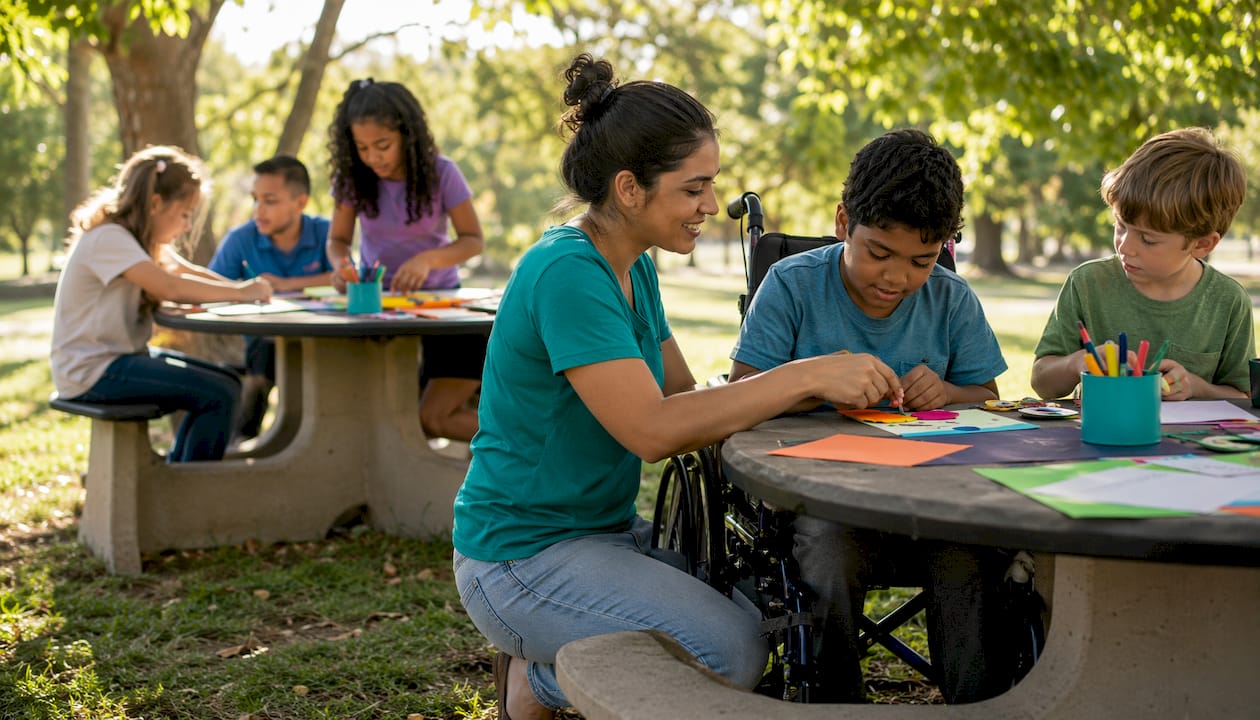
Inclusive education means every child, regardless of ability, language, background, or learning difference, learns alongside peers in the same classroom with the right supports in place. UNICEF defines it as a system-level commitment to equitable access, full participation, and genuine belonging for all learners — not a program added on top of regular schooling.
TL;DR:
Inclusive education covers students with disabilities, English learners, neurodivergent learners, children from low-income households, and learners from minority language backgrounds.
Core goals: equitable access, active participation, high achievement, and a sense of belonging for every child.
Common classroom models include co-teaching teams, Universal Design for Learning (UDL), and assistive technology.
In the United States, the legal backbone is the Individuals with Disabilities Education Act (IDEA), supported by the ADA and Section 504.
Research shows that when inclusion is implemented well, it improves academic and social outcomes for students with disabilities and produces neutral-to-positive effects for their peers.
Table of Contents
What inclusive education really means — and who it covers
Inclusion is a systemic commitment, not a seating arrangement. According to UNESCO, inclusive education works to identify every barrier to learning and remove it — across curricula, pedagogy, assessment, and school culture. A child placed in a general education classroom without adapted materials, trained teachers, or meaningful participation is integrated, not included.
The scope is broader than many parents realize. Inclusive education covers students with physical, sensory, and intellectual disabilities; children who are neurodivergent (autism, ADHD, dyslexia); English learners and students from minority language backgrounds; learners from low-income households who face resource barriers; and gifted learners whose needs are just as real, if less visible. The World Bank frames inclusion as transforming whole systems rather than fitting individual students into unchanged structures.
A common misconception is that inclusion means every child does the same thing at the same pace. It does not. It means every child has access to the same high-quality learning environment, with supports calibrated to their needs. The goal is participation and achievement, not uniformity.
Core principles that make an inclusive classroom work
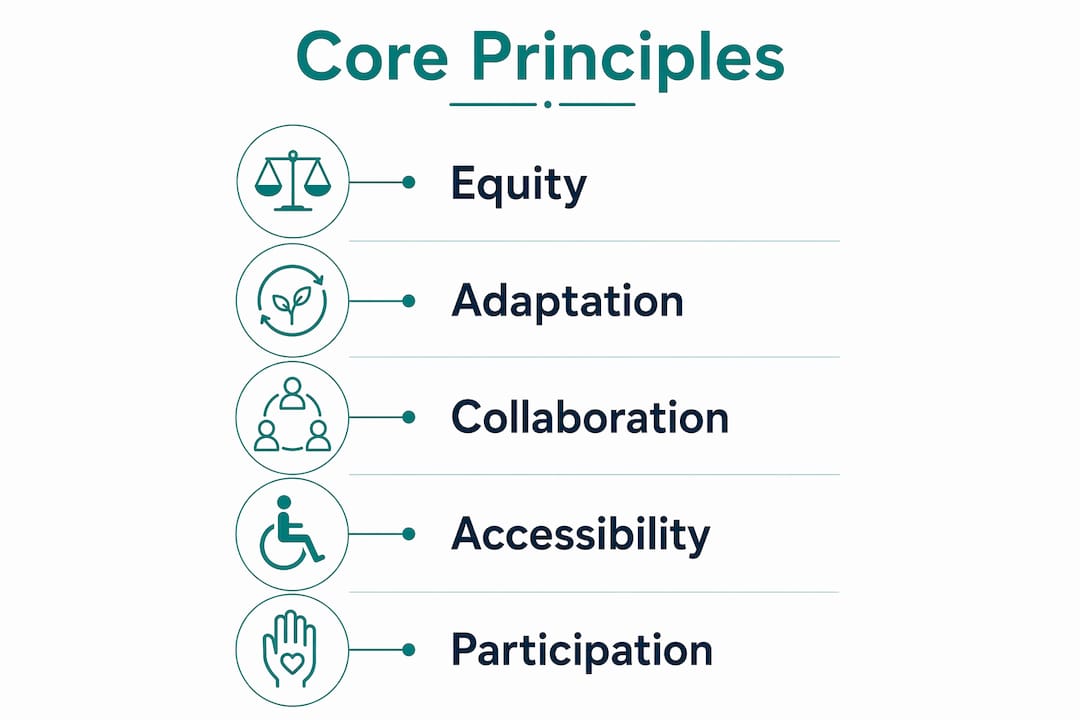
Effective inclusion rests on a set of interlocking principles. The table below maps each principle to the classroom features that bring it to life.

Principle | What it means in practice |
Equity | Every student receives what they need to succeed, not identical instruction. Differentiated materials and flexible grouping reflect this. |
Access | Physical spaces, digital tools, and curricula are designed so no student is excluded by default. UDL frameworks guide this design. |
Participation | Students are active contributors, not passive recipients. Co-teaching models create space for every voice. |
High expectations | All students are held to meaningful, ambitious goals. IEPs set individualized targets, not lowered bars. |
Individualized supports | Assistive technology, speech services, and paraprofessional support are matched to each learner’s profile. |
Collaborative practice | General and special education teachers plan together. Co-teaching and peer-support models are central to this. |
Data-driven planning | Progress monitoring and regular IEP reviews keep instruction responsive and accountable. |
UNESCO and UNICEF both frame these principles as human-rights obligations, not optional enhancements. That framing matters because it shifts the question from “Can we include this child?” to “What do we need to change so this child can thrive here?” For parents evaluating schools, that shift in mindset is one of the clearest signals of genuine inclusion.
Curriculum adaptation is another practical expression of these principles. When schools design learning experiences that flex for diverse learners from the start, the need for separate pull-out programs shrinks considerably. You can read more about how curriculum adaptation supports diverse learners in international school settings.
How inclusive education looks in real classrooms
Knowing the principles is one thing. Seeing them in action is another. Here are five concrete examples of what meaningful inclusion looks like day to day.
Co-teaching teams: A general education teacher and a special education teacher share the classroom, co-plan lessons, and divide instructional responsibilities. Neither teacher is a “visitor” — both are full partners. This model reduces the need to pull students out and keeps specialized support embedded in the lesson.
Mixed-ability grouping: Students work in flexible groups that change based on the task, not fixed by ability level. A child who struggles with reading may lead a science investigation. Mixed-age and mixed-ability grouping builds confidence and reduces the social stigma of being labeled the “slow group.”
Universal access to assistive technology: Text-to-speech tools, graphic organizers, and communication devices are available to any student who benefits, not just those with a formal diagnosis. When the tools are normalized, no child feels singled out for using them.
Flex spaces instead of pull-out rooms: Resource rooms are redesigned as flexible learning spaces any student can use for focused work, quiet reading, or small-group instruction. The space loses its stigma when it is not reserved for one group.
Scheduled intervention blocks: A 30–40 minute daily block is built into the schedule for all students to receive targeted support or enrichment. Because every student participates, no one is marked as the child who “has to leave.”
Pro Tip: Schedule intervention blocks universally — for every student, not just those with IEPs. When the whole class has a structured support period, the stigma of needing extra help disappears almost entirely. This single scheduling change is one of the highest-leverage moves a school can make.
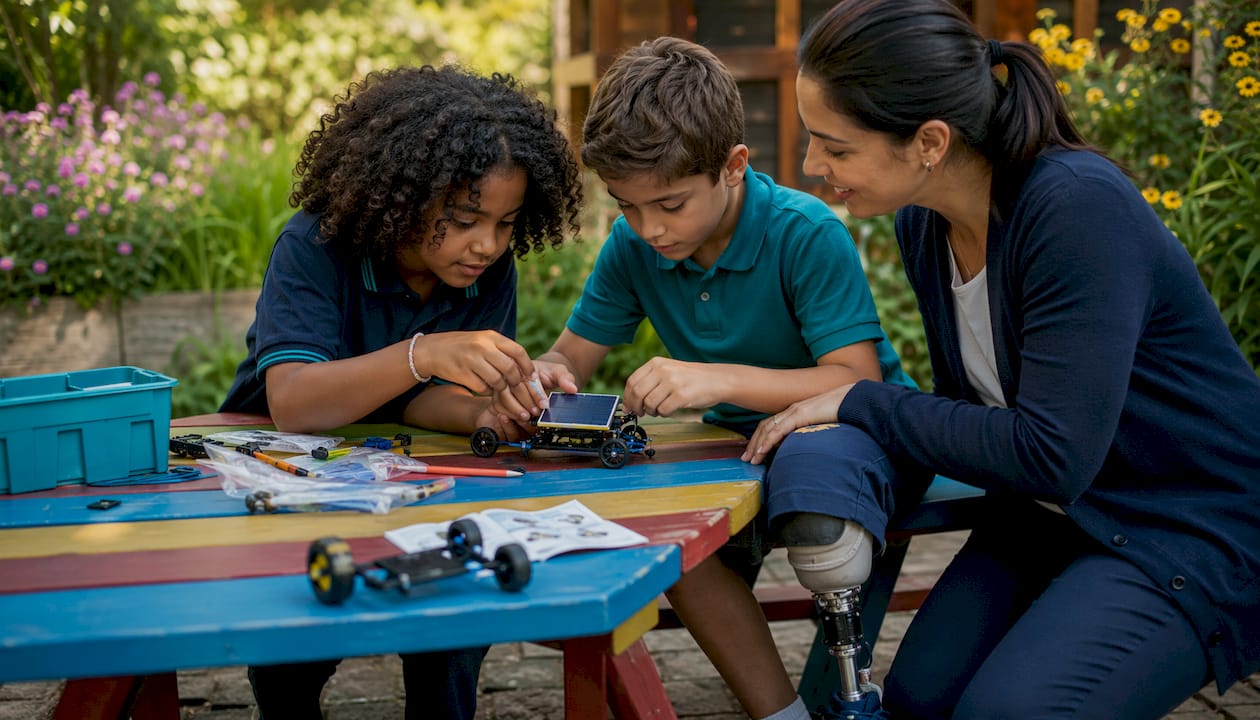
For inclusive STEAM activities that work across ability levels, adaptive design principles make hands-on learning accessible without separate tracks.
The U.S. legal framework behind inclusive education
Three federal laws form the legal backbone of inclusive education in American public schools: the Individuals with Disabilities Education Act (IDEA), the Americans with Disabilities Act (ADA), and Section 504 of the Rehabilitation Act.
IDEA is the most specific. It guarantees students with disabilities a Free Appropriate Public Education (FAPE) in the Least Restrictive Environment (LRE). LRE means schools must educate students with disabilities alongside non-disabled peers to the maximum extent appropriate, with supplementary aids and services provided before considering more restrictive placements. IDEA also mandates an Individualized Education Program (IEP) for every eligible student — a legally binding document that specifies goals, services, accommodations, and placement.
Section 504 of the Rehabilitation Act covers a broader group: any student with a physical or mental impairment that substantially limits a major life activity. Students who do not qualify for an IEP under IDEA may still receive a 504 plan with accommodations such as extended time, preferential seating, or modified assignments.
The ADA extends non-discrimination protections to all public spaces, including schools. It requires physical accessibility and prohibits exclusion based on disability.
For parents, these laws translate into concrete rights: the right to participate in IEP meetings, to request evaluations, to review records, and to dispute placement decisions. Schools are required to provide prior written notice before changing a student’s placement or services. Knowing these rights is the first step toward advocating effectively for your child.
This article provides general information about U.S. education law. For guidance specific to your child’s situation, consult your school district’s special education coordinator or a qualified education advocate.
How schools implement inclusive education step by step
Moving from policy to practice requires deliberate, phased action. The steps below reflect what districts like Nebraska’s have done to build inclusion with measurable results.
Align leadership and policy. The principal and district leadership publicly commit to inclusion as a school-wide value, not a special education initiative. This shapes hiring, budgeting, and scheduling decisions.
Audit current placement and practice. Review where students with disabilities are spending their instructional time and identify gaps between current practice and LRE requirements.
Define roles and staffing. Clarify how general education teachers, special education teachers, paraprofessionals, and specialists will collaborate. Paraprofessionals should rotate across students rather than shadow one child.
Adopt a UDL curriculum framework. Redesign lessons so materials, assessments, and participation modes are flexible from the start. This reduces the need for individual modifications after the fact.
Build co-teaching into the master schedule. Allocate shared planning time for co-teaching pairs — at least one period per week. Without protected planning time, co-teaching defaults to one teacher helping and one teacher watching. Team teaching in diverse classrooms works best when both teachers are genuinely co-designing instruction.
Schedule universal intervention blocks. Embed 30–40 minute daily blocks for all students. This protects core instruction time while delivering targeted support without stigma.
Invest in professional development. Ongoing coaching, not one-time workshops, drives lasting change. Teachers need training in UDL, co-teaching protocols, assistive technology, and behavior support.
Monitor progress and adjust. Use IEP data, classroom assessments, and social-emotional check-ins to track whether inclusion is producing participation and growth — then adjust supports accordingly.
Resource implications are real. Co-teaching requires two teachers in one room, which demands scheduling creativity. Assistive technology requires procurement and training. The key is phasing changes so teachers are not overwhelmed and instruction quality is protected throughout the transition.
What research shows about the benefits of inclusive education
When inclusion is implemented with fidelity, the evidence is encouraging. Studies reviewed in education research consistently show that students with disabilities in inclusive settings make stronger academic and social gains than peers in more segregated placements. Crucially, the effects on students without disabilities tend to be neutral to positive.
Finding | Source / Context |
93–150 million children worldwide live with a disability | UNESCO global estimate; highlights the scale of the inclusion challenge |
Students in inclusive settings are 7% more likely to show empathy toward peers | National Center for Education Statistics (NCES) data cited by University of Illinois |
Students in inclusive settings report lower levels of anxiety and depression | NCES findings cited by University of Illinois, 2024 |
Inclusive practices improve academic outcomes and social skills for students with disabilities | Multiple studies summarized in Journal of Special Education reviews |
Inclusion is not only about the child receiving support — it shapes the social and emotional development of every child in the room. Classrooms where difference is normalized tend to produce students who are more adaptable, more compassionate, and more prepared for a diverse world.
The caveat is equally important: implementation quality determines outcomes. Inclusion without trained teachers, adequate planning time, and appropriate supports does not produce these benefits. Presence alone is not enough.
Common challenges in inclusive education — and practical solutions
Even well-intentioned schools run into barriers. Here are the most common ones and what actually helps.
Limited teacher training. Many general education teachers feel underprepared to support students with significant learning differences. The solution is sustained coaching, not one-day workshops. Pairing teachers with instructional coaches who specialize in UDL and differentiated instruction produces lasting change.
Pull-out stigma. When only certain students leave the room for services, those students are marked as different. Scheduling universal intervention blocks — where all students receive targeted support or enrichment simultaneously — removes the social cost of needing extra help.
Insufficient assistive technology. Schools often purchase devices but skip training. Assistive technology only works when teachers know how to integrate it into lessons and students have consistent access. Budgeting for training alongside hardware is non-negotiable.
Scheduling conflicts. Co-teaching requires two teachers in the same room at the same time, which creates master schedule complexity. Schools that treat co-teaching as a scheduling priority — rather than fitting it in where space allows — see far better outcomes.
Assessment misalignment. Standardized assessments often do not reflect what students with disabilities actually know. Pairing formal assessments with portfolio evidence and teacher observation gives a more accurate picture of growth and keeps expectations high without being punitive.
Paraprofessional over-reliance. Assigning one paraprofessional to shadow a single student can actually reduce that student’s independence and peer interaction. Rotating paraprofessionals across students and embedding them in whole-class activities produces better social outcomes. Positive reinforcement strategies used consistently across the classroom also reduce the need for one-on-one behavioral management.
How to tell whether a school is truly inclusive
Presence in a general education classroom is the starting point, not the finish line. What you are really looking for is whether a child participates meaningfully and belongs socially. Here is a practical checklist for parents and educators.
Do paraprofessionals rotate among students rather than shadow one child throughout the day?
Are UDL principles visible in lesson design — multiple ways to access content, express learning, and engage?
Are intervention blocks scheduled for all students, not just those with IEPs?
Do general and special education teachers co-plan, or does one teacher simply observe while the other instructs?
Is assistive technology available to any student who benefits, without requiring a formal diagnosis first?
Are students with disabilities included in extracurricular activities, not just academic classes?
Does the school track social belonging and peer relationships alongside academic data?
Are IEP goals ambitious and aligned with grade-level standards, or are they consistently below grade level?
Is the physical environment fully accessible — not just legally compliant, but genuinely welcoming?
Can the school show you data on outcomes for students with disabilities, not just placement statistics?
Sample questions to ask at an enrollment meeting or IEP:
“How do your co-teaching teams divide instructional responsibilities?”
“What does a typical intervention block look like for all students?”
“How do you measure belonging, not just academic progress?”
A school that answers these questions confidently, with specific examples, is one that has thought carefully about what inclusion actually requires.
Key Takeaways
Inclusive education works when schools commit to systemic change — in curriculum, staffing, scheduling, and culture — not just physical placement of students together.
Point | Details |
Inclusion is systemic, not physical | Placing a child in a general classroom without adapted supports is integration, not inclusion. |
Three U.S. laws protect students | IDEA, ADA, and Section 504 guarantee FAPE, LRE, IEPs, and 504 plans for eligible students. |
Research supports inclusion | Students with disabilities show stronger academic and social gains in inclusive settings; peers show neutral-to-positive effects. |
Universal design reduces stigma | Scheduling intervention blocks for all students and rotating paraprofessionals removes the social cost of needing support. |
Use the checklist | Ask schools about co-planning, UDL visibility, and outcome data — not just placement policies. |
Why inclusive education is more than a policy checkbox
There is a version of inclusion that looks right on paper and fails children in practice. A student with an IEP placed in a general education classroom, assigned a paraprofessional who follows them everywhere, and given modified work that no one else sees — that child is present, but not truly included. The paperwork says inclusion. The experience says otherwise.
What separates meaningful inclusion from its imitation is whether the school has done the harder work: redesigning schedules so support is universal, training teachers to co-plan rather than co-exist, and building a culture where difference is genuinely unremarkable. That cultural shift takes years, not a single policy revision.
At Edu, small class sizes are not just a selling point — they are the structural condition that makes this kind of attentive, personalized teaching possible. When a teacher knows every child deeply, differentiation stops being an add-on and becomes the default. The IPC curriculum at Astor International School is built around inquiry and flexible learning, which naturally supports diverse learners without requiring a separate track. Parents who care about inclusion should look for schools where the structure itself makes inclusion easier, not schools that are working against their own design to accommodate difference.
The best learning really does happen when every child is truly seen and supported. That is not a slogan. It is a design principle.
Useful sources and further reading
UNICEF: Inclusive Education — UNICEF’s primary resource on inclusive education as a human-rights imperative; covers system-level barriers and global policy frameworks. Start here for the rights-based framing.
UNESCO: Inclusion in Education — UNESCO’s hub for inclusive education policy, research, and tools. Includes the global disability statistics (93–150 million children) and guidance on removing barriers across curricula and pedagogy.
World Bank: Inclusive Education — Frames inclusion as systemic transformation rather than individual integration; useful for understanding why whole-school change is required.
Education Week: Inside a School That Doesn’t Single Out Students — A detailed practitioner case study of a U.S. school where supports are universal and stigma is actively designed out. Excellent for concrete examples.
University of Illinois: Nine Ways to Promote Inclusion — Practical classroom strategies backed by NCES research, including the empathy and mental health findings.
Christian Science Monitor: Nebraska’s Journey to Inclusion — A real-world district implementation story showing how training, co-teaching, and intervention blocks produce measurable gains.
Astor International School: The Role of Inclusive Teaching for Ages 1.5–12 — Edu’s own resource on inclusive teaching practice across early childhood and primary years; directly relevant for families considering international school options.
UN Convention on the Rights of Persons with Disabilities — The primary international legal instrument underpinning inclusive education as a right; essential for understanding the global policy context.
Recommended