


Why Values-Based Education Shapes Your Child's Future
- sasha2644
- Jul 12
- 8 min read
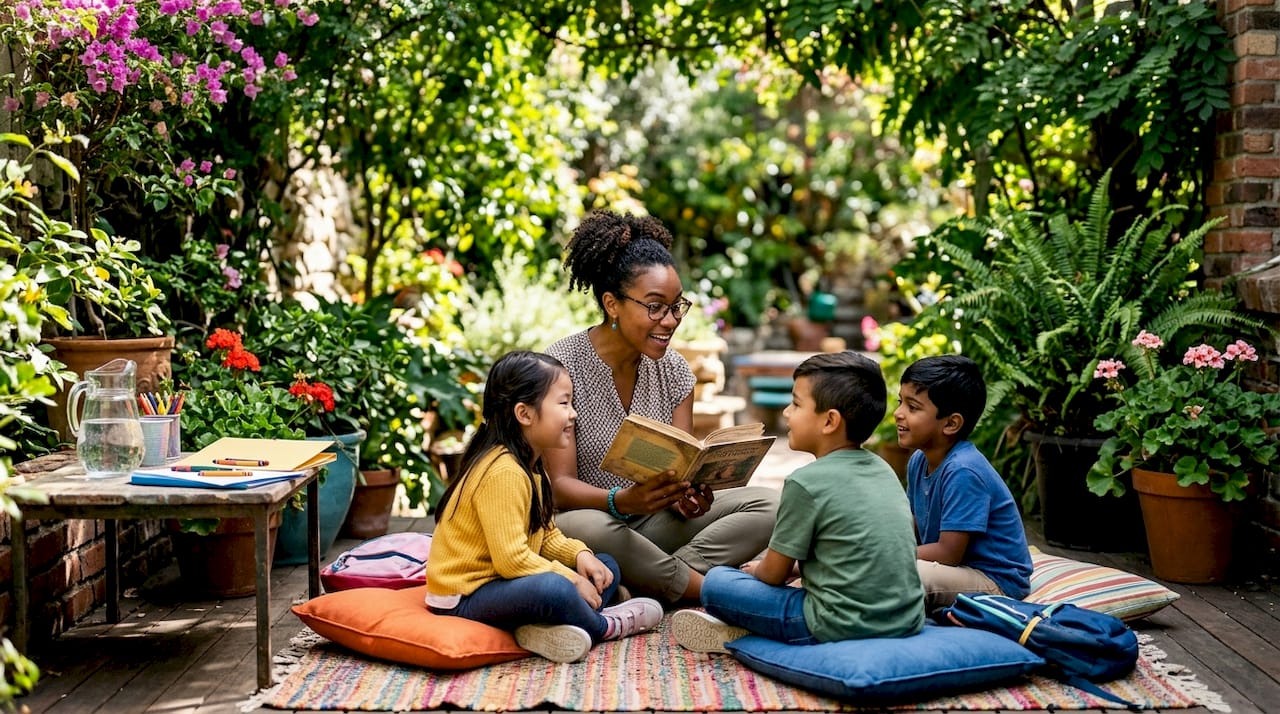
Values-based education is the intentional integration of core ethical principles into every aspect of a child’s learning experience, shaping character alongside academic skills. Why values-based education matters has become one of the most pressing questions for parents choosing a school for children ages 1.5 to 12. A systematic review of 105 papers confirms that weaving values into learning consistently supports well-being and counters social fragmentation. The evidence is clear: schools that treat character development as equal to academic achievement produce children who are more engaged, more resilient, and better prepared for life beyond the classroom.
What are the benefits of values-based education for children?
Values-based education produces measurable gains in moral awareness, social responsibility, and academic engagement. A study of 100 secondary school students using a 20-item Likert scale found moderate to high positive values orientation among those in values-integrated programs. That result signals something important: when children learn why honesty, respect, and empathy matter, they internalize those principles rather than simply following rules.
The academic benefits are equally real. Schools practicing values education report improved engagement, behavior, and academic output. The reason is straightforward: children who feel connected to a purpose-driven community invest more in their own learning. A thematic analysis of 30 peer-reviewed sources confirms that values integration supports child development in ways that purely academic curricula cannot replicate.

Children with special educational needs benefit in a specific and often overlooked way. Values education reduces helplessness and gives these children a stronger sense of agency and voice. That shift from passive recipient to active participant changes how a child experiences school entirely.
Key benefits of values-based teaching include:
Stronger moral awareness — children learn to recognize ethical choices in everyday situations
Greater empathy and social skills — they practice perspective-taking in real interactions, not just lessons
Higher academic motivation — a sense of purpose and belonging drives genuine effort
Emotional resilience — shared values give children a framework for handling conflict and setbacks
Civic readiness — they develop the critical thinking needed to navigate a complex, digital world
Pro Tip: Ask your child’s school how values appear in daily routines, not just in a printed list on the wall. The difference between a values poster and a values culture is everything.
How is values-based education effectively delivered in schools?
The most effective values education is caught as much as it is taught. Values must be integrated holistically within school culture, influencing daily interactions rather than appearing only in isolated lessons. A teacher who models patience during a difficult moment teaches more about respect than any worksheet can.
Experiential learning and role-modeling are the two most research-supported methods for embedding values in young children. Experiential learning means children practice values through real situations: collaborative projects, conflict resolution conversations, and community service activities. Role-modeling means every adult in the school community demonstrates the values they expect from children. When a teacher admits a mistake openly, they teach accountability without saying the word.
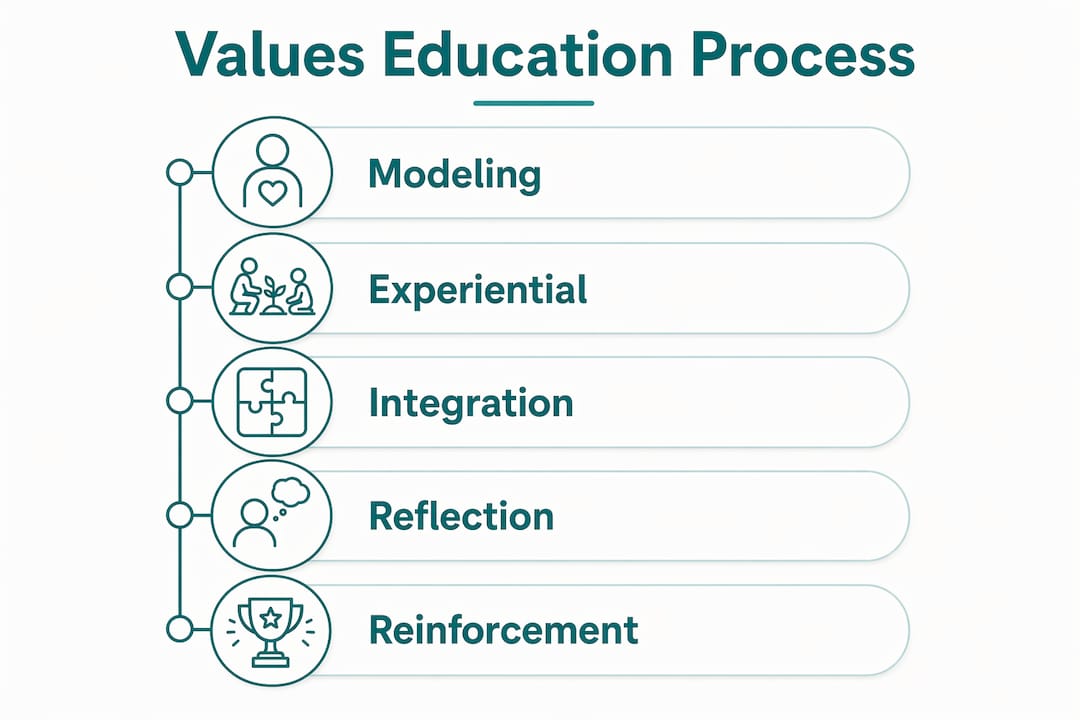
Reflective dialogue is the third pillar. Children ages 5 to 12 are capable of surprisingly deep ethical reasoning when adults ask the right questions. “What would have been a fairer choice?” or “How do you think that made your friend feel?” are more powerful than a lecture on kindness. A shared language around values transforms even disciplinary moments into growth opportunities. A positive classroom culture built on this language makes every interaction a chance to reinforce character.
Effective delivery methods include:
Morning circle discussions focused on a weekly value
Collaborative problem-solving tasks that require empathy and negotiation
Reflective journaling for older primary children to process ethical choices
Community projects that connect values to real-world impact
Consistent adult modeling across all staff, not just classroom teachers
Pro Tip: Reinforce school values at home by naming them when you see them. When your child shares without being asked, say “That was generous” rather than just “Good job.” Naming the value builds the concept.
What challenges and misconceptions exist around values education?
The most common misconception is that values education is “soft,” a nice addition that takes time away from real learning. Without values, education produces intellectually capable but morally underdeveloped individuals. Academic skill without ethical grounding is not a complete education. It is half of one.
A second challenge is teacher training. Educators need preparation to facilitate values conversations with confidence, especially across culturally diverse classrooms. Singapore’s international school environment, for example, brings together families from dozens of countries, each with distinct cultural norms. Effective values education does not impose a single cultural lens. It identifies universal principles like fairness, honesty, and care, while respecting how different communities express them.
A third misconception is that values education and academic rigor are in competition. They are not. Research consistently shows that values integration supports academic engagement, not the opposite. Children who feel emotionally safe and morally grounded concentrate better, collaborate more effectively, and take greater intellectual risks.
Common misconceptions and the reality behind them:
“It replaces academic time” — values education is woven into existing subjects, not added as a separate class
“It imposes one set of beliefs” — effective programs teach children how to choose values, not which values to hold
“Only older children benefit” — children as young as 18 months respond to modeling of care, fairness, and respect
“It is the school’s job alone” — the most effective outcomes happen when home and school align on shared principles
“Results are unmeasurable” — improved behavior, engagement, and social skills are all observable and documented
How can parents support values-based learning at home?
Parents are the most powerful values educators a child will ever have. The school builds the framework; the home gives it daily life. The most effective thing you can do is make values visible in ordinary moments, not just in formal conversations.
Teaching children to actively choose their values equips them with civic literacy for navigating modern challenges. That process starts at home. When your child sees you apologize sincerely, handle disagreement calmly, or choose honesty when it is inconvenient, they learn that values are not abstract ideals. They are daily decisions. You can also explore holistic education approaches that align school and home priorities for children in Singapore’s international community.
Practical steps for parents:
Talk about values by name. Use words like “responsible,” “fair,” and “kind” in everyday conversation so children build a working vocabulary for ethics.
Ask reflective questions. After a conflict or a kind act, ask “What value were you showing there?” rather than jumping to praise or correction.
Connect school values to home life. If the school’s value of the month is “courage,” find examples of courage in books, news stories, or your own day.
Model openly. Share your own ethical dilemmas at an age-appropriate level. “I wasn’t sure whether to say something or stay quiet. I chose to speak up because I thought it was the honest thing to do.”
Collaborate with teachers. Ask at parent meetings which values the class is exploring and how you can reinforce them at home. Schools that prioritize strong student-teacher relationships welcome this kind of partnership.
The parent-school partnership is not a bonus feature of values education. It is the mechanism that makes values stick across every context a child moves through.
Key Takeaways
Values-based education is the single most effective way to develop children who are academically engaged, emotionally resilient, and morally grounded, because it treats character as a core subject rather than an afterthought.
Point | Details |
Character and academics reinforce each other | Children in values-integrated schools show improved engagement, behavior, and academic output. |
Values are caught, not just taught | School culture, adult modeling, and reflective dialogue matter more than isolated lessons. |
Parents are essential partners | Naming values at home and aligning with school frameworks makes learning transfer across contexts. |
All children benefit, including those with special needs | Values education builds agency and resilience, reducing helplessness in diverse learners. |
Early is not too early | Children from age 18 months respond to modeling of care, fairness, and respect. |
Why I believe character education is the real foundation of learning
I have spent years watching children move through schools that prioritize test scores above everything else, and schools that treat character as equally important. The difference in how children carry themselves is not subtle. It shows up in how they handle losing a game, how they treat a classmate who is struggling, and how they respond when an adult is not watching.
The argument that values education is secondary to academics assumes that the two are separate. They are not. A child who lacks empathy will struggle to collaborate. A child without self-discipline will not sustain the effort that real academic achievement requires. Values are the missing foundation of meaningful education, not a decorative addition to it.
What I find most compelling is the civic dimension. Teaching children how to choose their values is a form of civic literacy. In a world saturated with competing information and social pressure, a child who knows why they hold a value is far harder to manipulate than one who simply follows instructions. That is not a soft outcome. That is one of the most durable skills a school can give a child.
My advice to parents is this: when you visit a school, do not only ask about the curriculum. Ask how the school handles a conflict between students. Ask what happens when a child makes a mistake. The answers will tell you more about the school’s values than any brochure will.
— Elena
Values-based learning at Astor International School
Astor International School in Singapore’s Tanglin area places character development at the center of its curriculum, not at the edges. The school’s IPC program integrates values directly into thematic, inquiry-based learning, so children practice empathy, responsibility, and critical thinking through every unit they study.
As a small school with small class sizes, Astor creates the conditions where values education actually works: teachers know every child by name, relationships run deep, and no student falls through the cracks. Awarded best small school in Singapore and best affordable international school in Singapore, Astor proves that character and academic excellence belong together. Explore Astor’s full curriculum to see how values shape learning from age 5 through 12.
FAQ
What is values-based education?
Values-based education is the intentional integration of ethical principles such as honesty, empathy, and responsibility into a school’s curriculum and culture. It develops character alongside academic skills rather than treating them as separate goals.
Why teach values in schools rather than leaving it to parents?
Children spend a significant portion of their waking hours at school, making the school environment a powerful context for values development. Research shows the most effective outcomes happen when schools and parents align on shared principles and reinforce them consistently.
At what age should values education begin?
Values education begins from the earliest years. Children as young as 18 months respond to adult modeling of care, fairness, and respect, making preschool an important starting point for character development.
Does values education affect academic performance?
Yes. Schools practicing values education report improved engagement and academic output. Children who feel emotionally safe and connected to a purpose-driven community invest more in their own learning.
How do I know if a school genuinely practices values-based education?
Ask how the school handles student conflict and what happens when a child makes a mistake. Schools with genuine values cultures use those moments as growth opportunities, not only as occasions for punishment.
Recommended
Comments