


How to Foster Early Learning in Kids Ages 1.5–5
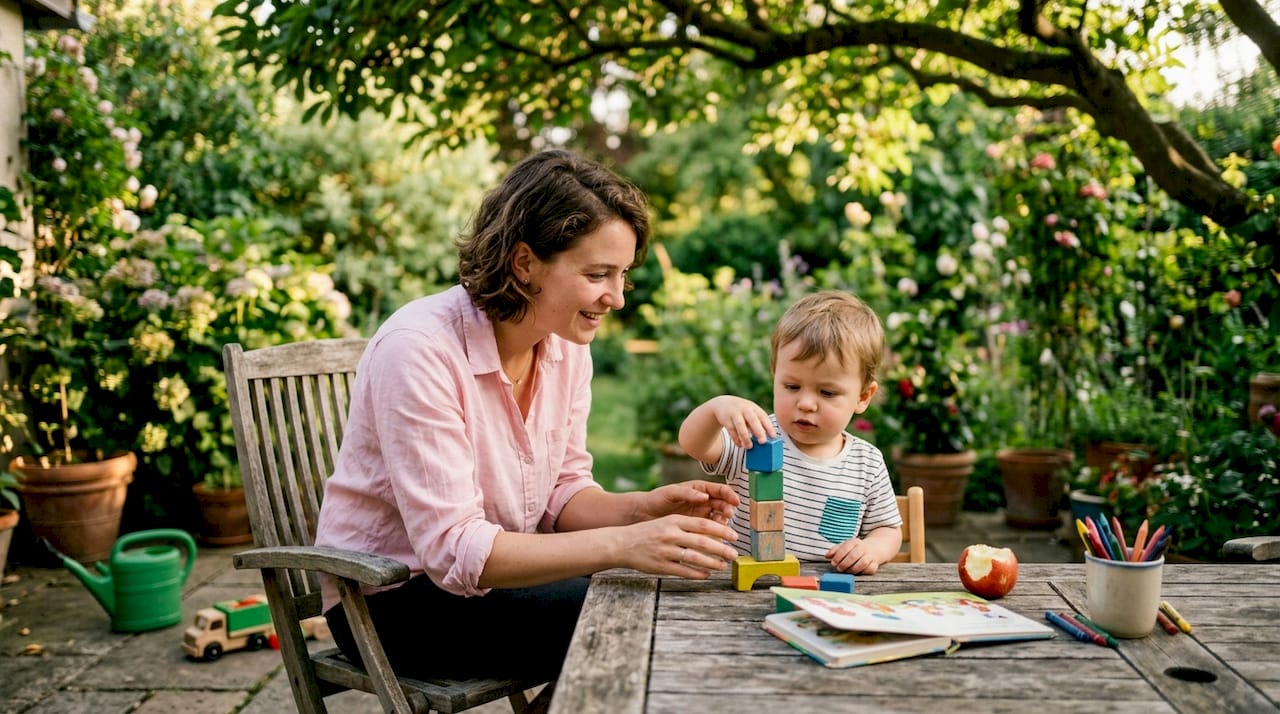
Fostering early learning means actively supporting your child’s cognitive, social, and emotional development during the first five years of life through intentional, responsive interactions and enriched daily experiences. Over 90% of brain development occurs before a child enters kindergarten. That single fact reframes everything: the conversations you have at the breakfast table, the songs you sing at bath time, and the blocks you stack together are not just play. They are the raw material of a developing mind. Understanding how to promote childhood learning during this window gives your child a head start that compounds for years.
What core principles guide effective early learning at home?
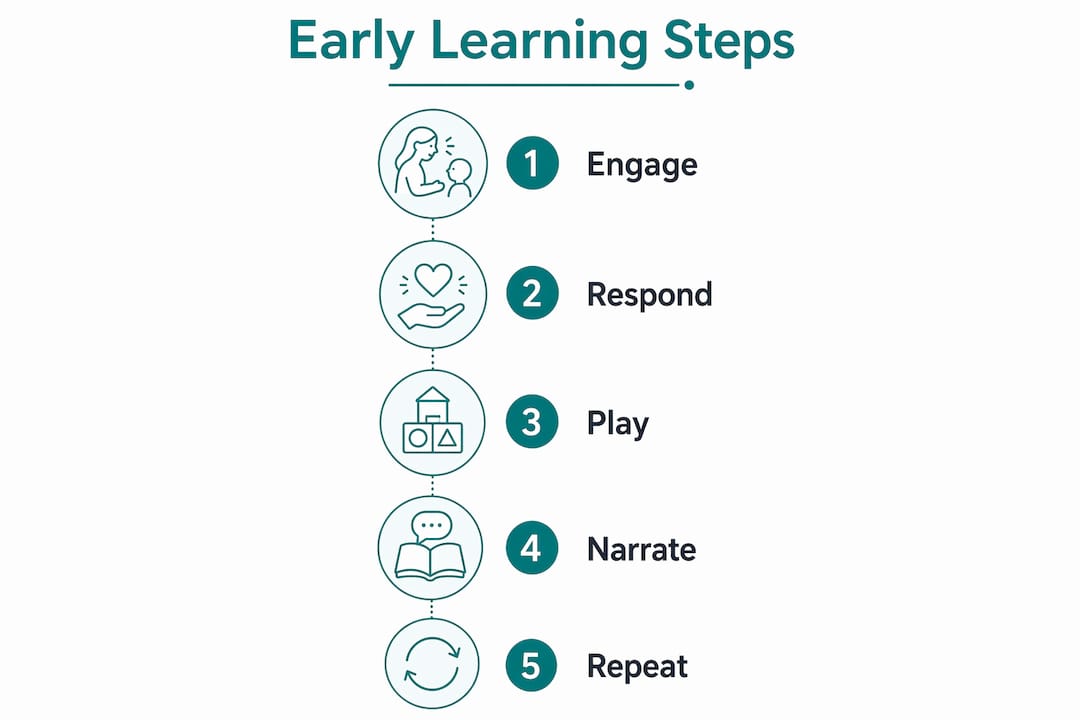
The most reliable framework for home-based early education comes from “The Basics,” a set of five evidence-based principles used in public health initiatives across the United States. These principles give parents a clear, memorable structure for daily interactions.
The five principles are:
Maximize love, manage stress. Calm, consistent caregiving lowers cortisol levels and creates the safety children need to explore and learn.
Talk, sing, and point. Narrating your world builds vocabulary faster than any app or flashcard.
Count, group, and compare. Sorting laundry by color or counting stairs builds early math intuition naturally.
Explore through movement and play. Physical activity and hands-on exploration wire the brain for problem-solving.
Read and discuss stories. Shared reading builds language, focus, and emotional understanding simultaneously.
The quality of your interaction matters as much as the activity itself. Serve-and-return exchanges, where a child initiates and a caregiver responds warmly, form the biological foundation for neural connections. Think of it as a conversation where every volley your child sends, whether a babble, a point, or a question, deserves a genuine return. These back-and-forth moments are not incidental. They are the architecture of learning.
Pro Tip: You do not need a dedicated “learning time.” Narrate what you are doing while cooking dinner or folding clothes. Your running commentary is one of the most powerful vocabulary tools available to you.
How can parents use play-based learning to enhance development?
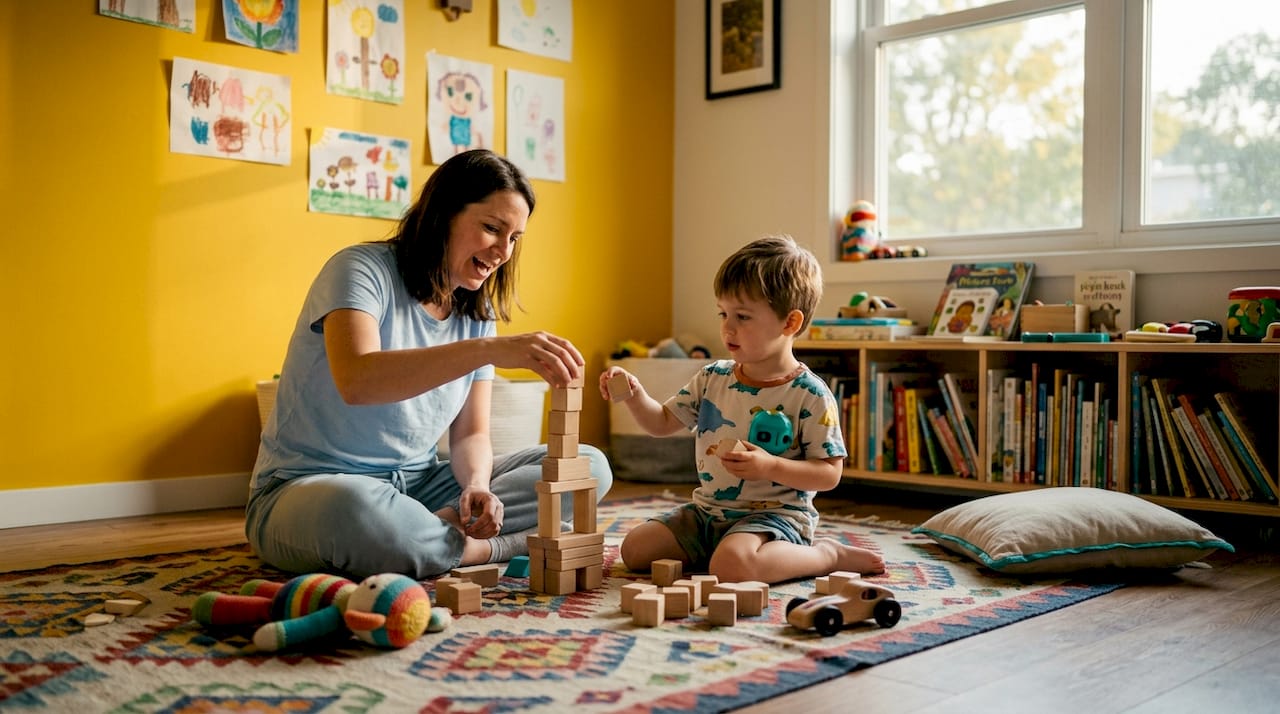
Play-based learning is not the same as unstructured free play. The distinction matters. Unstructured play is child-directed with no adult input. Play-based learning involves a caregiver who scaffolds the experience by introducing just-right challenges that stretch a child’s current abilities without causing frustration.
Scaffolding looks like this in practice:
Your child is stacking blocks and they keep falling. Instead of building it for them, you ask, “What if we put the big ones on the bottom?”
Your child is pretending to cook. You extend the play by asking, “How many cups of flour does your recipe need?”
Your child is drawing. You add language by saying, “Tell me about what you drew.”
Each of these moves extends thinking without taking over. The child stays in the lead, and you stay just one step ahead of where they are.
Play also builds skills that no worksheet can replicate. Problem-solving, emotional regulation, language expansion, and social negotiation all emerge naturally through play. When children play together, they practice reading social cues, managing disagreement, and expressing needs. These are the skills that predict school readiness as reliably as letter recognition.
Everyday tasks like grocery shopping and cooking are natural learning labs. Counting apples, comparing sizes, and reading labels together turns a routine errand into a rich STEM experience. You do not need special materials or a structured curriculum to make this work.
Observe the process, not just the product. When your child builds a tower that falls, the moment of problem-solving is more valuable than a finished structure. Focusing on trial and error over final outcomes builds a growth mindset that serves children for life. Document what your child tried, not just what they made.
Pro Tip: Keep a simple photo journal on your phone of your child’s play moments. Reviewing these together builds language skills and shows your child that their thinking process has value.
What daily routines build language and literacy skills?
Language and literacy development is the single most studied area of early childhood education, and the findings are consistent. Shared reading, endorsed by the American Academy of Pediatrics, promotes early literacy while strengthening the parent-child bond and building executive function skills. Reading together is not just about learning letters. It is one of the most complete developmental activities available to families.
These daily practices make the biggest difference for early literacy:
Read aloud every day. Even ten minutes of shared reading builds vocabulary, comprehension, and listening skills. Choose books with rich language and varied sentence structures.
Use dialogic reading. Instead of reading straight through, pause and ask open-ended questions. “What do you think will happen next?” invites prediction and critical thinking.
Sing songs and rhymes. Rhyming builds phonological awareness, which is the ability to hear and manipulate sounds in words. This skill is a direct predictor of reading success.
Tell stories from your own life. Personal narratives teach children story structure, sequencing, and the idea that their experiences have meaning worth sharing.
Use connected sentences in everyday talk. Instead of “Put on your shoes,” try “We need to put on your shoes because we are going to the park.” Connected language models how ideas link together.
Parental cognitive stimulation during toddlerhood produces measurable improvements in vocabulary and reading skills by age 6. The effect is not dramatic in any single interaction, but it compounds across thousands of daily conversations. Consistency matters far more than perfection.
How do you build curiosity and critical thinking in toddlers?
Curiosity is not a personality trait. It is a skill that adults model and encourage. When you stop to wonder aloud, “I wonder why the sky is orange tonight,” you show your child that questions are worth asking and that not knowing is a starting point, not a failure.
Hands-on activities are the most direct path to multisensory learning, which NAEYC recommends for deepening understanding and language expression. Activities that engage touch, sight, smell, and movement create stronger memory traces than visual-only instruction.
Practical ways to build curiosity and critical thinking include:
Bug hunts and nature walks. Observing insects, leaves, and weather patterns teaches classification, comparison, and careful attention.
Simple cooking projects. Measuring, mixing, and watching ingredients change state introduces basic science concepts in a meaningful context.
Open-ended art. Providing paint, clay, or collage materials without a template encourages creative problem-solving and self-expression.
Building challenges. “Can you build a bridge for this toy car?” gives children a goal without a prescribed method, which is the definition of critical thinking.
Balancing guidance with independence is the key. Too much direction removes the cognitive challenge. Too little leaves children without the vocabulary or concepts to make sense of what they observe. The sweet spot is what educators call “guided discovery.” You set the stage, ask the questions, and then step back.
Joy and laughter during learning are not signs that children are off-task. They are signals of genuine engagement. NAEYC prioritizes joyful learning over rigid instruction precisely because positive emotional states open children to new information. When your child is laughing and curious, their brain is primed to learn.
Safe risk-taking is equally important. Allowing a child to climb a slightly challenging structure, try a new food, or attempt a puzzle that is just beyond their current level teaches them that effort leads to growth. An error-friendly environment, where mistakes are treated as information rather than failure, builds the confidence children need to keep trying.
Key Takeaways
The most effective way to support early childhood development is through consistent, joyful, language-rich interactions woven into daily life, not through structured lessons or expensive programs.
Point | Details |
Brain development peaks early | Over 90% of brain development occurs before kindergarten, making ages 1.5–5 the most critical window for learning. |
Use “The Basics” framework | Five principles (love, talk, count, play, read) give parents a clear daily structure for supporting development. |
Scaffold play intentionally | Introduce just-right challenges during play to extend your child’s thinking without taking over the activity. |
Read aloud every day | Shared reading builds vocabulary, executive function, and the parent-child bond simultaneously. |
Model curiosity openly | Wondering aloud and embracing mistakes teaches children that questions and effort matter more than right answers. |
What I have learned from watching early learning happen in real life
By Elena
The advice I find most underrated is also the simplest: small moments add up faster than parents expect. I have seen families invest in expensive learning kits and elaborate activity schedules, only to find that the richest learning happened during a ten-minute walk where a parent stopped to examine a snail with their child.
The pressure to “do enough” is real, and I understand it. But over-scheduling a toddler’s day crowds out the unscripted moments where genuine curiosity lives. A child who is always being directed toward the next activity never gets the chance to notice what interests them. That self-directed attention is the seed of intrinsic motivation.
What actually works, in my experience, is a parent who is present and responsive rather than perfectly prepared. You do not need a lesson plan. You need to follow your child’s gaze, answer their questions honestly, and let them lead sometimes. The learning through play research backs this up clearly: children learn more from a caregiver who engages warmly than from any structured program delivered without connection.
One more thing worth saying directly: collaborate with your child’s educators. When parents and teachers share observations, children get consistent support across both environments. That consistency is where real progress happens.
— Elena
How Edu supports early learning with a nurturing, child-centered approach
Knowing what to do at home is a strong start. Pairing that with a school environment built around the same principles takes it further.
At Edu, Astor International Preschool in Holland and Astor International School in Tanglin are designed around exactly the kind of personalized, curiosity-driven learning this article describes. Small class sizes mean every child is genuinely seen and supported. The school’s IPC curriculum places child-centered inquiry at the center of every school day, connecting learning to real-world experiences in the same way the best home learning does. Astor’s enrichment programs reinforce language, creativity, and critical thinking through engaging, playful activities that complement what families build at home. If you are looking for a school that treats early education as seriously as you do, Edu is worth a closer look.
FAQ
What does “fostering early learning” actually mean?
Fostering early learning means intentionally supporting a child’s cognitive, social, and emotional growth during the first five years through responsive interactions, play, and language-rich experiences. It is not about formal instruction but about creating conditions where curiosity and development can thrive.
At what age should parents start encouraging early education?
Learning begins at birth. The period from 18 months to 5 years is particularly critical because over 90% of brain development occurs before kindergarten entry, making every interaction during this window meaningful.
How does shared reading support early literacy?
Shared reading builds vocabulary, phonological awareness, and executive function skills. The American Academy of Pediatrics endorses daily reading aloud as one of the most impactful practices parents can adopt for early literacy development.
Is play really as effective as structured learning for preschoolers?
Play is the primary mode of learning for children under 5. When adults scaffold play by introducing gentle challenges, children develop problem-solving, language, and social skills that structured lessons rarely replicate as effectively.
How can I support my child’s learning if I have limited time?
Integrate learning into what you already do. Narrating daily routines, counting objects during chores, and reading for ten minutes before bed are all evidence-based practices that require no extra time, only intentional presence.
Recommended
Comments