


What Is Academic Excellence? A Guide for Parents

Academic excellence is defined as a student’s demonstrated ability to master knowledge, think critically, and build habits that support sustained educational and personal success. It goes far beyond earning top marks on a report card. The definition of academic excellence encompasses intellectual maturity, resilience, ethical behavior, and a genuine love of learning. Understanding this concept helps you, as a parent, set meaningful expectations for your child and choose learning environments that nurture the whole person. Edu, through Astor International School in Singapore, sees academic excellence not as a fixed destination but as a living, growing quality in every child.
What is academic excellence, and how is it defined?
Academic excellence is the comprehensive achievement of educational goals across both the short and long term. Those goals include mastering subject content, developing critical thinking, and building lifelong learning habits. Completing academic benchmarks like diplomas and degrees matters, but so does the intellectual maturity a student gains along the way.
The term “academic achievement” is the standard educational term for measurable learning outcomes. Academic excellence builds on that foundation by adding depth: it asks not just what a child knows, but how well they can apply, question, and extend that knowledge. A student who scores well on a test but cannot explain the reasoning behind the answer has achieved a grade. A student who can defend, adapt, and build on that reasoning is demonstrating excellence.
Three qualities anchor the definition: mastery of content, the ability to think critically across subjects, and the discipline to keep learning even when it is difficult. These qualities prepare children for challenges that no single exam can predict. That is why the importance of academic excellence reaches well beyond the classroom.

What are the essential criteria for academic excellence beyond grades?
Academic excellence criteria extend well past grade point averages. The most meaningful criteria fall into four categories: cognitive skills, procedural knowledge, emotional intelligence, and character.
Cognitive skills include critical thinking, problem-solving, and the ability to synthesize information from multiple sources. A child who can compare two arguments, identify a flaw in reasoning, or propose a creative solution is demonstrating cognitive excellence. These skills do not appear automatically on a transcript, but they show up clearly in how a child approaches a challenge.
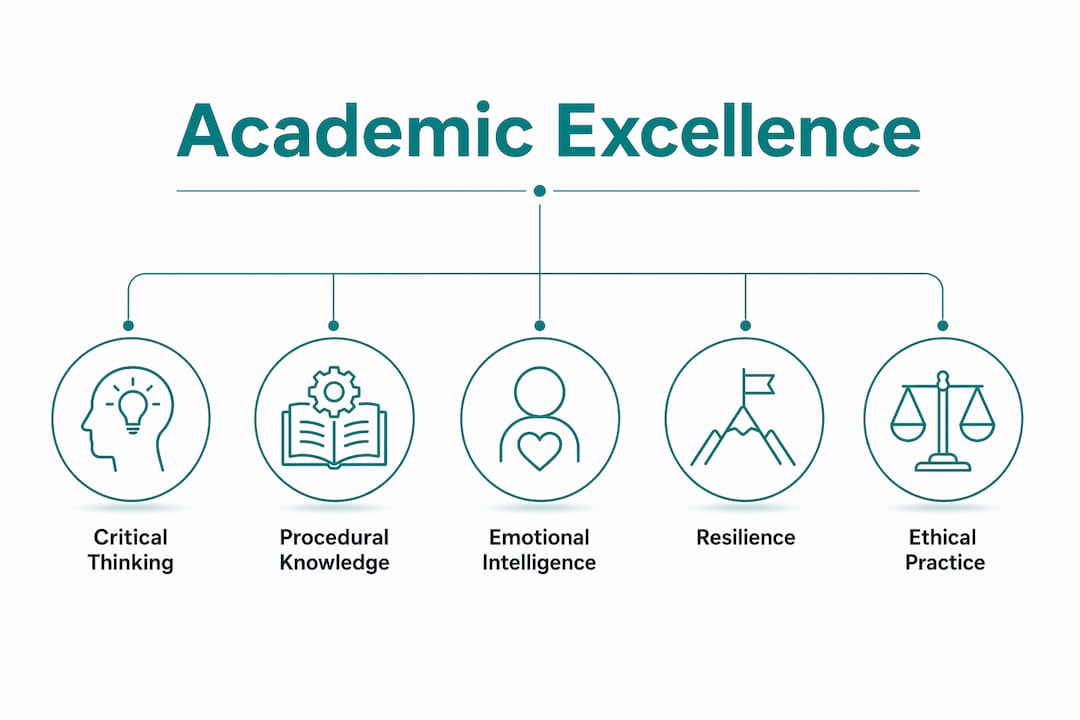
Procedural knowledge is the ability to learn, not just to recall. Schools that emphasize academic excellence teach self-regulation, time management, and knowledge synthesis rather than rote memorization. This distinction matters enormously. A child who knows how to study, how to organize their thinking, and how to recover from a poor result will outperform a child who only memorizes facts, every single time.
Emotional intelligence is a core component that many parents overlook. Handling pressure, collaborating with peers, and maintaining ethical standards are as vital as intellectual ability. A child who can manage stress, work well in a group, and act with integrity is already practicing excellence in a way that grades cannot fully capture.
Character traits complete the picture. Motivation, discipline, resilience, and a commitment to continuous improvement are not soft extras. They are the engine behind every other criterion. Without them, even a gifted child will plateau.
Critical thinking and problem-solving across subjects
Self-regulation and time management (procedural knowledge)
Emotional intelligence: stress management, collaboration, ethics
Resilience: the ability to recover and improve after setbacks
Intrinsic motivation and personal discipline
Pro Tip: Praise your child’s effort and problem-solving strategy, not just the score. Saying “I love how you kept trying different approaches” builds the mindset that drives lasting excellence.
Why does academic excellence matter for your child’s future?
Academic excellence builds the foundational professional traits that employers and institutions value most. Resilience, discipline, and analytical communication are the traits that sustain a career over decades, not just land a first job. A child who learns to earn outcomes through persistence and ethical conduct arrives in the workforce already prepared for its demands.
“Connections without competence are shortcuts to short-lived success. Academic excellence provides the sustained ability to deliver when opportunities arise.” — Keyaka Magazine
That insight cuts to the heart of why the benefits of academic excellence matter so much. Networking opens doors, but competence keeps them open. A child who has developed genuine mastery, strong communication skills, and a track record of perseverance will build credibility that no shortcut can replicate.
Academic credentials signal reliability and sustained effort to professional networks. That signal matters in competitive environments where employers and universities receive hundreds of applications. Beyond credentials, the habits formed during years of disciplined learning, such as meeting deadlines, thinking under pressure, and collaborating across differences, transfer directly into workplace performance.
The personal growth dimension is equally significant. Children who pursue excellence develop a stronger sense of identity and self-worth. They learn that effort produces results, that setbacks are information rather than verdicts, and that curiosity is a strength. These are the qualities that support a fulfilling life, not just a successful career.
How can parents support academic excellence at home?
Parents are the most consistent influence on a child’s learning habits. The good news is that supporting excellence does not require tutoring every subject. It requires creating the right conditions and modeling the right attitudes.
Build a growth mindset at home
Academic excellence is learned behavior developed through consistent effort and constructive responses to setbacks, not fixed intelligence. When your child struggles, treat it as a normal part of learning. Ask “What did you try?” before “What did you get?” That single shift in language teaches your child that effort and strategy matter more than natural ability. You can explore this further through growth mindset resources that explain how to put this into practice at home.
Practical steps parents can take
Set a consistent homework routine with a dedicated, distraction-free space.
Ask open-ended questions about what your child learned, not just what grade they received.
Encourage your child to teach you something they studied. Teaching reinforces understanding.
Help your child break large projects into smaller steps to build time management skills.
Model your own curiosity by reading, asking questions, and admitting when you do not know something.
Support emotional wellbeing alongside academics
Stress is one of the biggest barriers to genuine learning. A child who is anxious about performance cannot think clearly or take the intellectual risks that lead to real understanding. Effective strategies for navigating school stress help children build the emotional regulation skills they need to stay engaged without burning out.
Talk openly about mistakes and what they teach.
Celebrate persistence, not just achievement.
Maintain boundaries around sleep, play, and family time.
Partner with your child’s teachers to understand their learning style and needs.
Building strong learning habits at home reinforces what happens in the classroom and gives your child a genuine advantage over time.
Pro Tip: Schedule a monthly “learning check-in” with your child. Ask three questions: What are you proud of? What was hard? What do you want to try differently? This builds self-reflection, a skill at the core of academic excellence.
What common misconceptions about academic excellence should parents avoid?
Several persistent myths make it harder for parents to support their children effectively. Recognizing them is the first step toward a healthier approach.
Myth 1: Excellence is a natural talent. Academic excellence develops through consistent practice and perseverance, not innate ability. Every child who demonstrates excellence has put in sustained effort, often invisibly. Treating it as a gift some children have and others do not discourages the very effort that produces it.
Myth 2: Grades equal excellence. Grades are feedback on learning processes, not endpoints. A child who earns a B through genuine inquiry and resilience is developing more lasting competence than one who earns an A through anxiety-driven memorization. Focusing solely on output breeds fragility.
Myth 3: Connections replace competence. Networking is valuable, but it amplifies competence rather than replacing it. A child who builds relationships without developing real skills will find those relationships difficult to sustain.
Myth 4: Excellence means pressure. Chronic pressure and anxiety actively undermine learning. The brain under sustained stress prioritizes survival over curiosity. True excellence grows in an environment of high expectations paired with genuine support, not fear.
Excellence is built, not born.
Grades measure one dimension of learning, not the whole child.
Character and ethics are part of the academic excellence definition.
Pressure without support produces anxiety, not excellence.
The goal is a child who loves learning, not one who fears failure.
Key Takeaways
Academic excellence is a multidimensional quality built from critical thinking, emotional intelligence, procedural knowledge, and character, and it is the strongest foundation a child can carry into adult life.
Point | Details |
Excellence goes beyond grades | It includes critical thinking, resilience, ethics, and lifelong learning habits. |
Procedural knowledge matters most | Teaching children how to learn outperforms drilling facts for long-term success. |
Parents shape the conditions | Consistent routines, open questions, and emotional support build excellence at home. |
Mindset drives performance | Praising effort over scores develops the resilience that sustains achievement. |
Competence outlasts connections | Skills and character give children the ability to deliver when opportunities arise. |
What I have learned about academic excellence as a parent and educator
The conversation about academic excellence has shifted meaningfully over the past decade. When I first started working with families, the question parents asked most often was “How do I get my child to score higher?” Now, more parents are asking “How do I help my child become a real learner?” That shift is encouraging, and it reflects a deeper understanding of what excellence actually means.
What I have observed is that the children who thrive long-term are rarely the ones who were pushed hardest. They are the ones who were genuinely curious, who learned to sit with difficulty without panicking, and who had adults around them who modeled intellectual humility. A parent who says “I don’t know, let’s find out together” teaches something no worksheet can.
The hardest thing I see parents struggle with is separating their own anxiety from their child’s experience. When a child brings home a disappointing result, the parent’s reaction in that moment shapes whether the child sees it as information or as a verdict on their worth. That is a profound responsibility, and it deserves more attention than any tutoring schedule.
My honest view is this: academic excellence is less about what your child achieves by age 12 and more about who they are becoming as a learner. The habits, the character, and the curiosity they develop now will serve them in ways that no single exam result ever could. Trust the process, stay engaged, and remember that the best learning happens when every child is truly seen and supported.
— Elena
Astor International School and academic excellence
Astor International School in Singapore’s Tanglin area was built on the belief that the best learning happens in small, nurturing environments where every child is genuinely known. Awarded best small school and best affordable international school in Singapore, Astor keeps class sizes intentionally small so teachers can respond to each child’s individual strengths and needs.

The school’s IPC curriculum is designed to develop exactly the qualities that define academic excellence: critical thinking, resilience, collaboration, and a genuine love of learning. Rather than drilling for test scores, the IPC approach builds procedural knowledge and emotional intelligence alongside subject mastery. Parents considering enrollment are welcome to explore Astor’s full curriculum to see how these principles come to life in the classroom every day.
FAQ
What is the simplest definition of academic excellence?
Academic excellence is the demonstrated ability to master knowledge, think critically, and develop habits that support sustained learning and personal growth. It includes intellectual maturity, resilience, and ethical behavior alongside academic achievement.
Is academic excellence only about getting high grades?
No. Grades measure one dimension of learning. Academic excellence also includes critical thinking, emotional intelligence, self-regulation, and character, qualities that grades alone cannot capture.
How can parents encourage academic excellence without adding pressure?
Praise effort and problem-solving strategies rather than scores, maintain open conversations about mistakes, and create consistent routines that support both learning and wellbeing. High expectations paired with genuine emotional support produce excellence; pressure without support produces anxiety.
At what age should parents start focusing on academic excellence?
The habits that support academic excellence, such as curiosity, persistence, and a love of learning, begin forming in the earliest years of childhood. Preschool and primary school are the ideal time to build these foundations in a nurturing, low-pressure environment.
Does academic excellence guarantee career success?
Academic excellence builds the traits that sustain career success: resilience, discipline, communication, and credibility. It does not guarantee outcomes, but it provides the strongest foundation a child can carry into professional life.
Recommended
Comments