


What Is Expat Schooling? A Guide for Families Abroad
- sasha2644
- 17 hours ago
- 8 min read

Expat schooling is defined as the set of educational arrangements designed for children of expatriate families living outside their home country, typically centered on internationally recognized curricula and culturally diverse classrooms. For parents of children aged 1.5 to 12, choosing the right school abroad is one of the most consequential decisions of a relocation. The choice shapes your child’s academic continuity, language development, social confidence, and emotional security. Accreditation bodies like CIS (Council of International Schools) and WASC (Western Association of Schools and Colleges) set the quality benchmarks that parents and schools use to navigate this space. Understanding your options clearly is the first step toward making a choice your child will benefit from for years.
What is expat schooling, and what are the main options for children aged 1.5 to 12?
Expat schooling covers three primary pathways: international schools, local public schools, and homeschooling. Each serves a different family profile, and the right fit depends on your child’s age, your relocation timeline, and your host country’s policies.
International schools are the most common choice for expat families. They offer globally portable curricula such as the International Baccalaureate (IB), British National Curriculum, or American Common Core. Portable curricula like IB reduce academic friction when families move again, which matters enormously for children who may attend three or four schools before age 12. Instruction is typically in English, and the student body is intentionally diverse.

Local public schools offer genuine language immersion and cultural depth. They are free in most countries, which makes them attractive for families managing tight relocation budgets. The trade-off is that younger children adapt more easily. A six-year-old can absorb a new language and social environment with remarkable speed. A ten-year-old faces a steeper climb.
Homeschooling is a legal and practical option in many countries, though regulations vary widely. Some host countries require registration with local education authorities. Others place no restrictions at all. Homeschooling works best for families with a highly mobile schedule or children with specific learning needs that local schools cannot meet.
Ages 1.5 to 3: Preschool or nursery programs within international school networks or standalone international preschools. Look for outdoor play, mixed learning environments, and small group sizes.
Ages 4 to 6: International kindergartens or local preschools where language immersion is a goal.
Ages 7 to 10: Both local schools and international schools are viable. Local schools work well in countries with strong public education systems.
Ages 11 to 12: International schools become the stronger choice. Curriculum continuity matters more as children approach secondary school entrance requirements.
Visa requirements strongly influence which schools your child can attend. Some countries restrict public school access to citizens or permanent residents. Dependent visas typically allow international school enrollment, but you should verify this before committing to any application.
Pro Tip: Research your host country’s visa category before shortlisting schools. A dependent visa may open international school doors, but public school access often requires a different residency status entirely.
What are the benefits and challenges of international schools for expat families?
International schools offer curriculum continuity. This is the single greatest benefit for mobile families. When your child moves from Singapore to Amsterdam, an IB transcript travels with them. Teachers in the new school understand the framework, the assessment style, and the learning expectations. That continuity protects your child’s academic progress and reduces the stress of starting over.
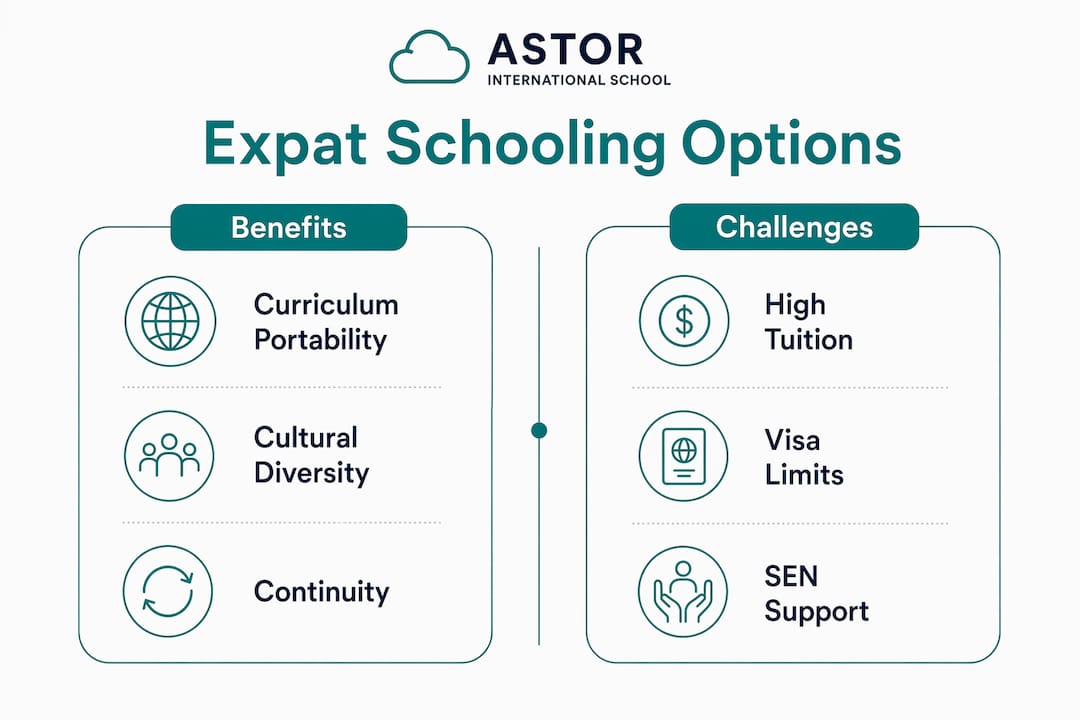
The diversity inside international schools is also genuine. International school student bodies increasingly include significant local student populations alongside expats. This is not just a marketing point. It means your child builds friendships across cultures from day one, which is a social skill that compounds in value over a lifetime.
The challenges are real, too. Annual tuition at international schools ranges from $10,000 to $45,000 depending on the city, curriculum, and facilities. That figure can consume a large share of a family’s relocation package. Budgeting for tuition before you negotiate your employment contract is not optional. It is necessary.
Accreditation matters more than most parents realize. CIS and WASC accreditation signals that a school meets internationally accepted standards for governance, curriculum, and student support. A school without recognized accreditation may offer a fine education locally, but its transcripts may not be accepted by schools in your next destination.
Special educational needs (SEN) support is another area where parents must do their homework. SEN provisions and Education, Health and Care Plans (EHCPs) do not transfer automatically across borders. Private international schools vary widely in what they can provide, and they are not bound by your home country’s legislation. If your child has a learning difference or a diagnosed condition, contact the school’s SEN coordinator directly before you apply.
Popular international schools fill up fast. Apply early, as waiting lists and assessments can begin months before the school year starts. Families who arrive in a new city and begin school research only weeks before term often find their preferred options already closed.
How do local public schools compare for younger expat children?
Local public schools are the right choice for more expat families than most people assume. The cost advantage is significant. Tuition is free or heavily subsidized in most countries with functional public systems. That saving can fund language tutoring, extracurricular activities, or simply reduce financial pressure on the family during an already expensive relocation.
The language acquisition benefit is real and well-documented. Local public schools are highly viable for children under 10 in countries with strong educational systems, offering superior language acquisition and cultural immersion compared to English-medium international schools. A child who attends a local school for two years often leaves bilingual. That outcome is difficult to replicate in an international school where English dominates every classroom.
The limitations are equally real. Curriculum mismatch is the primary risk. If your child spends two years in a French national curriculum school and then transfers to an IB school in another country, there will be gaps. Some concepts will overlap. Others will be missing entirely. The younger the child, the more manageable this gap tends to be.
Factor | Local public school | International school |
Cost | Free or low cost | $10,000–$45,000 per year |
Language | Host country language | Primarily English |
Curriculum portability | Low | High (IB, British, American) |
Best age range | Under 10 | All ages, especially 10 to 12 |
Cultural immersion | Deep | Moderate |
Integration can be socially challenging for older children. A seven-year-old who does not speak the local language will find friends through play. A twelve-year-old navigates more complex social dynamics and may struggle without language support. The host country’s educational quality also varies enormously. A public school in Singapore or Finland is a different proposition from one in a country with under-resourced infrastructure.
Pro Tip: If you choose a local school for a younger child, pair it with a weekly language support class in English. This protects reading and writing skills in your home language while the child builds fluency in the new one.
What practical steps should expat parents take when choosing a school abroad?
Choosing a school abroad requires a structured approach. The families who feel most confident on the first day of term are the ones who started planning months earlier.
Start research before you relocate. Identify three to five schools that match your child’s age, your curriculum preference, and your budget. Use the international school checklist to organize your evaluation criteria before you visit.
Gather documents early. Most schools require academic transcripts, vaccination records, passport copies, and proof of visa status. Some ask for language proficiency assessments. Collect these before you leave your home country.
Visit schools in person. Visiting schools to observe teacher-student interactions is more revealing than any brochure. Watch how teachers respond to a child who is confused. Notice whether the hallways feel calm or chaotic. Culture is visible if you know what to look for.
Verify accreditation. Confirm CIS or WASC accreditation directly on the accrediting body’s website. Do not rely on a school’s own marketing materials for this confirmation.
Evaluate curriculum fit. If you plan to relocate again within three years, prioritize a portable curriculum. The curriculum selection guide for Singapore-based expat parents explains how IB, British, and American curricula differ in structure and transferability.
Check visa and enrollment eligibility. Confirm that your visa category permits enrollment at your chosen school type. Some schools require a student visa rather than a dependent visa for formal enrollment.
Apply to more than one school. Waiting lists are common at well-regarded international schools. Apply to your top choice and two backups simultaneously.
Key Takeaways
Expat schooling works best when parents match the school type to the child’s age, the family’s mobility plans, and the host country’s legal framework.
Point | Details |
Define your priorities first | Decide between curriculum portability, language immersion, and cost before shortlisting schools. |
Age shapes the best option | Children under 10 adapt well to local schools; children 10 to 12 benefit most from international curricula. |
Accreditation protects continuity | CIS and WASC accreditation confirms that transcripts will be accepted at your next destination. |
Apply early and apply broadly | Popular international schools fill months before term; apply to backups at the same time. |
Visa status gates enrollment | Confirm your visa category allows access to your chosen school type before submitting any application. |
What I’ve learned about choosing schools for expat children
The families I see navigate expat schooling most confidently share one habit: they stop chasing prestige and start asking what their specific child needs right now. There is no universal “best” international school. The right school is the one where your child feels seen, understood, and genuinely challenged.
Parents often underestimate the hidden weight of language and cultural adaptation. Your child is not just learning math in a new building. They are decoding a new social code, a new set of classroom norms, and sometimes a new language, all at the same time. That is a significant cognitive and emotional load. A school with small class sizes and attentive teachers absorbs that load far better than a large, prestigious institution where your child is one of thirty in a room.
I also think parents wait too long to start planning. The families who feel most settled six months after a move are the ones who began school research before they packed a single box. Early planning is not about anxiety. It is about giving yourself options. When you apply late, you take what is available, not what fits.
Finally, be your child’s cultural translator. Sit with them after school. Ask specific questions. “Who did you eat lunch with?” tells you more than “How was your day?” A child who feels supported at home adapts to a new school environment faster than one who processes the transition alone.
— Elena
Astor International School: built for expat families in Singapore
Edu’s Astor International School in Singapore’s Tanglin area was built with exactly these families in mind. It has earned recognition as both the best small school and the best affordable international school in Singapore, which means you get genuine personal attention without the price tag of larger institutions.
Astor’s IPC curriculum (International Primary Curriculum) is designed for children aged 5 to 12 and travels well across relocations. Small class sizes mean every teacher knows your child by name, not by seat number. For families with younger children, the Astor International Preschool in Holland Village offers a nurturing environment with two playgrounds and a mix of outdoor and classroom learning. If you want to understand how Astor’s curriculum supports expat children specifically, the school welcomes visits and conversations before you commit.
FAQ
What is expat schooling in simple terms?
Expat schooling refers to educational programs designed for children living abroad with their families, typically offered through international schools with globally recognized curricula like the IB or British National Curriculum.
At what age should my child start an international school?
International schools accept children from preschool age onward. For children under 10, local public schools are also a strong option, particularly for language immersion. Children aged 10 to 12 benefit most from the curriculum continuity that international schools provide.
How much does an international school cost for expat families?
Annual tuition ranges from $10,000 to $45,000 depending on the city, curriculum, and school facilities. Families should budget for tuition before finalizing a relocation package.
Does my child’s SEN support transfer to an international school abroad?
No. SEN provisions and EHCPs do not transfer automatically. Parents must contact the school’s SEN coordinator directly to confirm what support is available before enrolling.
How early should I apply to international schools?
Apply as early as possible, ideally six to twelve months before your intended start date. Popular international schools maintain waiting lists and require assessments well ahead of the school year.
Recommended
Very informative post